Disability evaluation isoften referred as an independent examination that can be
requested by employer, government institutions, insurance agencies, or either party
in litigation. The purpose of such reports is to help them decide their course of action
such as providing healthcare benefits or arranging damages and workplace
accommodations.
3.
NEED OF DISABILITY
EVALUATION:
Disability evaluation is useful for health care and policy decisions, in terms of:
identifying needs
matching treatments and intervention
measuring outcomes and effectiveness
setting priorities
allocating resources
4.
BARRIERS FACED BY
PERSONSWITH DISABILITIES :
People with disabilities encounter a range of barriers when they attempt to access
health care including the following:
Prohibitive costs
Limited availability of services
Physical barriers
Inadequate skills and knowledge of health workers
5.
According to theInternational Classification of Impairments, Disabilities, and
Handicap [ICIDH]
Impairment is concerned with physical aspects of health,
Disability has to do with the loss of functional capacity resulting from impaired
organ,
Handicap is a measure of the social and cultural consequences of an impairment or
disability.
6.
The International Classificationof Functioning, Disability and Health (ICF) is a
framework for describing functioning and disability in relation to a health condition.
It provides a common language and framework for describing the level of function
of a person within their unique environment or in other words, what a person with a
specific health condition can do in a standard environment (their level of
capacity), and also what they actually do in their usual environment (their level of
performance). as opposed to classifying the person by their having a specific
condition or as a 'Yes/No' answer regarding disability.
The World Confederation of Physical Therapy (WCPT) adopted a motion supporting
the implementation of the ICF in physiotherapy in 2003.
7.
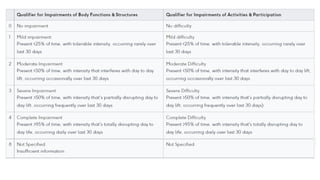
The International Classificationof Functioning, Disability and Health (ICF) has
shifted the focus of disability from cause to impact. While measuring disability,
interaction of impairment with environment is considered. India has agreed to adopt
the ICF and thereby the World Health Organization Disability Assessment Schedule
(WHODAS). In India, disability is certified when the disability score is ≥40%.
8.
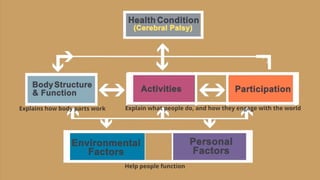
COMPONENTS OF THEICF
•The ICF focuses on three components:
•Body Functions and Structures
•Activities and Participation (at individual and societal levels)
•Personal and Environmental Factors (at a contextual level).
These three components underscore the importance of the interplay and influence of
both internal and external factors to each individual’s health status.
9.
BODY FUNCTIONS ANDSTRUCTURES
Definitions:
Body Functions: The physiological functions of body systems (including psychological
functions)
Body Structures: Anatomical parts of the body such as organs, limbs and their components
Impairments: Problems in body function and structure such as significant deviation or loss
Examples:
Pain in head and neck
Structure of shoulder region
Structures of areas of skin
10.
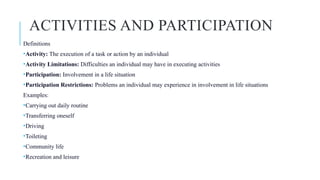
ACTIVITIES AND PARTICIPATION
Definitions
•Activity:The execution of a task or action by an individual
•Activity Limitations: Difficulties an individual may have in executing activities
•Participation: Involvement in a life situation
•Participation Restrictions: Problems an individual may experience in involvement in life situations
Examples:
•Carrying out daily routine
•Transferring oneself
•Driving
•Toileting
•Community life
•Recreation and leisure
11.
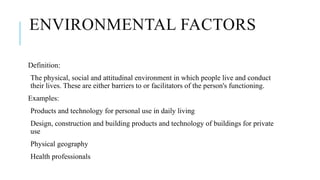
ENVIRONMENTAL FACTORS
Definition:
The physical,social and attitudinal environment in which people live and conduct
their lives. These are either barriers to or facilitators of the person's functioning.
Examples:
Products and technology for personal use in daily living
Design, construction and building products and technology of buildings for private
use
Physical geography
Health professionals


![According to the International Classification of Impairments, Disabilities, and
Handicap [ICIDH]
Impairment is concerned with physical aspects of health,
Disability has to do with the loss of functional capacity resulting from impaired
organ,
Handicap is a measure of the social and cultural consequences of an impairment or
disability.](https://image.slidesharecdn.com/disabilityevaluation-250329031421-9b7f29c8/85/Disability-Evaluation-in-community-health-5-320.jpg)