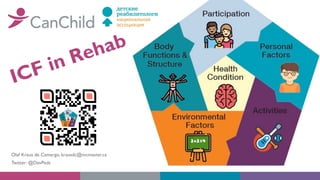
ICF in Rehab
Olaf Kraus de Camargo, krausdc@mcmaster.ca
Twitter: @DevPeds
Outline
1. The ICF
2. The Rehab Team
3. The “F-Words”
4. Video
The ICF - Health
§ Health is ‘the ability to adapt and self-manage in the face of social,
physical and emotional challenges’ (Huber et al. 2011).
§ In other words, functioning (however it is done, regardless of
ability/disability) can be understood as the evidence of health.
Huber M, Knottnerus JA, Green L, et al. How should we define health? BMJ
2011; 343: d4163.
The ICF - Disability
§ We are increasingly aware that developmental conditions are not
‘diseases’ requiring a ‘disease-care’ system
§ We use an ‘alphabet soup’ of so-called ‘diagnoses’ – CP, ASD, DCD,
ID, ODD and so on – for what are really descriptive labels.
The ICF - Disability
§ The ‘non-categorical’ way of thinking and talking reminds us that
many issues are common across ‘developmental disabilities’
§ It is also essential to take a life-course approach to these life-long
‘child-onset’ conditions.
§ And, to accept/celebrate diversity & variation.
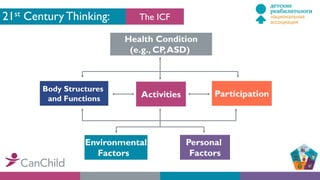
21st Century Thinking:
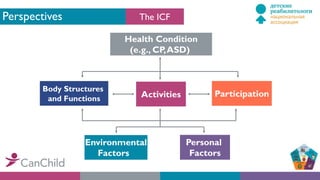
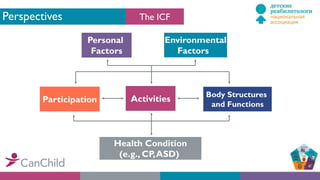
Health Condition
(e.g., CP,ASD)
Body Structures
and Functions Activities Participation
Environmental
Factors
Personal
Factors
The ICF
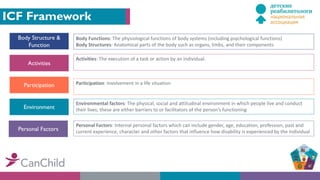
ICF Framework
Body Structure &
Function
Activities
Participation
Environment
Personal Factors
Body Functions: The physiological functions of body systems (including psychological functions)
Body Structures: Anatomical parts of the body such as organs, limbs, and their components
Activities: The execution of a task or action by an individual.
Participation: Involvement in a life situation
Environmental factors: The physical, social and attitudinal environment in which people live and conduct
their lives; these are either barriers to or facilitators of the person’s functioning
Personal Factors: Internal personal factors which can include gender, age, education, profession, past and
current experience, character and other factors that influence how disability is experienced by the individual
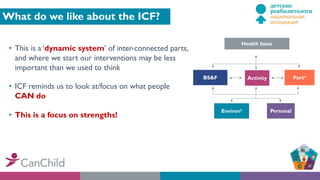
What do we like about the ICF?
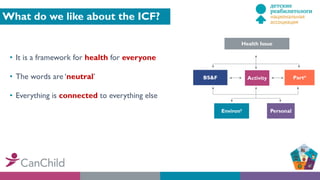
• This is a ‘dynamic system’ of inter-connected parts,
and where we start our interventions may be less
important than we used to think
• ICF reminds us to look at/focus on what people
CAN do
• This is a focus on strengths!
Health Issue
BS&F Activity Partn
Environt Personal
• It is a framework for health for everyone
• The words are ‘neutral’
• Everything is connected to everything else
Health Issue
BS&F Activity Partn
Environt Personal
What do we like about the ICF?
Perspectives
Health Condition
(e.g., CP,ASD)
Body Structures
and Functions Activities Participation
Environmental
Factors
Personal
Factors
The ICF
Look
again!
What Do
We See?
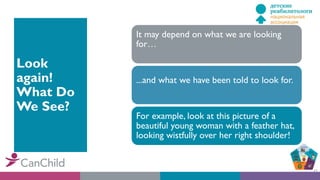
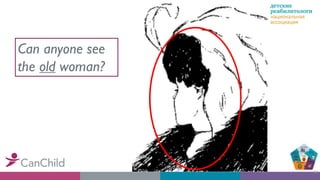
It may depend on what we are looking
for…
...and what we have been told to look for.
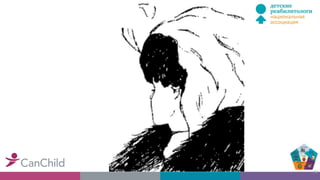
For example, look at this picture of a
beautiful young woman with a feather hat,
looking wistfully over her right shoulder!
11
12
13
Can anyone see
the old woman?
Perspectives
Health Condition
(e.g., CP,ASD)
Body Structures
and Functions
ActivitiesParticipation
Environmental
Factors
Personal
Factors
The ICF
Rehab Teams
Acute Care
Rehab
Strategy Patients Physician/Clinician
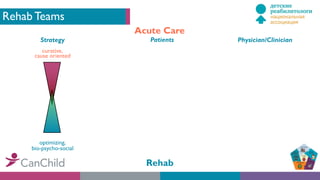
Rehab Teams
Acute Care
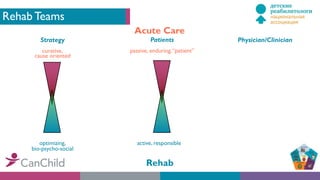
Strategy
curative,
cause oriented
optimizing,
bio-psycho-social
Patients Physician/Clinician
Rehab
Rehab Teams
Acute Care
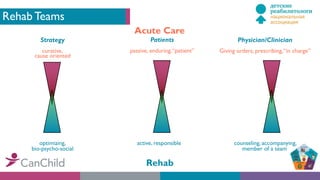
Strategy
curative,
cause oriented
optimizing,
bio-psycho-social
Patients
passive, enduring,“patient”
active, responsible
Physician/Clinician
Rehab
Rehab Teams
Acute Care
Strategy
curative,
cause oriented
optimizing,
bio-psycho-social
Patients
passive, enduring,“patient”
active, responsible
Physician/Clinician
Giving orders, prescribing,“in charge”
counseling, accompanying,
member of a team
Rehab
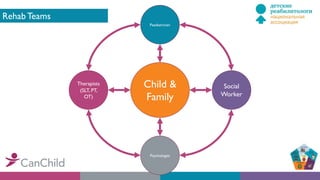
Therapists
(SLT, PT,
OT)
Paediatrician
Social
Worker
Psychologist
Child &
Family
Rehab Teams
F-Words
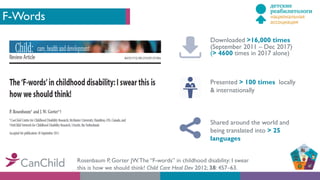
Downloaded >16,000 times
(September 2011 – Dec 2017)
(> 4600 times in 2017 alone)
Presented > 100 times locally
& internationally
Shared around the world and
being translated into > 25
languages
Rosenbaum P, Gorter JW.The “F-words” in childhood disability: I swear
this is how we should think! Child Care Heal Dev 2012; 38: 457–63.
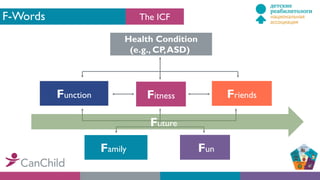
F-Words
Health Condition
(e.g., CP,ASD)
Function Fitness Friends
Family Fun
The ICF
Future
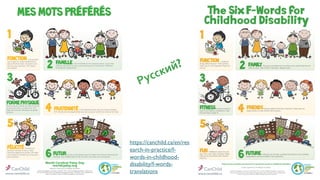
https://canchild.ca/en/res
earch-in-practice/f-
words-in-childhood-
disability/f-words-
translations
Русский?
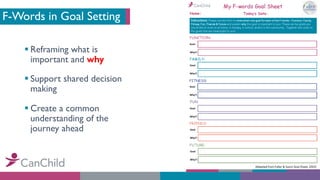
F-Words in Goal Setting
§ Reframing what is
important and why
§ Support shared decision
making
§ Create a common
understanding of the
journey ahead
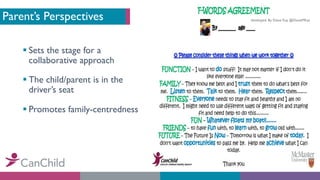
Parent’s Perspectives
§ Sets the stage for a
collaborative approach
§ The child/parent is in the
driver’s seat
§ Promotes family-centredness
developed. By Diane Kay @DianeMKay
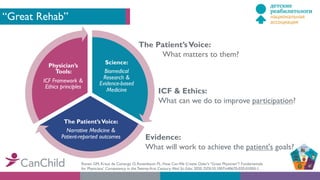
“Great Rehab”
Science:
Biomedical
Research &
Evidence-based
Medicine
The Patient’sVoice:
Narrative Medicine &
Patient-reported outcomes
Physician’s
Tools:
ICF Framework &
Ethics principles
ICF & Ethics:
What can we do to improve participation?
Evidence:
What will work to achieve the patient's goals?
The Patient’sVoice:
What matters to them?
Ronen GM, Kraus de Camargo O, Rosenbaum PL. How Can We Create Osler’s “Great Physician”? Fundamentals
for Physicians’ Competency in the Twenty-first Century. Med Sci Educ 2020. DOI:10.1007/s40670-020-01003-1.
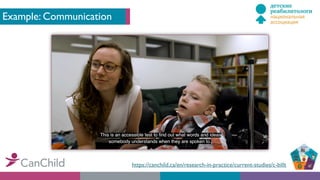
Example: Communication
https://canchild.ca/en/research-in-practice/current-studies/c-billt
Q & A Session
Q A&
Спасибо!
http://www.mackeith.co.uk/shop/icf-a-hands-on-approach-for-clinicians-and-families-ebook/

ICF in Rehab

  • 1.
    ICF in Rehab OlafKraus de Camargo, krausdc@mcmaster.ca Twitter: @DevPeds
  • 2.
    Outline 1. The ICF 2.The Rehab Team 3. The “F-Words” 4. Video
  • 3.
    The ICF -Health § Health is ‘the ability to adapt and self-manage in the face of social, physical and emotional challenges’ (Huber et al. 2011). § In other words, functioning (however it is done, regardless of ability/disability) can be understood as the evidence of health. Huber M, Knottnerus JA, Green L, et al. How should we define health? BMJ 2011; 343: d4163.
  • 4.
    The ICF -Disability § We are increasingly aware that developmental conditions are not ‘diseases’ requiring a ‘disease-care’ system § We use an ‘alphabet soup’ of so-called ‘diagnoses’ – CP, ASD, DCD, ID, ODD and so on – for what are really descriptive labels.
  • 5.
    The ICF -Disability § The ‘non-categorical’ way of thinking and talking reminds us that many issues are common across ‘developmental disabilities’ § It is also essential to take a life-course approach to these life-long ‘child-onset’ conditions. § And, to accept/celebrate diversity & variation.
  • 6.
    21st Century Thinking: HealthCondition (e.g., CP,ASD) Body Structures and Functions Activities Participation Environmental Factors Personal Factors The ICF
  • 7.
    ICF Framework Body Structure& Function Activities Participation Environment Personal Factors Body Functions: The physiological functions of body systems (including psychological functions) Body Structures: Anatomical parts of the body such as organs, limbs, and their components Activities: The execution of a task or action by an individual. Participation: Involvement in a life situation Environmental factors: The physical, social and attitudinal environment in which people live and conduct their lives; these are either barriers to or facilitators of the person’s functioning Personal Factors: Internal personal factors which can include gender, age, education, profession, past and current experience, character and other factors that influence how disability is experienced by the individual
  • 8.
    What do welike about the ICF? • This is a ‘dynamic system’ of inter-connected parts, and where we start our interventions may be less important than we used to think • ICF reminds us to look at/focus on what people CAN do • This is a focus on strengths! Health Issue BS&F Activity Partn Environt Personal
  • 9.
    • It isa framework for health for everyone • The words are ‘neutral’ • Everything is connected to everything else Health Issue BS&F Activity Partn Environt Personal What do we like about the ICF?
  • 10.
    Perspectives Health Condition (e.g., CP,ASD) BodyStructures and Functions Activities Participation Environmental Factors Personal Factors The ICF
  • 11.
    Look again! What Do We See? Itmay depend on what we are looking for… ...and what we have been told to look for. For example, look at this picture of a beautiful young woman with a feather hat, looking wistfully over her right shoulder! 11
  • 12.
  • 13.
  • 14.
    Perspectives Health Condition (e.g., CP,ASD) BodyStructures and Functions ActivitiesParticipation Environmental Factors Personal Factors The ICF
  • 15.
    Rehab Teams Acute Care Rehab StrategyPatients Physician/Clinician
  • 16.
    Rehab Teams Acute Care Strategy curative, causeoriented optimizing, bio-psycho-social Patients Physician/Clinician Rehab
  • 17.
    Rehab Teams Acute Care Strategy curative, causeoriented optimizing, bio-psycho-social Patients passive, enduring,“patient” active, responsible Physician/Clinician Rehab
  • 18.
    Rehab Teams Acute Care Strategy curative, causeoriented optimizing, bio-psycho-social Patients passive, enduring,“patient” active, responsible Physician/Clinician Giving orders, prescribing,“in charge” counseling, accompanying, member of a team Rehab
  • 19.
  • 20.
    F-Words Downloaded >16,000 times (September2011 – Dec 2017) (> 4600 times in 2017 alone) Presented > 100 times locally & internationally Shared around the world and being translated into > 25 languages Rosenbaum P, Gorter JW.The “F-words” in childhood disability: I swear this is how we should think! Child Care Heal Dev 2012; 38: 457–63.
  • 21.
    F-Words Health Condition (e.g., CP,ASD) FunctionFitness Friends Family Fun The ICF Future
  • 22.
  • 23.
    F-Words in GoalSetting § Reframing what is important and why § Support shared decision making § Create a common understanding of the journey ahead
  • 24.
    Parent’s Perspectives § Setsthe stage for a collaborative approach § The child/parent is in the driver’s seat § Promotes family-centredness developed. By Diane Kay @DianeMKay
  • 25.
    “Great Rehab” Science: Biomedical Research & Evidence-based Medicine ThePatient’sVoice: Narrative Medicine & Patient-reported outcomes Physician’s Tools: ICF Framework & Ethics principles ICF & Ethics: What can we do to improve participation? Evidence: What will work to achieve the patient's goals? The Patient’sVoice: What matters to them? Ronen GM, Kraus de Camargo O, Rosenbaum PL. How Can We Create Osler’s “Great Physician”? Fundamentals for Physicians’ Competency in the Twenty-first Century. Med Sci Educ 2020. DOI:10.1007/s40670-020-01003-1.
  • 26.
  • 27.
    Q & ASession Q A& Спасибо! http://www.mackeith.co.uk/shop/icf-a-hands-on-approach-for-clinicians-and-families-ebook/