PESTEL ANALYSIS OF AUSTRALIA
Presented B
Bappaditya Chakroborty
Gourav Nag
Indujyoti Kar
Flow Of Presentation
• Introduction
• Political analysis of Australia
• Economic analysis of Australia
• Social Analysis of Australia
• Technological analysis of Australia
• Environmental analysis of Australia
• Legal analysis of Australia
Introduction
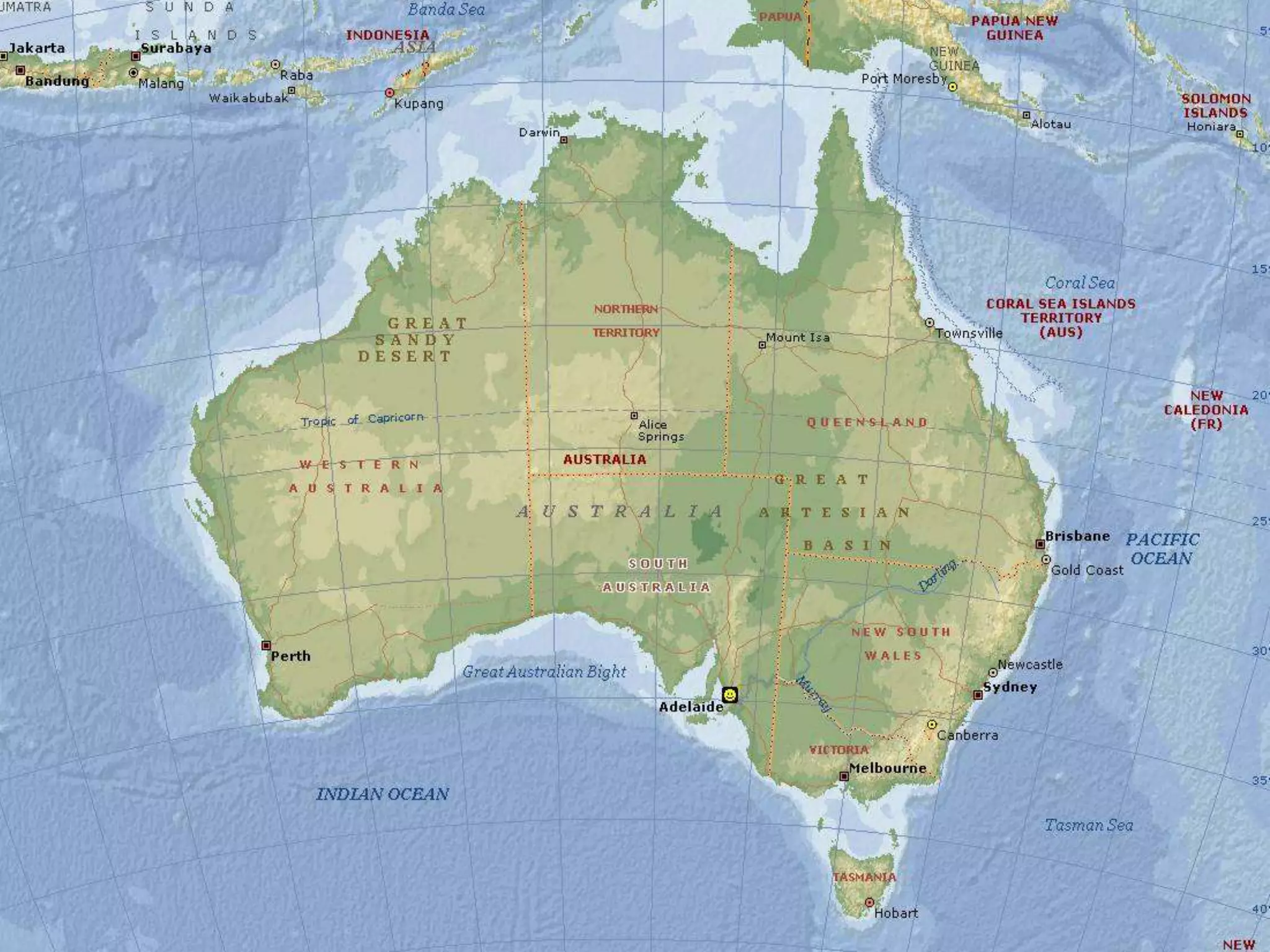
Location: Oceania, continent between the Indian
Ocean and the South Pacific Ocean
• Capital: Canberra
• Climate: generally arid to semiarid; temperate in
south and east; tropical in north
• Population:22.9 million
• Religions: Christianity (61.1%), no religion
(22.3%), undeclared(9.3%)
• Languages in Australia: English is the primary
language used in Australia.
Introduction
• It is the world's sixth-largest country by total area.
• Australia is the world's 12th-largest economy and has the
world's fifth-highest per capita income.
• Australia's military expenditure is the world's 13th-largest. With
the second-highest human development index globally,
Australia ranks highly in many international comparisons of national
performance, such as quality of life, health, education, economic
freedom, and the protection of civil liberties and political rights.
• Australia is a member of the G20 , OECD , WTO , APEC , UN
, Commonwealth of Nations , ANZUS and the Pacific Islands
Forum.
• The Commonwealth of Australia is a federal
constitutional monarchy under a parliamentary
democracy. The Commonwealth of Australia was
formed in 1901 as a result of an agreement
among six-governing British colonies, which
became the six states. The Commonwealth also
includes two territories - Northern Territory (NT)
and Australian Capital Territory (ACT).
• A governor-general represents the British
monarch who is the designated head of state.
POLITICAL
• The Queen (Head of
State), Governor-general,
prime Minister
• The Prime Minister is a
Member of Parliament
• The prime Minister
sometimes chooses the
cabinet but this depends
on the policy of the
winning party.
Government format
The Queen Elizabeth
• 150 members
• Single seat
constituencies,
which reflect the
differing
population of the
state (eg NSW- 50
members,
Tasmania – 6)
• Elections at least
every three years
The House of
Representatives
• 76 members
• All states elect 12 regardless of population, plus
2 ACT and 2 NT.
• Senators are elected for a six years term with half
seats renewed every three years.
Senate
Liberal Party of Australia
(centre-right)
Main policies:
• Economic liberalization
• Business and middle
class orientated
Main parties
National Party of Australia
(conservative)
Main policies:
• Anti-union
• Free-trade
• Pro-mining
• Rural and agriculture
orientated
Australian Labor Party
(social democrat)
• Strong national
government
• Equal opportunities
• Working class/union
orientated
• Efficient and transparent
legal framework
• Stable political
environment
ECONOMIC ANALYSIS OF
AUSTRALIA
Economy situation
• Australia has an enviable, strong economy with a per capita
GDP on par with the four dominant West European
economies.
• Australia's abundant and diverse natural resources attract
high levels of foreign investment and include extensive
reserves of coal, iron ore, copper, gold, natural gas,
uranium, and renewable energy sources.
• Australia also has a large services sector and is a significant
exporter of natural resources, energy, and food.
• The Australian economy grew for 17 consecutive years
before the global financial crisis.
Economic Indicators
Markets Last Reference Previous Frequency
Currency 0.76 15-Mar 0.76 Daily
Government Bond 10Y 2.56 percent 15-Mar 2.56
Daily
Stock Market 5814 Index points 15-Mar 5814 Daily
GDP Last Reference Previous Frequency
GDP 1561 USD Billion 13-Dec 1561 Yearly
GDP Growth Rate 0.5 percent 14-Nov 0.5
Quarterly
GDP Annual Growth
Rate 2.5 percent 14-Nov 2.5 Quarterly
GDP Constant Prices 397341 AUD Million 14-Nov 397341
Quarterly
Gross National Product 380643 AUD Million 14-Nov 380643 Quarterly
GDP per capita 37493 USD 13-Dec 37493 Yearly
Gross Fixed Capital
Formation 102472 AUD Million 14-Nov 102472 Quarterly
GDP per capita PPP 42810 USD 13-Dec 42810
Yearly
Economic Indicators
Labour Last Reference Previous Frequency
Unemployment
Rate 6.3 percent 15-Feb 6.3
Monthly
Employed Persons 11652 Thousand 15-Feb 11652 Monthly
Full Time
Employment 10300 Persons 15-Feb 10300
Monthly
Wages 1129 AUD/Week 14-Nov 1129 Quarterly
Population 23.13 Million 13-Dec 23.13 Yearly
Retirement Age
Women 64.5 15-Jan 64.5
Yearly
Retirement Age
Men 65 15-Jan 65 Yearly
Minimum Wages 641 AUD 14-Dec 641
Yearly
Wage Growth 2.5 percent 14-Nov 2.5 Quarterly
Taxation in Australia
Taxes Last Reference Previous Frequency
Corporate Tax
Rate 30 percent 14-Jan 30
Yearly
Personal Income
Tax Rate 45 percent 14-Jan 45Yearly
Sales Tax Rate 10 percent 14-Jan 10
Yearly
Social Security
Rate 10.75 percent 14-Jan 10.75
Yearly
Social Security
Rate For
Companies 9.25 percent 14-Jan 9.25Yearly
Social Security
Rate For
Employees 1.5 percent 14-Jan 1.5Yearly
International trade
• The new trade strategy is based on five key principles :
• Unilaterism
• non discrimination
• separation
• transparency
• Indivisibility of trade policy and economic reform
• Australia’s highest regional trade negotiation priority at present is the
conclusion of the Trans-Pacific Partnership Agreement.
• Other priorities include the pursuit of Free Trade Agreements with Korea,
Japan, Malaysia, Indonesia, India, China and the Gulf Cooperation
Council.
• The Government will pursue bilateral trade deals only where they offer net
benefits to Australia and where they do not impede the progress of
multilateral agreements.
Exchange rates
• The Australian dollar is currently the fifth-most-traded currency in
the world foreign exchange markets behind the US dollar, the euro,
the yen and the pound sterling
• The Australian dollar is popular with currency traders, because of
the comparatively high interest rates in Australia, the relative
freedom of the foreign exchange market from government
intervention, the general stability of Australia’s economy and
political system.
• The Australian economy operates with a floating exchange rate.
• Australian dollar offers diversification benefits in a portfolio
containing the major world currencies, especially because of its
greater exposure to Asian economies and the commodities cycle.
Social Analysis of Australia
Aborigines
 Australia’s first
people were the
Aborigines. They
have occupied the
continent for at
least 40,000 years,
and before the
Europeans arrived
in 1788 their
population as
probably between
300,000 and
750,000. They
occupied a lot of
the northern
territory.
• Although Captain
James Cook had sailed
the length of the east
coast in 1770 the
British did not settle in
Australia until 1788.
The first ships arrived
and brought 1,000
convicts from
England. They called
the area where they
landed New South
Wales.James Cook
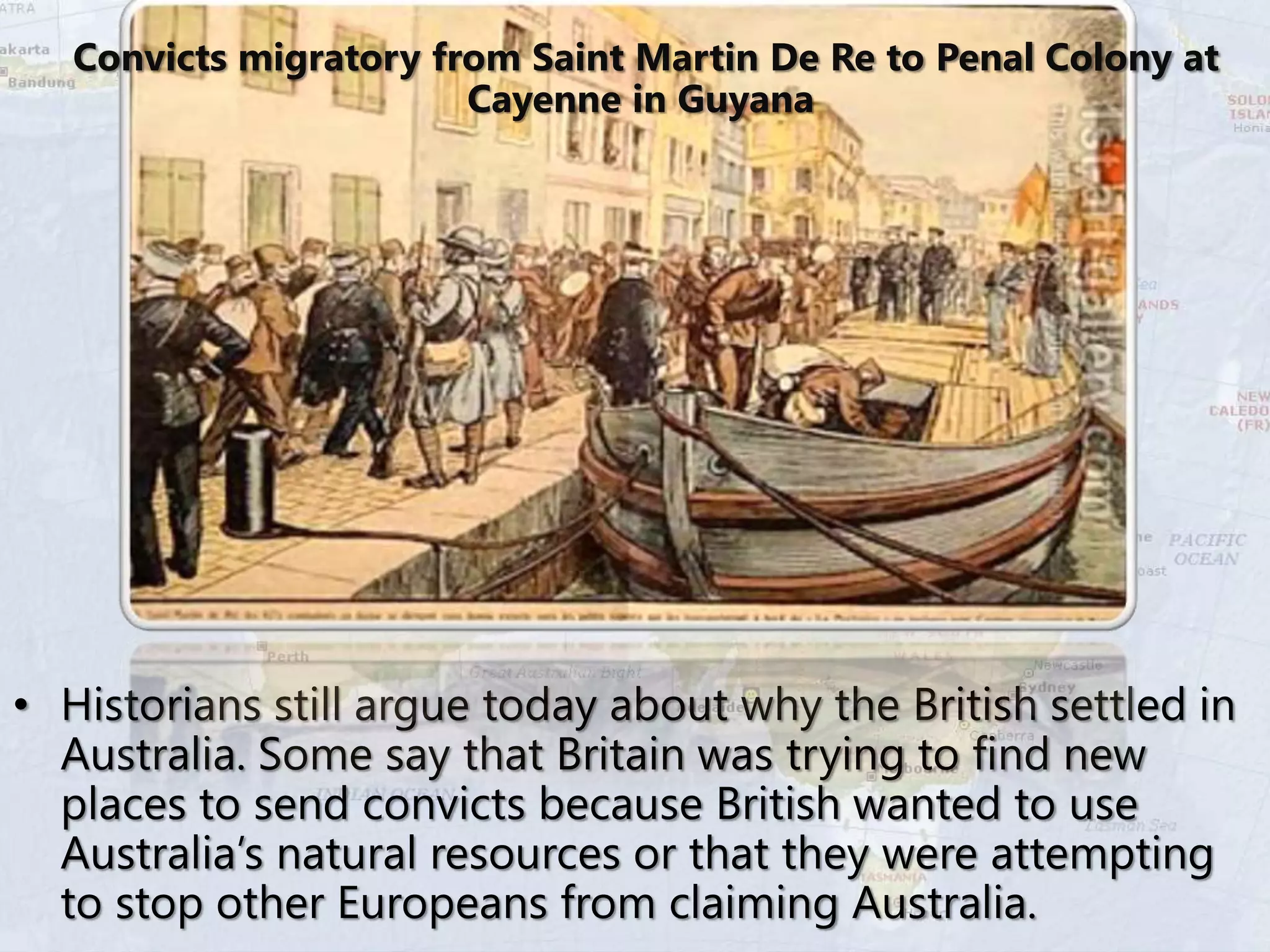
• Historians still argue today about why the British settled in
Australia. Some say that Britain was trying to find new
places to send convicts because British wanted to use
Australia’s natural resources or that they were attempting
to stop other Europeans from claiming Australia.
Convicts migratory from Saint Martin De Re to Penal Colony at
Cayenne in Guyana
The use of convict labor on the prisoners' ranch.
Port Arthur, Tasmania, Australia in1926
Language
• English is most commonly spoken by about 81%.
• The next most common languages spoken at home are
Mandarin (1.7%), Italian (1.5%), Arabic (1.4%), Cantonese
(1.3%), Greek (1.3%), Vietnamese (1.2%)
• Sign Language called Auslan, used by 5500 deaf people.
Education
• Responsibility of individual states and territories
• 4.5% GDP contributed for education
• General school going age-> 5-16
• Adult Literacy of 99%
• 37 Govt funded & 2 Private Universities
• Approximately 58 per cent of Australians aged from 25 to 64
have vocational or tertiary qualifications, tertiary graduation
rate of 49 per cent is the highest among OECD countries.
Cuisine
• Australia's 11 million sq Km fishing zone is the
third largest in the world and allows for
bountiful access to seafood which significantly
influences Australian cuisine.
• Lobster, prawn, tuna, salmon, and abalone are
the main ocean species harvested
• Few iconic Australian foods are Vegemite,
Australian hamburger, Pavlova
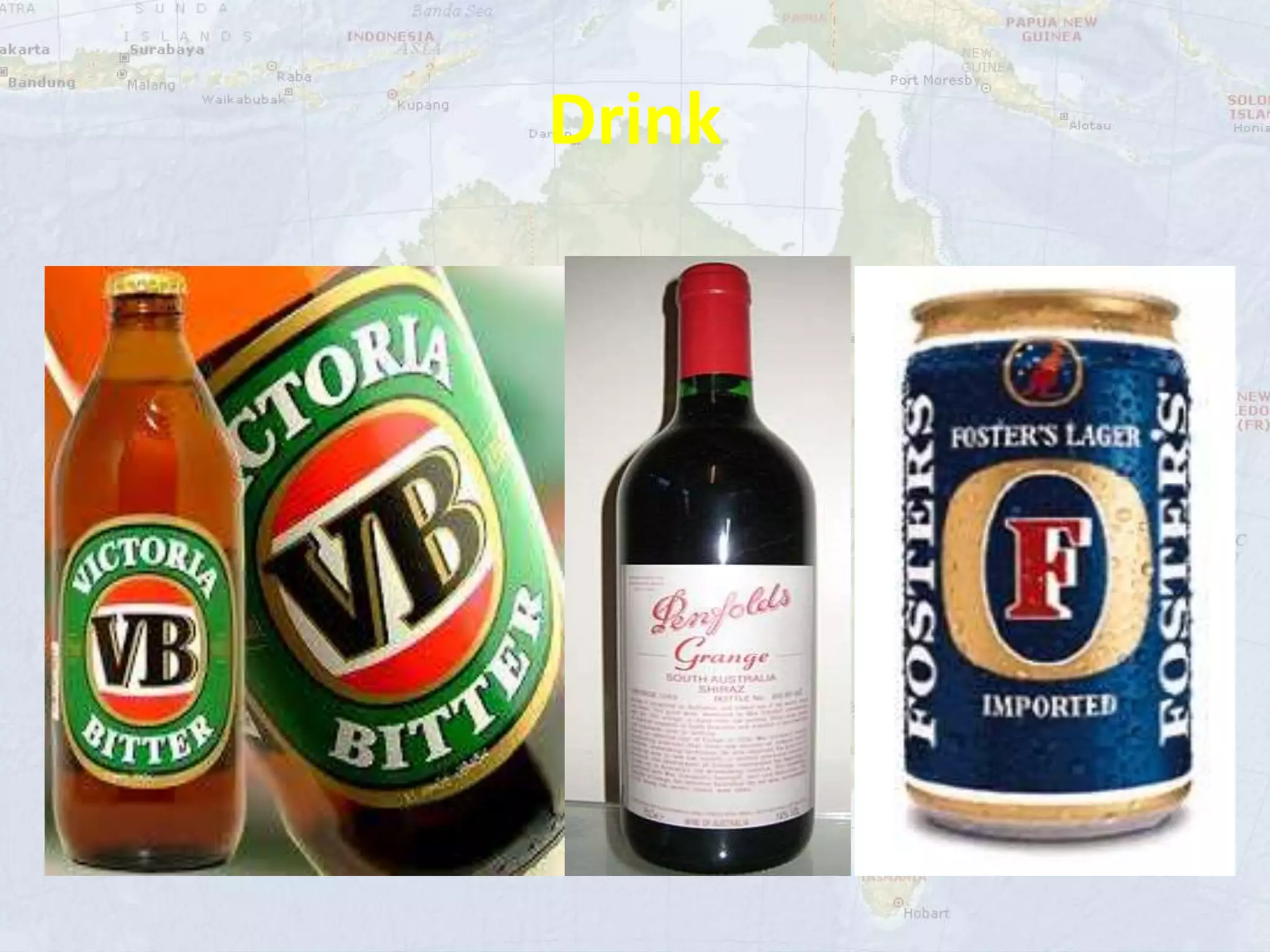
Drink
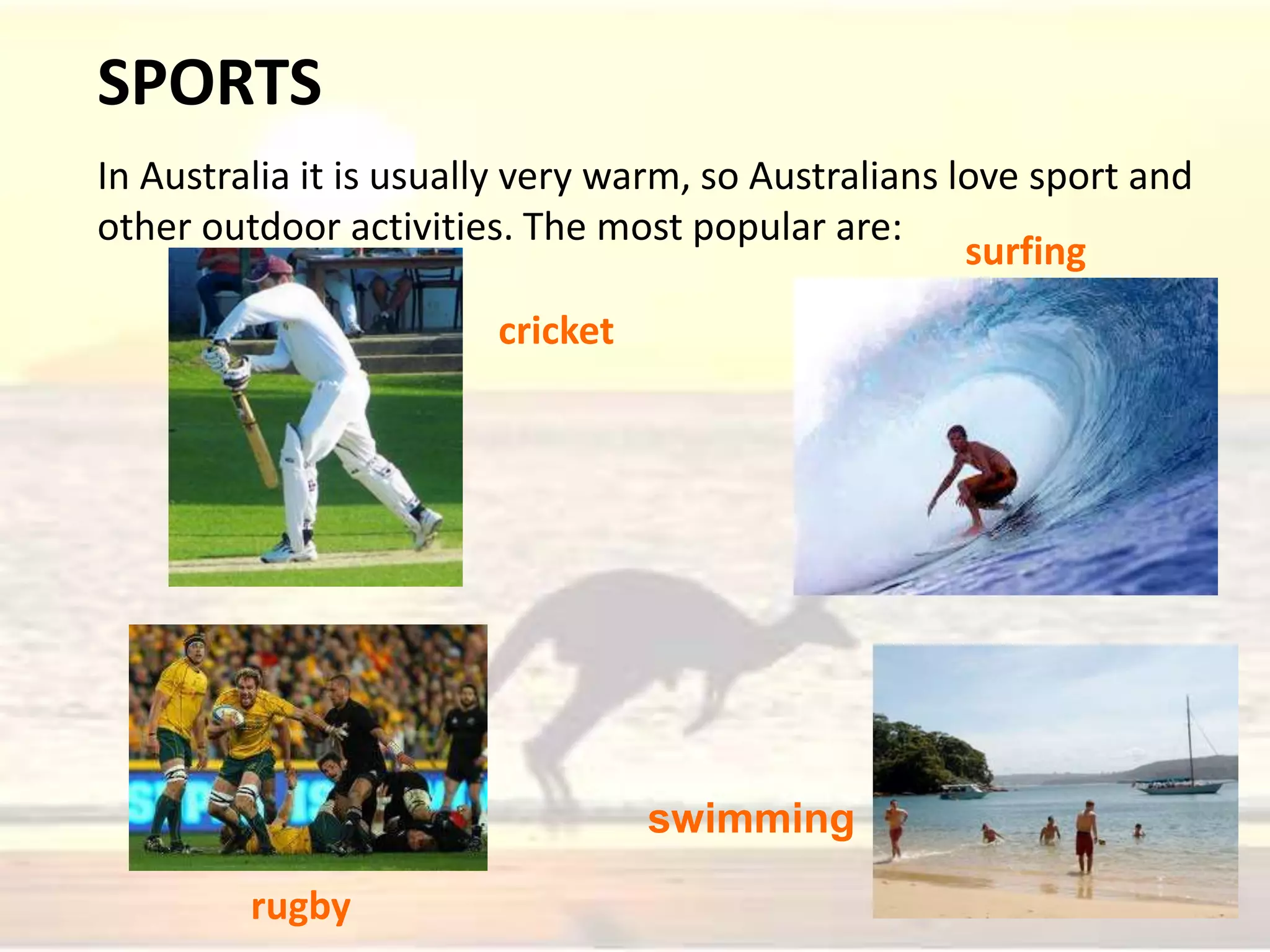
SPORTS
In Australia it is usually very warm, so Australians love sport and
other outdoor activities. The most popular are:
surfing
swimming
cricket
rugby
Some Famous Australians
- What is the capital of Australia?
a. Sydney b. Melbourne c. Canberra
- Which city is the oldest and largest?
a. Canberra b. Sydney c. Darwin
- Which is a popular Australian animal?
a. bear b. kangaroo c. fox
- Who are the Australian natives?
a. Eskimos b. Aborigines c. Indians
- Who discovered Australia?
a. Columbus b. Captain Cook c. Lewis and Clark
- What is the official Language in Australia?
a. English b. German c. Spain
Technological Analysis of
Australia
Information and communication technology
• Household access to the Internet has grown from 1.1
million households in 1998 to 4.7 million in 2005–06.
• There were 6.7 million active Internet subscribers in
Australia in September 2006, with more than 1.1 million
using connections with speeds of 1.5 megabits per second
(Mbps) or greater.
Research and innovation
• Expenditure on research and development (R&D) in
Australia reached more than $15.7 billion in 2004–05, up
more than 19% on the figure two years previously.
• Australian business accounted for the highest expenditure
on R&D (54%), followed by higher education (27%).
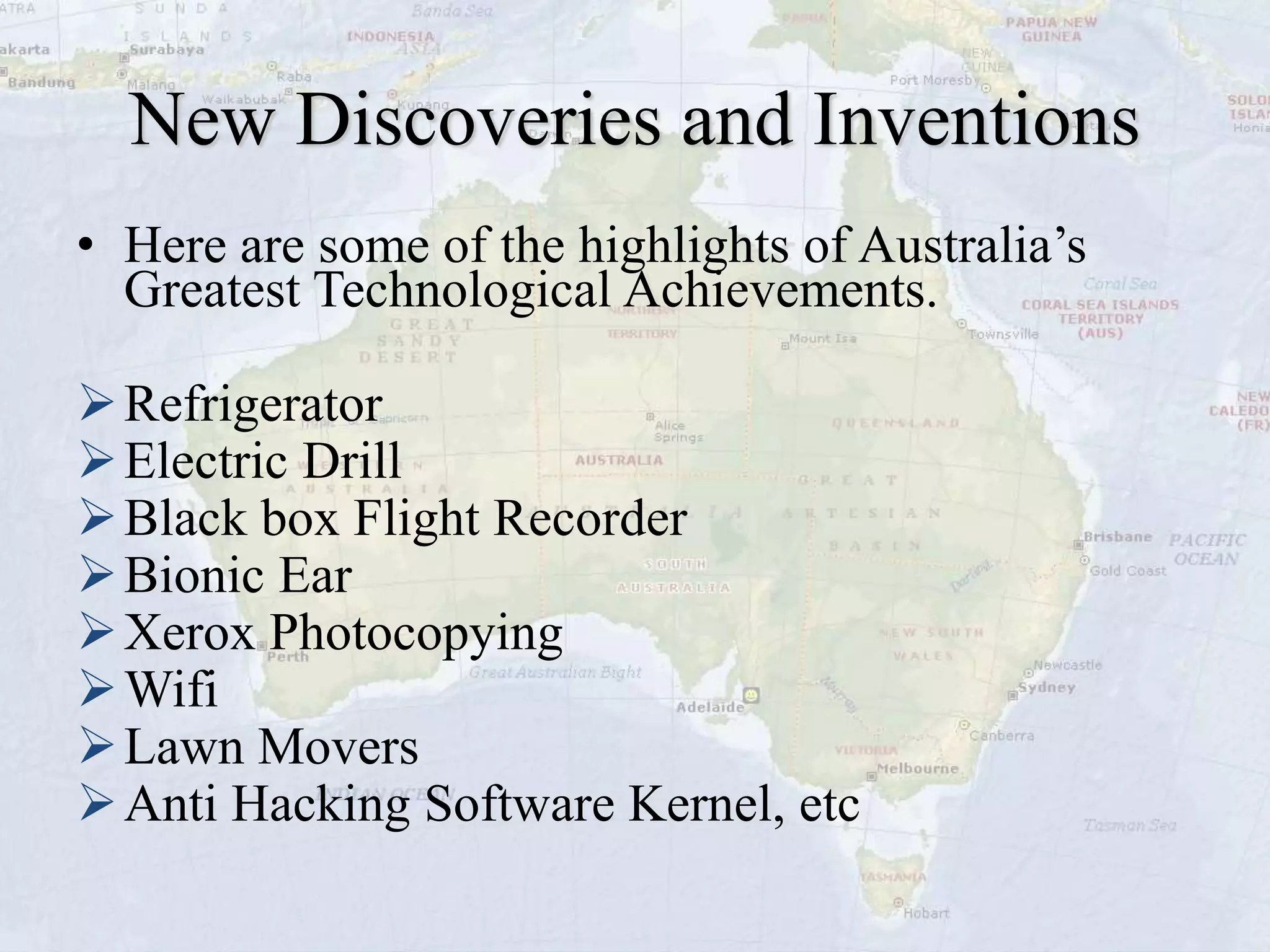
New Discoveries and Inventions
• Here are some of the highlights of Australia’s
Greatest Technological Achievements.
Refrigerator
Electric Drill
Black box Flight Recorder
Bionic Ear
Xerox Photocopying
Wifi
Lawn Movers
Anti Hacking Software Kernel, etc
Environmental analysis
of Australia
Environment
Australia is a large island continent and is one of the
most biologically diverse countries in the world, with
a large portion of its plants and animals and
ecosystems found nowhere else. About five percent
of Australia is national parks that provide excellent
places from which to experience such diverse
habitats as rainforests, deserts, coral reefs and
woodlands, and the plant sand animals that inhabit
them.
Environment issue 3 types:
• International
• National
• local
International
Global warming: Australia, like many regions of the world,
has already begun to experience the impacts of global
warming. In recent years, severe wildfires and drought
have not only caused widespread damage to the land,
but also negatively impacted tourism and the
economy. Perhaps the most noteworthy effect global
warming has had on Australia can be seen on the Great
Barrier Reef, where coral bleaching threatens the
world’s most diverse ocean ecosystem.
National
Marine and native fauna conservation: The Australian
Government uses the Environment Protection and Biodiversity
Conservation Act 1999 (EPBC Act) to protect and manage
threatened, migratory and marine species. Threatened
species are listed under the EPBC Act.
Ocean dumping: Waters surrounding Australia's coastlines are
protected from wastes and pollution dumped at sea by
the Environment Protection (Sea Dumping) Act 1981 (the Sea
Dumping Act). The Sea Dumping Act regulates the loading and
dumping of waste at sea. Permits are required from the
Department for all ocean disposal activities
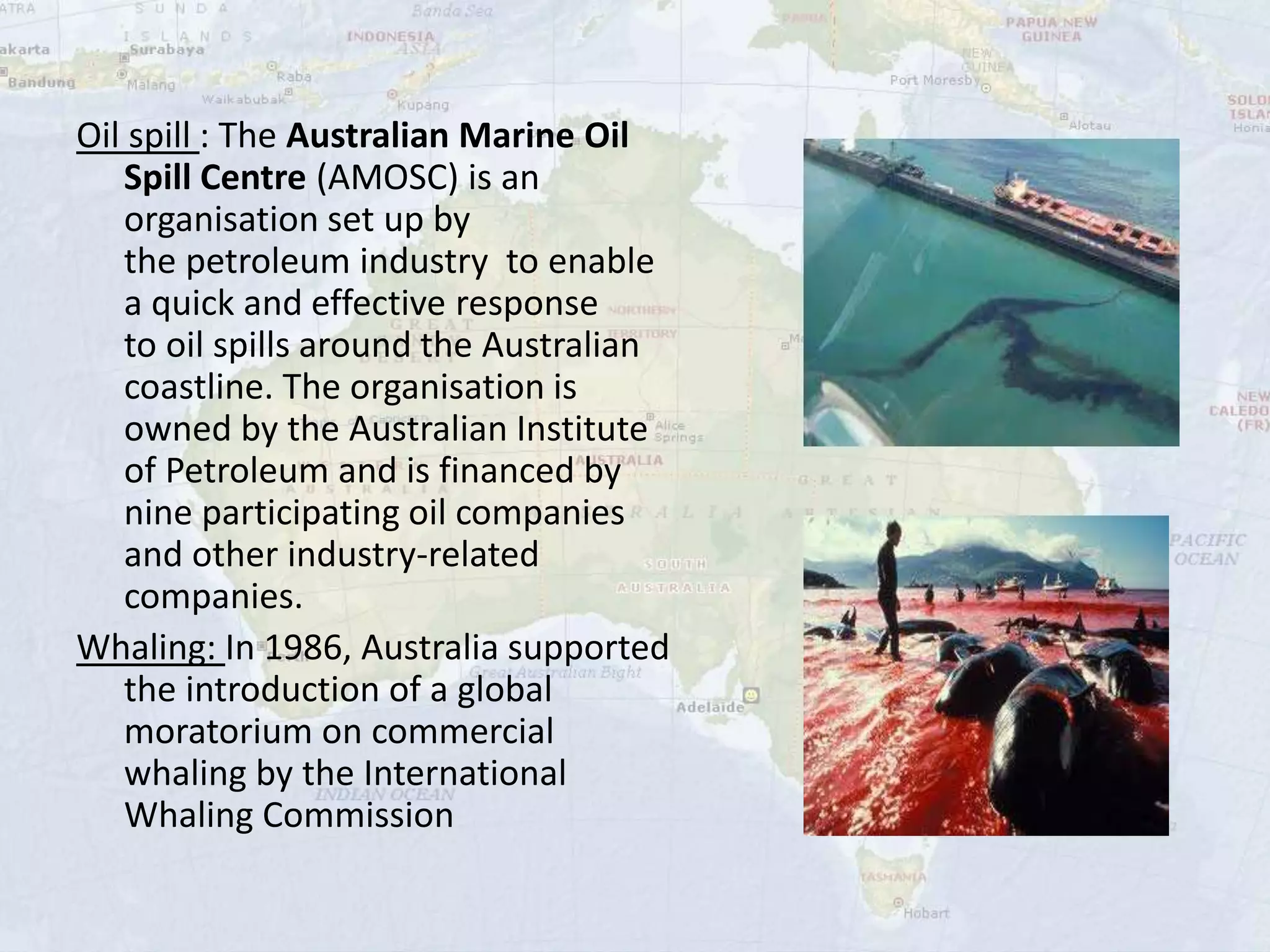
Oil spill : The Australian Marine Oil
Spill Centre (AMOSC) is an
organisation set up by
the petroleum industry to enable
a quick and effective response
to oil spills around the Australian
coastline. The organisation is
owned by the Australian Institute
of Petroleum and is financed by
nine participating oil companies
and other industry-related
companies.
Whaling: In 1986, Australia supported
the introduction of a global
moratorium on commercial
whaling by the International
Whaling Commission
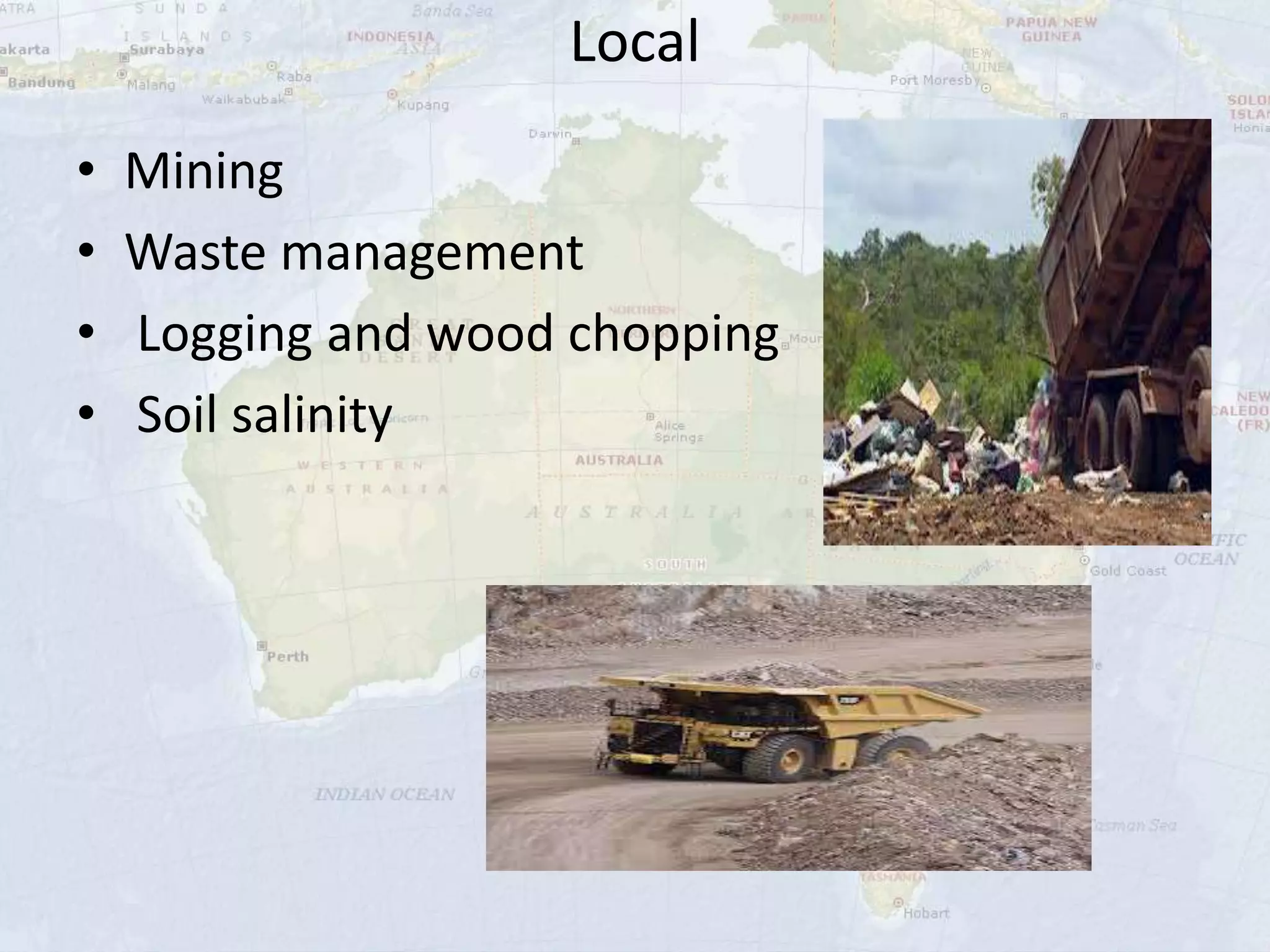
Local
• Mining
• Waste management
• Logging and wood chopping
• Soil salinity
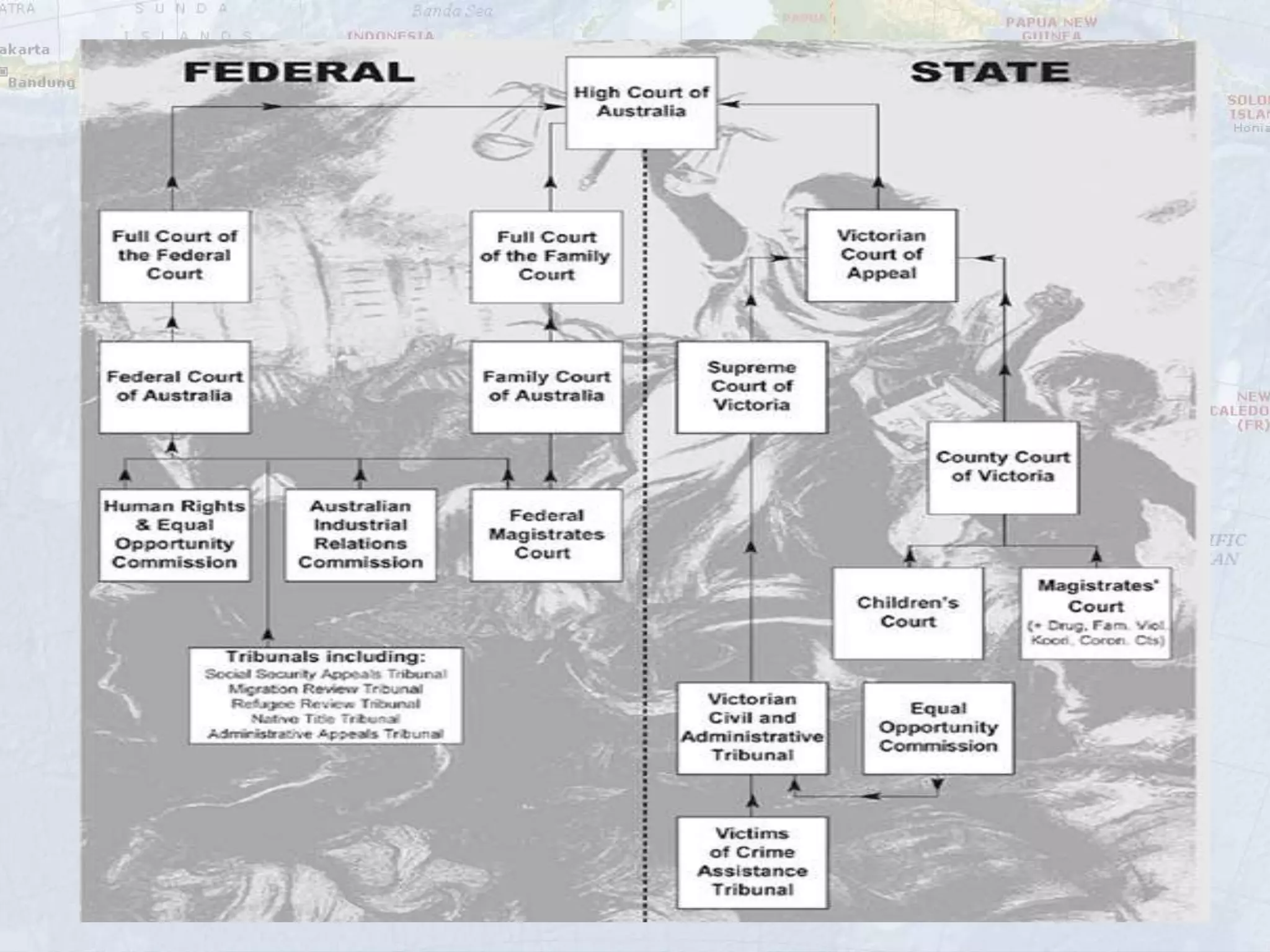
Legal environment
• The Australian legal system is based on a
fundamental belief in the rule of law,
justice and the independence of the
judiciary. All people—Australians and
non-Australians alike—are treated
equally before the law and safeguards
exist to ensure that people are not
treated arbitrarily or unfairly by
governments or officials.
• The Australian Constitution of 1901
established a federal system of
government, under which powers are
distributed between the federal
government and the states. Australian
law has developed from English law.
High Court of Australia
• Australia has nine legal systems—
the eight state and territory systems
and one federal system. However, it is
the state and territory criminal laws
that mainly affect the day-to-day lives
of most Australians. In all cases,
defendants are considered to be
innocent until proven guilty beyond all
reasonable doubt.
• Each of the federal and state systems
incorporates three separate branches
of government—legislative, executive
and judicial. Parliaments make the laws,
the executive government administers
the laws, and the judiciary
independently interprets and applies
them.
THANK YOU

Pestel analysis of australia

  • 1.
    PESTEL ANALYSIS OFAUSTRALIA Presented B Bappaditya Chakroborty Gourav Nag Indujyoti Kar
  • 2.
    Flow Of Presentation •Introduction • Political analysis of Australia • Economic analysis of Australia • Social Analysis of Australia • Technological analysis of Australia • Environmental analysis of Australia • Legal analysis of Australia
  • 4.
    Introduction Location: Oceania, continentbetween the Indian Ocean and the South Pacific Ocean • Capital: Canberra • Climate: generally arid to semiarid; temperate in south and east; tropical in north • Population:22.9 million • Religions: Christianity (61.1%), no religion (22.3%), undeclared(9.3%) • Languages in Australia: English is the primary language used in Australia.
  • 5.
    Introduction • It isthe world's sixth-largest country by total area. • Australia is the world's 12th-largest economy and has the world's fifth-highest per capita income. • Australia's military expenditure is the world's 13th-largest. With the second-highest human development index globally, Australia ranks highly in many international comparisons of national performance, such as quality of life, health, education, economic freedom, and the protection of civil liberties and political rights. • Australia is a member of the G20 , OECD , WTO , APEC , UN , Commonwealth of Nations , ANZUS and the Pacific Islands Forum.
  • 6.
    • The Commonwealthof Australia is a federal constitutional monarchy under a parliamentary democracy. The Commonwealth of Australia was formed in 1901 as a result of an agreement among six-governing British colonies, which became the six states. The Commonwealth also includes two territories - Northern Territory (NT) and Australian Capital Territory (ACT). • A governor-general represents the British monarch who is the designated head of state. POLITICAL
  • 7.
    • The Queen(Head of State), Governor-general, prime Minister • The Prime Minister is a Member of Parliament • The prime Minister sometimes chooses the cabinet but this depends on the policy of the winning party. Government format The Queen Elizabeth
  • 8.
    • 150 members •Single seat constituencies, which reflect the differing population of the state (eg NSW- 50 members, Tasmania – 6) • Elections at least every three years The House of Representatives
  • 9.
    • 76 members •All states elect 12 regardless of population, plus 2 ACT and 2 NT. • Senators are elected for a six years term with half seats renewed every three years. Senate
  • 10.
    Liberal Party ofAustralia (centre-right) Main policies: • Economic liberalization • Business and middle class orientated Main parties National Party of Australia (conservative) Main policies: • Anti-union • Free-trade • Pro-mining • Rural and agriculture orientated
  • 11.
    Australian Labor Party (socialdemocrat) • Strong national government • Equal opportunities • Working class/union orientated • Efficient and transparent legal framework • Stable political environment
  • 12.
  • 13.
    Economy situation • Australiahas an enviable, strong economy with a per capita GDP on par with the four dominant West European economies. • Australia's abundant and diverse natural resources attract high levels of foreign investment and include extensive reserves of coal, iron ore, copper, gold, natural gas, uranium, and renewable energy sources. • Australia also has a large services sector and is a significant exporter of natural resources, energy, and food. • The Australian economy grew for 17 consecutive years before the global financial crisis.
  • 14.
    Economic Indicators Markets LastReference Previous Frequency Currency 0.76 15-Mar 0.76 Daily Government Bond 10Y 2.56 percent 15-Mar 2.56 Daily Stock Market 5814 Index points 15-Mar 5814 Daily GDP Last Reference Previous Frequency GDP 1561 USD Billion 13-Dec 1561 Yearly GDP Growth Rate 0.5 percent 14-Nov 0.5 Quarterly GDP Annual Growth Rate 2.5 percent 14-Nov 2.5 Quarterly GDP Constant Prices 397341 AUD Million 14-Nov 397341 Quarterly Gross National Product 380643 AUD Million 14-Nov 380643 Quarterly GDP per capita 37493 USD 13-Dec 37493 Yearly Gross Fixed Capital Formation 102472 AUD Million 14-Nov 102472 Quarterly GDP per capita PPP 42810 USD 13-Dec 42810 Yearly
  • 15.
    Economic Indicators Labour LastReference Previous Frequency Unemployment Rate 6.3 percent 15-Feb 6.3 Monthly Employed Persons 11652 Thousand 15-Feb 11652 Monthly Full Time Employment 10300 Persons 15-Feb 10300 Monthly Wages 1129 AUD/Week 14-Nov 1129 Quarterly Population 23.13 Million 13-Dec 23.13 Yearly Retirement Age Women 64.5 15-Jan 64.5 Yearly Retirement Age Men 65 15-Jan 65 Yearly Minimum Wages 641 AUD 14-Dec 641 Yearly Wage Growth 2.5 percent 14-Nov 2.5 Quarterly
  • 16.
    Taxation in Australia TaxesLast Reference Previous Frequency Corporate Tax Rate 30 percent 14-Jan 30 Yearly Personal Income Tax Rate 45 percent 14-Jan 45Yearly Sales Tax Rate 10 percent 14-Jan 10 Yearly Social Security Rate 10.75 percent 14-Jan 10.75 Yearly Social Security Rate For Companies 9.25 percent 14-Jan 9.25Yearly Social Security Rate For Employees 1.5 percent 14-Jan 1.5Yearly
  • 17.
    International trade • Thenew trade strategy is based on five key principles : • Unilaterism • non discrimination • separation • transparency • Indivisibility of trade policy and economic reform • Australia’s highest regional trade negotiation priority at present is the conclusion of the Trans-Pacific Partnership Agreement. • Other priorities include the pursuit of Free Trade Agreements with Korea, Japan, Malaysia, Indonesia, India, China and the Gulf Cooperation Council. • The Government will pursue bilateral trade deals only where they offer net benefits to Australia and where they do not impede the progress of multilateral agreements.
  • 18.
    Exchange rates • TheAustralian dollar is currently the fifth-most-traded currency in the world foreign exchange markets behind the US dollar, the euro, the yen and the pound sterling • The Australian dollar is popular with currency traders, because of the comparatively high interest rates in Australia, the relative freedom of the foreign exchange market from government intervention, the general stability of Australia’s economy and political system. • The Australian economy operates with a floating exchange rate. • Australian dollar offers diversification benefits in a portfolio containing the major world currencies, especially because of its greater exposure to Asian economies and the commodities cycle.
  • 19.
  • 20.
    Aborigines  Australia’s first peoplewere the Aborigines. They have occupied the continent for at least 40,000 years, and before the Europeans arrived in 1788 their population as probably between 300,000 and 750,000. They occupied a lot of the northern territory.
  • 21.
    • Although Captain JamesCook had sailed the length of the east coast in 1770 the British did not settle in Australia until 1788. The first ships arrived and brought 1,000 convicts from England. They called the area where they landed New South Wales.James Cook
  • 22.
    • Historians stillargue today about why the British settled in Australia. Some say that Britain was trying to find new places to send convicts because British wanted to use Australia’s natural resources or that they were attempting to stop other Europeans from claiming Australia. Convicts migratory from Saint Martin De Re to Penal Colony at Cayenne in Guyana
  • 23.
    The use ofconvict labor on the prisoners' ranch. Port Arthur, Tasmania, Australia in1926
  • 24.
    Language • English ismost commonly spoken by about 81%. • The next most common languages spoken at home are Mandarin (1.7%), Italian (1.5%), Arabic (1.4%), Cantonese (1.3%), Greek (1.3%), Vietnamese (1.2%) • Sign Language called Auslan, used by 5500 deaf people. Education • Responsibility of individual states and territories • 4.5% GDP contributed for education • General school going age-> 5-16 • Adult Literacy of 99% • 37 Govt funded & 2 Private Universities • Approximately 58 per cent of Australians aged from 25 to 64 have vocational or tertiary qualifications, tertiary graduation rate of 49 per cent is the highest among OECD countries.
  • 25.
    Cuisine • Australia's 11million sq Km fishing zone is the third largest in the world and allows for bountiful access to seafood which significantly influences Australian cuisine. • Lobster, prawn, tuna, salmon, and abalone are the main ocean species harvested • Few iconic Australian foods are Vegemite, Australian hamburger, Pavlova
  • 26.
  • 27.
    SPORTS In Australia itis usually very warm, so Australians love sport and other outdoor activities. The most popular are: surfing swimming cricket rugby
  • 28.
  • 29.
    - What isthe capital of Australia? a. Sydney b. Melbourne c. Canberra - Which city is the oldest and largest? a. Canberra b. Sydney c. Darwin - Which is a popular Australian animal? a. bear b. kangaroo c. fox - Who are the Australian natives? a. Eskimos b. Aborigines c. Indians - Who discovered Australia? a. Columbus b. Captain Cook c. Lewis and Clark - What is the official Language in Australia? a. English b. German c. Spain
  • 30.
  • 31.
    Information and communicationtechnology • Household access to the Internet has grown from 1.1 million households in 1998 to 4.7 million in 2005–06. • There were 6.7 million active Internet subscribers in Australia in September 2006, with more than 1.1 million using connections with speeds of 1.5 megabits per second (Mbps) or greater. Research and innovation • Expenditure on research and development (R&D) in Australia reached more than $15.7 billion in 2004–05, up more than 19% on the figure two years previously. • Australian business accounted for the highest expenditure on R&D (54%), followed by higher education (27%).
  • 32.
    New Discoveries andInventions • Here are some of the highlights of Australia’s Greatest Technological Achievements. Refrigerator Electric Drill Black box Flight Recorder Bionic Ear Xerox Photocopying Wifi Lawn Movers Anti Hacking Software Kernel, etc
  • 33.
  • 34.
    Environment Australia is alarge island continent and is one of the most biologically diverse countries in the world, with a large portion of its plants and animals and ecosystems found nowhere else. About five percent of Australia is national parks that provide excellent places from which to experience such diverse habitats as rainforests, deserts, coral reefs and woodlands, and the plant sand animals that inhabit them.
  • 35.
    Environment issue 3types: • International • National • local
  • 36.
    International Global warming: Australia,like many regions of the world, has already begun to experience the impacts of global warming. In recent years, severe wildfires and drought have not only caused widespread damage to the land, but also negatively impacted tourism and the economy. Perhaps the most noteworthy effect global warming has had on Australia can be seen on the Great Barrier Reef, where coral bleaching threatens the world’s most diverse ocean ecosystem.
  • 37.
    National Marine and nativefauna conservation: The Australian Government uses the Environment Protection and Biodiversity Conservation Act 1999 (EPBC Act) to protect and manage threatened, migratory and marine species. Threatened species are listed under the EPBC Act. Ocean dumping: Waters surrounding Australia's coastlines are protected from wastes and pollution dumped at sea by the Environment Protection (Sea Dumping) Act 1981 (the Sea Dumping Act). The Sea Dumping Act regulates the loading and dumping of waste at sea. Permits are required from the Department for all ocean disposal activities
  • 38.
    Oil spill :The Australian Marine Oil Spill Centre (AMOSC) is an organisation set up by the petroleum industry to enable a quick and effective response to oil spills around the Australian coastline. The organisation is owned by the Australian Institute of Petroleum and is financed by nine participating oil companies and other industry-related companies. Whaling: In 1986, Australia supported the introduction of a global moratorium on commercial whaling by the International Whaling Commission
  • 39.
    Local • Mining • Wastemanagement • Logging and wood chopping • Soil salinity
  • 40.
    Legal environment • TheAustralian legal system is based on a fundamental belief in the rule of law, justice and the independence of the judiciary. All people—Australians and non-Australians alike—are treated equally before the law and safeguards exist to ensure that people are not treated arbitrarily or unfairly by governments or officials. • The Australian Constitution of 1901 established a federal system of government, under which powers are distributed between the federal government and the states. Australian law has developed from English law.
  • 41.
    High Court ofAustralia • Australia has nine legal systems— the eight state and territory systems and one federal system. However, it is the state and territory criminal laws that mainly affect the day-to-day lives of most Australians. In all cases, defendants are considered to be innocent until proven guilty beyond all reasonable doubt. • Each of the federal and state systems incorporates three separate branches of government—legislative, executive and judicial. Parliaments make the laws, the executive government administers the laws, and the judiciary independently interprets and applies them.
  • 43.