UNIT-I: Globalization – Introduction to the field of Global Business, Significance, Nature and Scope of
Global Business, Modes of Global business – Global Business Environment- Social, Cultural, Economic,
Political and Ecological factors


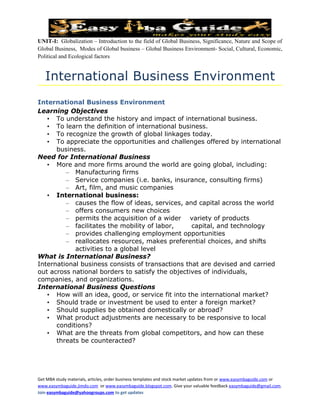
   International Business Environment
International Business Environment
Learning Objectives
   • To understand the history and impact of international business.
   • To learn the definition of international business.
   • To recognize the growth of global linkages today.
   • To appreciate the opportunities and challenges offered by international
      business.
Need for International Business
   • More and more firms around the world are going global, including:
         – Manufacturing firms
         – Service companies (i.e. banks, insurance, consulting firms)
         – Art, film, and music companies
   • International business:
         – causes the flow of ideas, services, and capital across the world
         – offers consumers new choices
         – permits the acquisition of a wider variety of products
         – facilitates the mobility of labor,     capital, and technology
         – provides challenging employment opportunities
         – reallocates resources, makes preferential choices, and shifts
            activities to a global level
What is International Business?
International business consists of transactions that are devised and carried
out across national borders to satisfy the objectives of individuals,
companies, and organizations.
International Business Questions
   • How will an idea, good, or service fit into the international market?
   • Should trade or investment be used to enter a foreign market?
   • Should supplies be obtained domestically or abroad?
   • What product adjustments are necessary to be responsive to local
      conditions?
   • What are the threats from global competitors, and how can these
      threats be counteracted?


Get MBA study materials, articles, order business templates and stock market updates from or www.easymbaguide.com or
www.easymbaguide.jimdo.com or www.easymbaguide.blogspot.com. Give your valuable feedback easymbaguide@gmail.com.
Join easymbaguide@yahoogroups.com to get updates
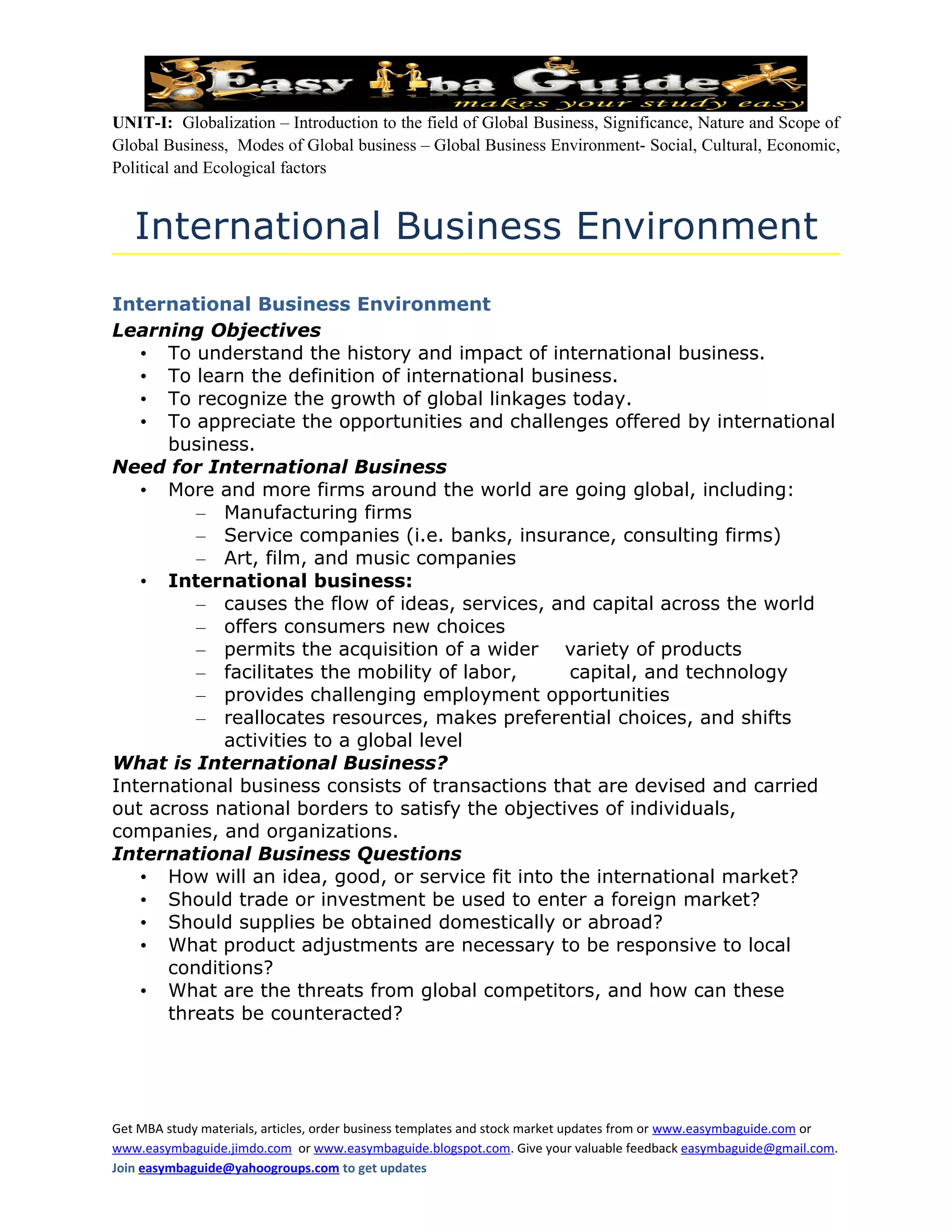
Global Links Today
   • International business has created a network of global links that bind
     countries, institutions, and individuals with trade, financial markets,
     technology, and living standards.
        – For example, a reduction in coffee production in Brazil would
           affect individuals and economies worldwide.
Recent Changes in International Business
   • Total world trade declined dramatically after 2000, but is again on the
     rise.
   • The rate of globalization is accelerating.
   • Regionalization is taking place, resulting in trading blocs.
   • The participation of countries in world trade is shifting.
The Composition of Trade
   • Between the 1960’s and the 1990’s the importance of manufactured
     goods increased while the role of primary commodities (i.e. rubber or
     mining) had decreased.
   • More recently, there has been a shift of manufacturing to countries
     with emerging economies.
   • There has been an increase in the area of services trade in recent
     years.


Globalization
    •    Because of globalization, for the first time in history, the availability
         of international products and services can be accessed by individuals in
         many countries, from diverse economic backgrounds.
The     Globalization Debate
  •      Antiglobalization Protest
  •      Globalization, Jobs and Debate
  •      Globalization, Labour Policies and the Environment
  •      Globalization and National Sovereignty
  •      Globalization and the National Sovereignty


Get MBA study materials, articles, order business templates and stock market updates from or www.easymbaguide.com or
www.easymbaguide.jimdo.com or www.easymbaguide.blogspot.com. Give your valuable feedback easymbaguide@gmail.com.
Join easymbaguide@yahoogroups.com to get updates
MODES OF GLOBAL BUSINESS

Learning Objectives
  • To learn how firms gradually progress through an internationalization
     process.
  • To understand the strategic effects of internationalization.
  • To study the various modes of entering international markets.
NEED
  • Managerial commitment is critical because foreign market penetration
     requires a vast amount of market development activity, sensitivity
     toward foreign environments, research, and innovation.
The Steps to Developing International Commitment
  • Become aware of international business opportunities.
  • Determine the degree of the firm’s internationalization.
  • Decide the timing of when to start the internationalization process and
     how quickly it should progress.


Modes of International Business
  • Licensing
  • Franchising
  • Inter firm cooperation
  • Importing
  • Exporting
  • Foreign Direct
  • Investment

   Licensing
    • The property licensed may include:
         – Patents: A patent is a set of exclusive rights granted by a state
           to an inventor or his assignee for a limited period of time in
           exchange for a disclosure of an invention.
         – Trademarks:
          A trademark or trade mark,[1] identified by the symbols ™ (not
           yet registered) and ® (registered), is a distinctive sign or
           indicator used by an individual, business organization or other
           legal entity to identify that the products and/or services to
           consumers with which the trademark appears originate from a

Get MBA study materials, articles, order business templates and stock market updates from or www.easymbaguide.com or
www.easymbaguide.jimdo.com or www.easymbaguide.blogspot.com. Give your valuable feedback easymbaguide@gmail.com.
Join easymbaguide@yahoogroups.com to get updates
unique source of origin, and to distinguish its products or
               services from those of other entities.
              A trademark is a type of intellectual property, and typically a
               name, word, phrase, logo, symbol, design, image, or a
               combination of these elements.[2]
             – Copyrights: Copyright is a form of intellectual property which
               gives the creator of an original work exclusive rights for a certain
               time period in relation to that work, including its publication,
               distribution and adaptation; after which time the work is said to
               enter the public domain.
             – Technology
             – Technical know-how
             – Specific business skills

   Benefits and Costs of Licensing


Why go in for Licensing
             • Less risk of capital and no involvement with foreign
                customers
             • Avoids host-country regulations
             • Allows a company to test the market
             • Avoids cultural problems
             • Trademark licensing—permits the names or logos to be
                used on products made in foreign market
             • May be creating own future competitor

Get MBA study materials, articles, order business templates and stock market updates from or www.easymbaguide.com or
www.easymbaguide.jimdo.com or www.easymbaguide.blogspot.com. Give your valuable feedback easymbaguide@gmail.com.
Join easymbaguide@yahoogroups.com to get updates
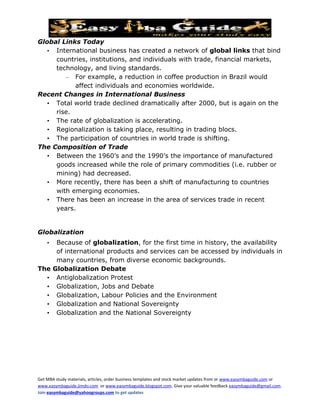
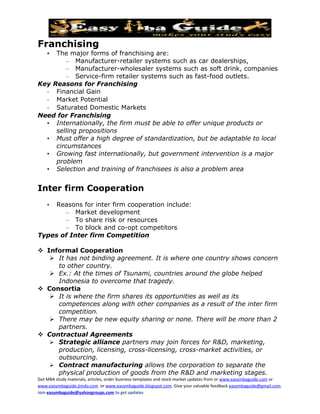
Franchising
    •The major forms of franchising are:
         – Manufacturer-retailer systems such as car dealerships,
         – Manufacturer-wholesaler systems such as soft drink, companies
         – Service-firm retailer systems such as fast-food outlets.
Key Reasons for Franchising
  - Financial Gain
  - Market Potential
  - Saturated Domestic Markets
Need for Franchising
  • Internationally, the firm must be able to offer unique products or
     selling propositions
  • Must offer a high degree of standardization, but be adaptable to local
     circumstances
  • Growing fast internationally, but government intervention is a major
     problem
  • Selection and training of franchisees is also a problem area


Inter firm Cooperation
    •Reasons for inter firm cooperation include:
       – Market development
       – To share risk or resources
       – To block and co-opt competitors
Types of Inter firm Competition

 Informal Cooperation
    It has not binding agreement. It is where one country shows concern
     to other country.
    Ex.: At the times of Tsunami, countries around the globe helped
     Indonesia to overcome that tragedy.
 Consortia
    It is where the firm shares its opportunities as well as its
     competences along with other companies as a result of the inter firm
     competition.
    There may be new equity sharing or none. There will be more than 2
     partners.
 Contractual Agreements
    Strategic alliance partners may join forces for R&D, marketing,
     production, licensing, cross-licensing, cross-market activities, or
     outsourcing.
    Contract manufacturing allows the corporation to separate the
     physical production of goods from the R&D and marketing stages.
Get MBA study materials, articles, order business templates and stock market updates from or www.easymbaguide.com or
www.easymbaguide.jimdo.com or www.easymbaguide.blogspot.com. Give your valuable feedback easymbaguide@gmail.com.
Join easymbaguide@yahoogroups.com to get updates
 Management contracts involve selling one’s expertise in running a
     company while avoiding the risk or benefit of ownership.
    A turnkey operation is a contractual agreement that permits a
     client to acquire a complete system following its completion.
 Equity Participation
    Some companies have acquired minority ownerships in companies
     that have strategic importance for them.
    Reasons for engaging in equity participation include:
         - It ensures supplier ability
         - It builds working relationships
         - It creates market entry and support of global operations
 FDI
   It is of 2 types
           -      Equity participation
           -      Non –Equity participation (Portfolio Investment)

Global Business Environment

Culture Environment
Culture is an integrated system of learned behavior patterns that are characteristic of the
members of any given society.
Elements of Social and Culture
 Language (verbal and nonverbal)
 Religion
 Values and Attitudes
 Manners and Customs
 Material Elements
 Aesthetics
 Education
 Social Institutions

Political Environment
 The Home Country Perspective
  Major areas of governmental activity that are of concern to the international business manager:
         – Embargoes and Sanctions
         – Export Controls
         – Regulation of International
         – Business Behavior


Get MBA study materials, articles, order business templates and stock market updates from or www.easymbaguide.com or
www.easymbaguide.jimdo.com or www.easymbaguide.blogspot.com. Give your valuable feedback easymbaguide@gmail.com.
Join easymbaguide@yahoogroups.com to get updates
 Host Country Political and Legal Environment
  Political Action and Risk
      o Varies widely from country to country
      o Three Types of Political Risk
      o Ownership Risk
           Exposes property and life
      o Operating Risk
           Interference with the ongoing operations of a firm
      o Transfer Risk
           Limitations on the outflow of funds
     Political Risk May Involve
  • Confiscation
           – The government takeover of a firm without compensation to the owners.
  • Expropriation
           – A form of government takeover in which the firm’s owners are compensated.
  • Domestication
           – The government demands transfer of ownership and management responsibility.

    Economic Risk
       o Less dangerous, but more common


Economic Environment
    •   Economic Size
    •   Economic Systems
    •   Key Macroeconomic Indicators
    •   Economies in Transition


Get MBA study materials, articles, order business templates and stock market updates from or www.easymbaguide.com or
www.easymbaguide.jimdo.com or www.easymbaguide.blogspot.com. Give your valuable feedback easymbaguide@gmail.com.
Join easymbaguide@yahoogroups.com to get updates

International Business Environment

  • 1.
    UNIT-I: Globalization –Introduction to the field of Global Business, Significance, Nature and Scope of Global Business, Modes of Global business – Global Business Environment- Social, Cultural, Economic, Political and Ecological factors International Business Environment International Business Environment Learning Objectives • To understand the history and impact of international business. • To learn the definition of international business. • To recognize the growth of global linkages today. • To appreciate the opportunities and challenges offered by international business. Need for International Business • More and more firms around the world are going global, including: – Manufacturing firms – Service companies (i.e. banks, insurance, consulting firms) – Art, film, and music companies • International business: – causes the flow of ideas, services, and capital across the world – offers consumers new choices – permits the acquisition of a wider variety of products – facilitates the mobility of labor, capital, and technology – provides challenging employment opportunities – reallocates resources, makes preferential choices, and shifts activities to a global level What is International Business? International business consists of transactions that are devised and carried out across national borders to satisfy the objectives of individuals, companies, and organizations. International Business Questions • How will an idea, good, or service fit into the international market? • Should trade or investment be used to enter a foreign market? • Should supplies be obtained domestically or abroad? • What product adjustments are necessary to be responsive to local conditions? • What are the threats from global competitors, and how can these threats be counteracted? Get MBA study materials, articles, order business templates and stock market updates from or www.easymbaguide.com or www.easymbaguide.jimdo.com or www.easymbaguide.blogspot.com. Give your valuable feedback easymbaguide@gmail.com. Join easymbaguide@yahoogroups.com to get updates
  • 2.
    Global Links Today • International business has created a network of global links that bind countries, institutions, and individuals with trade, financial markets, technology, and living standards. – For example, a reduction in coffee production in Brazil would affect individuals and economies worldwide. Recent Changes in International Business • Total world trade declined dramatically after 2000, but is again on the rise. • The rate of globalization is accelerating. • Regionalization is taking place, resulting in trading blocs. • The participation of countries in world trade is shifting. The Composition of Trade • Between the 1960’s and the 1990’s the importance of manufactured goods increased while the role of primary commodities (i.e. rubber or mining) had decreased. • More recently, there has been a shift of manufacturing to countries with emerging economies. • There has been an increase in the area of services trade in recent years. Globalization • Because of globalization, for the first time in history, the availability of international products and services can be accessed by individuals in many countries, from diverse economic backgrounds. The Globalization Debate • Antiglobalization Protest • Globalization, Jobs and Debate • Globalization, Labour Policies and the Environment • Globalization and National Sovereignty • Globalization and the National Sovereignty Get MBA study materials, articles, order business templates and stock market updates from or www.easymbaguide.com or www.easymbaguide.jimdo.com or www.easymbaguide.blogspot.com. Give your valuable feedback easymbaguide@gmail.com. Join easymbaguide@yahoogroups.com to get updates
  • 3.
    MODES OF GLOBALBUSINESS Learning Objectives • To learn how firms gradually progress through an internationalization process. • To understand the strategic effects of internationalization. • To study the various modes of entering international markets. NEED • Managerial commitment is critical because foreign market penetration requires a vast amount of market development activity, sensitivity toward foreign environments, research, and innovation. The Steps to Developing International Commitment • Become aware of international business opportunities. • Determine the degree of the firm’s internationalization. • Decide the timing of when to start the internationalization process and how quickly it should progress. Modes of International Business • Licensing • Franchising • Inter firm cooperation • Importing • Exporting • Foreign Direct • Investment Licensing • The property licensed may include: – Patents: A patent is a set of exclusive rights granted by a state to an inventor or his assignee for a limited period of time in exchange for a disclosure of an invention. – Trademarks:  A trademark or trade mark,[1] identified by the symbols ™ (not yet registered) and ® (registered), is a distinctive sign or indicator used by an individual, business organization or other legal entity to identify that the products and/or services to consumers with which the trademark appears originate from a Get MBA study materials, articles, order business templates and stock market updates from or www.easymbaguide.com or www.easymbaguide.jimdo.com or www.easymbaguide.blogspot.com. Give your valuable feedback easymbaguide@gmail.com. Join easymbaguide@yahoogroups.com to get updates
  • 4.
    unique source oforigin, and to distinguish its products or services from those of other entities.  A trademark is a type of intellectual property, and typically a name, word, phrase, logo, symbol, design, image, or a combination of these elements.[2] – Copyrights: Copyright is a form of intellectual property which gives the creator of an original work exclusive rights for a certain time period in relation to that work, including its publication, distribution and adaptation; after which time the work is said to enter the public domain. – Technology – Technical know-how – Specific business skills Benefits and Costs of Licensing Why go in for Licensing • Less risk of capital and no involvement with foreign customers • Avoids host-country regulations • Allows a company to test the market • Avoids cultural problems • Trademark licensing—permits the names or logos to be used on products made in foreign market • May be creating own future competitor Get MBA study materials, articles, order business templates and stock market updates from or www.easymbaguide.com or www.easymbaguide.jimdo.com or www.easymbaguide.blogspot.com. Give your valuable feedback easymbaguide@gmail.com. Join easymbaguide@yahoogroups.com to get updates
  • 5.
    Franchising •The major forms of franchising are: – Manufacturer-retailer systems such as car dealerships, – Manufacturer-wholesaler systems such as soft drink, companies – Service-firm retailer systems such as fast-food outlets. Key Reasons for Franchising - Financial Gain - Market Potential - Saturated Domestic Markets Need for Franchising • Internationally, the firm must be able to offer unique products or selling propositions • Must offer a high degree of standardization, but be adaptable to local circumstances • Growing fast internationally, but government intervention is a major problem • Selection and training of franchisees is also a problem area Inter firm Cooperation •Reasons for inter firm cooperation include: – Market development – To share risk or resources – To block and co-opt competitors Types of Inter firm Competition  Informal Cooperation  It has not binding agreement. It is where one country shows concern to other country.  Ex.: At the times of Tsunami, countries around the globe helped Indonesia to overcome that tragedy.  Consortia  It is where the firm shares its opportunities as well as its competences along with other companies as a result of the inter firm competition.  There may be new equity sharing or none. There will be more than 2 partners.  Contractual Agreements  Strategic alliance partners may join forces for R&D, marketing, production, licensing, cross-licensing, cross-market activities, or outsourcing.  Contract manufacturing allows the corporation to separate the physical production of goods from the R&D and marketing stages. Get MBA study materials, articles, order business templates and stock market updates from or www.easymbaguide.com or www.easymbaguide.jimdo.com or www.easymbaguide.blogspot.com. Give your valuable feedback easymbaguide@gmail.com. Join easymbaguide@yahoogroups.com to get updates
  • 6.
     Management contractsinvolve selling one’s expertise in running a company while avoiding the risk or benefit of ownership.  A turnkey operation is a contractual agreement that permits a client to acquire a complete system following its completion.  Equity Participation  Some companies have acquired minority ownerships in companies that have strategic importance for them.  Reasons for engaging in equity participation include: - It ensures supplier ability - It builds working relationships - It creates market entry and support of global operations  FDI  It is of 2 types - Equity participation - Non –Equity participation (Portfolio Investment) Global Business Environment Culture Environment Culture is an integrated system of learned behavior patterns that are characteristic of the members of any given society. Elements of Social and Culture  Language (verbal and nonverbal)  Religion  Values and Attitudes  Manners and Customs  Material Elements  Aesthetics  Education  Social Institutions Political Environment  The Home Country Perspective Major areas of governmental activity that are of concern to the international business manager: – Embargoes and Sanctions – Export Controls – Regulation of International – Business Behavior Get MBA study materials, articles, order business templates and stock market updates from or www.easymbaguide.com or www.easymbaguide.jimdo.com or www.easymbaguide.blogspot.com. Give your valuable feedback easymbaguide@gmail.com. Join easymbaguide@yahoogroups.com to get updates
  • 7.
     Host CountryPolitical and Legal Environment Political Action and Risk o Varies widely from country to country o Three Types of Political Risk o Ownership Risk Exposes property and life o Operating Risk Interference with the ongoing operations of a firm o Transfer Risk Limitations on the outflow of funds Political Risk May Involve • Confiscation – The government takeover of a firm without compensation to the owners. • Expropriation – A form of government takeover in which the firm’s owners are compensated. • Domestication – The government demands transfer of ownership and management responsibility. Economic Risk o Less dangerous, but more common Economic Environment • Economic Size • Economic Systems • Key Macroeconomic Indicators • Economies in Transition Get MBA study materials, articles, order business templates and stock market updates from or www.easymbaguide.com or www.easymbaguide.jimdo.com or www.easymbaguide.blogspot.com. Give your valuable feedback easymbaguide@gmail.com. Join easymbaguide@yahoogroups.com to get updates