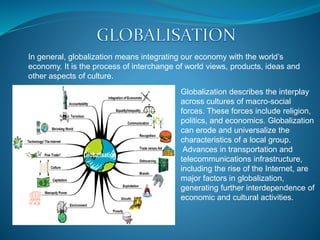
In general, globalization means integrating our economy with the world’s
economy. It is the process of interchange of world views, products, ideas and
other aspects of culture.
Globalization describes the interplay
across cultures of macro-social
forces. These forces include religion,
politics, and economics. Globalization
can erode and universalize the
characteristics of a local group.
Advances in transportation and
telecommunications infrastructure,
including the rise of the Internet, are
major factors in globalization,
generating further interdependence of
economic and cultural activities.
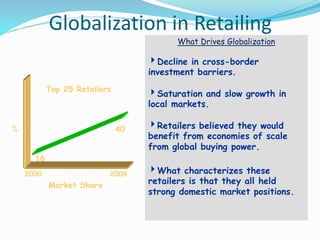
Top 25 Retailers
Market Share
%
2000 2009
16
40
What Drives Globalization
Decline in cross-border
investment barriers.
Saturation and slow growth in
local markets.
Retailers believed they would
benefit from economies of scale
from global buying power.
What characterizes these
retailers is that they all held
strong domestic market positions.
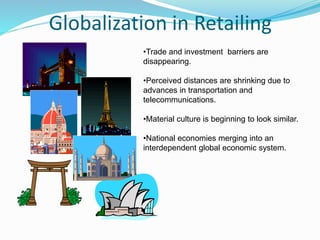
Globalization in Retailing
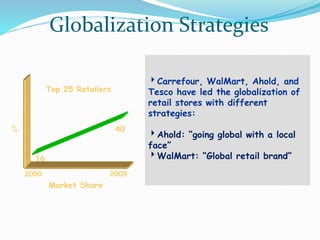
Globalization Strategies
Carrefour, WalMart, Ahold, and
Tesco have led the globalization of
retail stores with different
strategies:
Ahold: “going global with a local
face”
WalMart: “Global retail brand”
Top 25 Retailers
Market Share
%
2000 2009
16
40
Problems for Globalization
 National differences in
 tastes and preferences
 Distribution channels
 Culturally embedded value systems
 Difficulty in establishing common retail model such as:
 Ahold: “going global with a local face”
 WalMart: “Global retail brand”
Globalization in Retailing
•Trade and investment barriers are
disappearing.
•Perceived distances are shrinking due to
advances in transportation and
telecommunications.
•Material culture is beginning to look similar.
•National economies merging into an
interdependent global economic system.
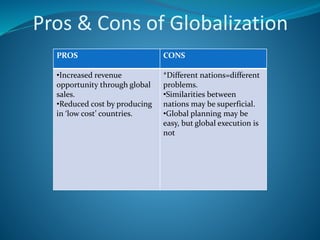
Pros & Cons of Globalization
PROS CONS
•Increased revenue
opportunity through global
sales.
•Reduced cost by producing
in ‘low cost’ countries.
*Different nations=different
problems.
•Similarities between
nations may be superficial.
•Global planning may be
easy, but global execution is
not
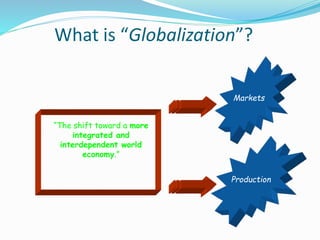
What is “Globalization”?
“The shift toward a more
integrated and
interdependent world
economy.”
Markets
Production
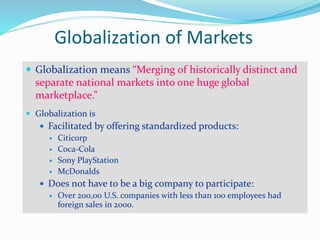
Globalization of Markets
 Globalization means “Merging of historically distinct and
separate national markets into one huge global
marketplace.”
 Globalization is
 Facilitated by offering standardized products:
 Citicorp
 Coca-Cola
 Sony PlayStation
 McDonalds
 Does not have to be a big company to participate:
 Over 200,00 U.S. companies with less than 100 employees had
foreign sales in 2000.
Where will
globalization most likely prosper better?
In consumer goods
Or
In industrial goods and materials
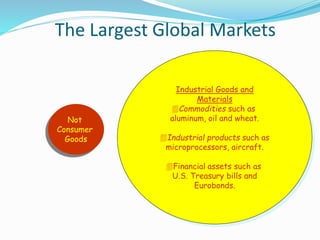
Not
Consumer
Goods
Industrial Goods and
Materials
Commodities such as
aluminum, oil and wheat.
Industrial products such as
microprocessors, aircraft.
Financial assets such as
U.S. Treasury bills and
Eurobonds.
The Largest Global Markets
Globalization of Production
Why does
globalization of production take place?
“The sourcing of goods and services from locations
around the globe to take advantage of national
differences in the cost and quality of factors of
production (labor, energy, land and capital).”
This also increases the company’s chance to obtain
those countries market for their products as well.
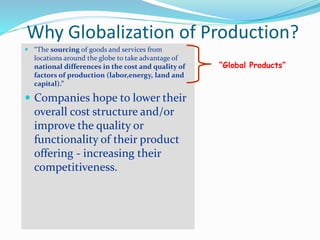
Why Globalization of Production?
 “The sourcing of goods and services from
locations around the globe to take advantage of
national differences in the cost and quality of
factors of production (labor,energy, land and
capital).”
 Companies hope to lower their
overall cost structure and/or
improve the quality or
functionality of their product
offering - increasing their
competitiveness.
“Global Products”
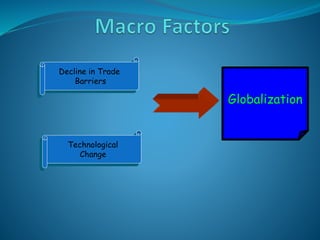
Decline in Trade
Barriers
Technological
Change
Globalization
International Trade: When a firm exports goods
or services to consumers in another country.
Foreign Direct Investment: When a firm invests
resources in business activities outside its home
country.
General Agreement on Tariffs and Trade
Member states (140) in eight negotiating ‘rounds’ worked to lower
barriers to the free flow of goods and services.
In the most recent round, the Uruguay Round, nations agreed to
enhanced patent, copyright and trademark protections and
established the World Trade Organization.
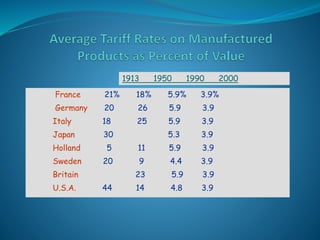
1913 1950 1990 2000
France 21% 18% 5.9% 3.9%
Germany 20 26 5.9 3.9
Italy 18 25 5.9 3.9
Japan 30 5.3 3.9
Holland 5 11 5.9 3.9
Sweden 20 9 4.4 3.9
Britain 23 5.9 3.9
U.S.A. 44 14 4.8 3.9
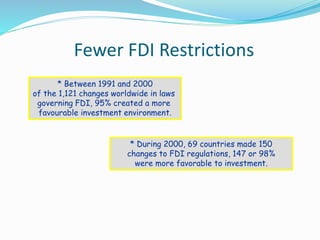
Fewer FDI Restrictions
* Between 1991 and 2000
of the 1,121 changes worldwide in laws
governing FDI, 95% created a more
favourable investment environment.
* During 2000, 69 countries made 150
changes to FDI regulations, 147 or 98%
were more favorable to investment.
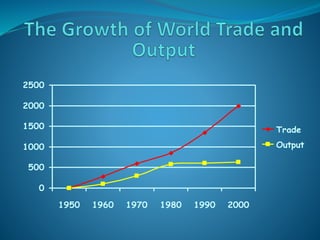
0
500
1000
1500
2000
2500
1950 1960 1970 1980 1990 2000
Trade
Output
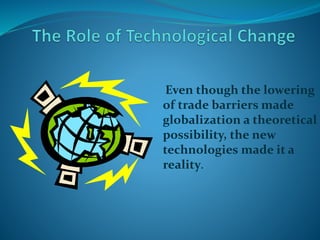
Even though the lowering
of trade barriers made
globalization a theoretical
possibility, the new
technologies made it a
reality.
The Role of Technological Change
Invention and innovations in
 Microprocessors and
telecommunications
 Container transportation
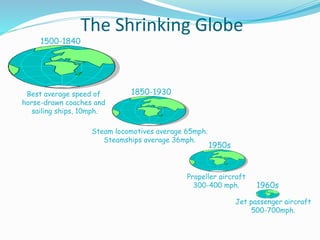
1500-1840
1850-1930
1950s
1960s
Best average speed of
horse-drawn coaches and
sailing ships, 10mph.
Steam locomotives average 65mph.
Steamships average 36mph.
Propeller aircraft
300-400 mph.
Jet passenger aircraft
500-700mph.
The Shrinking Globe
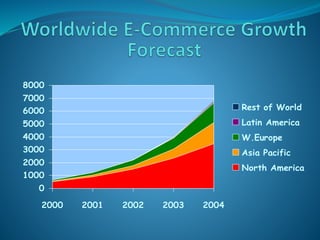
0
1000
2000
3000
4000
5000
6000
7000
8000
2000 2001 2002 2003 2004
Rest of World
Latin America
W.Europe
Asia Pacific
North America
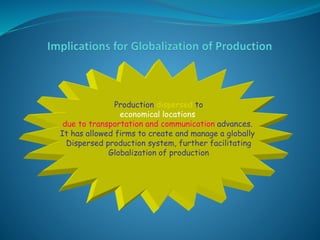
Production dispersed to
economical locations
due to transportation and communication advances.
It has allowed firms to create and manage a globally
Dispersed production system, further facilitating
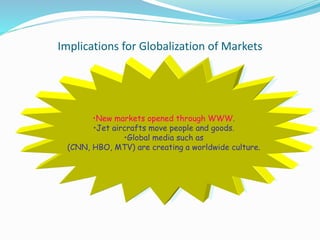
Globalization of production
Implications for Globalization of Markets
•New markets opened through WWW.
•Jet aircrafts move people and goods.
•Global media such as
(CNN, HBO, MTV) are creating a worldwide culture.
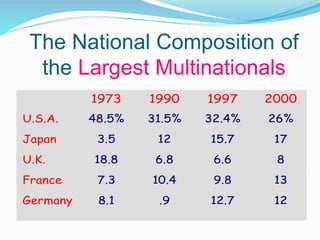
The National Composition of
the Largest Multinationals
1973 1990 1997 2000
U.S.A. 48.5% 31.5% 32.4% 26%
Japan 3.5 12 15.7 17
U.K. 18.8 6.8 6.6 8
France 7.3 10.4 9.8 13
Germany 8.1 .9 12.7 12
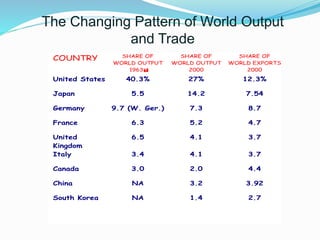
The Changing Pattern of World Output
and Trade
COUNTRY SHARE OF
WORLD OUTPUT
1963
SHARE OF
WORLD OUTPUT
2000
SHARE OF
WORLD EXPORTS
2000
United States 40.3% 27% 12.3%
Japan 5.5 14.2 7.54
Germany 9.7 (W. Ger.) 7.3 8.7
France 6.3 5.2 4.7
United
Kingdom
6.5 4.1 3.7
Italy 3.4 4.1 3.7
Canada 3.0 2.0 4.4
China NA 3.2 3.92
South Korea NA 1.4 2.7
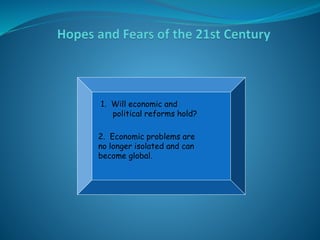
1. Will economic and
political reforms hold?
2. Economic problems are
no longer isolated and can
become global.
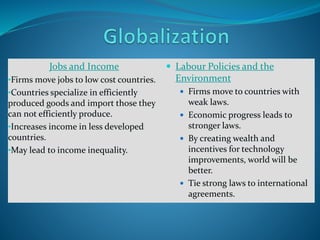
Jobs and Income
•Firms move jobs to low cost countries.
•Countries specialize in efficiently
produced goods and import those they
can not efficiently produce.
•Increases income in less developed
countries.
•May lead to income inequality.
 Labour Policies and the
Environment
 Firms move to countries with
weak laws.
 Economic progress leads to
stronger laws.
 By creating wealth and
incentives for technology
improvements, world will be
better.
 Tie strong laws to international
agreements.
Globalization and the World’s Poor
 Other factors may have influenced the gap.
 Totalitarian governments.
 Economic policies that destroyed wealth creation.
 Little protection of property rights.
 Expanding populations.
 War.
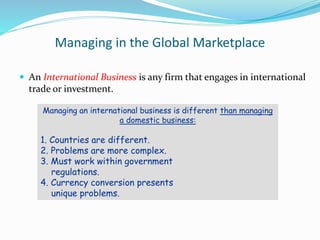
Managing in the Global Marketplace
 An International Business is any firm that engages in international
trade or investment.
Managing an international business is different than managing
a domestic business:
1. Countries are different.
2. Problems are more complex.
3. Must work within government
regulations.
4. Currency conversion presents
unique problems.

Internation business, globalisation

  • 1.
    In general, globalizationmeans integrating our economy with the world’s economy. It is the process of interchange of world views, products, ideas and other aspects of culture. Globalization describes the interplay across cultures of macro-social forces. These forces include religion, politics, and economics. Globalization can erode and universalize the characteristics of a local group. Advances in transportation and telecommunications infrastructure, including the rise of the Internet, are major factors in globalization, generating further interdependence of economic and cultural activities.
  • 2.
    Top 25 Retailers MarketShare % 2000 2009 16 40 What Drives Globalization Decline in cross-border investment barriers. Saturation and slow growth in local markets. Retailers believed they would benefit from economies of scale from global buying power. What characterizes these retailers is that they all held strong domestic market positions. Globalization in Retailing
  • 3.
    Globalization Strategies Carrefour, WalMart,Ahold, and Tesco have led the globalization of retail stores with different strategies: Ahold: “going global with a local face” WalMart: “Global retail brand” Top 25 Retailers Market Share % 2000 2009 16 40
  • 4.
    Problems for Globalization National differences in  tastes and preferences  Distribution channels  Culturally embedded value systems  Difficulty in establishing common retail model such as:  Ahold: “going global with a local face”  WalMart: “Global retail brand”
  • 5.
    Globalization in Retailing •Tradeand investment barriers are disappearing. •Perceived distances are shrinking due to advances in transportation and telecommunications. •Material culture is beginning to look similar. •National economies merging into an interdependent global economic system.
  • 6.
    Pros & Consof Globalization PROS CONS •Increased revenue opportunity through global sales. •Reduced cost by producing in ‘low cost’ countries. *Different nations=different problems. •Similarities between nations may be superficial. •Global planning may be easy, but global execution is not
  • 7.
    What is “Globalization”? “Theshift toward a more integrated and interdependent world economy.” Markets Production
  • 8.
    Globalization of Markets Globalization means “Merging of historically distinct and separate national markets into one huge global marketplace.”  Globalization is  Facilitated by offering standardized products:  Citicorp  Coca-Cola  Sony PlayStation  McDonalds  Does not have to be a big company to participate:  Over 200,00 U.S. companies with less than 100 employees had foreign sales in 2000.
  • 9.
    Where will globalization mostlikely prosper better? In consumer goods Or In industrial goods and materials
  • 10.
    Not Consumer Goods Industrial Goods and Materials Commoditiessuch as aluminum, oil and wheat. Industrial products such as microprocessors, aircraft. Financial assets such as U.S. Treasury bills and Eurobonds. The Largest Global Markets
  • 11.
    Globalization of Production Whydoes globalization of production take place?
  • 12.
    “The sourcing ofgoods and services from locations around the globe to take advantage of national differences in the cost and quality of factors of production (labor, energy, land and capital).” This also increases the company’s chance to obtain those countries market for their products as well.
  • 13.
    Why Globalization ofProduction?  “The sourcing of goods and services from locations around the globe to take advantage of national differences in the cost and quality of factors of production (labor,energy, land and capital).”  Companies hope to lower their overall cost structure and/or improve the quality or functionality of their product offering - increasing their competitiveness. “Global Products”
  • 14.
  • 15.
    International Trade: Whena firm exports goods or services to consumers in another country. Foreign Direct Investment: When a firm invests resources in business activities outside its home country.
  • 16.
    General Agreement onTariffs and Trade Member states (140) in eight negotiating ‘rounds’ worked to lower barriers to the free flow of goods and services. In the most recent round, the Uruguay Round, nations agreed to enhanced patent, copyright and trademark protections and established the World Trade Organization.
  • 17.
    1913 1950 19902000 France 21% 18% 5.9% 3.9% Germany 20 26 5.9 3.9 Italy 18 25 5.9 3.9 Japan 30 5.3 3.9 Holland 5 11 5.9 3.9 Sweden 20 9 4.4 3.9 Britain 23 5.9 3.9 U.S.A. 44 14 4.8 3.9
  • 18.
    Fewer FDI Restrictions *Between 1991 and 2000 of the 1,121 changes worldwide in laws governing FDI, 95% created a more favourable investment environment. * During 2000, 69 countries made 150 changes to FDI regulations, 147 or 98% were more favorable to investment.
  • 19.
    0 500 1000 1500 2000 2500 1950 1960 19701980 1990 2000 Trade Output
  • 20.
    Even though thelowering of trade barriers made globalization a theoretical possibility, the new technologies made it a reality.
  • 21.
    The Role ofTechnological Change Invention and innovations in  Microprocessors and telecommunications  Container transportation
  • 22.
    1500-1840 1850-1930 1950s 1960s Best average speedof horse-drawn coaches and sailing ships, 10mph. Steam locomotives average 65mph. Steamships average 36mph. Propeller aircraft 300-400 mph. Jet passenger aircraft 500-700mph. The Shrinking Globe
  • 23.
    0 1000 2000 3000 4000 5000 6000 7000 8000 2000 2001 20022003 2004 Rest of World Latin America W.Europe Asia Pacific North America
  • 24.
    Production dispersed to economicallocations due to transportation and communication advances. It has allowed firms to create and manage a globally Dispersed production system, further facilitating Globalization of production
  • 25.
    Implications for Globalizationof Markets •New markets opened through WWW. •Jet aircrafts move people and goods. •Global media such as (CNN, HBO, MTV) are creating a worldwide culture.
  • 26.
    The National Compositionof the Largest Multinationals 1973 1990 1997 2000 U.S.A. 48.5% 31.5% 32.4% 26% Japan 3.5 12 15.7 17 U.K. 18.8 6.8 6.6 8 France 7.3 10.4 9.8 13 Germany 8.1 .9 12.7 12
  • 27.
    The Changing Patternof World Output and Trade COUNTRY SHARE OF WORLD OUTPUT 1963 SHARE OF WORLD OUTPUT 2000 SHARE OF WORLD EXPORTS 2000 United States 40.3% 27% 12.3% Japan 5.5 14.2 7.54 Germany 9.7 (W. Ger.) 7.3 8.7 France 6.3 5.2 4.7 United Kingdom 6.5 4.1 3.7 Italy 3.4 4.1 3.7 Canada 3.0 2.0 4.4 China NA 3.2 3.92 South Korea NA 1.4 2.7
  • 28.
    1. Will economicand political reforms hold? 2. Economic problems are no longer isolated and can become global.
  • 29.
    Jobs and Income •Firmsmove jobs to low cost countries. •Countries specialize in efficiently produced goods and import those they can not efficiently produce. •Increases income in less developed countries. •May lead to income inequality.  Labour Policies and the Environment  Firms move to countries with weak laws.  Economic progress leads to stronger laws.  By creating wealth and incentives for technology improvements, world will be better.  Tie strong laws to international agreements.
  • 30.
    Globalization and theWorld’s Poor  Other factors may have influenced the gap.  Totalitarian governments.  Economic policies that destroyed wealth creation.  Little protection of property rights.  Expanding populations.  War.
  • 31.
    Managing in theGlobal Marketplace  An International Business is any firm that engages in international trade or investment. Managing an international business is different than managing a domestic business: 1. Countries are different. 2. Problems are more complex. 3. Must work within government regulations. 4. Currency conversion presents unique problems.