Seminar On
Presented By:
Abdul Abid – Roll No.1
Ajeesh Moosakutty - Roll No.4
GLOBALISATION OF BUSSINESS
GLOBALISATION OF BUSINESS
• Globalization refers to the changes in the world where we are moving
away from self-contained countries and toward a more integrated
world.
• Globalization of business is the change in a business from a company
associated with a single country to one that operates in multiple
countries.
GLOBALISATION- DEFINITION(1)
The UK Department for International Development (DFID, 2000a) has
defined Globalization as:
“The growing interdependence and interconnectedness of the modem
world through increased flows of goods, services, capital, people and
information. The process is driven by technological advances and
reductions in the costs of international transactions, which spread
technology and ideas, raise the share of trade in world production and
increase the mobility of capital.”
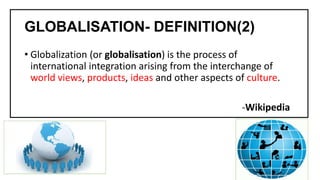
GLOBALISATION- DEFINITION(2)
• Globalization (or globalisation) is the process of
international integration arising from the interchange of
world views, products, ideas and other aspects of culture.
-Wikipedia
Causes of Globalisation:
1. Improved Communications
• The development of communication
technologies such as internet, email and mobile
phones have been vital to the growth of
globalisation because they help MNCs to operate
throughout the world.
• The development of satellite TV channels such as
Sky and CNN have also provided worldwide
marketing avenues for the concept and products
of globalisation.
Causes of Globalisation
2. Improved Transport
• The development of refrigerated and container
transport, bulk shipping and improved air transport
has allowed the easy mass movement of goods
throughout the world. This assists globalisation.
Causes of Globalisation:
3. Free Trade Agreements
• MNCs and rich capitalist countries have always
promoted global free trade as a way of increasing
their own wealth and influence.
• International organisations such as the World Trade
Organisation and the IMF also promote free trade.
Causes of Globalisation:
4. Global Banking
• Modern communication technologies allow vast
amounts of capital to flow freely and instantly
throughout the world.
• The equivalent of up to $US1.3 trillion is traded each
day through international stock exchanges in cities
such as New York, London and Tokyo.
Causes of Globalisation:
5. The Growth of MNCs
• The rapid growth of big MNCs such as Microsoft, McDonalds
and Nike is a cause as well as a consequence of globalisation.
• The investment of MNCs in farms, mines and factories across
the world is a major part of globalisation.
• Globalisation allows MNCs to produce goods and services and
to sell products on a massive scale throughout the world.
BENEFITS OF GLOBALISATION
• I. Benefits to the Company .
• 1. Better utilization of resources : There is a good opportunity
to utilize excess or unused production capacity, professional as
well as technical skill. Thus, a company gets benefits of large
scale production, reduction in cost and improvement in
efficiency of the workers.
• 2. Spreading of risk of loss : A risk of loss between domestic and
global market can be spread by the company. From the profits
made by global business, the loss in domestic market can be
easily compensated.
• 3. Achievement of objective of Profit : A company can attain
its profit objective. It should be remembered that global
business/market provides the maximum profit.
• 4. Incentives from the Government : The Government
provides incentives to the companies to enter the global
market. The Government provides number of incentives such
as reduction in taxes, duties, pre-shipment, post-shipment
finance, duty withdrawal, concessions in custom duties etc.
• 5. Intangible/Non-economic benefits :
(i) Improvement in the quality of goods : Globalisation helps to improve the
quality of goods produce and uphold international standards.
(ii) Improvement in the efficiency and productivity : Globalisation enables a
company to improve efficiency and the level of productivity.
(iii) Development activities : Globalisation helps to ensure technological
progress, improvement in skill, and large scale Research and Development
activities.
(iv) Increase in Competitive ability : Globalisation increases the competitive
ability of the company.
(v) Enhancement of Goodwill and Reputation : Globalisation enhances
goodwill and reputation of a company in the domestic market.
The Effects of Globalisation:
1. Division of Labour
• Because MNCs search for the cheapest locations to manufacture and
assemble components, production processes may be moved from
developed to developing countries where costs are lower.
The Effects of Globalisation:
2. Less Job Security
• In the global economy jobs are becoming more temporary and
insecure.
• A survey of American workers showed that people now hold 7 to 10
jobs over their working life.
The Effects of Globalisation:
3. Damage to the Environment
• More trade means more transport
which uses more fossil fuels and
causes pollution.
• Climate change is a serious threat to
our future.
The Effects of Globalisation:
4. Cultural Impact
• Websites such as YouTube connect people across the planet. As the
world becomes more unified, diverse cultures are being ignored.
MNCs can create a monoculture as they remove local competition
and thereby force local firms to close.
Replacing
The Effects of Globalisation
5. Increase in anti-Globalisation Protests
• There is a growing awareness of the negative impacts of globalisation.
People have begun to realise that globalisation can be challenged by
communities supporting each other in business and society and
through public protest and political lobbying.
Globalisation

Globalisation

  • 1.
    Seminar On Presented By: AbdulAbid – Roll No.1 Ajeesh Moosakutty - Roll No.4 GLOBALISATION OF BUSSINESS
  • 2.
    GLOBALISATION OF BUSINESS •Globalization refers to the changes in the world where we are moving away from self-contained countries and toward a more integrated world. • Globalization of business is the change in a business from a company associated with a single country to one that operates in multiple countries.
  • 3.
    GLOBALISATION- DEFINITION(1) The UKDepartment for International Development (DFID, 2000a) has defined Globalization as: “The growing interdependence and interconnectedness of the modem world through increased flows of goods, services, capital, people and information. The process is driven by technological advances and reductions in the costs of international transactions, which spread technology and ideas, raise the share of trade in world production and increase the mobility of capital.”
  • 4.
    GLOBALISATION- DEFINITION(2) • Globalization(or globalisation) is the process of international integration arising from the interchange of world views, products, ideas and other aspects of culture. -Wikipedia
  • 5.
    Causes of Globalisation: 1.Improved Communications • The development of communication technologies such as internet, email and mobile phones have been vital to the growth of globalisation because they help MNCs to operate throughout the world. • The development of satellite TV channels such as Sky and CNN have also provided worldwide marketing avenues for the concept and products of globalisation.
  • 6.
    Causes of Globalisation 2.Improved Transport • The development of refrigerated and container transport, bulk shipping and improved air transport has allowed the easy mass movement of goods throughout the world. This assists globalisation.
  • 7.
    Causes of Globalisation: 3.Free Trade Agreements • MNCs and rich capitalist countries have always promoted global free trade as a way of increasing their own wealth and influence. • International organisations such as the World Trade Organisation and the IMF also promote free trade.
  • 8.
    Causes of Globalisation: 4.Global Banking • Modern communication technologies allow vast amounts of capital to flow freely and instantly throughout the world. • The equivalent of up to $US1.3 trillion is traded each day through international stock exchanges in cities such as New York, London and Tokyo.
  • 9.
    Causes of Globalisation: 5.The Growth of MNCs • The rapid growth of big MNCs such as Microsoft, McDonalds and Nike is a cause as well as a consequence of globalisation. • The investment of MNCs in farms, mines and factories across the world is a major part of globalisation. • Globalisation allows MNCs to produce goods and services and to sell products on a massive scale throughout the world.
  • 10.
    BENEFITS OF GLOBALISATION •I. Benefits to the Company . • 1. Better utilization of resources : There is a good opportunity to utilize excess or unused production capacity, professional as well as technical skill. Thus, a company gets benefits of large scale production, reduction in cost and improvement in efficiency of the workers. • 2. Spreading of risk of loss : A risk of loss between domestic and global market can be spread by the company. From the profits made by global business, the loss in domestic market can be easily compensated.
  • 11.
    • 3. Achievementof objective of Profit : A company can attain its profit objective. It should be remembered that global business/market provides the maximum profit. • 4. Incentives from the Government : The Government provides incentives to the companies to enter the global market. The Government provides number of incentives such as reduction in taxes, duties, pre-shipment, post-shipment finance, duty withdrawal, concessions in custom duties etc.
  • 12.
    • 5. Intangible/Non-economicbenefits : (i) Improvement in the quality of goods : Globalisation helps to improve the quality of goods produce and uphold international standards. (ii) Improvement in the efficiency and productivity : Globalisation enables a company to improve efficiency and the level of productivity. (iii) Development activities : Globalisation helps to ensure technological progress, improvement in skill, and large scale Research and Development activities. (iv) Increase in Competitive ability : Globalisation increases the competitive ability of the company. (v) Enhancement of Goodwill and Reputation : Globalisation enhances goodwill and reputation of a company in the domestic market.
  • 13.
    The Effects ofGlobalisation: 1. Division of Labour • Because MNCs search for the cheapest locations to manufacture and assemble components, production processes may be moved from developed to developing countries where costs are lower.
  • 14.
    The Effects ofGlobalisation: 2. Less Job Security • In the global economy jobs are becoming more temporary and insecure. • A survey of American workers showed that people now hold 7 to 10 jobs over their working life.
  • 15.
    The Effects ofGlobalisation: 3. Damage to the Environment • More trade means more transport which uses more fossil fuels and causes pollution. • Climate change is a serious threat to our future.
  • 16.
    The Effects ofGlobalisation: 4. Cultural Impact • Websites such as YouTube connect people across the planet. As the world becomes more unified, diverse cultures are being ignored. MNCs can create a monoculture as they remove local competition and thereby force local firms to close. Replacing
  • 17.
    The Effects ofGlobalisation 5. Increase in anti-Globalisation Protests • There is a growing awareness of the negative impacts of globalisation. People have begun to realise that globalisation can be challenged by communities supporting each other in business and society and through public protest and political lobbying.

Editor's Notes

  • #4 Source: International Handbook on Globalization, Education and Policy Research , Joseph Zajda
  • #5 Source: http://en.wikipedia.org/wiki/Globalization
  • #11 Source: International Business and New Trends
  • #12 Source: International Business and New Trends
  • #13 Source: International Business and New Trends
  • #14 Source: http://www.mgimo.ru/fileserver/2004/kafedry/mirec/konf_2-12-05/globaliz_countries-transition.pdf
  • #15 Source: http://www.mgimo.ru/fileserver/2004/kafedry/mirec/konf_2-12-05/globaliz_countries-transition.pdf
  • #16 Source: http://www.mgimo.ru/fileserver/2004/kafedry/mirec/konf_2-12-05/globaliz_countries-transition.pdf
  • #17 Source: http://www.mgimo.ru/fileserver/2004/kafedry/mirec/konf_2-12-05/globaliz_countries-transition.pdf
  • #18 Source: http://www.mgimo.ru/fileserver/2004/kafedry/mirec/konf_2-12-05/globaliz_countries-transition.pdf