The 1798 Rebellion

The United Irishmen: Revolution in
              Ireland
The United Irishmen
•   Inspired by the revolutions in France and
    America. Founded in 1791.
•   Wanted to unite “Protestant, Catholic and
    Dissenter” to create an Irish Republic free
    of Britain.
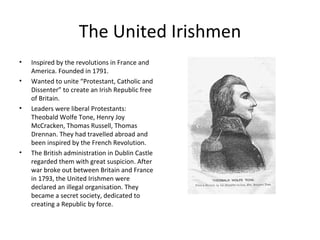
•   Leaders were liberal Protestants:
    Theobald Wolfe Tone, Henry Joy
    McCracken, Thomas Russell, Thomas
    Drennan. They had travelled abroad and
    been inspired by the French Revolution.
•   The British administration in Dublin Castle
    regarded them with great suspicion. After
    war broke out between Britain and France
    in 1793, the United Irishmen were
    declared an illegal organisation. They
    became a secret society, dedicated to
    creating a Republic by force.
The Rising in Leinster
•   Due to confusion, the Rising did not
    happen in Dublin as planned. Although
    Wolfe Tone had succeeded in getting help
    from France, bad weather prevented the
    ships from landing.
•   There was no coordination between the
    Dublin leadership and the provinces.
    Government forces easily beat the rebels
    in Kildare, Carlow, Wicklow and Meath.
•   In Wexford, people were infuriated by the
    execution without trial of 35 United
    Irishmen, and by the burning of the
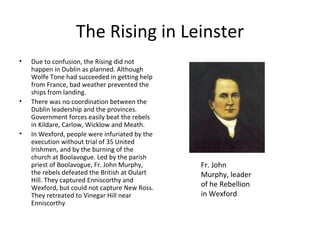
    church at Boolavogue. Led by the parish
    priest of Boolavogue, Fr. John Murphy,      Fr. John
    the rebels defeated the British at Oulart   Murphy, leader
    Hill. They captured Enniscorthy and
    Wexford, but could not capture New Ross.    of he Rebellion
    They retreated to Vinegar Hill near         in Wexford
    Enniscorthy
The Rising in Ulster
•   The Rising in Ulster was mainly a
    Presbyterian rising. The military
    commanders were Henry Joy McCracken
    and Henry Monro, a descendant of
    General Monro, who had been defeated
    by Eoghan Roe O’Neill at Benburb.
•   The British forces, aided by the Orange
    Order, which had been set up as an
    organisation to protect Protestant
    priviliges, defeated the Ulster rising at a
    battle at Ballynahinch, 12 km from Belfast.
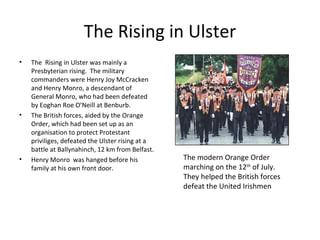
•   Henry Monro was hanged before his             The modern Orange Order
    family at his own front door.                 marching on the 12th of July.
                                                  They helped the British forces
                                                  defeat the United Irishmen
The end of the Rising
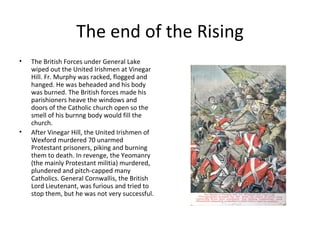
•   The British Forces under General Lake
    wiped out the United Irishmen at Vinegar
    Hill. Fr. Murphy was racked, flogged and
    hanged. He was beheaded and his body
    was burned. The British forces made his
    parishioners heave the windows and
    doors of the Catholic church open so the
    smell of his burnng body would fill the
    church.
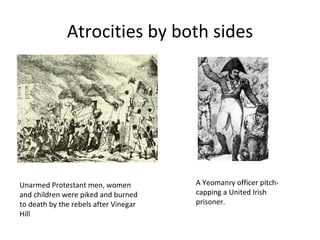
•   After Vinegar Hill, the United Irishmen of
    Wexford murdered 70 unarmed
    Protestant prisoners, piking and burning
    them to death. In revenge, the Yeomanry
    (the mainly Protestant militia) murdered,
    plundered and pitch-capped many
    Catholics. General Cornwallis, the British
    Lord Lieutenant, was furious and tried to
    stop them, but he was not very successful.
Atrocities by both sides


Unarmed Protestant men, women          A Yeomanry officer pitch-
and children were piked and burned     capping a United Irish
to death by the rebels after Vinegar   prisoner.
Hill
Results of the 1798 Rebellion
•   Wolfe Tone committed suicide in his jail cell,
    rather than be hanged by the British. Many
    other United Irish leaders were hanged or
    deported to Australia.
•   Although the United Irishmen had hoped to
    unite Protestant, Catholic and Dissenter,
    memories of the atrocities carried out during
    the Rising led to a great increase in sectarian
    bitterness. Frightened by Presbyterian
    participation in the Rising, the Orange Order
    began to pose as the champions of all
    Protestants, and to preach an increasing
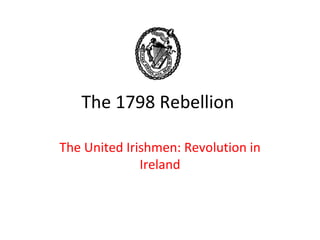
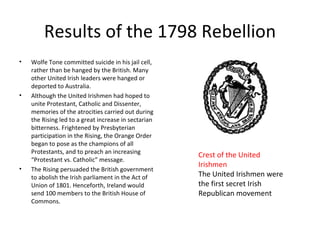
                                                      Crest of the United
    “Protestant vs. Catholic” message.
                                                      Irishmen
•   The Rising persuaded the British government
    to abolish the Irish parliament in the Act of     The United Irishmen were
    Union of 1801. Henceforth, Ireland would          the first secret Irish
    send 100 members to the British House of          Republican movement
    Commons.

The 1798 rebellion

  • 1.
    The 1798 Rebellion TheUnited Irishmen: Revolution in Ireland
  • 2.
    The United Irishmen • Inspired by the revolutions in France and America. Founded in 1791. • Wanted to unite “Protestant, Catholic and Dissenter” to create an Irish Republic free of Britain. • Leaders were liberal Protestants: Theobald Wolfe Tone, Henry Joy McCracken, Thomas Russell, Thomas Drennan. They had travelled abroad and been inspired by the French Revolution. • The British administration in Dublin Castle regarded them with great suspicion. After war broke out between Britain and France in 1793, the United Irishmen were declared an illegal organisation. They became a secret society, dedicated to creating a Republic by force.
  • 3.
    The Rising inLeinster • Due to confusion, the Rising did not happen in Dublin as planned. Although Wolfe Tone had succeeded in getting help from France, bad weather prevented the ships from landing. • There was no coordination between the Dublin leadership and the provinces. Government forces easily beat the rebels in Kildare, Carlow, Wicklow and Meath. • In Wexford, people were infuriated by the execution without trial of 35 United Irishmen, and by the burning of the church at Boolavogue. Led by the parish priest of Boolavogue, Fr. John Murphy, Fr. John the rebels defeated the British at Oulart Murphy, leader Hill. They captured Enniscorthy and Wexford, but could not capture New Ross. of he Rebellion They retreated to Vinegar Hill near in Wexford Enniscorthy
  • 4.
    The Rising inUlster • The Rising in Ulster was mainly a Presbyterian rising. The military commanders were Henry Joy McCracken and Henry Monro, a descendant of General Monro, who had been defeated by Eoghan Roe O’Neill at Benburb. • The British forces, aided by the Orange Order, which had been set up as an organisation to protect Protestant priviliges, defeated the Ulster rising at a battle at Ballynahinch, 12 km from Belfast. • Henry Monro was hanged before his The modern Orange Order family at his own front door. marching on the 12th of July. They helped the British forces defeat the United Irishmen
  • 5.
    The end ofthe Rising • The British Forces under General Lake wiped out the United Irishmen at Vinegar Hill. Fr. Murphy was racked, flogged and hanged. He was beheaded and his body was burned. The British forces made his parishioners heave the windows and doors of the Catholic church open so the smell of his burnng body would fill the church. • After Vinegar Hill, the United Irishmen of Wexford murdered 70 unarmed Protestant prisoners, piking and burning them to death. In revenge, the Yeomanry (the mainly Protestant militia) murdered, plundered and pitch-capped many Catholics. General Cornwallis, the British Lord Lieutenant, was furious and tried to stop them, but he was not very successful.
  • 6.
    Atrocities by bothsides Unarmed Protestant men, women A Yeomanry officer pitch- and children were piked and burned capping a United Irish to death by the rebels after Vinegar prisoner. Hill
  • 7.
    Results of the1798 Rebellion • Wolfe Tone committed suicide in his jail cell, rather than be hanged by the British. Many other United Irish leaders were hanged or deported to Australia. • Although the United Irishmen had hoped to unite Protestant, Catholic and Dissenter, memories of the atrocities carried out during the Rising led to a great increase in sectarian bitterness. Frightened by Presbyterian participation in the Rising, the Orange Order began to pose as the champions of all Protestants, and to preach an increasing Crest of the United “Protestant vs. Catholic” message. Irishmen • The Rising persuaded the British government to abolish the Irish parliament in the Act of The United Irishmen were Union of 1801. Henceforth, Ireland would the first secret Irish send 100 members to the British House of Republican movement Commons.