1
Unit 3
GLOBALIZATION
2
MEANING
It describes the way countries and people of
the world interact and integrate. Many things
have become globalized as people come into
contact. Economic globalizations how
countries are coming together as one big
global economy, making international trade
easier.
3
DEFINITIONS
• According to R.J Holton, “Globalization represents
the triumph of a capitalist world economy tied
together by a global division of labour.”
• According to Anthony Mc Grew, “Globalization is
a process which generates flows and connections,
not simply across nation-states and national
territorial boundaries but between global
regions, continents and civilizations.”
4
Characteristics of Globalization
• Intellectual- thinkers, entrepreneurs, policy makers, manufacturers
• Economic-Dominance of TNC, division of labour, Each country has their own advantage
• Technological- Tech driven, knowledge driven, AI
• Organizational- Decentralise, Scale, Flattened. streamlining
• Political- Privatisation and disinvestment
• Social- Lifestyle and disparity of income
• Borderless Globe & Liberalization –free flow of goods
and services
5
Why go ‘Global’?
1. Competition within your national market is
becoming too intense so you decide to push
sales in overseas markets.
2. Your products within your national markets
are reaching the end of the lifecycle so you
wish to push it into national markets.
3. Sales and profit are generally declining in
national markets.
4. You wish to become a global player.
5. To seek needed factor inputs at low cost.
6
The Five Stages of Going Global
Same as stages of Internationalization
7
Factors to be considered before entering
global markets
• Political factors
• Economical factors
• Social factors
• Technological factors
8
Drivers/ Forces of Globalization
1. To achieve higher rate of profits
2. Expanding the production capacity beyond the demand of
the domestic country
3. Severe competition in the home country
4. Limited home market
5. Political conditions
6. Availability of technology and managerial competence
7. Cost of manpower, transportation
8. Nearness to raw material
9. Liberalization, Privatization and Globalization (LPG)
10. To increase market share
11. Increase in cross border business is due to falling trade
barriers (WTO), decreasing costs in telecommunications
and transportation; and free capital markets
9
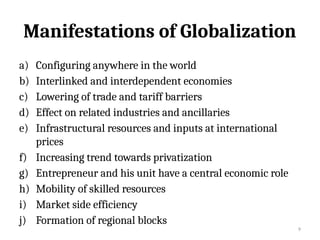
Manifestations of Globalization
a) Configuring anywhere in the world
b) Interlinked and interdependent economies
c) Lowering of trade and tariff barriers
d) Effect on related industries and ancillaries
e) Infrastructural resources and inputs at international
prices
f) Increasing trend towards privatization
g) Entrepreneur and his unit have a central economic role
h) Mobility of skilled resources
i) Market side efficiency
j) Formation of regional blocks
10
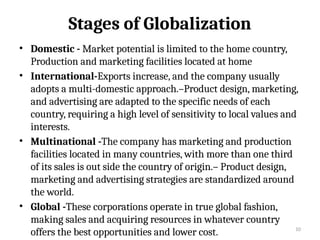
Stages of Globalization
• Domestic - Market potential is limited to the home country,
Production and marketing facilities located at home
• International-Exports increase, and the company usually
adopts a multi-domestic approach.–Product design, marketing,
and advertising are adapted to the specific needs of each
country, requiring a high level of sensitivity to local values and
interests.
• Multinational -The company has marketing and production
facilities located in many countries, with more than one third
of its sales is out side the country of origin.– Product design,
marketing and advertising strategies are standardized around
the world.
• Global -These corporations operate in true global fashion,
making sales and acquiring resources in whatever country
offers the best opportunities and lower cost.
11
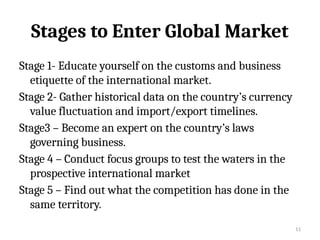
Stages to Enter Global Market
Stage 1- Educate yourself on the customs and business
etiquette of the international market.
Stage 2- Gather historical data on the country’s currency
value fluctuation and import/export timelines.
Stage3 – Become an expert on the country’s laws
governing business.
Stage 4 – Conduct focus groups to test the waters in the
prospective international market
Stage 5 – Find out what the competition has done in the
same territory.
12
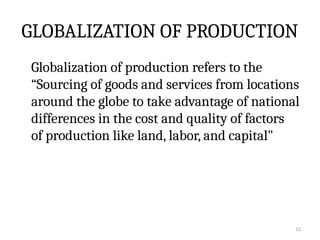
GLOBALIZATION OF PRODUCTION
Globalization of production refers to the
“Sourcing of goods and services from locations
around the globe to take advantage of national
differences in the cost and quality of factors
of production like land, labor, and capital"
13
REASONS FOR GLOBALIZATION OF
PRODUCTION
• Imposition of restrictions on imports by the
foreign countries forces the MNC’s to establish
manufacturing facilities in other countries
• Availability of high quality raw materials
• Availability of inputs at low cost in foreign
countries
• To reduce the cost of transportation and easy
logistic management.
14
ADVANTAGES OF GLOBAL PRODUCTION
1. Advantage of free trade
2. Advantage of free movement of labour
3. Increased economies of scale
4. Greater competition
5. Increased production capacity through
increased investment
15
Global Investment
The global investment process is similar to the
domestic but with the added layers of
complexity of language, custom, information,
currency, accounting, disclosure, trade, liquidity,
settlement, tax, political and legal issues.
Technology, the need for capital, harmonized
accounting and legal standards, treaties and
general cultural awareness continue to erode
these layers of complexity.
16
Stage in Global Investment Process
1. Equity Research- Equity Research primarily means analyzing
company's financials, perform ratio analysis, forecast the financial in
excel (financial modeling) and explore scenarios with an objective of
making BUY/SELL stock investment recommendation.
2. Portfolio Construction- Portfolio construction means determining the
actual composition of portfolio. It is critical stage because asset mix is
the single most determinant of portfolio performance. Portfolio
construction requires knowledge of the different aspects of securities.
3. Equity trading- Execution is the manifestation of the abstract steps of
research and portfolio construction. This is where theory meets
reality the market. A smooth and efficient transition from the
portfolio construction phase through the execution phase is essential.
17
4. Post trade- Post-trade processing occurs after a trade is
complete. At this point, the buyer and the seller
compare trade details, approve the transaction, change
records of ownership, and arrange for the transfer of
securities and cash.
5. Process improvement- This includes the ongoing tasks
of general investment management , compliance ,
accounting and client and regulatory reporting. Specific
tasks that must be
 Portfolio analysis
 Risk management
 Portfolio rebalancing, management, accounting and reporting
 Performance attribution and measurement
 Trade performance measurement
18
Globalization of technology
• Technological globalization is speeded in large
part by technological diffusion, the spread
of technology across borders.
• While the diffusion of information
technologies has the potential to resolve many
global social problems, it is often the
population most in need that is most affected
by the digital divide.
19
Technology transfer:
Technology transfer is the process of sharing of skills,
knowledge, technologies, methods of manufacturing, samples
of manufacturing and facilities among governments and other
institutions to ensure that scientific and technological
developments are accessible to a wider range of users who can
then further develop and exploit the technology into new
products, processes, applications, materials or services. It is
closely related to (and may arguably be considered a subset of)
knowledge transfer.
Technology Transfer Agreement:
Technology Transfer Arrangement refers to contracts
or agreements, including renewals thereof, involving
the transfer of systematic knowledge for the manufacture of a
product, the application of a process, or rendering of a service
including management contracts; and the transfer,
assignment or licensing of all forms
20
Advantages of globalization
Increase in employment opportunities: As globalization increases, more
and more companies are setting up businesses in other countries. This in
turn increases the employment opportunities that people atone place
have. People can get better jobs without having to move to other countries
in search of better jobs. Today, many multinational companies such as
Microsoft, Google and Toyota etc. have their offices in India and many
Indians work for these companies in India. Without globalization, Indian
people would not have had the opportunity to work for such companies
in India.
Education: With the increase in globalization, it has become easier for
people to move across borders to different parts of the world to acquire
better education. This has resulted in an integration of cultures. People
from underdeveloped and developing countries often move to developed
countries to get better education. More and more Indian students are
traveling to countries like the UK or the USA to pursue higher education.
This has also opened their cultures towards the Indian culture to some
extent.
21
Faster flow of Information: Information flows from one part of the world to the
other immediately, resulting in the world being tied together. Vital information
can be shared between individuals and corporations at a very fast rate. It has also
facilitated in increasing the ease of transporting people and goods.
Increase in quality of goods and services: As a result of globalization, people have
access to the best quality of goods and services throughout the world. Companies
have to strive to provide better quality goods and services to the consumer and the
consumer has the liberty of choosing whichever product he thinks is best suited
for his needs. This allows a person in America to wear clothes made in India and
Mexico while watching a football match taking place in England on a TV made in
China.
Decrease in prices of goods and services: As the competition in the market has
increased due to rapid globalization, producers have to price their products
competitively in order to remain in the market. This has become a boon for the
consumer as he can get better quality products at cheaper prices. An example is
that of the car Ambassador in India. It was the only car available in India along
with the Fiat before the liberalization of the Indian Economy. These cars were
inefficient and expensive. Once the Indian economy was opened, other car
companies started selling their cars in India at cheaper prices. This was a major
benefit for the Indian consumer.
22
Reduction in cultural barriers: As people move from one country to
another, barriers between various cultures tend to decrease. This has
resulted in tolerance and openness towards other cultures. This has
also facilitated communication between different cultures and hence,
nations. It has also led to a reduction in wars as we are today living in
one of the most peaceful periods in the history of mankind.
Increase in free trade: An increase in free trade has opened doors for
investors in developed countries to invest their money in developing
countries. Big companies from developed countries have the freedom
to operate in developing countries. In the 2000s, Japanese and
European companies such as Kawasaki and Siemens started producing
high-speed trains in China. This helped Chinese firms in gaining
knowledge about the production process and now Chinese companies
such as China South Locomotive & Rolling Stock Corp. are producing
high-speed trains on their own.
23
Disadvantages
Environmental degradation: Developed countries can take advantage of
underdeveloped countries’ weak regulatory laws in terms of environmental
protection.
Unfair working conditions: Many multinationals have been accused of social
injustice by exploiting labor in underdeveloped countries in order to cut costs.
Labor are provided unhealthy working conditions leading to health hazards.
Many large companies have also been accused of using child labor in their
factories in underdeveloped countries. Nike’s much publicized use of child labor
along with poor working conditions and low wages in its factories in Indonesia
is a well-documented example.
Fall in employment growth rate: Though the promotion of the idea that the
advances in technology and increase in productivity would create more jobs has
been a cornerstone of globalization, it has been seen that in the past few years,
such advances have led to a decrease in the employment growth rate in some
developing economies. This can also be attributed to the fact that companies
move their production facilities from one place to another in search of cheaper
labor once the workers in the previous country start demanding better wages.
24
Growing disparity among the rich and the poor: 86% of the world’s
resources are said to be consumed by the richest 20% of the world
population. This means that the poorer 80% only gets to consume 14% of
the world’s resources. This is a direct result of globalization according to
some activists who believe that globalization only serves the rich whereas
the poor have to face its disadvantages.
Small scale industries face extinction: Small scale industries which are
indigenous to a particular place face extinction as they do not have the
resources or the power that the multinational companies have. As a result,
these small industries are unable to compete with bigger companies and
go out of business. An example is the bamboo furniture making industry
in India. The manufacturers work out of their homes and work hard to
make furniture out of bamboo. These workers cannot compete with large
companies selling cheap plastic furniture and as a result, their industry
faces extinction.
Rapid spread of deadly diseases: Deadly diseases such as AIDS or other
communicable diseases can spread at very fast pace via travelers or due to
other means as a direct consequence of globalization.
25
Routes of Globalization
• International trade
1. Export
2. Import
• Foreign Direct Investment
1. International company
2. Multinational company
3. Global company
4. Transnational company
26
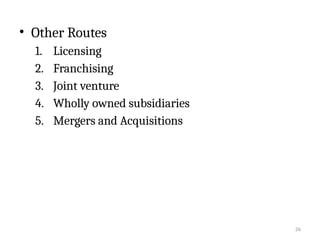
• Other Routes
1. Licensing
2. Franchising
3. Joint venture
4. Wholly owned subsidiaries
5. Mergers and Acquisitions
27
Impact of Globalization on Indian
Economy
• Economic impact of globalization in India
• Technological and cultural impact of
globalization in India
• Impact of globalization on agriculture in India
28
India’s problem with globalization
1. Some section of people in India, basically poor and very poor,
tribal groups, they did not feel the heat of globalization at all.
They remain poor & poorest as they were.
2. Increased gap between rich and poor fuels potential terrorist
reaction.
3. Ethical responsibility of business has been diminished.
4. Youth group of India leaving their studies very early and
joining Call centers to earn easy money thereby losing their
social life after getting habituated with monotonous work.
5. High growth but problem of unemployment.
6. Multi party rule, hence political ideology intervenes
globalization (reservation, labor law reforms).
7. Price hike of every daily usable commodities.
29
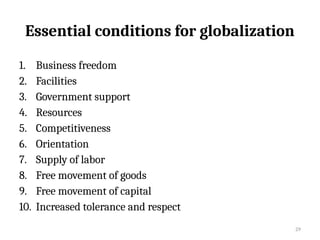
Essential conditions for globalization
1. Business freedom
2. Facilities
3. Government support
4. Resources
5. Competitiveness
6. Orientation
7. Supply of labor
8. Free movement of goods
9. Free movement of capital
10. Increased tolerance and respect
30
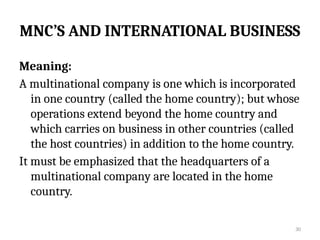
MNC’S AND INTERNATIONAL BUSINESS
Meaning:
A multinational company is one which is incorporated
in one country (called the home country); but whose
operations extend beyond the home country and
which carries on business in other countries (called
the host countries) in addition to the home country.
It must be emphasized that the headquarters of a
multinational company are located in the home
country.
31
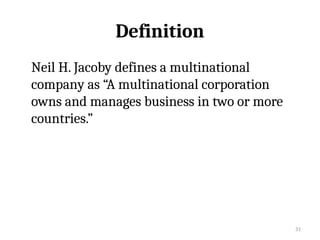
Definition
Neil H. Jacoby defines a multinational
company as “A multinational corporation
owns and manages business in two or more
countries.”
32
Objectives of MNC’s
1. To expand the business beyond the boundaries of the
home country
2. To minimize cost of production, especially labor cost
3. To capture lucrative foreign market against
international competitors
4. To avail of competitive advantage internationally
5. To achieve greater efficiency by producing in local
market and then exporting the products
6. To make best use of technological advantage by setting
up production facilities abroad
7. To establish an international corporate image.
33
Features/Characteristics of MNC’s
1. World wide operations
2. Large scale operations
3. Optimum utilization of resources
4. Advanced technology
5. Objective
6. Enhanced efficiency
7. Monopolistic or Oligopolistic market
8. Ownership and control
9. Timing flexibility
10. Value addition through tax reduction
34
Difference between domestic and foreign
companies
• The most important differences Between domestic and international
business are classified as under:
• Domestic Business is defined as the business whose economic transaction is
conducted within the geographical limits of the country. International
Business refers to a business which is not restricted to a single country, i.e. a
business which is engaged in the economic transaction with several
countries in the world.
• The area of operation of the domestic business is limited, which is the home
country. On the other hand, the area of operation of an international
business is vast, i.e. it serves many countries at the same time.
• The quality standards of products and services provided by a domestic
business is relatively low. Conversely, the quality standards of international
business are very high which are set according to global standards.
• Domestic business deals in the currency of the country in which it operates.
On the contrary, the international business deals in the multiple currencies.
35
• Domestic Business has few restrictions, as it is subject to rules,
law taxation of a single country. As against this, international
business is subject to rules, law taxation, tariff and quotas of
many countries and therefore, it has to face many restrictions
which are barriers in the international business.
• The nature of customers of a domestic business is more or less
same. Unlike, international business wherein the nature of
customers of every country it serves is different.
• Business Research can be conducted easily, in domestic
business. As against this, in the case of international research,
it is difficult to conduct business research as it is expensive and
research reliability varies from country to country.
• In domestic business, factors of production are mobile
whereas, in international business, the mobility of factors of
production are restricted.
• Domestic Business requires comparatively less capital
investment as compared to international business.
36
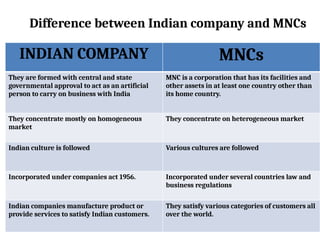
Difference between Indian company and MNCs
INDIAN COMPANY MNCs
They are formed with central and state
governmental approval to act as an artificial
person to carry on business with India
MNC is a corporation that has its facilities and
other assets in at least one country other than
its home country.
They concentrate mostly on homogeneous
market
They concentrate on heterogeneous market
Indian culture is followed Various cultures are followed
Incorporated under companies act 1956. Incorporated under several countries law and
business regulations
Indian companies manufacture product or
provide services to satisfy Indian customers.
They satisfy various categories of customers all
over the world.
37
Different way of multinational
companies
1. Ethnocentric MNC
2. Regio centric MNC
3. Continental MNC
4. Polycentric MNC
5. Transnational MNC
6. Global MNC
38
Reasons for the growth of MNCs
1. Innovations
2. Market facilities
3. Technological superiority
4. Financial superiority
5. Availability of capital
6. Avoiding tariffs and quotas
7. Symbiotic relationships
39
Organizational structure
The typically hierarchical arrangement of
lines of authority, communications, rights and
duties of an organization. Organizational
structure determines how the roles, power
and responsibilities are assigned, controlled,
and coordinated, and how
information flows between the different levels
of management.
40
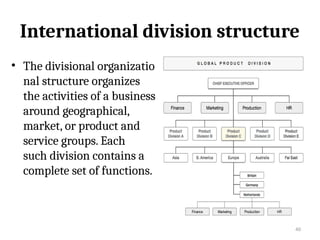
International division structure
• The divisional organizatio
nal structure organizes
the activities of a business
around geographical,
market, or product and
service groups. Each
such division contains a
complete set of functions.
41
Advantages of International division
structure
Accountability
The divisional organizational structure allows each division of a firm to be accounted
for in isolation. It can easily be seen which department is successful in making profits
while which are bearing losses. Loss bearing divisions can be shut down completely
while more investments can be made in profit earning divisions. This analysis is not
possible when a firm is working in any other structures such as functional structures.
Team working
The divisional organizational structure allows people in a single division to interact with
each other. When all of them are working towards a single goal, the success of their
division, the motivation is higher than ever. The communication is much efficient, and
everyone knows what the other person needs from them. For example, a finance
department would know how much money is needed for a division’s research and
development.
Responsiveness to external changes
When in a divisional organizational structure, a division focuses just on its own product,
service or region. This helps them focus better on external factors that can affect their
operations. Divisions become quicker in responding to external changes such as weather
change, natural disasters, financial crisis, trade union matters and so on.
42
Organizational culture
Organizational culture is the values and the practices that persist
in an organization. The divisional structure allows this type of
culture to persist in a division. The organizational culture can
help people interact better with each other. It also helps create
bonds between them. A better understanding of each other helps
in achieving the pre-set goals and targets, no matter how
difficult they are.
Leadership
In the divisional structure, each division has its own leader. The
leader sets goals along with his/her employees and works
alongside them to achieve those goals. The direct control from
the top leadership of the firm is no longer a necessity. The upper
leadership can indulge in strategic decisions. Divisional leaders
also become experts in their areas of work and work very
efficiently.
43
Disadvantages of International division
structure
Small organizations
Divisional structure is not a possibility in small organizations. The organization
may produce a variety of goods and services, and they might be operating in several
regions, but they still do not have the resources to run so many different divisions
and have the employees of same level in each division. This also causes duplication
of work. All of this would increase the organization’s costs, and if the organization is
small, it will not be able to bear the high costs and may go out of business.
Competition: healthy or not?
Competition is good until it becomes cruel. Healthy competition among divisions is
good and bears good fruit for the entire organization, but when the competition
becomes so severe that division heads start holding grudges against each other, it
can be extremely harmful for the organization as a whole. Divisions would want
other divisions to perform badly, instead of performing better themselves, in order
to get past them and get the reward. The employees think themselves as a part of a
certain division, but they forget that they are still a part of a much bigger
organization.
44
Lack of communication amongst divisions
When divisions would not communicate amongst each other, they would not
know each other’s objectives and goals. This lack of knowledge might hamper the
organization in the form of extra taxes, fines, lack of finance available because a
division might have spent extra on CSR (corporate social responsibility) and so on.
Economies of scale
Economies of scale are the cost savings when an organization produces goods or
services in a large quantity. Divisional structure prevents organizations from
getting the most out of economies of scale. As a single division does not produce
enough to take great benefits out of the economies of scale.
Related products
Organizations producing products that are relation with each other might find it
difficult to integrate divisions producing those complementary (related) products.
For example, a smart phone manufacturer that also manufactures accessories for
smart phones might find it difficult for their mobile phones and accessories
divisions to stay on the same ground and integrate on their future prospects. As a
result, organizations may bear heavy losses if the products in relation to each
other are not effectively syncing.
45
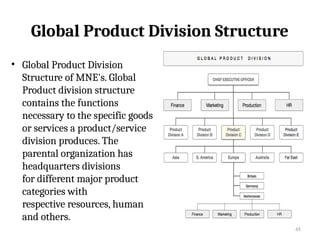
Global Product Division Structure
• Global Product Division
Structure of MNE's. Global
Product division structure
contains the functions
necessary to the specific goods
or services a product/service
division produces. The
parental organization has
headquarters divisions
for different major product
categories with
respective resources, human
and others.
46
Advantages
• Helps to manage diversity
• Marketing, production and finance can be
co-ordinated on a product by product global basis.
• Focus by product allows the company to gain benefits
from economies of scale
• Global product divisions operate as profit centers
• Helps to manage product, technology, customer
diversity
• Ability to cater to local needs.
47
Disadvantages
• Knowledge transfer between product divisions is difficult
because there is little coordination between products of the
same company.
• Duplication of facilities and staff personnel
• Managers spend to much time trying to tap local instead of
international markets
• Division manager may pursue currently attractive
geographic prospects and neglect others with long-term
potential.
• Division managers my spend too much time tapping local
rather than international markets.
48
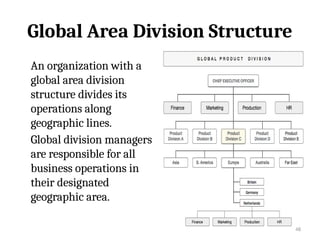
Global Area Division Structure
An organization with a
global area division
structure divides its
operations along
geographic lines.
Global division managers
are responsible for all
business operations in
their designated
geographic area.
49
Advantages and Disadvantages
Advantages
• Reduce cost per unit by
manufacturing in a region, the
firm is able to reduce cost per
unit and price competitively.
• Caters to local market
• Makes rapid decisions to
accommodate environmental
changes
• Focus by region allows the
company to tailor strategies to
the unique requirements of
each region.
Disadvantages
• Knowledge and best practices
are not easily spread from
region to region
• Difficulty in reconciling a
product emphasis with
geographic orientation
• Ignores new research and
development by division
groups
• New R&D efforts often
ignored because divisions are
selling in mature market.
50
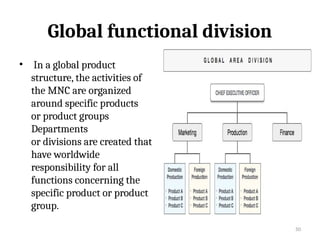
Global functional division
• In a global product
structure, the activities of
the MNC are organized
around specific products
or product groups
Departments
or divisions are created that
have worldwide
responsibility for all
functions concerning the
specific product or product
group.
51
Advantages and Disadvantages
Advantages
• Emphasizes functional
expertise, centralized
control and relatively lean
managerial staff
• Helps maximize economies
of scale
• Highly efficient
• Gains from being globally
integrated as well as locally
responsive
Disadvantages
• Confusion
• Difficulty in managing
• Co-ordination of
manufacturing
• Managing multiple product
lines can be very
challenging because of the
separation of production
and marketing into
different departments
52
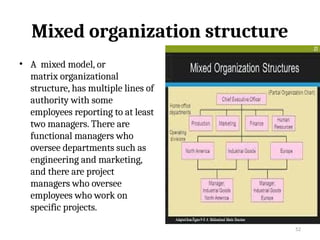
Mixed organization structure
• A mixed model, or
matrix organizational
structure, has multiple lines of
authority with some
employees reporting to at least
two managers. There are
functional managers who
oversee departments such as
engineering and marketing,
and there are project
managers who oversee
employees who work on
specific projects.
53
Advantages and Disadvantages
Advantages
• Allows organization to
create the specific type
of design to meet its
needs.
Disadvantages
• Complexity increases
• Difficulty arises in co
coordinating personnel
54
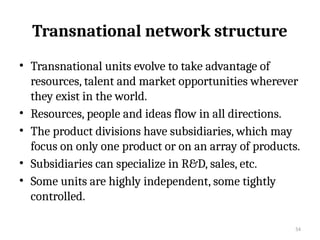
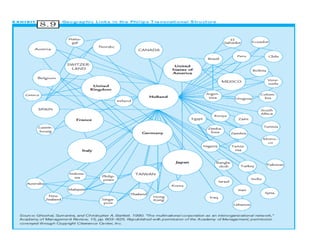
Transnational network structure
• Transnational units evolve to take advantage of
resources, talent and market opportunities wherever
they exist in the world.
• Resources, people and ideas flow in all directions.
• The product divisions have subsidiaries, which may
focus on only one product or on an array of products.
• Subsidiaries can specialize in R&D, sales, etc.
• Some units are highly independent, some tightly
controlled.
55
56
ROLE OF MNCS IN DEVELOPING COUNTRIES/ ROLE OF
MNCS IN THE DEVELOPMENT OF INDIANBUSINESS
MNCs have contributed significantly to the development of world economy at large. They have also
served as an engine of growth in many host countries. Their importance in a developing
country may be traced as follows:
1. MNCs help a developing host country by increasing investment, income and employment in its
economy.
2. They contribute to the rapid process of development of the country through transfer of
technology, finance and Tnodern management.
3. MNCs promote professionalization management in the companies of the host countries.
4. MNCs help in promoting exports of the host country.
5. MNCs by producing certain required goods in the host country help in reducing its dependence
on imports.
6. MNCs due to their wide network of productive activity equalize the cost of production in the
global market.
7. Entry of MNCs in the host country makes its market more competitive and break the domestic
monopolies.
8. MNCs accelerate the growth process in the host country through rapid industrialization and
allied activities.
57
9. The growth of MNCs creates a positive impact on the business environment in the
host country.
10. MNCs are regarded as agents of modernization and rapid growth.
11. MNCs are the vehicles for peace in the world. They help in developing cordial
political relations among the countries of the world.
12. MNCs bring ideas and help in exchange of cultural values.
13. MNCs through their positive attitude and efforts work for the establishment of
social welfare institutions and improvement of health facilities in the host
countries.
14. Growth of MNCs help in improving the balance of payment status of the host
country.
15. The MNCs integrate national and international markets. Their growth in these days
has remarkably influenced economic, industrial, social environment and business
conditions.
In short, through basically seeking maximization of profits by using all types of
resources and strategies of the global economy, eventually globalization has become
the main focus of their business. In this way, it has become a main propelling force
behind the expansion of world economy at large.
58
ORGANISATIONAL TRANSFORMATION
Organisational transformation is a process of
profound and radical change that orients an
organisation in a new direction and takes it to
an entirely different level of effectiveness.
59
Process of organisational transformation
1. Mobilize executive leadership
2. Translate strategy into tangible terms
3. Align business and support units
4. Motivate teams for effective implementation
5. Strive for perfection
60
Strategies of organisational transformation
1. Transformation through values
2. Transformation through organisational
development
3. Transformation through re-engineering
4. Transformation through competitive
benchmarking
5. Transformation of six sigma
61
Steps of organisational transformation
plan
• Design a balanced plan for communicating the
transformation throughout the organisation, encouraging
an open, two-way flow of knowledge while also guarding
against information overload and inaccuracy that could
undermine change
• Implement a plan for effective project and program
management
• Develop and implement work processes that support new
strategic goals on a trial basis, documenting new
workflows and piloting new workflow structures to assess
their effectiveness before they are scaled organisation wide
62
• Document new workflow processes and
develop and implement job training programs
• Provide structure and support for the revision
of job description.
• Last topics are merits of MNCs
• Demerits of MNCs
Unit 3 completed

International business notes unit 3.pptx

  • 1.
  • 2.
    2 MEANING It describes theway countries and people of the world interact and integrate. Many things have become globalized as people come into contact. Economic globalizations how countries are coming together as one big global economy, making international trade easier.
  • 3.
    3 DEFINITIONS • According toR.J Holton, “Globalization represents the triumph of a capitalist world economy tied together by a global division of labour.” • According to Anthony Mc Grew, “Globalization is a process which generates flows and connections, not simply across nation-states and national territorial boundaries but between global regions, continents and civilizations.”
  • 4.
    4 Characteristics of Globalization •Intellectual- thinkers, entrepreneurs, policy makers, manufacturers • Economic-Dominance of TNC, division of labour, Each country has their own advantage • Technological- Tech driven, knowledge driven, AI • Organizational- Decentralise, Scale, Flattened. streamlining • Political- Privatisation and disinvestment • Social- Lifestyle and disparity of income • Borderless Globe & Liberalization –free flow of goods and services
  • 5.
    5 Why go ‘Global’? 1.Competition within your national market is becoming too intense so you decide to push sales in overseas markets. 2. Your products within your national markets are reaching the end of the lifecycle so you wish to push it into national markets. 3. Sales and profit are generally declining in national markets. 4. You wish to become a global player. 5. To seek needed factor inputs at low cost.
  • 6.
    6 The Five Stagesof Going Global Same as stages of Internationalization
  • 7.
    7 Factors to beconsidered before entering global markets • Political factors • Economical factors • Social factors • Technological factors
  • 8.
    8 Drivers/ Forces ofGlobalization 1. To achieve higher rate of profits 2. Expanding the production capacity beyond the demand of the domestic country 3. Severe competition in the home country 4. Limited home market 5. Political conditions 6. Availability of technology and managerial competence 7. Cost of manpower, transportation 8. Nearness to raw material 9. Liberalization, Privatization and Globalization (LPG) 10. To increase market share 11. Increase in cross border business is due to falling trade barriers (WTO), decreasing costs in telecommunications and transportation; and free capital markets
  • 9.
    9 Manifestations of Globalization a)Configuring anywhere in the world b) Interlinked and interdependent economies c) Lowering of trade and tariff barriers d) Effect on related industries and ancillaries e) Infrastructural resources and inputs at international prices f) Increasing trend towards privatization g) Entrepreneur and his unit have a central economic role h) Mobility of skilled resources i) Market side efficiency j) Formation of regional blocks
  • 10.
    10 Stages of Globalization •Domestic - Market potential is limited to the home country, Production and marketing facilities located at home • International-Exports increase, and the company usually adopts a multi-domestic approach.–Product design, marketing, and advertising are adapted to the specific needs of each country, requiring a high level of sensitivity to local values and interests. • Multinational -The company has marketing and production facilities located in many countries, with more than one third of its sales is out side the country of origin.– Product design, marketing and advertising strategies are standardized around the world. • Global -These corporations operate in true global fashion, making sales and acquiring resources in whatever country offers the best opportunities and lower cost.
  • 11.
    11 Stages to EnterGlobal Market Stage 1- Educate yourself on the customs and business etiquette of the international market. Stage 2- Gather historical data on the country’s currency value fluctuation and import/export timelines. Stage3 – Become an expert on the country’s laws governing business. Stage 4 – Conduct focus groups to test the waters in the prospective international market Stage 5 – Find out what the competition has done in the same territory.
  • 12.
    12 GLOBALIZATION OF PRODUCTION Globalizationof production refers to the “Sourcing of goods and services from locations around the globe to take advantage of national differences in the cost and quality of factors of production like land, labor, and capital"
  • 13.
    13 REASONS FOR GLOBALIZATIONOF PRODUCTION • Imposition of restrictions on imports by the foreign countries forces the MNC’s to establish manufacturing facilities in other countries • Availability of high quality raw materials • Availability of inputs at low cost in foreign countries • To reduce the cost of transportation and easy logistic management.
  • 14.
    14 ADVANTAGES OF GLOBALPRODUCTION 1. Advantage of free trade 2. Advantage of free movement of labour 3. Increased economies of scale 4. Greater competition 5. Increased production capacity through increased investment
  • 15.
    15 Global Investment The globalinvestment process is similar to the domestic but with the added layers of complexity of language, custom, information, currency, accounting, disclosure, trade, liquidity, settlement, tax, political and legal issues. Technology, the need for capital, harmonized accounting and legal standards, treaties and general cultural awareness continue to erode these layers of complexity.
  • 16.
    16 Stage in GlobalInvestment Process 1. Equity Research- Equity Research primarily means analyzing company's financials, perform ratio analysis, forecast the financial in excel (financial modeling) and explore scenarios with an objective of making BUY/SELL stock investment recommendation. 2. Portfolio Construction- Portfolio construction means determining the actual composition of portfolio. It is critical stage because asset mix is the single most determinant of portfolio performance. Portfolio construction requires knowledge of the different aspects of securities. 3. Equity trading- Execution is the manifestation of the abstract steps of research and portfolio construction. This is where theory meets reality the market. A smooth and efficient transition from the portfolio construction phase through the execution phase is essential.
  • 17.
    17 4. Post trade-Post-trade processing occurs after a trade is complete. At this point, the buyer and the seller compare trade details, approve the transaction, change records of ownership, and arrange for the transfer of securities and cash. 5. Process improvement- This includes the ongoing tasks of general investment management , compliance , accounting and client and regulatory reporting. Specific tasks that must be  Portfolio analysis  Risk management  Portfolio rebalancing, management, accounting and reporting  Performance attribution and measurement  Trade performance measurement
  • 18.
    18 Globalization of technology •Technological globalization is speeded in large part by technological diffusion, the spread of technology across borders. • While the diffusion of information technologies has the potential to resolve many global social problems, it is often the population most in need that is most affected by the digital divide.
  • 19.
    19 Technology transfer: Technology transferis the process of sharing of skills, knowledge, technologies, methods of manufacturing, samples of manufacturing and facilities among governments and other institutions to ensure that scientific and technological developments are accessible to a wider range of users who can then further develop and exploit the technology into new products, processes, applications, materials or services. It is closely related to (and may arguably be considered a subset of) knowledge transfer. Technology Transfer Agreement: Technology Transfer Arrangement refers to contracts or agreements, including renewals thereof, involving the transfer of systematic knowledge for the manufacture of a product, the application of a process, or rendering of a service including management contracts; and the transfer, assignment or licensing of all forms
  • 20.
    20 Advantages of globalization Increasein employment opportunities: As globalization increases, more and more companies are setting up businesses in other countries. This in turn increases the employment opportunities that people atone place have. People can get better jobs without having to move to other countries in search of better jobs. Today, many multinational companies such as Microsoft, Google and Toyota etc. have their offices in India and many Indians work for these companies in India. Without globalization, Indian people would not have had the opportunity to work for such companies in India. Education: With the increase in globalization, it has become easier for people to move across borders to different parts of the world to acquire better education. This has resulted in an integration of cultures. People from underdeveloped and developing countries often move to developed countries to get better education. More and more Indian students are traveling to countries like the UK or the USA to pursue higher education. This has also opened their cultures towards the Indian culture to some extent.
  • 21.
    21 Faster flow ofInformation: Information flows from one part of the world to the other immediately, resulting in the world being tied together. Vital information can be shared between individuals and corporations at a very fast rate. It has also facilitated in increasing the ease of transporting people and goods. Increase in quality of goods and services: As a result of globalization, people have access to the best quality of goods and services throughout the world. Companies have to strive to provide better quality goods and services to the consumer and the consumer has the liberty of choosing whichever product he thinks is best suited for his needs. This allows a person in America to wear clothes made in India and Mexico while watching a football match taking place in England on a TV made in China. Decrease in prices of goods and services: As the competition in the market has increased due to rapid globalization, producers have to price their products competitively in order to remain in the market. This has become a boon for the consumer as he can get better quality products at cheaper prices. An example is that of the car Ambassador in India. It was the only car available in India along with the Fiat before the liberalization of the Indian Economy. These cars were inefficient and expensive. Once the Indian economy was opened, other car companies started selling their cars in India at cheaper prices. This was a major benefit for the Indian consumer.
  • 22.
    22 Reduction in culturalbarriers: As people move from one country to another, barriers between various cultures tend to decrease. This has resulted in tolerance and openness towards other cultures. This has also facilitated communication between different cultures and hence, nations. It has also led to a reduction in wars as we are today living in one of the most peaceful periods in the history of mankind. Increase in free trade: An increase in free trade has opened doors for investors in developed countries to invest their money in developing countries. Big companies from developed countries have the freedom to operate in developing countries. In the 2000s, Japanese and European companies such as Kawasaki and Siemens started producing high-speed trains in China. This helped Chinese firms in gaining knowledge about the production process and now Chinese companies such as China South Locomotive & Rolling Stock Corp. are producing high-speed trains on their own.
  • 23.
    23 Disadvantages Environmental degradation: Developedcountries can take advantage of underdeveloped countries’ weak regulatory laws in terms of environmental protection. Unfair working conditions: Many multinationals have been accused of social injustice by exploiting labor in underdeveloped countries in order to cut costs. Labor are provided unhealthy working conditions leading to health hazards. Many large companies have also been accused of using child labor in their factories in underdeveloped countries. Nike’s much publicized use of child labor along with poor working conditions and low wages in its factories in Indonesia is a well-documented example. Fall in employment growth rate: Though the promotion of the idea that the advances in technology and increase in productivity would create more jobs has been a cornerstone of globalization, it has been seen that in the past few years, such advances have led to a decrease in the employment growth rate in some developing economies. This can also be attributed to the fact that companies move their production facilities from one place to another in search of cheaper labor once the workers in the previous country start demanding better wages.
  • 24.
    24 Growing disparity amongthe rich and the poor: 86% of the world’s resources are said to be consumed by the richest 20% of the world population. This means that the poorer 80% only gets to consume 14% of the world’s resources. This is a direct result of globalization according to some activists who believe that globalization only serves the rich whereas the poor have to face its disadvantages. Small scale industries face extinction: Small scale industries which are indigenous to a particular place face extinction as they do not have the resources or the power that the multinational companies have. As a result, these small industries are unable to compete with bigger companies and go out of business. An example is the bamboo furniture making industry in India. The manufacturers work out of their homes and work hard to make furniture out of bamboo. These workers cannot compete with large companies selling cheap plastic furniture and as a result, their industry faces extinction. Rapid spread of deadly diseases: Deadly diseases such as AIDS or other communicable diseases can spread at very fast pace via travelers or due to other means as a direct consequence of globalization.
  • 25.
    25 Routes of Globalization •International trade 1. Export 2. Import • Foreign Direct Investment 1. International company 2. Multinational company 3. Global company 4. Transnational company
  • 26.
    26 • Other Routes 1.Licensing 2. Franchising 3. Joint venture 4. Wholly owned subsidiaries 5. Mergers and Acquisitions
  • 27.
    27 Impact of Globalizationon Indian Economy • Economic impact of globalization in India • Technological and cultural impact of globalization in India • Impact of globalization on agriculture in India
  • 28.
    28 India’s problem withglobalization 1. Some section of people in India, basically poor and very poor, tribal groups, they did not feel the heat of globalization at all. They remain poor & poorest as they were. 2. Increased gap between rich and poor fuels potential terrorist reaction. 3. Ethical responsibility of business has been diminished. 4. Youth group of India leaving their studies very early and joining Call centers to earn easy money thereby losing their social life after getting habituated with monotonous work. 5. High growth but problem of unemployment. 6. Multi party rule, hence political ideology intervenes globalization (reservation, labor law reforms). 7. Price hike of every daily usable commodities.
  • 29.
    29 Essential conditions forglobalization 1. Business freedom 2. Facilities 3. Government support 4. Resources 5. Competitiveness 6. Orientation 7. Supply of labor 8. Free movement of goods 9. Free movement of capital 10. Increased tolerance and respect
  • 30.
    30 MNC’S AND INTERNATIONALBUSINESS Meaning: A multinational company is one which is incorporated in one country (called the home country); but whose operations extend beyond the home country and which carries on business in other countries (called the host countries) in addition to the home country. It must be emphasized that the headquarters of a multinational company are located in the home country.
  • 31.
    31 Definition Neil H. Jacobydefines a multinational company as “A multinational corporation owns and manages business in two or more countries.”
  • 32.
    32 Objectives of MNC’s 1.To expand the business beyond the boundaries of the home country 2. To minimize cost of production, especially labor cost 3. To capture lucrative foreign market against international competitors 4. To avail of competitive advantage internationally 5. To achieve greater efficiency by producing in local market and then exporting the products 6. To make best use of technological advantage by setting up production facilities abroad 7. To establish an international corporate image.
  • 33.
    33 Features/Characteristics of MNC’s 1.World wide operations 2. Large scale operations 3. Optimum utilization of resources 4. Advanced technology 5. Objective 6. Enhanced efficiency 7. Monopolistic or Oligopolistic market 8. Ownership and control 9. Timing flexibility 10. Value addition through tax reduction
  • 34.
    34 Difference between domesticand foreign companies • The most important differences Between domestic and international business are classified as under: • Domestic Business is defined as the business whose economic transaction is conducted within the geographical limits of the country. International Business refers to a business which is not restricted to a single country, i.e. a business which is engaged in the economic transaction with several countries in the world. • The area of operation of the domestic business is limited, which is the home country. On the other hand, the area of operation of an international business is vast, i.e. it serves many countries at the same time. • The quality standards of products and services provided by a domestic business is relatively low. Conversely, the quality standards of international business are very high which are set according to global standards. • Domestic business deals in the currency of the country in which it operates. On the contrary, the international business deals in the multiple currencies.
  • 35.
    35 • Domestic Businesshas few restrictions, as it is subject to rules, law taxation of a single country. As against this, international business is subject to rules, law taxation, tariff and quotas of many countries and therefore, it has to face many restrictions which are barriers in the international business. • The nature of customers of a domestic business is more or less same. Unlike, international business wherein the nature of customers of every country it serves is different. • Business Research can be conducted easily, in domestic business. As against this, in the case of international research, it is difficult to conduct business research as it is expensive and research reliability varies from country to country. • In domestic business, factors of production are mobile whereas, in international business, the mobility of factors of production are restricted. • Domestic Business requires comparatively less capital investment as compared to international business.
  • 36.
    36 Difference between Indiancompany and MNCs INDIAN COMPANY MNCs They are formed with central and state governmental approval to act as an artificial person to carry on business with India MNC is a corporation that has its facilities and other assets in at least one country other than its home country. They concentrate mostly on homogeneous market They concentrate on heterogeneous market Indian culture is followed Various cultures are followed Incorporated under companies act 1956. Incorporated under several countries law and business regulations Indian companies manufacture product or provide services to satisfy Indian customers. They satisfy various categories of customers all over the world.
  • 37.
    37 Different way ofmultinational companies 1. Ethnocentric MNC 2. Regio centric MNC 3. Continental MNC 4. Polycentric MNC 5. Transnational MNC 6. Global MNC
  • 38.
    38 Reasons for thegrowth of MNCs 1. Innovations 2. Market facilities 3. Technological superiority 4. Financial superiority 5. Availability of capital 6. Avoiding tariffs and quotas 7. Symbiotic relationships
  • 39.
    39 Organizational structure The typicallyhierarchical arrangement of lines of authority, communications, rights and duties of an organization. Organizational structure determines how the roles, power and responsibilities are assigned, controlled, and coordinated, and how information flows between the different levels of management.
  • 40.
    40 International division structure •The divisional organizatio nal structure organizes the activities of a business around geographical, market, or product and service groups. Each such division contains a complete set of functions.
  • 41.
    41 Advantages of Internationaldivision structure Accountability The divisional organizational structure allows each division of a firm to be accounted for in isolation. It can easily be seen which department is successful in making profits while which are bearing losses. Loss bearing divisions can be shut down completely while more investments can be made in profit earning divisions. This analysis is not possible when a firm is working in any other structures such as functional structures. Team working The divisional organizational structure allows people in a single division to interact with each other. When all of them are working towards a single goal, the success of their division, the motivation is higher than ever. The communication is much efficient, and everyone knows what the other person needs from them. For example, a finance department would know how much money is needed for a division’s research and development. Responsiveness to external changes When in a divisional organizational structure, a division focuses just on its own product, service or region. This helps them focus better on external factors that can affect their operations. Divisions become quicker in responding to external changes such as weather change, natural disasters, financial crisis, trade union matters and so on.
  • 42.
    42 Organizational culture Organizational cultureis the values and the practices that persist in an organization. The divisional structure allows this type of culture to persist in a division. The organizational culture can help people interact better with each other. It also helps create bonds between them. A better understanding of each other helps in achieving the pre-set goals and targets, no matter how difficult they are. Leadership In the divisional structure, each division has its own leader. The leader sets goals along with his/her employees and works alongside them to achieve those goals. The direct control from the top leadership of the firm is no longer a necessity. The upper leadership can indulge in strategic decisions. Divisional leaders also become experts in their areas of work and work very efficiently.
  • 43.
    43 Disadvantages of Internationaldivision structure Small organizations Divisional structure is not a possibility in small organizations. The organization may produce a variety of goods and services, and they might be operating in several regions, but they still do not have the resources to run so many different divisions and have the employees of same level in each division. This also causes duplication of work. All of this would increase the organization’s costs, and if the organization is small, it will not be able to bear the high costs and may go out of business. Competition: healthy or not? Competition is good until it becomes cruel. Healthy competition among divisions is good and bears good fruit for the entire organization, but when the competition becomes so severe that division heads start holding grudges against each other, it can be extremely harmful for the organization as a whole. Divisions would want other divisions to perform badly, instead of performing better themselves, in order to get past them and get the reward. The employees think themselves as a part of a certain division, but they forget that they are still a part of a much bigger organization.
  • 44.
    44 Lack of communicationamongst divisions When divisions would not communicate amongst each other, they would not know each other’s objectives and goals. This lack of knowledge might hamper the organization in the form of extra taxes, fines, lack of finance available because a division might have spent extra on CSR (corporate social responsibility) and so on. Economies of scale Economies of scale are the cost savings when an organization produces goods or services in a large quantity. Divisional structure prevents organizations from getting the most out of economies of scale. As a single division does not produce enough to take great benefits out of the economies of scale. Related products Organizations producing products that are relation with each other might find it difficult to integrate divisions producing those complementary (related) products. For example, a smart phone manufacturer that also manufactures accessories for smart phones might find it difficult for their mobile phones and accessories divisions to stay on the same ground and integrate on their future prospects. As a result, organizations may bear heavy losses if the products in relation to each other are not effectively syncing.
  • 45.
    45 Global Product DivisionStructure • Global Product Division Structure of MNE's. Global Product division structure contains the functions necessary to the specific goods or services a product/service division produces. The parental organization has headquarters divisions for different major product categories with respective resources, human and others.
  • 46.
    46 Advantages • Helps tomanage diversity • Marketing, production and finance can be co-ordinated on a product by product global basis. • Focus by product allows the company to gain benefits from economies of scale • Global product divisions operate as profit centers • Helps to manage product, technology, customer diversity • Ability to cater to local needs.
  • 47.
    47 Disadvantages • Knowledge transferbetween product divisions is difficult because there is little coordination between products of the same company. • Duplication of facilities and staff personnel • Managers spend to much time trying to tap local instead of international markets • Division manager may pursue currently attractive geographic prospects and neglect others with long-term potential. • Division managers my spend too much time tapping local rather than international markets.
  • 48.
    48 Global Area DivisionStructure An organization with a global area division structure divides its operations along geographic lines. Global division managers are responsible for all business operations in their designated geographic area.
  • 49.
    49 Advantages and Disadvantages Advantages •Reduce cost per unit by manufacturing in a region, the firm is able to reduce cost per unit and price competitively. • Caters to local market • Makes rapid decisions to accommodate environmental changes • Focus by region allows the company to tailor strategies to the unique requirements of each region. Disadvantages • Knowledge and best practices are not easily spread from region to region • Difficulty in reconciling a product emphasis with geographic orientation • Ignores new research and development by division groups • New R&D efforts often ignored because divisions are selling in mature market.
  • 50.
    50 Global functional division •In a global product structure, the activities of the MNC are organized around specific products or product groups Departments or divisions are created that have worldwide responsibility for all functions concerning the specific product or product group.
  • 51.
    51 Advantages and Disadvantages Advantages •Emphasizes functional expertise, centralized control and relatively lean managerial staff • Helps maximize economies of scale • Highly efficient • Gains from being globally integrated as well as locally responsive Disadvantages • Confusion • Difficulty in managing • Co-ordination of manufacturing • Managing multiple product lines can be very challenging because of the separation of production and marketing into different departments
  • 52.
    52 Mixed organization structure •A mixed model, or matrix organizational structure, has multiple lines of authority with some employees reporting to at least two managers. There are functional managers who oversee departments such as engineering and marketing, and there are project managers who oversee employees who work on specific projects.
  • 53.
    53 Advantages and Disadvantages Advantages •Allows organization to create the specific type of design to meet its needs. Disadvantages • Complexity increases • Difficulty arises in co coordinating personnel
  • 54.
    54 Transnational network structure •Transnational units evolve to take advantage of resources, talent and market opportunities wherever they exist in the world. • Resources, people and ideas flow in all directions. • The product divisions have subsidiaries, which may focus on only one product or on an array of products. • Subsidiaries can specialize in R&D, sales, etc. • Some units are highly independent, some tightly controlled.
  • 55.
  • 56.
    56 ROLE OF MNCSIN DEVELOPING COUNTRIES/ ROLE OF MNCS IN THE DEVELOPMENT OF INDIANBUSINESS MNCs have contributed significantly to the development of world economy at large. They have also served as an engine of growth in many host countries. Their importance in a developing country may be traced as follows: 1. MNCs help a developing host country by increasing investment, income and employment in its economy. 2. They contribute to the rapid process of development of the country through transfer of technology, finance and Tnodern management. 3. MNCs promote professionalization management in the companies of the host countries. 4. MNCs help in promoting exports of the host country. 5. MNCs by producing certain required goods in the host country help in reducing its dependence on imports. 6. MNCs due to their wide network of productive activity equalize the cost of production in the global market. 7. Entry of MNCs in the host country makes its market more competitive and break the domestic monopolies. 8. MNCs accelerate the growth process in the host country through rapid industrialization and allied activities.
  • 57.
    57 9. The growthof MNCs creates a positive impact on the business environment in the host country. 10. MNCs are regarded as agents of modernization and rapid growth. 11. MNCs are the vehicles for peace in the world. They help in developing cordial political relations among the countries of the world. 12. MNCs bring ideas and help in exchange of cultural values. 13. MNCs through their positive attitude and efforts work for the establishment of social welfare institutions and improvement of health facilities in the host countries. 14. Growth of MNCs help in improving the balance of payment status of the host country. 15. The MNCs integrate national and international markets. Their growth in these days has remarkably influenced economic, industrial, social environment and business conditions. In short, through basically seeking maximization of profits by using all types of resources and strategies of the global economy, eventually globalization has become the main focus of their business. In this way, it has become a main propelling force behind the expansion of world economy at large.
  • 58.
    58 ORGANISATIONAL TRANSFORMATION Organisational transformationis a process of profound and radical change that orients an organisation in a new direction and takes it to an entirely different level of effectiveness.
  • 59.
    59 Process of organisationaltransformation 1. Mobilize executive leadership 2. Translate strategy into tangible terms 3. Align business and support units 4. Motivate teams for effective implementation 5. Strive for perfection
  • 60.
    60 Strategies of organisationaltransformation 1. Transformation through values 2. Transformation through organisational development 3. Transformation through re-engineering 4. Transformation through competitive benchmarking 5. Transformation of six sigma
  • 61.
    61 Steps of organisationaltransformation plan • Design a balanced plan for communicating the transformation throughout the organisation, encouraging an open, two-way flow of knowledge while also guarding against information overload and inaccuracy that could undermine change • Implement a plan for effective project and program management • Develop and implement work processes that support new strategic goals on a trial basis, documenting new workflows and piloting new workflow structures to assess their effectiveness before they are scaled organisation wide
  • 62.
    62 • Document newworkflow processes and develop and implement job training programs • Provide structure and support for the revision of job description. • Last topics are merits of MNCs • Demerits of MNCs Unit 3 completed

Editor's Notes