
Ecommerce Business in India 
2014 to 2015
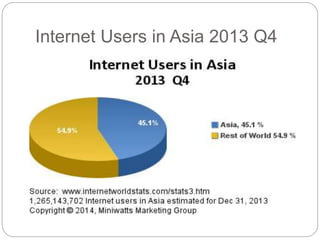
Internet Users in Asia 2013 Q4
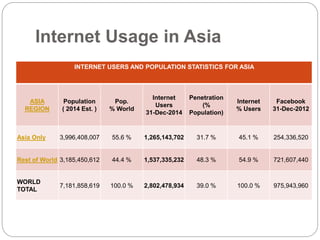
Internet Usage in Asia 
INTERNET USERS AND POPULATION STATISTICS FOR ASIA 
ASIA 
REGION 
Population 
( 2014 Est. ) 
Pop. 
% World 
Internet 
Users 
31-Dec-2014 
Penetration 
(% 
Population) 
Internet 
% Users 
Facebook 
31-Dec-2012 
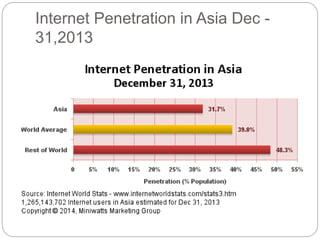
Asia Only 3,996,408,007 55.6 % 1,265,143,702 31.7 % 45.1 % 254,336,520 
Rest of World 3,185,450,612 44.4 % 1,537,335,232 48.3 % 54.9 % 721,607,440 
WORLD 
TOTAL 
7,181,858,619 100.0 % 2,802,478,934 39.0 % 100.0 % 975,943,960
Internet Penetration in Asia Dec - 
31,2013
Asia Internet USE, Population Data 
& Facebook Statistics
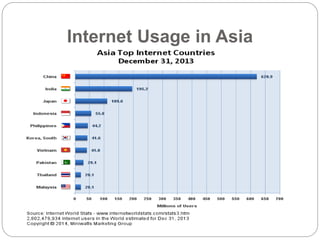
Internet Usage in Asia
E-Commerce Market in India 
E-Commerce is gaining momentum globally with Asian 
economies like China, India and Indonesia being the fastest 
growing e-commerce markets. E-commerce in India is 
growing at a fast pace with an estimated size of Rs.43,930 
crore in FY13 and a CAGR of 43.8% (FY08-13). 
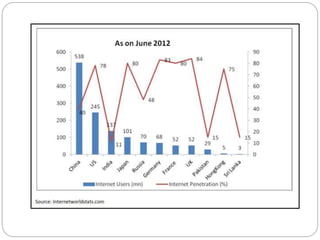
As per the internetworldstats.com – The top 20 countries in 
the internet by number of users as on June 30, 2012, India 
ranks 3rd after China and US. The ecommerce industry is 
mainly dominated by the travel segment which accounts for 
more than 70% of the transactions of industry and e-retail’s 
share in e-commerce stands at approximately 12.5%. 
In spite of the robust growth, the ecommerce industry is still 
in a nascent stage with significant e- commerce ventures 
being started by young first-time entrepreneurs. The e-commerce 
industry in India lags far behind various 
developed and developing countries (share of ecommerce to 
total retail is approximately 1.5% vis-à-vis 5.8% in US) mainly 
on account of low internet penetration due to poor 
infrastructure.
E-Commerce in India : Evolving 
Models 
The Indian e-commerce industry comprises two key 
business models: B2B (90% of market share) and the 
remaining 10% comprise of B2C. India and China, 
unlike US are characterized by ‘Marketplace Model’, 
while US follows inventory-based/independent model. 
‘Market Place’ model only provides platform to a large 
number of manufacturers/traders (especially MSMEs) to 
advertise their products (which translates to benefit the 
MSMEs in the form of increased turnover) as well as 
manages related functions and in turn the entity earns 
commission from sellers for goods and services. The 
B2B players do not carry inventory while in the other 
model-B2C, the merchant owns the goods. Currently 
FDI is restricted in B2C model in India.
E-Retailing: At an inflexion point 
The e-retailing market in India is estimated at Rs.5,513 
crore in FY13 with a robust CAGR of 30.5% (FY08- 
FY13). 
However, e-retailing in India constitutes a miniscule 
0.2% of the total retail market and 2.3% of organised 
retail in India. E-retailing industry in India is fragmented 
with a few large players at the top and race for high 
valuation has led to fierce competition and aggressive 
growth. Furthermore, the industry has also witnessed 
consolidation with the largest acquisition of Myntra by 
Flipkart. The trend is likely to continue in future given 
the foray of Amazon, inability to raise follow-up capital 
from PE by majority start-ups in the past couple of years 
and likely opening of FDI in B2C. 
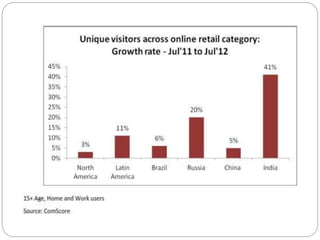
Below-average penetration of e-retailing, has led to 
explosive growth of unique visitors during July 2011 to 
July 2012 within Indian retail online market.
Key Drivers for E-Retailing 
Today’s consumer, especially the middle-class 
urban and semi-urban India, who are increasingly 
pressurized due to paucity of time as well as lured 
by convenience and increased use of plastic money 
are all leading way to more online consumption. 
Furthermore, favorable demographic profile (75% 
of internet users are aged between 15-34), limited 
geographical reach by brick & mortar model, 
increasing internet penetration, increasing 
smartphone usage & declining data charges offer 
high market potential for e-retailing in India.
Indian Ecommerce : Growing 
under constraints 
The inability to provide a direct connect with consumer 
is the biggest challenge in e-retailing. Further, apart 
from low internet penetration, like low debit card/credit 
card usage which is being offset by cash on delivery, 
multiple languages, and logistics issues which is being 
managed by building in-house logistics by players are 
also some of the challenges faced by players. However 
with the help of technology, backbone of e-retailing, an 
attempt is made to bridge this gap. Also, other 
challenges are developing efficient supply chain 
management, customer relationship management 
solution and enhanced security systems which form 
heart of e-retailing. Foreign capital inflow is the next 
logical step to build the necessary infrastructure.
FDI in B2C: Next Logical Step 
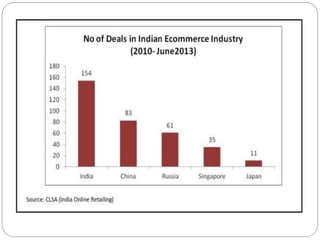
FDI in ecommerce in India has seen around US$1.3 
billion of foreign investment in the ecommerce industry 
since 2010 to June 2013 and a large number of deals 
compared with some other peers on account of huge 
potential seen in India. 
At present, 100% FDI is allowed in business-to-business 
(B2B) e-commerce. Restriction on FDI in B2C 
Inventory / Independent model has restricted the growth 
of this segment on account of lack of financial backing 
required for their expansion plans. Equity funding is 
important for growth of e-retailing given the large 
requirements on account of deep discounts given to 
customer as an acquisition strategy, for establishing 
logistics and creating differentiation in terms of 
customer service.
FDI in B2C: Pros and Cons 
FDI in B2C model is likely to have a positive impact on 
overall economic development.It will provide the required 
significant financial backing to the young entreprenuers. 
MSMEs, if provided financial backing, will be able to enhance 
their coverage through e-commerce platform.Long-term 
committed investment will also bring in know how and 
improve efficiencies in the supply chain necessary for the 
industry and also lead to competitive pricing.It will boost the 
ancilliary industries like logistics, warehousing, online 
advertising etc. Minimum investment requirement, if 
mandated, in backend may also lead to infrastructure 
development. 
On the other hand, with opening of FDI in B2C model, 
monopolies of foreign retailers may adversely impact the 
domestic industry Brick and Mortar players as well as 
existing B2C players leading to consolidation in the industry. 
It may shrink the Indian Entrepreneurship & MSME sector. 
However, foreign player’s entry with certain riders like 
mandated minimum local sourcing with the MSMEs will lead 
to increased manufacturing activities.
Conclusion 
With the new government focusing on overall 
economic development, they may look at careful 
calibrated approach for opening up B2C model in 
India to FDI. Opening up of Foreign Direct 
Investment (FDI) in this segment shall change the 
contours of E-commerce industry in India as well as 
contribute positively to the overall economic 
development going forward.
Thanks you 
Vishal Joshi 
+91-9099089387 
Ahmedabad

Ecommerce Business in India

  • 1.
    Ecommerce Business inIndia 2014 to 2015
  • 2.
    Internet Users inAsia 2013 Q4
  • 3.
    Internet Usage inAsia INTERNET USERS AND POPULATION STATISTICS FOR ASIA ASIA REGION Population ( 2014 Est. ) Pop. % World Internet Users 31-Dec-2014 Penetration (% Population) Internet % Users Facebook 31-Dec-2012 Asia Only 3,996,408,007 55.6 % 1,265,143,702 31.7 % 45.1 % 254,336,520 Rest of World 3,185,450,612 44.4 % 1,537,335,232 48.3 % 54.9 % 721,607,440 WORLD TOTAL 7,181,858,619 100.0 % 2,802,478,934 39.0 % 100.0 % 975,943,960
  • 4.
    Internet Penetration inAsia Dec - 31,2013
  • 5.
    Asia Internet USE,Population Data & Facebook Statistics
  • 6.
  • 7.
    E-Commerce Market inIndia E-Commerce is gaining momentum globally with Asian economies like China, India and Indonesia being the fastest growing e-commerce markets. E-commerce in India is growing at a fast pace with an estimated size of Rs.43,930 crore in FY13 and a CAGR of 43.8% (FY08-13). As per the internetworldstats.com – The top 20 countries in the internet by number of users as on June 30, 2012, India ranks 3rd after China and US. The ecommerce industry is mainly dominated by the travel segment which accounts for more than 70% of the transactions of industry and e-retail’s share in e-commerce stands at approximately 12.5%. In spite of the robust growth, the ecommerce industry is still in a nascent stage with significant e- commerce ventures being started by young first-time entrepreneurs. The e-commerce industry in India lags far behind various developed and developing countries (share of ecommerce to total retail is approximately 1.5% vis-à-vis 5.8% in US) mainly on account of low internet penetration due to poor infrastructure.
  • 9.
    E-Commerce in India: Evolving Models The Indian e-commerce industry comprises two key business models: B2B (90% of market share) and the remaining 10% comprise of B2C. India and China, unlike US are characterized by ‘Marketplace Model’, while US follows inventory-based/independent model. ‘Market Place’ model only provides platform to a large number of manufacturers/traders (especially MSMEs) to advertise their products (which translates to benefit the MSMEs in the form of increased turnover) as well as manages related functions and in turn the entity earns commission from sellers for goods and services. The B2B players do not carry inventory while in the other model-B2C, the merchant owns the goods. Currently FDI is restricted in B2C model in India.
  • 10.
    E-Retailing: At aninflexion point The e-retailing market in India is estimated at Rs.5,513 crore in FY13 with a robust CAGR of 30.5% (FY08- FY13). However, e-retailing in India constitutes a miniscule 0.2% of the total retail market and 2.3% of organised retail in India. E-retailing industry in India is fragmented with a few large players at the top and race for high valuation has led to fierce competition and aggressive growth. Furthermore, the industry has also witnessed consolidation with the largest acquisition of Myntra by Flipkart. The trend is likely to continue in future given the foray of Amazon, inability to raise follow-up capital from PE by majority start-ups in the past couple of years and likely opening of FDI in B2C. Below-average penetration of e-retailing, has led to explosive growth of unique visitors during July 2011 to July 2012 within Indian retail online market.
  • 12.
    Key Drivers forE-Retailing Today’s consumer, especially the middle-class urban and semi-urban India, who are increasingly pressurized due to paucity of time as well as lured by convenience and increased use of plastic money are all leading way to more online consumption. Furthermore, favorable demographic profile (75% of internet users are aged between 15-34), limited geographical reach by brick & mortar model, increasing internet penetration, increasing smartphone usage & declining data charges offer high market potential for e-retailing in India.
  • 13.
    Indian Ecommerce :Growing under constraints The inability to provide a direct connect with consumer is the biggest challenge in e-retailing. Further, apart from low internet penetration, like low debit card/credit card usage which is being offset by cash on delivery, multiple languages, and logistics issues which is being managed by building in-house logistics by players are also some of the challenges faced by players. However with the help of technology, backbone of e-retailing, an attempt is made to bridge this gap. Also, other challenges are developing efficient supply chain management, customer relationship management solution and enhanced security systems which form heart of e-retailing. Foreign capital inflow is the next logical step to build the necessary infrastructure.
  • 14.
    FDI in B2C:Next Logical Step FDI in ecommerce in India has seen around US$1.3 billion of foreign investment in the ecommerce industry since 2010 to June 2013 and a large number of deals compared with some other peers on account of huge potential seen in India. At present, 100% FDI is allowed in business-to-business (B2B) e-commerce. Restriction on FDI in B2C Inventory / Independent model has restricted the growth of this segment on account of lack of financial backing required for their expansion plans. Equity funding is important for growth of e-retailing given the large requirements on account of deep discounts given to customer as an acquisition strategy, for establishing logistics and creating differentiation in terms of customer service.
  • 16.
    FDI in B2C:Pros and Cons FDI in B2C model is likely to have a positive impact on overall economic development.It will provide the required significant financial backing to the young entreprenuers. MSMEs, if provided financial backing, will be able to enhance their coverage through e-commerce platform.Long-term committed investment will also bring in know how and improve efficiencies in the supply chain necessary for the industry and also lead to competitive pricing.It will boost the ancilliary industries like logistics, warehousing, online advertising etc. Minimum investment requirement, if mandated, in backend may also lead to infrastructure development. On the other hand, with opening of FDI in B2C model, monopolies of foreign retailers may adversely impact the domestic industry Brick and Mortar players as well as existing B2C players leading to consolidation in the industry. It may shrink the Indian Entrepreneurship & MSME sector. However, foreign player’s entry with certain riders like mandated minimum local sourcing with the MSMEs will lead to increased manufacturing activities.
  • 17.
    Conclusion With thenew government focusing on overall economic development, they may look at careful calibrated approach for opening up B2C model in India to FDI. Opening up of Foreign Direct Investment (FDI) in this segment shall change the contours of E-commerce industry in India as well as contribute positively to the overall economic development going forward.
  • 18.
    Thanks you VishalJoshi +91-9099089387 Ahmedabad