Internal Audits Role in Compliance
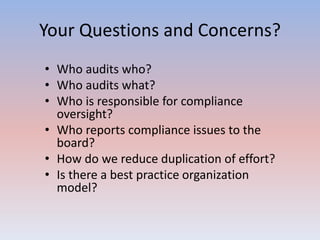
Your Questions and Concerns? 
• Who audits who? 
• Who audits what? 
• Who is responsible for compliance 
oversight? 
• Who reports compliance issues to the 
board? 
• How do we reduce duplication of effort? 
• Is there a best practice organization 
model?
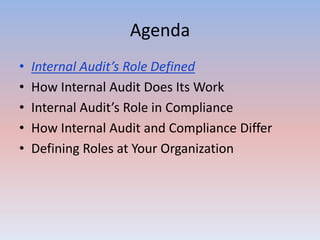
Agenda 
• Internal Audit’s Role Defined 
• How Internal Audit Does Its Work 
• Internal Audit’s Role in Compliance 
• How Internal Audit and Compliance Differ 
• Defining Roles at Your Organization
Audit Committee’s Primary Role 
Internal Audit’s Role Defined 
Foreign Corrupt Practices Act of 1997 requires companies to devise and 
maintain a system of internal accounting control sufficient to provide 
reasonable assurances that: 
 transactions are authorized by management; 
 transactions are recorded so that statements can be prepared in 
accordance with generally accepted accounting principles and 
accountability for assets maintained; 
 access to assets is authorized by management; 
 and periodic inventory is performed to compare recorded assets with 
existing assets.
Audit Committee’s Additional Roles 
Internal Audit’s Role Defined 
In order to assist a Corporation’s Board of Directors in fulfilling its 
fiduciary responsibilities, Audit Committees are usually chartered to 
review: 
 The financial information provided in the Company's Annual Report on Form 
10-K and the quarterly reports on Form 10-Q and other reports as 
appropriate. 
 The Company’s systems of internal controls regarding finance, accounting, 
legal, compliance and ethics that management and the Board have 
established. 
 The Company’s auditing, accounting and financial reporting processes. 
 The independence and performance of the Company's independent 
accountants and internal auditing department.
Internal Audit’s Role Defined 
What is Internal Auditing? 
Internal auditing is an independent, objective assurance and consulting 
activity designed to add value and improve an organization's operations. It 
helps an organization accomplish its objectives by bringing a systematic, 
disciplined approach to evaluate and improve the effectiveness of risk 
management, control, and governance processes. (Institute of Internal Auditors)
Internal Audit’s Role Defined 
Corporate Governance Defined 
Elements of Corporate Governance 
– Corporate and Functional Strategy and Planning 
– Enterprise Risk Management 
– Tone at the Top - Ethics and Compliance 
– Measuring and Monitoring Performance 
– Transformational Transactions - Mergers, Acquisitions, Divestitures 
– Management Evaluation, Compensation, and Succession Planning 
– Telling the World: External Communications & Financial Reporting 
– Board Dynamics
Summary - Internal Audit’s Role 
Defined 
#1 - Support the Audit Committee 
#2 - Assurance on Risk Management, Control, and Governance 
#3 - Consulting on Risk Management, Control, and Governance
Agenda 
• Internal Audit’s Role Defined 
• How Internal Audit Does Its Work 
• Internal Audit’s Role in Compliance 
• How Internal Audit and Compliance Differ 
• Defining Roles at Your Organization
Risk Based Engagement Planning 
How Internal Audit Does Its Work 
• The internal auditor should be alert to significant risks that 
might affect objectives, operations, or resources. 
• The internal auditor should consider the probability of 
significant errors, irregularities, noncompliance, and other 
exposures when developing the engagement objectives.
Focus of Engagement Risk Assessment 
How Internal Audit Does Its Work 
Based on the results of the risk assessment, the internal audit activity 
should evaluate the adequacy and effectiveness of controls 
encompassing the organization’s governance, operations, and 
information systems. This should include: 
– Reliability of integrity of financial and 
operational information. 
– Effectiveness and efficiency of operations. 
– Safeguarding of assets. 
– Compliance with laws, regulations, and 
contracts.
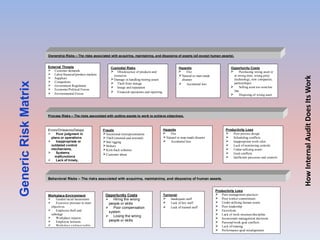
Ownership Risks – The risks associated with acquiring, maintaining, and disposing of assets (all except human assets). 
External Threats 
Ø Customer demands 
Ø Labor/financial/product markets 
Ø Suppliers 
Ø Competitors 
Ø Government Regulation 
Ø Economic/Political Forces 
Ø Environmental Forces 
Custodial Risks 
Ø Obsolescence of products and 
resources 
Ø Damage in handling/storing assets 
Ø Theft from storage 
Ø Image and reputation 
Ø Financial operations and reporting 
Hazards 
Ø Fire 
Ø Natural or man-made 
disaster 
Ø Accidental loss 
Opportunity Costs 
Ø Purchasing wrong asset or 
at wrong time, wrong price 
(technology, new companies, 
partnerships) 
Ø Selling asset too soon/too 
late 
Ø Disposing of wrong asset 
Errors/Omissions/Delays 
Ø Poor judgment in 
plans or operations 
Ø Inappropriate or 
outdated control 
mechanisms, 
Ø Systems 
malfunctions 
Ø Lack of timely, 
accurate information 
Ø Customer relations 
Hazards 
Ø Fire 
Ø Natural or man-made disaster 
Ø Accidental loss 
Frauds 
Ø Intentional misrepresentation 
Ø Theft (internal and external) 
Ø Bid rigging 
Ø Bribery 
Ø Kick-back schemes 
Ø Customer abuse 
Productivity Loss 
Ø Poor process design 
Ø Scheduling conflicts 
Ø Inappropriate work rules 
Ø Lack of monitoring controls 
Ø Under-utilizing assets 
Ø Goal conflicts 
Ø Inefficient processes and controls 
Workplace Environment 
Ø Gender/racial harassment 
Ø Excessive pressure to meet 
objectives 
Ø Employee theft and 
sabotage 
Ø Workplace injuries 
Ø Employee lawsuits 
Ø Workplace violence/safety 
Opportunity Costs 
Ø Hiring the wrong 
people or skills 
Ø Poor compensation 
system 
Ø Losing the wrong 
people or skills 
Turnover 
Ø Inadequate staff 
Ø Lack of key staff 
Ø Lack of trained staff 
Productivity Loss 
Ø Poor management practices 
Ø Poor worker commitment 
Ø Under-utilizing human assets 
Ø Poor leadership 
Ø Favoritism 
Ø Lack of work structure/discipline 
Ø Inconsistent management decisions 
Ø Personal/work goal conflicts 
Ø Lack of training 
Ø Performance-goal misalignment 
Process Risks – The risks associated with putting assets to work to achieve objectives. 
Behavioral Risks – The risks associated with acquiring, maintaining, and disposing of human assets. 
Generic Risk Matrix 
How Internal Audit Does Its Work
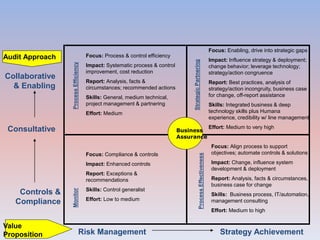
Audit Approach 
Collaborative 
& Enabling 
Consultative 
Controls & 
Compliance 
Focus: Process & control efficiency 
Impact: Systematic process & control 
improvement, cost reduction 
Report: Analysis, facts & 
circumstances; recommended actions 
Skills: General, medium technical, 
project management & partnering 
Effort: Medium 
Focus: Compliance & controls 
Impact: Enhanced controls 
Report: Exceptions & 
recommendations 
Skills: Control generalist 
Effort: Low to medium 
Strategic Partnering 
Business 
Assurance 
Focus: Enabling, drive into strategic gaps 
Impact: Influence strategy & deployment; 
change behavior; leverage technology; 
strategy/action congruence 
Report: Best practices, analysis of 
strategy/action incongruity, business case 
for change, off-report assistance 
Skills: Integrated business & deep 
technology skills plus Humana 
experience, credibility w/ line management 
Effort: Medium to very high 
Focus: Align process to support 
objectives; automate controls & solutions 
Impact: Change, influence system 
development & deployment 
Report: Analysis, facts & circumstances, 
business case for change 
Skills: Business process, IT/automation, 
management consulting 
Effort: Medium to high 
Process Efficiency 
Monitor 
Process Effectiveness 
Value 
Proposition Risk Management Strategy Achievement
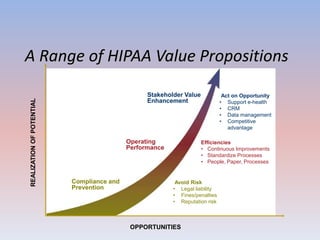
A Range of HIPAA Value Propositions 
Stakeholder Value 
Enhancement 
OPPORTUNITIES 
Compliance and 
Prevention 
Operating 
Performance 
Act on Opportunity 
• Support e-health 
• CRM 
• Data management 
• Competitive 
advantage 
Efficiencies 
• Continuous Improvements 
• Standardize Processes 
• People, Paper, Processes 
Avoid Risk 
• Legal liability 
• Fines/penalties 
• Reputation risk 
REALIZATION OF POTENTIAL
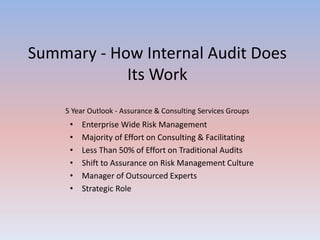
Summary - How Internal Audit Does 
Its Work 
5 Year Outlook - Assurance & Consulting Services Groups 
• Enterprise Wide Risk Management 
• Majority of Effort on Consulting & Facilitating 
• Less Than 50% of Effort on Traditional Audits 
• Shift to Assurance on Risk Management Culture 
• Manager of Outsourced Experts 
• Strategic Role
Agenda 
• Internal Audit’s Role Defined 
• How Internal Audit Does Its Work 
• Internal Audit’s Role in Compliance 
• How Internal Audit and Compliance Differ 
• Defining Roles at Your Organization
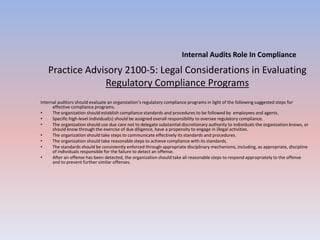
Practice Advisory 2100-5: Legal Considerations in Evaluating 
Regulatory Compliance Programs 
Internal auditors should evaluate an organization’s regulatory compliance programs in light of the following suggested steps for 
effective compliance programs. 
• The organization should establish compliance standards and procedures to be followed by employees and agents. 
• Specific high-level individual(s) should be assigned overall responsibility to oversee regulatory compliance. 
• The organization should use due care not to delegate substantial discretionary authority to individuals the organization knows, or 
should know through the exercise of due diligence, have a propensity to engage in illegal activities. 
• The organization should take steps to communicate effectively its standards and procedures. 
• The organization should take reasonable steps to achieve compliance with its standards. 
• The standards should be consistently enforced through appropriate disciplinary mechanisms, including, as appropriate, discipline 
of individuals responsible for the failure to detect an offense. 
• After an offense has been detected, the organization should take all reasonable steps to respond appropriately to the offense 
and to prevent further similar offenses. 
Internal Audits Role In Compliance
Internal Audits Role In Compliance 
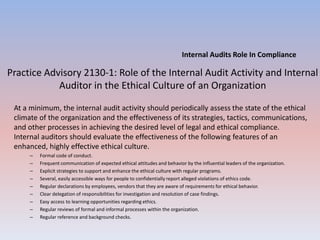
Practice Advisory 2130-1: Role of the Internal Audit Activity and Internal 
Auditor in the Ethical Culture of an Organization 
At a minimum, the internal audit activity should periodically assess the state of the ethical 
climate of the organization and the effectiveness of its strategies, tactics, communications, 
and other processes in achieving the desired level of legal and ethical compliance. 
Internal auditors should evaluate the effectiveness of the following features of an 
enhanced, highly effective ethical culture. 
– Formal code of conduct. 
– Frequent communication of expected ethical attitudes and behavior by the influential leaders of the organization. 
– Explicit strategies to support and enhance the ethical culture with regular programs. 
– Several, easily accessible ways for people to confidentially report alleged violations of ethics code. 
– Regular declarations by employees, vendors that they are aware of requirements for ethical behavior. 
– Clear delegation of responsibilities for investigation and resolution of case findings. 
– Easy access to learning opportunities regarding ethics. 
– Regular reviews of formal and informal processes within the organization. 
– Regular reference and background checks.
Internal Audits Role In Compliance 
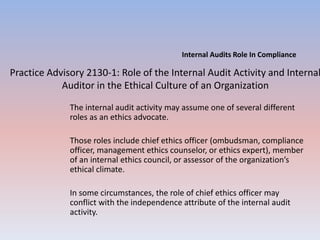
Practice Advisory 2130-1: Role of the Internal Audit Activity and Internal 
Auditor in the Ethical Culture of an Organization 
The internal audit activity may assume one of several different 
roles as an ethics advocate. 
Those roles include chief ethics officer (ombudsman, compliance 
officer, management ethics counselor, or ethics expert), member 
of an internal ethics council, or assessor of the organization’s 
ethical climate. 
In some circumstances, the role of chief ethics officer may 
conflict with the independence attribute of the internal audit 
activity.
Summary - Internal Audits Role in 
Compliance 
• Internal Audit Independently and Objectively 
Reviews Organizations Compliance and Ethics 
Policies and Processes 
• The Internal Audit Function May Assume 
Various Roles Including That of Ethics or 
Compliance Officer
Agenda 
• Internal Audit’s Role Defined 
• How Internal Audit Does Its Work 
• Internal Audit’s Role in Compliance 
• How Internal Audit and Compliance Differ 
• Defining Roles at Your Organization
Independence Requirement - IIA 
Standards 
How Internal Audit and Compliance Differ 
Independence and Objectivity: The internal audit activity should be 
independent, and internal auditors should be objective in performing their 
work. 
Assurance engagements for functions over which the chief audit executive 
has responsibility should be overseen by a party outside the internal audit 
activity. 
How would these standards be applied if the Internal Audit Function was 
responsible for establishing and overseeing the compliance & ethics 
functions?
Reporting Requirement - IIA Standard 
How Internal Audit and Compliance Differ 
The chief audit executive is responsible for communicating the final results of 
engagements to individuals who can ensure that the results are given due 
consideration. 
The chief audit executive should establish a follow-up process to monitor and 
ensure that management actions have been effectively implemented or 
that senior management has accepted the risk of not taking action.
How Internal Audit and Compliance Differ 
Management’s Acceptance of Risks - IIA 
Standard 
When the chief audit executive believes that senior management 
has accepted a level of residual risk that is unacceptable to the 
organization, the chief audit executive should discuss the matter 
with senior management. If the decision regarding residual risk 
is not resolved, the chief audit executive and senior 
management should report the matter to the board for 
resolution.
How Internal Audit and Compliance Differ 
Summary - How Internal Audit & 
Compliance Differ 
• Independence Requirement 
• Explicit and Expected Regular Reporting Role to the Audit 
Committee 
• Chief Audit Executive Reports and Is Accountable to the Audit 
Committee 
• Compliance Functions May Not Have an Independent or 
Objective Means for Assessing or Regularly Reporting How Well 
They Achieve Compliance 
• Compliance Functions Generally Have A Responsibility for 
Implementing Compliance Processes
Agenda 
• Internal Audit’s Role Defined 
• How Internal Audit Does Its Work 
• Internal Audit’s Role in Compliance 
• How Internal Audit and Compliance Differ 
• Defining Roles at Your Organization
Defining Roles at Your Organization 
Internal Audit - Different Approaches 
Activities Other Than Traditional Audit 
• GE - Controllership, Corporate Initiatives, and Management Development 
• GM - Enterprise Risk Management, Crisis Management, Continuity Planning 
• Disney, DuPont, Caterpillar - Enterprise Risk Management 
• Citicorp - Rating Awareness & Management of Risks
Coordination - IIA Standard 
The chief audit executive should share information and coordinate 
activities with other internal and external providers of relevant 
assurance and consulting services to ensure proper coverage and 
minimize duplication of efforts. 
How do you coordinate compliance and Internal Audit activity? 
What information does compliance provide to internal audit at your 
organization? 
Defining Roles at Your Organization
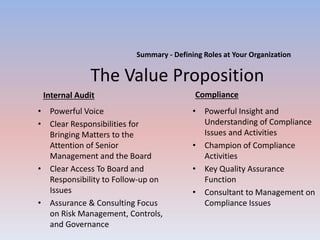
Summary - Defining Roles at Your Organization 
The Value Proposition 
Internal Audit Compliance 
• Powerful Voice 
• Clear Responsibilities for 
Bringing Matters to the 
Attention of Senior 
Management and the Board 
• Clear Access To Board and 
Responsibility to Follow-up on 
Issues 
• Assurance & Consulting Focus 
on Risk Management, Controls, 
and Governance 
• Powerful Insight and 
Understanding of Compliance 
Issues and Activities 
• Champion of Compliance 
Activities 
• Key Quality Assurance 
Function 
• Consultant to Management on 
Compliance Issues

Internal audits role in compliance

  • 2.
    Internal Audits Rolein Compliance
  • 3.
    Your Questions andConcerns? • Who audits who? • Who audits what? • Who is responsible for compliance oversight? • Who reports compliance issues to the board? • How do we reduce duplication of effort? • Is there a best practice organization model?
  • 4.
    Agenda • InternalAudit’s Role Defined • How Internal Audit Does Its Work • Internal Audit’s Role in Compliance • How Internal Audit and Compliance Differ • Defining Roles at Your Organization
  • 5.
    Audit Committee’s PrimaryRole Internal Audit’s Role Defined Foreign Corrupt Practices Act of 1997 requires companies to devise and maintain a system of internal accounting control sufficient to provide reasonable assurances that:  transactions are authorized by management;  transactions are recorded so that statements can be prepared in accordance with generally accepted accounting principles and accountability for assets maintained;  access to assets is authorized by management;  and periodic inventory is performed to compare recorded assets with existing assets.
  • 6.
    Audit Committee’s AdditionalRoles Internal Audit’s Role Defined In order to assist a Corporation’s Board of Directors in fulfilling its fiduciary responsibilities, Audit Committees are usually chartered to review:  The financial information provided in the Company's Annual Report on Form 10-K and the quarterly reports on Form 10-Q and other reports as appropriate.  The Company’s systems of internal controls regarding finance, accounting, legal, compliance and ethics that management and the Board have established.  The Company’s auditing, accounting and financial reporting processes.  The independence and performance of the Company's independent accountants and internal auditing department.
  • 7.
    Internal Audit’s RoleDefined What is Internal Auditing? Internal auditing is an independent, objective assurance and consulting activity designed to add value and improve an organization's operations. It helps an organization accomplish its objectives by bringing a systematic, disciplined approach to evaluate and improve the effectiveness of risk management, control, and governance processes. (Institute of Internal Auditors)
  • 8.
    Internal Audit’s RoleDefined Corporate Governance Defined Elements of Corporate Governance – Corporate and Functional Strategy and Planning – Enterprise Risk Management – Tone at the Top - Ethics and Compliance – Measuring and Monitoring Performance – Transformational Transactions - Mergers, Acquisitions, Divestitures – Management Evaluation, Compensation, and Succession Planning – Telling the World: External Communications & Financial Reporting – Board Dynamics
  • 9.
    Summary - InternalAudit’s Role Defined #1 - Support the Audit Committee #2 - Assurance on Risk Management, Control, and Governance #3 - Consulting on Risk Management, Control, and Governance
  • 10.
    Agenda • InternalAudit’s Role Defined • How Internal Audit Does Its Work • Internal Audit’s Role in Compliance • How Internal Audit and Compliance Differ • Defining Roles at Your Organization
  • 11.
    Risk Based EngagementPlanning How Internal Audit Does Its Work • The internal auditor should be alert to significant risks that might affect objectives, operations, or resources. • The internal auditor should consider the probability of significant errors, irregularities, noncompliance, and other exposures when developing the engagement objectives.
  • 12.
    Focus of EngagementRisk Assessment How Internal Audit Does Its Work Based on the results of the risk assessment, the internal audit activity should evaluate the adequacy and effectiveness of controls encompassing the organization’s governance, operations, and information systems. This should include: – Reliability of integrity of financial and operational information. – Effectiveness and efficiency of operations. – Safeguarding of assets. – Compliance with laws, regulations, and contracts.
  • 13.
    Ownership Risks –The risks associated with acquiring, maintaining, and disposing of assets (all except human assets). External Threats Ø Customer demands Ø Labor/financial/product markets Ø Suppliers Ø Competitors Ø Government Regulation Ø Economic/Political Forces Ø Environmental Forces Custodial Risks Ø Obsolescence of products and resources Ø Damage in handling/storing assets Ø Theft from storage Ø Image and reputation Ø Financial operations and reporting Hazards Ø Fire Ø Natural or man-made disaster Ø Accidental loss Opportunity Costs Ø Purchasing wrong asset or at wrong time, wrong price (technology, new companies, partnerships) Ø Selling asset too soon/too late Ø Disposing of wrong asset Errors/Omissions/Delays Ø Poor judgment in plans or operations Ø Inappropriate or outdated control mechanisms, Ø Systems malfunctions Ø Lack of timely, accurate information Ø Customer relations Hazards Ø Fire Ø Natural or man-made disaster Ø Accidental loss Frauds Ø Intentional misrepresentation Ø Theft (internal and external) Ø Bid rigging Ø Bribery Ø Kick-back schemes Ø Customer abuse Productivity Loss Ø Poor process design Ø Scheduling conflicts Ø Inappropriate work rules Ø Lack of monitoring controls Ø Under-utilizing assets Ø Goal conflicts Ø Inefficient processes and controls Workplace Environment Ø Gender/racial harassment Ø Excessive pressure to meet objectives Ø Employee theft and sabotage Ø Workplace injuries Ø Employee lawsuits Ø Workplace violence/safety Opportunity Costs Ø Hiring the wrong people or skills Ø Poor compensation system Ø Losing the wrong people or skills Turnover Ø Inadequate staff Ø Lack of key staff Ø Lack of trained staff Productivity Loss Ø Poor management practices Ø Poor worker commitment Ø Under-utilizing human assets Ø Poor leadership Ø Favoritism Ø Lack of work structure/discipline Ø Inconsistent management decisions Ø Personal/work goal conflicts Ø Lack of training Ø Performance-goal misalignment Process Risks – The risks associated with putting assets to work to achieve objectives. Behavioral Risks – The risks associated with acquiring, maintaining, and disposing of human assets. Generic Risk Matrix How Internal Audit Does Its Work
  • 14.
    Audit Approach Collaborative & Enabling Consultative Controls & Compliance Focus: Process & control efficiency Impact: Systematic process & control improvement, cost reduction Report: Analysis, facts & circumstances; recommended actions Skills: General, medium technical, project management & partnering Effort: Medium Focus: Compliance & controls Impact: Enhanced controls Report: Exceptions & recommendations Skills: Control generalist Effort: Low to medium Strategic Partnering Business Assurance Focus: Enabling, drive into strategic gaps Impact: Influence strategy & deployment; change behavior; leverage technology; strategy/action congruence Report: Best practices, analysis of strategy/action incongruity, business case for change, off-report assistance Skills: Integrated business & deep technology skills plus Humana experience, credibility w/ line management Effort: Medium to very high Focus: Align process to support objectives; automate controls & solutions Impact: Change, influence system development & deployment Report: Analysis, facts & circumstances, business case for change Skills: Business process, IT/automation, management consulting Effort: Medium to high Process Efficiency Monitor Process Effectiveness Value Proposition Risk Management Strategy Achievement
  • 15.
    A Range ofHIPAA Value Propositions Stakeholder Value Enhancement OPPORTUNITIES Compliance and Prevention Operating Performance Act on Opportunity • Support e-health • CRM • Data management • Competitive advantage Efficiencies • Continuous Improvements • Standardize Processes • People, Paper, Processes Avoid Risk • Legal liability • Fines/penalties • Reputation risk REALIZATION OF POTENTIAL
  • 16.
    Summary - HowInternal Audit Does Its Work 5 Year Outlook - Assurance & Consulting Services Groups • Enterprise Wide Risk Management • Majority of Effort on Consulting & Facilitating • Less Than 50% of Effort on Traditional Audits • Shift to Assurance on Risk Management Culture • Manager of Outsourced Experts • Strategic Role
  • 17.
    Agenda • InternalAudit’s Role Defined • How Internal Audit Does Its Work • Internal Audit’s Role in Compliance • How Internal Audit and Compliance Differ • Defining Roles at Your Organization
  • 18.
    Practice Advisory 2100-5:Legal Considerations in Evaluating Regulatory Compliance Programs Internal auditors should evaluate an organization’s regulatory compliance programs in light of the following suggested steps for effective compliance programs. • The organization should establish compliance standards and procedures to be followed by employees and agents. • Specific high-level individual(s) should be assigned overall responsibility to oversee regulatory compliance. • The organization should use due care not to delegate substantial discretionary authority to individuals the organization knows, or should know through the exercise of due diligence, have a propensity to engage in illegal activities. • The organization should take steps to communicate effectively its standards and procedures. • The organization should take reasonable steps to achieve compliance with its standards. • The standards should be consistently enforced through appropriate disciplinary mechanisms, including, as appropriate, discipline of individuals responsible for the failure to detect an offense. • After an offense has been detected, the organization should take all reasonable steps to respond appropriately to the offense and to prevent further similar offenses. Internal Audits Role In Compliance
  • 19.
    Internal Audits RoleIn Compliance Practice Advisory 2130-1: Role of the Internal Audit Activity and Internal Auditor in the Ethical Culture of an Organization At a minimum, the internal audit activity should periodically assess the state of the ethical climate of the organization and the effectiveness of its strategies, tactics, communications, and other processes in achieving the desired level of legal and ethical compliance. Internal auditors should evaluate the effectiveness of the following features of an enhanced, highly effective ethical culture. – Formal code of conduct. – Frequent communication of expected ethical attitudes and behavior by the influential leaders of the organization. – Explicit strategies to support and enhance the ethical culture with regular programs. – Several, easily accessible ways for people to confidentially report alleged violations of ethics code. – Regular declarations by employees, vendors that they are aware of requirements for ethical behavior. – Clear delegation of responsibilities for investigation and resolution of case findings. – Easy access to learning opportunities regarding ethics. – Regular reviews of formal and informal processes within the organization. – Regular reference and background checks.
  • 20.
    Internal Audits RoleIn Compliance Practice Advisory 2130-1: Role of the Internal Audit Activity and Internal Auditor in the Ethical Culture of an Organization The internal audit activity may assume one of several different roles as an ethics advocate. Those roles include chief ethics officer (ombudsman, compliance officer, management ethics counselor, or ethics expert), member of an internal ethics council, or assessor of the organization’s ethical climate. In some circumstances, the role of chief ethics officer may conflict with the independence attribute of the internal audit activity.
  • 21.
    Summary - InternalAudits Role in Compliance • Internal Audit Independently and Objectively Reviews Organizations Compliance and Ethics Policies and Processes • The Internal Audit Function May Assume Various Roles Including That of Ethics or Compliance Officer
  • 22.
    Agenda • InternalAudit’s Role Defined • How Internal Audit Does Its Work • Internal Audit’s Role in Compliance • How Internal Audit and Compliance Differ • Defining Roles at Your Organization
  • 23.
    Independence Requirement -IIA Standards How Internal Audit and Compliance Differ Independence and Objectivity: The internal audit activity should be independent, and internal auditors should be objective in performing their work. Assurance engagements for functions over which the chief audit executive has responsibility should be overseen by a party outside the internal audit activity. How would these standards be applied if the Internal Audit Function was responsible for establishing and overseeing the compliance & ethics functions?
  • 24.
    Reporting Requirement -IIA Standard How Internal Audit and Compliance Differ The chief audit executive is responsible for communicating the final results of engagements to individuals who can ensure that the results are given due consideration. The chief audit executive should establish a follow-up process to monitor and ensure that management actions have been effectively implemented or that senior management has accepted the risk of not taking action.
  • 25.
    How Internal Auditand Compliance Differ Management’s Acceptance of Risks - IIA Standard When the chief audit executive believes that senior management has accepted a level of residual risk that is unacceptable to the organization, the chief audit executive should discuss the matter with senior management. If the decision regarding residual risk is not resolved, the chief audit executive and senior management should report the matter to the board for resolution.
  • 26.
    How Internal Auditand Compliance Differ Summary - How Internal Audit & Compliance Differ • Independence Requirement • Explicit and Expected Regular Reporting Role to the Audit Committee • Chief Audit Executive Reports and Is Accountable to the Audit Committee • Compliance Functions May Not Have an Independent or Objective Means for Assessing or Regularly Reporting How Well They Achieve Compliance • Compliance Functions Generally Have A Responsibility for Implementing Compliance Processes
  • 27.
    Agenda • InternalAudit’s Role Defined • How Internal Audit Does Its Work • Internal Audit’s Role in Compliance • How Internal Audit and Compliance Differ • Defining Roles at Your Organization
  • 28.
    Defining Roles atYour Organization Internal Audit - Different Approaches Activities Other Than Traditional Audit • GE - Controllership, Corporate Initiatives, and Management Development • GM - Enterprise Risk Management, Crisis Management, Continuity Planning • Disney, DuPont, Caterpillar - Enterprise Risk Management • Citicorp - Rating Awareness & Management of Risks
  • 29.
    Coordination - IIAStandard The chief audit executive should share information and coordinate activities with other internal and external providers of relevant assurance and consulting services to ensure proper coverage and minimize duplication of efforts. How do you coordinate compliance and Internal Audit activity? What information does compliance provide to internal audit at your organization? Defining Roles at Your Organization
  • 30.
    Summary - DefiningRoles at Your Organization The Value Proposition Internal Audit Compliance • Powerful Voice • Clear Responsibilities for Bringing Matters to the Attention of Senior Management and the Board • Clear Access To Board and Responsibility to Follow-up on Issues • Assurance & Consulting Focus on Risk Management, Controls, and Governance • Powerful Insight and Understanding of Compliance Issues and Activities • Champion of Compliance Activities • Key Quality Assurance Function • Consultant to Management on Compliance Issues