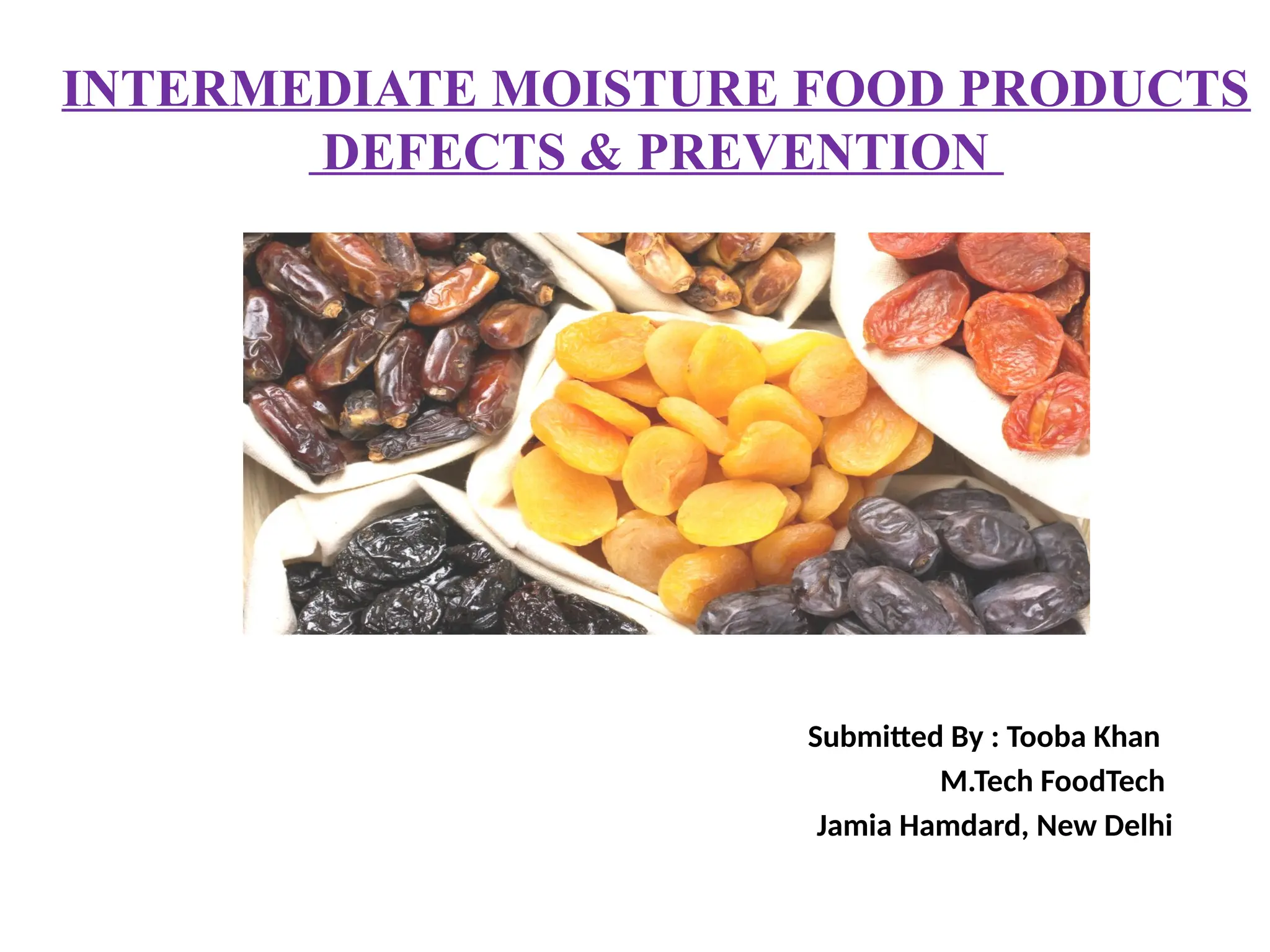
Describes the features, properties and method of production of Foods with less moisture and higher shelf Life known as IMF (Intermediate Moisture Foods). Like Candies , Dried Fruits.
INTERMEDIATE MOISTURE FOODPRODUCTS
DEFECTS & PREVENTION
Submitted By : Tooba Khan
M.Tech FoodTech
Jamia Hamdard, New Delhi
2.
INTERMEDIATE MOISTURE FOODS
•Traditional intermediate moisture
foods (IMF) can be regarded as one of
the oldest foods preserved by man.
• IMF foods rely heavily on the addition
of humectants and preservatives to
prevent or reduce the growth of
microorganisms.
• Can be stored without refrigeration
3.
INTRODUCTION
Intermediate moisture foods(IMF)
• Shelf-stable products.
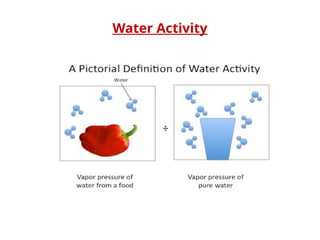
• Water activities of 0.6-0.84.
• Moisture content 15% - 40% .
• Edible without rehydration.
• Susceptible to yeast and mold growth.
• Examples are: dried fruits, sugar added commodities,
marshmallows, and pie fillings.
4.
SHELF LIFE ANDSAFETY
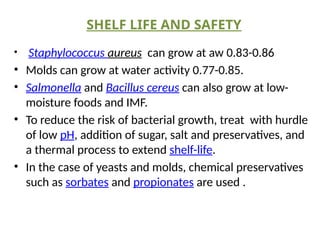
• Staphylococcus aureus can grow at aw 0.83-0.86
• Molds can grow at water activity 0.77-0.85.
• Salmonella and Bacillus cereus can also grow at low-
moisture foods and IMF.
• To reduce the risk of bacterial growth, treat with hurdle
of low pH, addition of sugar, salt and preservatives, and
a thermal process to extend shelf-life.
• In the case of yeasts and molds, chemical preservatives
such as sorbates and propionates are used .
5.
STABILITY
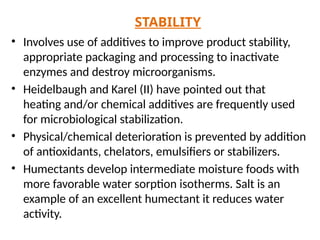
• Involves useof additives to improve product stability,
appropriate packaging and processing to inactivate
enzymes and destroy microorganisms.
• Heidelbaugh and Karel (II) have pointed out that
heating and/or chemical additives are frequently used
for microbiological stabilization.
• Physical/chemical deterioration is prevented by addition
of antioxidants, chelators, emulsifiers or stabilizers.
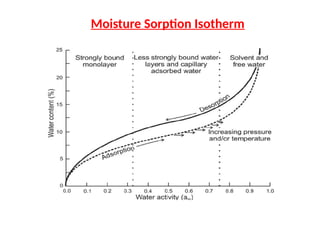
• Humectants develop intermediate moisture foods with
more favorable water sorption isotherms. Salt is an
example of an excellent humectant it reduces water
activity.
6.
Fruits preserved underIMF concept
• Preserving fruits and vegetables
without refrigeration.
• Sugar acts as a water activity
depressor limiting the capability
of bacteria to grow in food.
TECHNOLOGY OF INTERMEDIATEMOISTURE
FOODS-
• The food science associated with characterization of
these foods is one aspect.
• The stability of intermediate moisture foods under
various storage conditions and the associated chemical
and microbial processes of degradation are another
part.
• The technology of developing a new intermediate
moisture food, including the processing and selection of
ingredients, is another consideration.
• The nutritional aspects of these foods is also important.
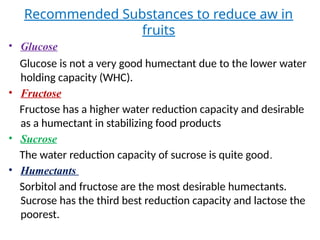
Recommended Substances toreduce aw in
fruits
• Glucose
Glucose is not a very good humectant due to the lower water
holding capacity (WHC).
• Fructose
Fructose has a higher water reduction capacity and desirable
as a humectant in stabilizing food products
• Sucrose
The water reduction capacity of sucrose is quite good.
• Humectants
Sorbitol and fructose are the most desirable humectants.
Sucrose has the third best reduction capacity and lactose the
poorest.
12.
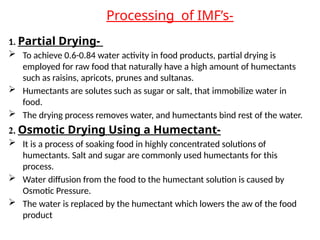
Processing of IMF’s-
1.Partial Drying-
To achieve 0.6-0.84 water activity in food products, partial drying is
employed for raw food that naturally have a high amount of humectants
such as raisins, apricots, prunes and sultanas.
Humectants are solutes such as sugar or salt, that immobilize water in
food.
The drying process removes water, and humectants bind rest of the water.
2. Osmotic Drying Using a Humectant-
It is a process of soaking food in highly concentrated solutions of
humectants. Salt and sugar are commonly used humectants for this
process.
Water diffusion from the food to the humectant solution is caused by
Osmotic Pressure.
The water is replaced by the humectant which lowers the aw of the food
product
13.
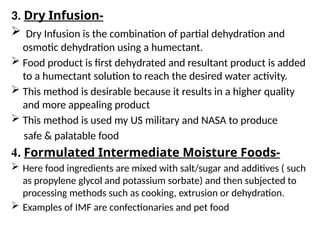
3. Dry Infusion-
Dry Infusion is the combination of partial dehydration and
osmotic dehydration using a humectant.
Food product is first dehydrated and resultant product is added
to a humectant solution to reach the desired water activity.
This method is desirable because it results in a higher quality
and more appealing product
This method is used my US military and NASA to produce
safe & palatable food
4. Formulated Intermediate Moisture Foods-
Here food ingredients are mixed with salt/sugar and additives ( such
as propylene glycol and potassium sorbate) and then subjected to
processing methods such as cooking, extrusion or dehydration.
Examples of IMF are confectionaries and pet food
14.
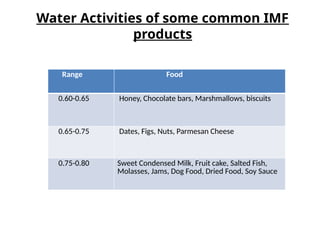
Water Activities ofsome common IMF
products
Range Food
0.60-0.65 Honey, Chocolate bars, Marshmallows, biscuits
0.65-0.75 Dates, Figs, Nuts, Parmesan Cheese
0.75-0.80 Sweet Condensed Milk, Fruit cake, Salted Fish,
Molasses, Jams, Dog Food, Dried Food, Soy Sauce
15.
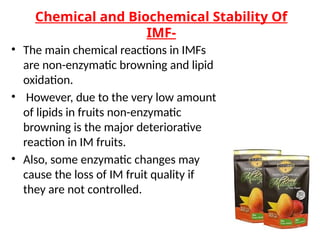
Chemical and BiochemicalStability Of
IMF-
• The main chemical reactions in IMFs
are non-enzymatic browning and lipid
oxidation.
• However, due to the very low amount
of lipids in fruits non-enzymatic
browning is the major deteriorative
reaction in IM fruits.
• Also, some enzymatic changes may
cause the loss of IM fruit quality if
they are not controlled.
16.
Non Enzymatic Browning-
•In IM fruits the reducing sugars produce some
undesirable brown pigments. These pigments are
formed especially during long term storage.
• However, thermal processing of foods may accelerate
the brown pigment formation by reducing sugars.
• In IMF these brown pigments may also cause the
formation of off-flavors that are not acceptable by
consumers.
• The reactivity of different sugars to form brown
pigments is as follows: ribose > xylose> arabinose >
galactose > glucose > fructose > galactose > mannose
> glucose >fructose > lactose > saccharose .
17.
• When non-enzymaticbrowning is a problem pentoses
such as ribose, xylose and arabinose should not be
used in the formulation of IM fruits
• The use of sulfites is the most effective method to
prevent non-enzymatic browning. However, due to
their adverse health effects, the use of these chemicals
has been discouraged.
18.
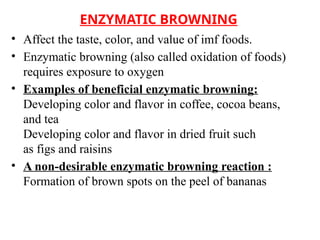
ENZYMATIC BROWNING
• Affectthe taste, color, and value of imf foods.
• Enzymatic browning (also called oxidation of foods)
requires exposure to oxygen
• Examples of beneficial enzymatic browning:
Developing color and flavor in coffee, cocoa beans,
and tea
Developing color and flavor in dried fruit such
as figs and raisins
• A non-desirable enzymatic browning reaction :
Formation of brown spots on the peel of bananas
19.
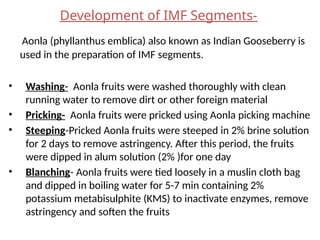
Development of IMFSegments-
Aonla (phyllanthus emblica) also known as Indian Gooseberry is
used in the preparation of IMF segments.
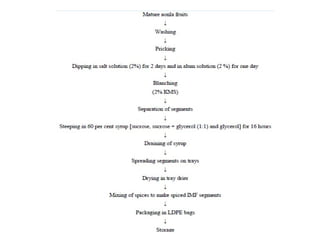
• Washing- Aonla fruits were washed thoroughly with clean
running water to remove dirt or other foreign material
• Pricking- Aonla fruits were pricked using Aonla picking machine
• Steeping-Pricked Aonla fruits were steeped in 2% brine solution
for 2 days to remove astringency. After this period, the fruits
were dipped in alum solution (2% )for one day
• Blanching- Aonla fruits were tied loosely in a muslin cloth bag
and dipped in boiling water for 5-7 min containing 2%
potassium metabisulphite (KMS) to inactivate enzymes, remove
astringency and soften the fruits
20.
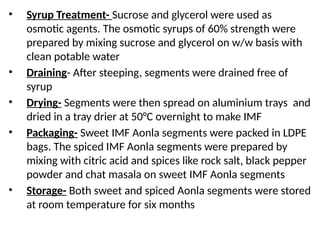
• Syrup Treatment-Sucrose and glycerol were used as
osmotic agents. The osmotic syrups of 60% strength were
prepared by mixing sucrose and glycerol on w/w basis with
clean potable water
• Draining- After steeping, segments were drained free of
syrup
• Drying- Segments were then spread on aluminium trays and
dried in a tray drier at 50°C overnight to make IMF
• Packaging- Sweet IMF Aonla segments were packed in LDPE
bags. The spiced IMF Aonla segments were prepared by
mixing with citric acid and spices like rock salt, black pepper
powder and chat masala on sweet IMF Aonla segments
• Storage- Both sweet and spiced Aonla segments were stored
at room temperature for six months
22.
Advantages and Disadvantagesof IMF Preservation
Advantages-
• Easy to prepare and store without refrigeration
• Energy efficient, relatively cheap and consumed without rehydration
• Not readily subject to spoilage even if packages have been damaged
prior to opening , as with thermostabilized foods because of low aw
• Have potential applications in developing countries, military and space
rations or in other situations where refrigeration or thermal processing
facilities are inadequate
Disadvantages-
• Some contain high levels of additives (i.e. nitrites, sulphites,
humectants, etc) that may cause health concerns .
• High sugar content is also a concern because of high calorific intake
• Therefore efforts are been made to improve the quality of such foods by
an intelligent application of hurdles
23.
REFERENCES
• Journal ofFood Protection. Vol. 45, No.5, Pages 484-
491 (Aprill982) Copyright International Association of
Milk, Food, and Environmental Sanitarians.
• Intermediate moisture foods by R. Davies.
• water activity: theory and application by rockland.
• www.fao.org/docrep/005/Y4358E/y4358e07.htm
chapter 4.