WEEK3 TE303
CHANNEL ASSIGNMENT
• DEFINITION: With the rapid increase in number of mobile users, the mobile service providers
had to follow strategies which ensure the effective utilization of the limited radio spectrum
• TYPE OF ASSIGNMENT- FIXED & DYNAMIC
• FIXED:- FIXED ALLOCATION AND POSSIBLE BORROWING FROM
ADJACENT CELLS
MSC SUPERVISES THE CHANNEL ASSIGNMENTS
-DYNAMIC CHANNEL ASSIGNMENT- N0 CHANNEL IS PERMANENTLY
ASSIGNED
THOUGH QUALITY SERVICE IS PROVIDED, MSC HAS A HEAVY LOAD
HANDOFF
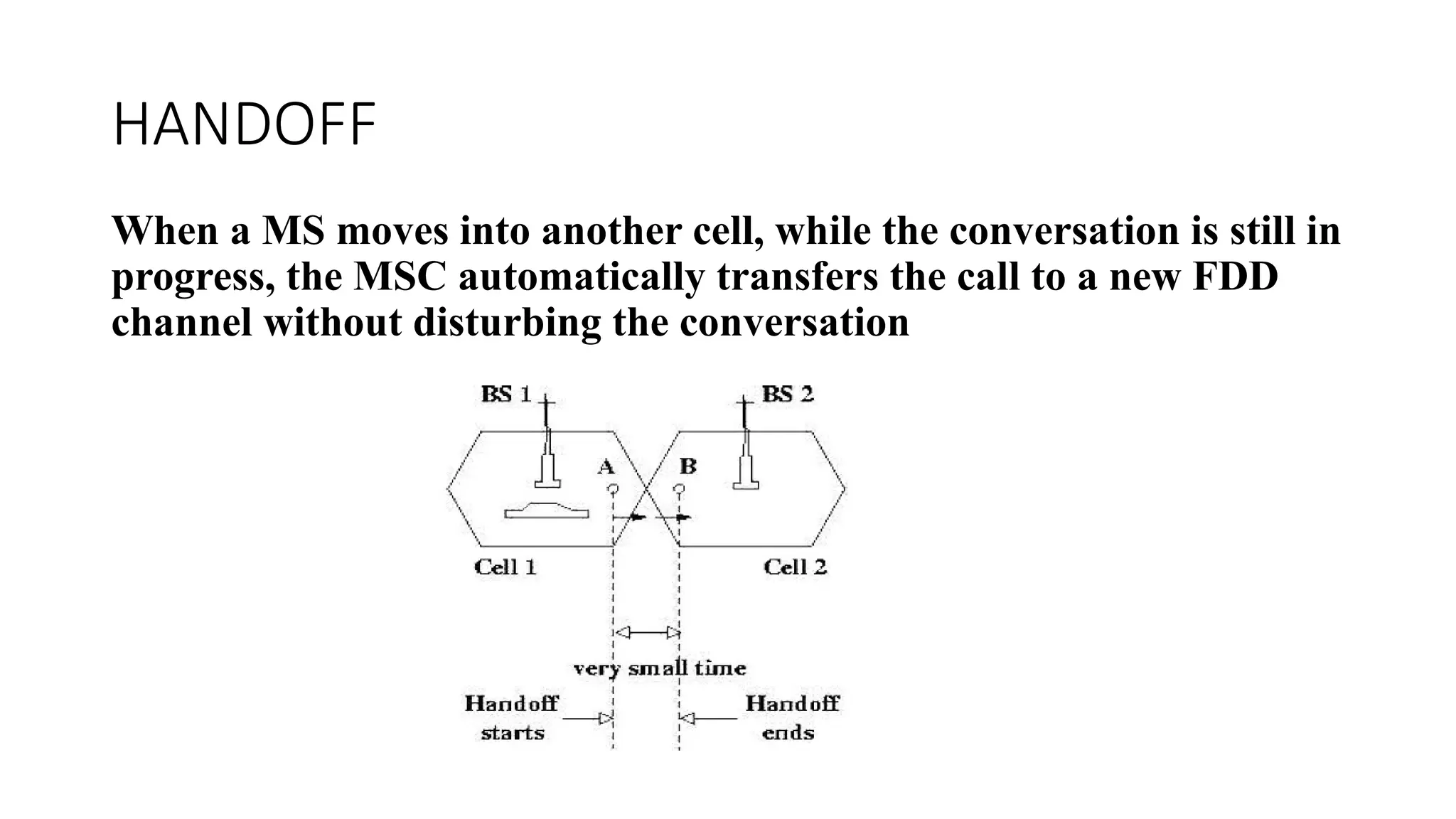
When a MS moves into another cell, while the conversation is still in
progress, the MSC automatically transfers the call to a new FDD
channel without disturbing the conversation
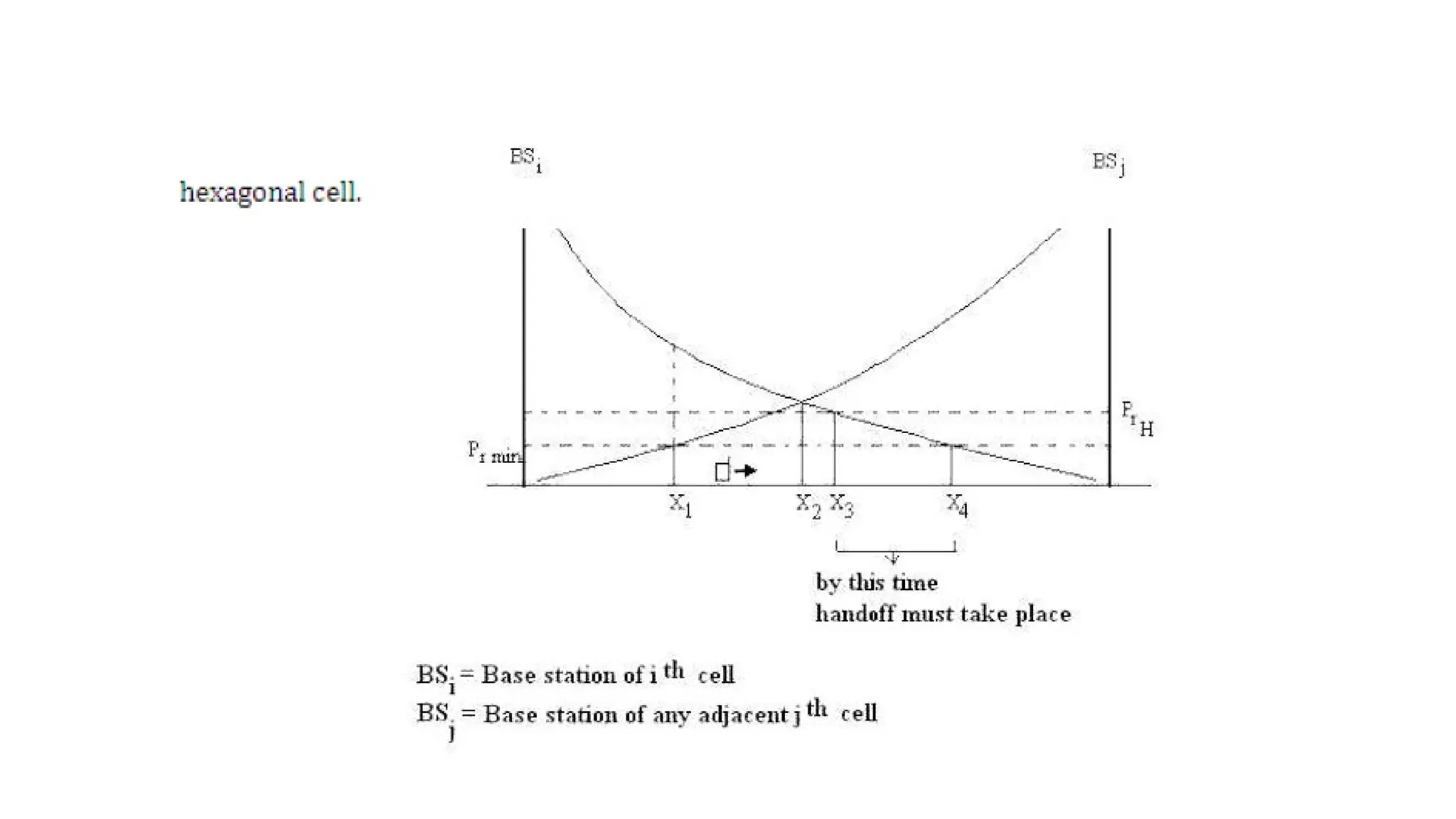
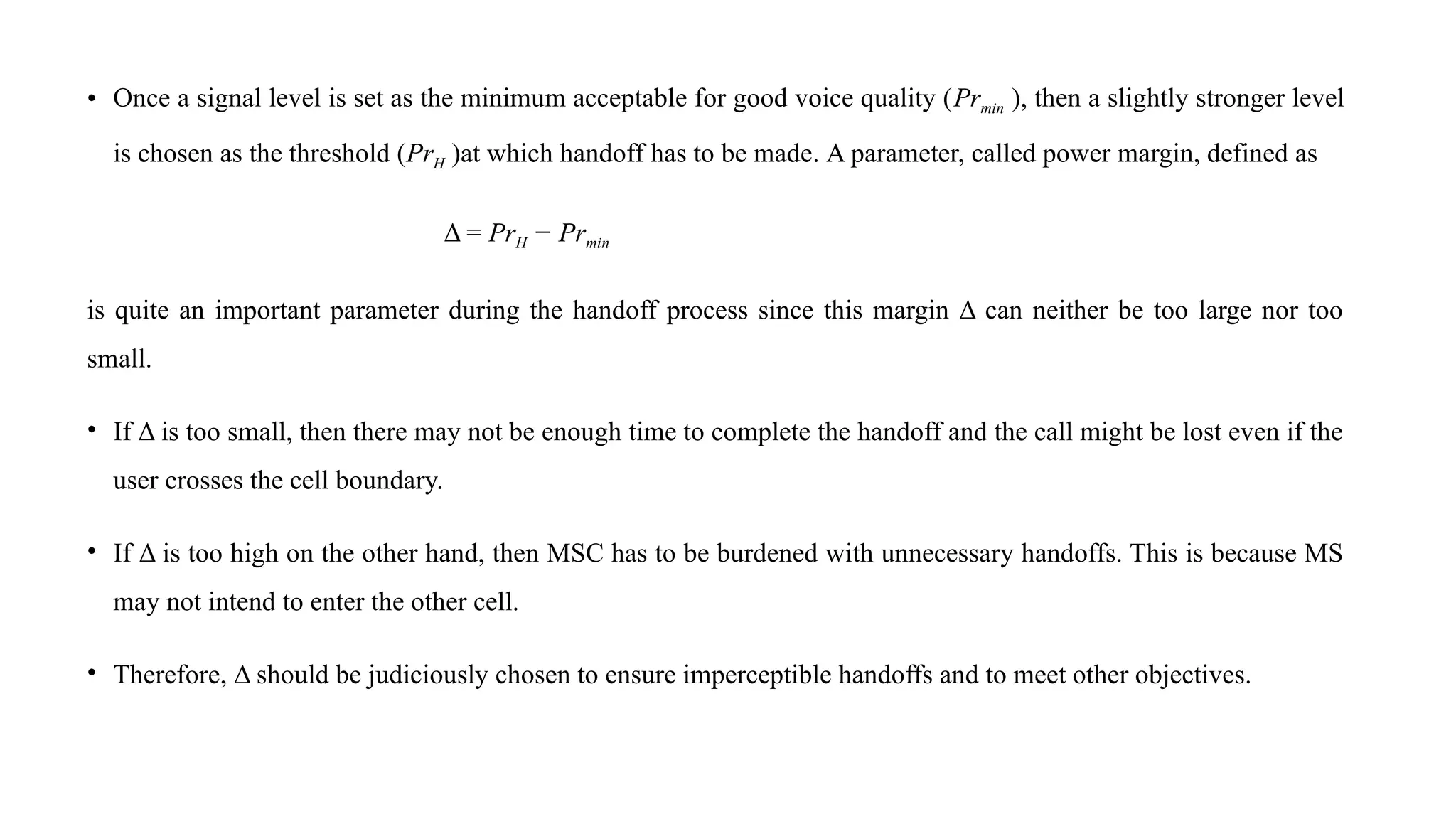
• Once a signal level is set as the minimum acceptable for good voice quality (Prmin ), then a slightly stronger level
is chosen as the threshold (PrH )at which handoff has to be made. A parameter, called power margin, defined as
Δ = PrH − Prmin
is quite an important parameter during the handoff process since this margin Δ can neither be too large nor too
small.
• If Δ is too small, then there may not be enough time to complete the handoff and the call might be lost even if the
user crosses the cell boundary.
• If Δ is too high on the other hand, then MSC has to be burdened with unnecessary handoffs. This is because MS
may not intend to enter the other cell.
• Therefore, Δ should be judiciously chosen to ensure imperceptible handoffs and to meet other objectives.
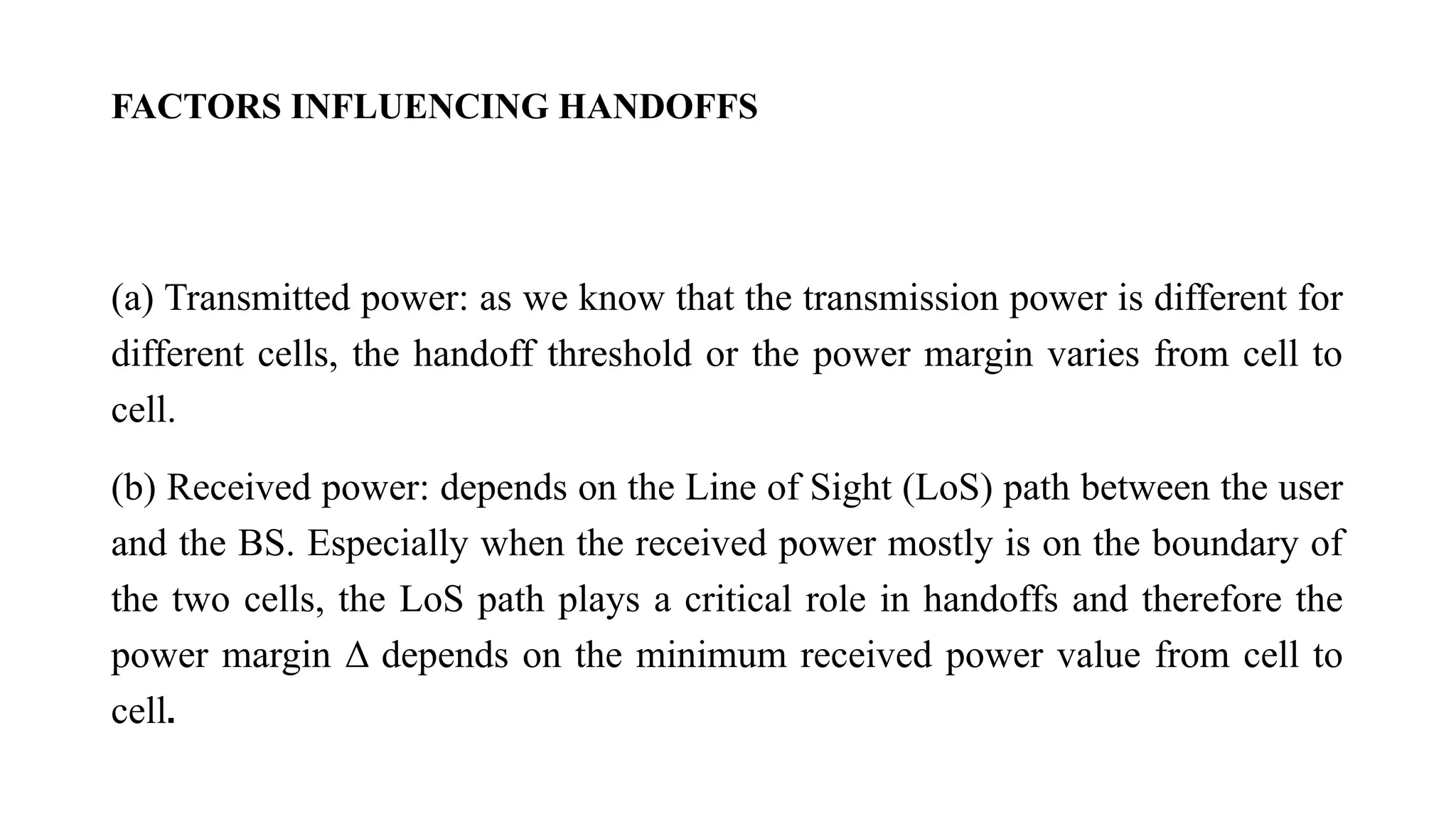
FACTORS INFLUENCING HANDOFFS
(a) Transmitted power: as we know that the transmission power is different for
different cells, the handoff threshold or the power margin varies from cell to
cell.
(b) Received power: depends on the Line of Sight (LoS) path between the user
and the BS. Especially when the received power mostly is on the boundary of
the two cells, the LoS path plays a critical role in handoffs and therefore the
power margin Δ depends on the minimum received power value from cell to
cell.
c) Area & shape of the cell. – cell structure
(d) Mobility of users: The number of mobile users entering or going out of a particular cell,
also affects the handoff strategy of a cell.
Assignment 1
1.
Discuss handoff in the different generations of mobile technology
A Few Practical Problems in Handoff Scenario
(a) Different speed of mobile users
with the increase of mobile users in urban areas, microcells are
introduced in the cells to increase the capacity . The users with high
speed frequently crossing the micro-cells becomes a burdened to
MSC as it has to take care of handoffs. Several schemes thus have
been designed to handle the simultaneous traffic of high speed and
low speed users while minimizing the handoff intervention from the
MSC, one of them being the ‘Umbrella Cell’ approach. This
technique provides large area coverage to high speed users while
providing small area coverage to users traveling at low speed.
By using different antenna heights and different power levels, it is
possible to provide larger and smaller cells at a same location. The BS
can measure the speed of the user by its short term average signal
strength over the coverage area and decides which cell to handle that
call. If the speed is less, then the corresponding microcell handles the
call so that there is good corner coverage. This approach assures that
handoffs are minimized for high speed users and provides additional
microcell channels for pedestrian users.
(b) Cell dragging problem:
This is another practical problem in the urban area with additional microcells. For example, consider
there is a LoS path between the MS and BS1 while the user is in the cell covered by BS2. Since there
is a LoS with the BS1, the signal strength received from BS1 would be greater than that received from
BS2.
However, since the user is in cell covered by BS2, handoff cannot take place and as a result, it
experiences a lot of interferences. This problem can be solved by judiciously choosing the handoff
threshold along with adjusting the coverage area.
(c) Inter-system handoff:
If one user is leaving the coverage area of one MSC and is
entering the area of another MSC, then the call might be lost if
there is no handoff in this case too. Such a handoff is called
inter-system handoff and in order to facilitate this, mobiles
usually have roaming facility.
Interference & System Capacity
• Susceptibility and interference problems associated with
mobile communications equipment are because of the
problem of time congestion within the electromagnetic
spectrum. It is the limiting factor in the performance of
cellular systems
• If there is an interference in the voice channels, cross talk is
heard will appear as noise between the users. The
interference in the control channels leads to missed and error
calls because of digital signalling
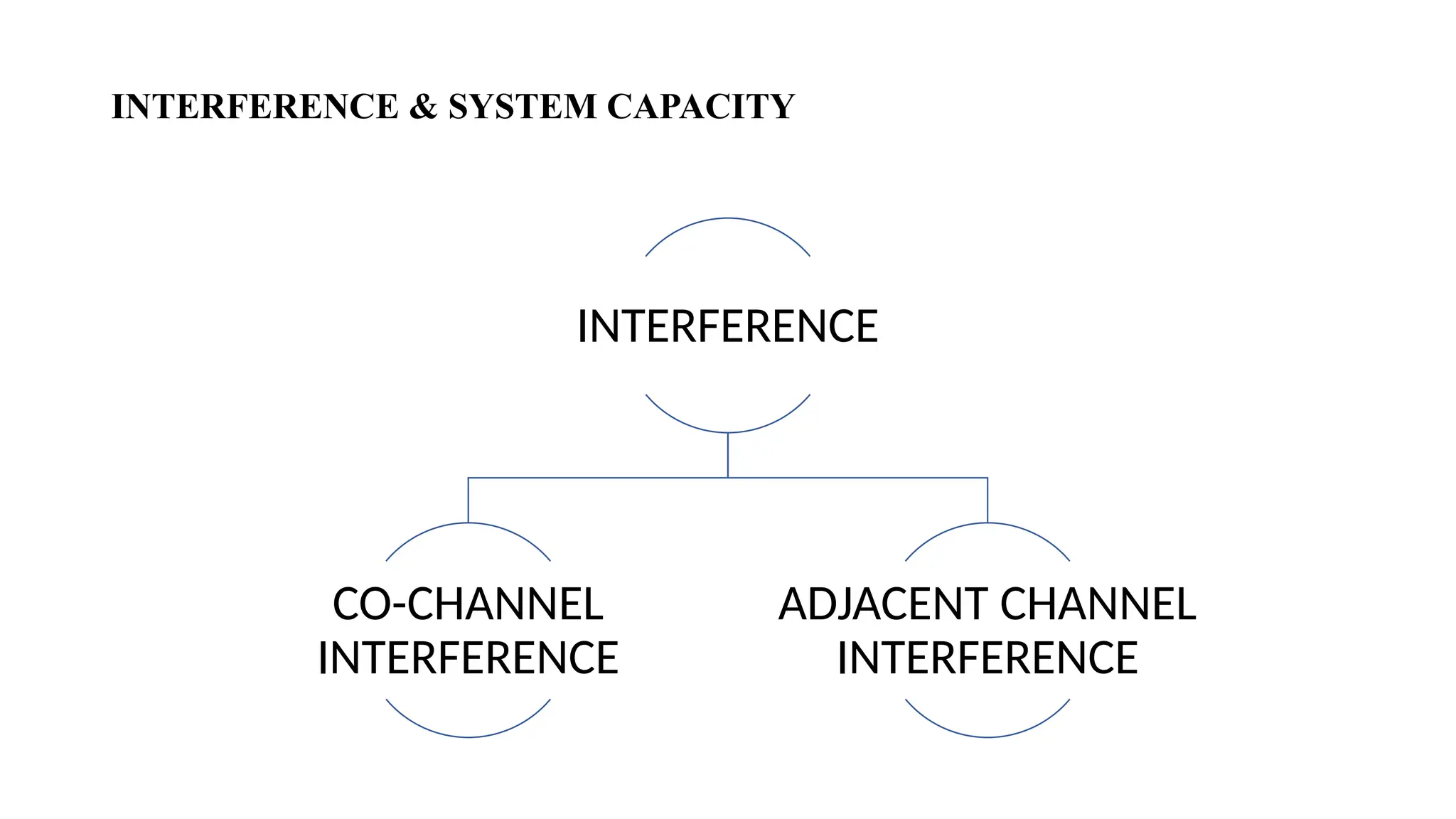
INTERFERENCE & SYSTEM CAPACITY
INTERFERENCE
CO-CHANNEL
INTERFERENCE
ADJACENT CHANNEL
INTERFERENCE
Co-Channel Interference
Increasing frequency reuse also increases interference, which decreases system capacity
and service quality.
The cells where the same set of frequencies is used are call co-channel cells.
Co-channel interference is the cross talk between two different radio transmitters using
the same radio frequency as is the case with the co-channel cells.
Other reasons of CCI can be because of either adverse weather conditions or poor
frequency planning or overly-crowded radio spectrum.
If the cell size and the power transmitted at the base stations are same then CCI
will become independent of the transmitted power and will depend on radius of
the cell (R) and the distance between the interfering co-channel cells (D).
If D/R ratio is increased, then the effective distance between the co-channel cells
will increase and interference will decrease. The parameter Q is called the
frequency reuse ratio and is related to the cluster size. For hexagonal geometry
Adjacent Channel Interference (ACI)
This is a different type of interference which is caused by adjacent channels i.e.
channels in adjacent cells.
It is the signal impairment which occurs to one frequency due to presence of another
signal on a nearby frequency.
This occurs when imperfect receiver filters allow nearby frequencies to leak into the
pass band.
This problem is enhanced if the adjacent channel user is transmitting in a close
range compared to the subscriber’s receiver while the receiver attempts to receive a
base station on the channel.
This effect can also occur if a mobile close to a base station transmits on a channel
close to one being used by a weak mobile.
This is called near-far effect.
The more adjacent channels are packed into the channel
block, the higher the spectral efficiency, provided that the
performance degradation can be tolerated in the system link
budget.
POWER CONTROL FOR REDUCING INTERFERENCE
• In practical cellular radio and personal communication systems the
power levels transmitted by every subscriber unit are under constant
control by the serving base stations. This is done to ensure that each
mobile transmits the smallest power necessary to maintain a good
quality link on the reverse channel.
• Power control not only helps prolong battery life for subscriber unit, but
also dramatically reduces the reverse channel S/I in the system.

WEEK3 TE303, Telecommunication networks. TE. Channel Assignments

  • 1.
  • 2.
    CHANNEL ASSIGNMENT • DEFINITION:With the rapid increase in number of mobile users, the mobile service providers had to follow strategies which ensure the effective utilization of the limited radio spectrum • TYPE OF ASSIGNMENT- FIXED & DYNAMIC • FIXED:- FIXED ALLOCATION AND POSSIBLE BORROWING FROM ADJACENT CELLS MSC SUPERVISES THE CHANNEL ASSIGNMENTS -DYNAMIC CHANNEL ASSIGNMENT- N0 CHANNEL IS PERMANENTLY ASSIGNED THOUGH QUALITY SERVICE IS PROVIDED, MSC HAS A HEAVY LOAD
  • 3.
    HANDOFF When a MSmoves into another cell, while the conversation is still in progress, the MSC automatically transfers the call to a new FDD channel without disturbing the conversation
  • 5.
    • Once asignal level is set as the minimum acceptable for good voice quality (Prmin ), then a slightly stronger level is chosen as the threshold (PrH )at which handoff has to be made. A parameter, called power margin, defined as Δ = PrH − Prmin is quite an important parameter during the handoff process since this margin Δ can neither be too large nor too small. • If Δ is too small, then there may not be enough time to complete the handoff and the call might be lost even if the user crosses the cell boundary. • If Δ is too high on the other hand, then MSC has to be burdened with unnecessary handoffs. This is because MS may not intend to enter the other cell. • Therefore, Δ should be judiciously chosen to ensure imperceptible handoffs and to meet other objectives.
  • 6.
    FACTORS INFLUENCING HANDOFFS (a)Transmitted power: as we know that the transmission power is different for different cells, the handoff threshold or the power margin varies from cell to cell. (b) Received power: depends on the Line of Sight (LoS) path between the user and the BS. Especially when the received power mostly is on the boundary of the two cells, the LoS path plays a critical role in handoffs and therefore the power margin Δ depends on the minimum received power value from cell to cell.
  • 7.
    c) Area &shape of the cell. – cell structure (d) Mobility of users: The number of mobile users entering or going out of a particular cell, also affects the handoff strategy of a cell.
  • 8.
    Assignment 1 1. Discuss handoffin the different generations of mobile technology
  • 9.
    A Few PracticalProblems in Handoff Scenario (a) Different speed of mobile users with the increase of mobile users in urban areas, microcells are introduced in the cells to increase the capacity . The users with high speed frequently crossing the micro-cells becomes a burdened to MSC as it has to take care of handoffs. Several schemes thus have been designed to handle the simultaneous traffic of high speed and low speed users while minimizing the handoff intervention from the MSC, one of them being the ‘Umbrella Cell’ approach. This technique provides large area coverage to high speed users while providing small area coverage to users traveling at low speed.
  • 10.
    By using differentantenna heights and different power levels, it is possible to provide larger and smaller cells at a same location. The BS can measure the speed of the user by its short term average signal strength over the coverage area and decides which cell to handle that call. If the speed is less, then the corresponding microcell handles the call so that there is good corner coverage. This approach assures that handoffs are minimized for high speed users and provides additional microcell channels for pedestrian users.
  • 11.
    (b) Cell draggingproblem: This is another practical problem in the urban area with additional microcells. For example, consider there is a LoS path between the MS and BS1 while the user is in the cell covered by BS2. Since there is a LoS with the BS1, the signal strength received from BS1 would be greater than that received from BS2. However, since the user is in cell covered by BS2, handoff cannot take place and as a result, it experiences a lot of interferences. This problem can be solved by judiciously choosing the handoff threshold along with adjusting the coverage area.
  • 12.
    (c) Inter-system handoff: Ifone user is leaving the coverage area of one MSC and is entering the area of another MSC, then the call might be lost if there is no handoff in this case too. Such a handoff is called inter-system handoff and in order to facilitate this, mobiles usually have roaming facility.
  • 13.
    Interference & SystemCapacity • Susceptibility and interference problems associated with mobile communications equipment are because of the problem of time congestion within the electromagnetic spectrum. It is the limiting factor in the performance of cellular systems • If there is an interference in the voice channels, cross talk is heard will appear as noise between the users. The interference in the control channels leads to missed and error calls because of digital signalling
  • 14.
    INTERFERENCE & SYSTEMCAPACITY INTERFERENCE CO-CHANNEL INTERFERENCE ADJACENT CHANNEL INTERFERENCE
  • 15.
    Co-Channel Interference Increasing frequencyreuse also increases interference, which decreases system capacity and service quality. The cells where the same set of frequencies is used are call co-channel cells. Co-channel interference is the cross talk between two different radio transmitters using the same radio frequency as is the case with the co-channel cells. Other reasons of CCI can be because of either adverse weather conditions or poor frequency planning or overly-crowded radio spectrum.
  • 16.
    If the cellsize and the power transmitted at the base stations are same then CCI will become independent of the transmitted power and will depend on radius of the cell (R) and the distance between the interfering co-channel cells (D). If D/R ratio is increased, then the effective distance between the co-channel cells will increase and interference will decrease. The parameter Q is called the frequency reuse ratio and is related to the cluster size. For hexagonal geometry
  • 17.
    Adjacent Channel Interference(ACI) This is a different type of interference which is caused by adjacent channels i.e. channels in adjacent cells. It is the signal impairment which occurs to one frequency due to presence of another signal on a nearby frequency. This occurs when imperfect receiver filters allow nearby frequencies to leak into the pass band. This problem is enhanced if the adjacent channel user is transmitting in a close range compared to the subscriber’s receiver while the receiver attempts to receive a base station on the channel. This effect can also occur if a mobile close to a base station transmits on a channel close to one being used by a weak mobile.
  • 18.
    This is callednear-far effect. The more adjacent channels are packed into the channel block, the higher the spectral efficiency, provided that the performance degradation can be tolerated in the system link budget.
  • 19.
    POWER CONTROL FORREDUCING INTERFERENCE • In practical cellular radio and personal communication systems the power levels transmitted by every subscriber unit are under constant control by the serving base stations. This is done to ensure that each mobile transmits the smallest power necessary to maintain a good quality link on the reverse channel. • Power control not only helps prolong battery life for subscriber unit, but also dramatically reduces the reverse channel S/I in the system.