Intercultural
Communication
and
Body Language
Presented by: KADDARI Ibrahim Elkhalil
ALI MOUSSA Yassine
BOUALEM Fethi
Lecture Plan
1) What is communication and intercultural
communication?
2) Nonverbal communication
3) Gestures used in different cultures and
their meaning.
Communication
Communication is the activity or process of
giving information to other people or living
things.
M. Kovyazina Comparative Culturology Lectures, Tyumen State University, 2004-2009
Intercultural Communication
 focuses on differences in language and
behavior patterns
 the theory of intercultural communication
encourages the understanding of the
differences between two speakers from
unique national cultures
Intercultural Verbal
Communication Advice
 Speak slowly
 Repeat as necessary
 Be sincere and empathetic
 Keep it simple and short
 Show and demonstrate by using
examples /illustrations
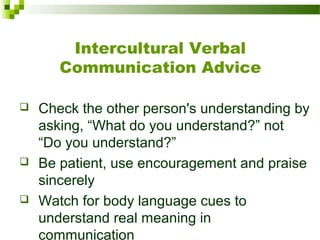
Intercultural Verbal
Communication Advice
 Check the other person's understanding by
asking, “What do you understand?” not
“Do you understand?”
 Be patient, use encouragement and praise
sincerely
 Watch for body language cues to
understand real meaning in
communication
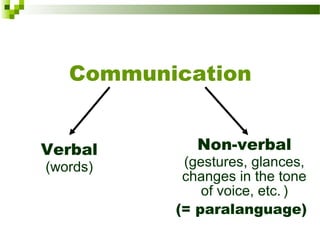
Communication
Verbal
(words)
Non-verbal
(gestures, glances,
changes in the tone
of voice, etc. )
(= paralanguage)
Nonverbal communication is
studied by:
1. Proxemics /pr k si m ks/ɒ ˈ ː ɪ
2. Haptics / hæpt ks/ˈ ɪ
3. Oculesics / kj lis ks/ˈɒ ʊ ɪ
4. Kinesics /ka ni s ks/ɪˈ ː ɪ
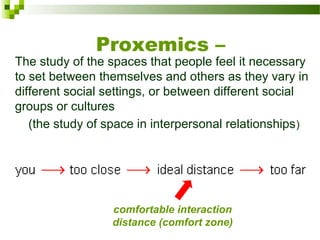
Proxemics –
The study of the spaces that people feel it necessary
to set between themselves and others as they vary in
different social settings, or between different social
groups or cultures
(the study of space in interpersonal relationships)
comfortable interaction
distance (comfort zone)
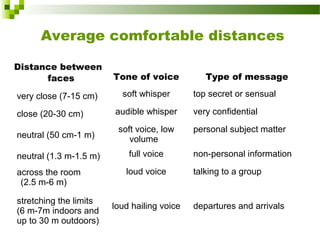
Average comfortable distances
Distance between
faces  Tone of voice Type of message
  very close (7-15 cm) soft whisper   top secret or sensual
  close (20-30 cm) audible whisper   very confidential
  neutral (50 cm-1 m)
soft voice, low 
volume  
  personal subject matter
  neutral (1.3 m-1.5 m) full voice   non-personal information  
  across the room          
 (2.5 m-6 m)
loud voice   talking to a group
  stretching the limits
  (6 m-7m indoors and
  up to 30 m outdoors)
loud hailing voice
  
  departures and arrivals
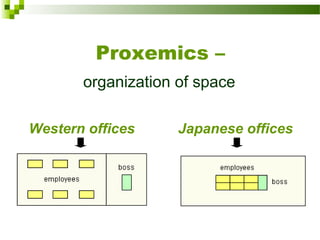
Proxemics –
organization of space 
Western offices Japanese offices
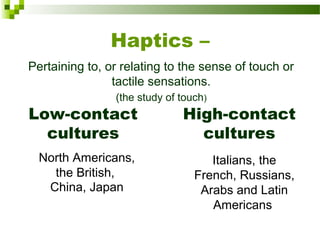
Haptics –
Pertaining to, or relating to the sense of touch or 
tactile sensations.
(the study of touch)
Low-contact
cultures
High-contact
cultures
North Americans, 
the British, 
China, Japan
Italians, the 
French, Russians, 
Arabs and Latin 
Americans 
Oculesics –
the study of the use of the eyes in 
interpersonal communication  
(connected with the eye as a bodily organ)
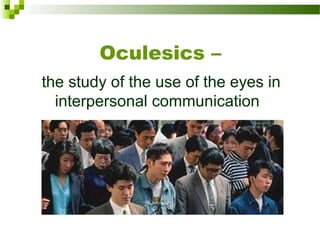
In China and Japan people avoid 
looking at each other in public places 
or in a crowd. 
Oculesics –
the study of the use of the eyes in 
interpersonal communication  
Oculesics –
the study of the use of the eyes in 
interpersonal communication  
Asians, Puerto Ricans, West Indians, African 
Americans and Native Americans consider a 
direct eye contact to be rude, or 
disrespectful, or intimidating, while 
Europeans find it a sign of openness and 
honesty.
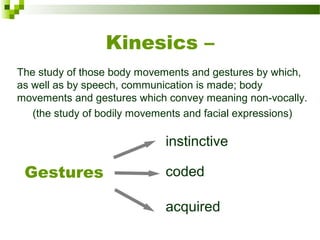
Kinesics –
The study of those body movements and gestures by which, 
as well as by speech, communication is made; body 
movements and gestures which convey meaning non-vocally.
(the study of bodily movements and facial expressions)
Gestures
instinctive
coded
acquired
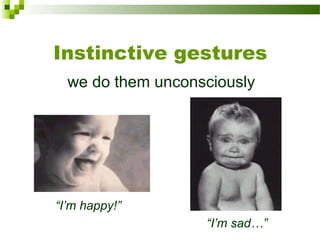
Instinctive gestures
we do them unconsciously
“I’m happy!”
“I’m sad…”
Universal hand gestures
MEANING HAND GESTURE
“I am hungry.” Patting the stomach with the hands
“I am cold”, or it's 
cozy.
Rubbing the hands together.
Coded / technical gestures –
hand signals used by TV directors,
gestures of referees or brokers in the
stock market
Acquired gestures – socially
generated
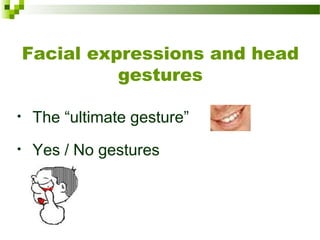
Facial expressions and head
gestures
• The “ultimate gesture”
• Yes / No gestures
Hand and arm gestures
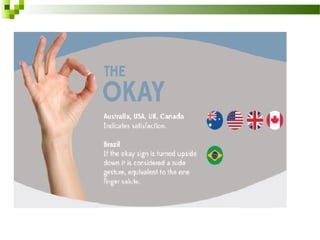
• "O.K." gesture
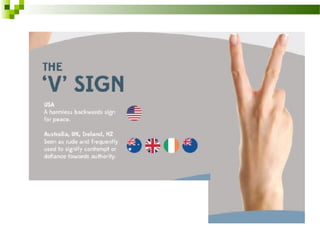
• Victory/Peace sign
Hand and arm gestures
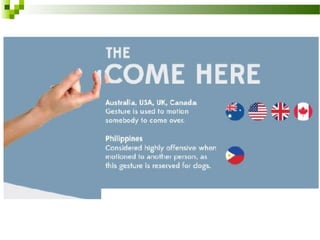
• finger beckoning
• upraised hand
Hand and arm gestures
• touching a child on the top of the
head
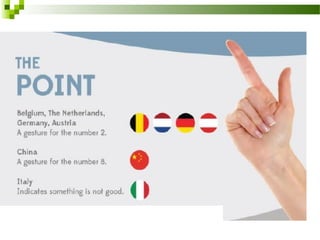
• point at an object
• placing your hand behind your
head
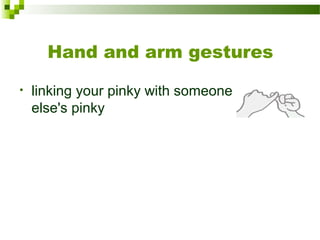
Hand and arm gestures
• linking your pinky with someone
else's pinky
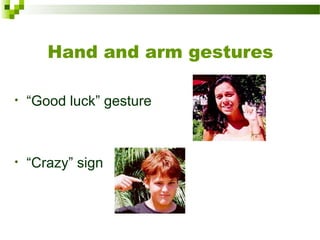
Hand and arm gestures
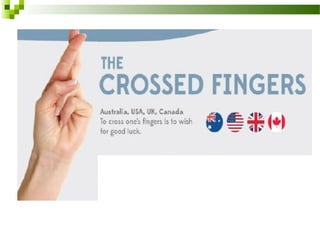
• “Good luck” gesture
• “Crazy” sign
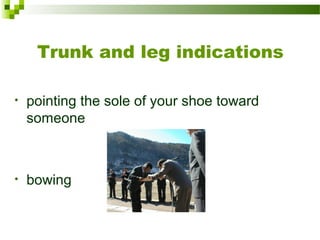
Trunk and leg indications
• pointing the sole of your shoe toward
someone
• bowing
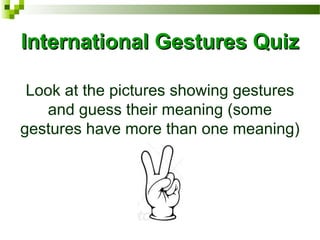
International Gestures QuizInternational Gestures Quiz
Look at the pictures showing gestures
and guess their meaning (some
gestures have more than one meaning)
THANK YOU
FOR
YOUR ATTENTION

Intercultural Communication and Body Language

Editor's Notes

  • #2 M. Kovyazina Comparative Culturology Lectures, Tyumen State University, 2004-2009
  • #3 M. Kovyazina Comparative Culturology Lectures, Tyumen State University, 2004-2009
  • #4 M. Kovyazina Comparative Culturology Lectures, Tyumen State University, 2004-2009
  • #5 M. Kovyazina Comparative Culturology Lectures, Tyumen State University, 2004-2009
  • #6 M. Kovyazina Comparative Culturology Lectures, Tyumen State University, 2004-2009
  • #7 M. Kovyazina Comparative Culturology Lectures, Tyumen State University, 2004-2009
  • #8 M. Kovyazina Comparative Culturology Lectures, Tyumen State University, 2004-2009
  • #9 M. Kovyazina Comparative Culturology Lectures, Tyumen State University, 2004-2009
  • #10 M. Kovyazina Comparative Culturology Lectures, Tyumen State University, 2004-2009
  • #20 auction
  • #22 M. Kovyazina Comparative Culturology Lectures, Tyumen State University, 2004
  • #23 Beckoning (follow me)
  • #24 M. Kovyazina Comparative Culturology Lectures, Tyumen State University, 2004
  • #25 M. Kovyazina Comparative Culturology Lectures, Tyumen State University, 2004
  • #26 Australia britain and canada means i stole your nose
  • #27 M. Kovyazina Comparative Culturology Lectures, Tyumen State University, 2004
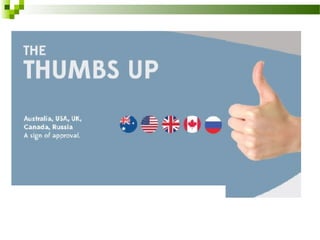
  • #34 Well done son