https://www.youtube.com/watch?v=QH2bsRLZ_CE
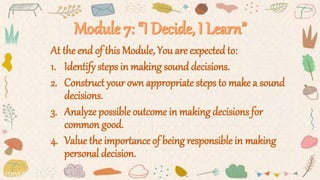
At the end of this Module, You are expected to:
1. Identify steps in making sound decisions.
2. Construct your own appropriate steps to make a sound
decisions.
3. Analyze possible outcome in making decisions for
common good.
4. Value the importance of being responsible in making
personal decision.
Making choices is one of the basic things you do everyday. You make
choices everywhere- at home, in school and in the community. You as a
person need to decide and choose the right and best choice in life and
career. But somehow, it is hard to decide on your own because there are
different factors that influence your decision.
In this module, try to appreciate the role of your teachers, parents
and other significant persons in your life in identifying the different steps
in decision making
Think what kindof decision maker you are
Do you decide based on your feelings?
Or you take enoughtime to think about it first?
Are you someone who asks opinions of others, like your parents, siblings, friends
and trustedadults?
Think of two to three personal experiences that support your thought.
• After 10 minutes, face the mirror and tell what kindof decision maker you are.
• Tell why you shouldmaintain or change your ways of deciding.
• After the activity answerthe following questions on a sheet of paper.
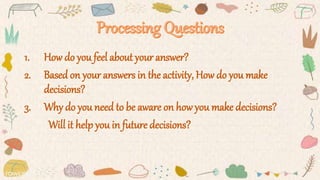
1. How do you feel about your answer?
2. Based on your answers in the activity, How do you make
decisions?
3. Why do you need to be aware on how you make decisions?
Will it help you in future decisions?
Help Betty by identifying her problemand by providing as many possible helpful
solutions as you can. Use the given template as yourguide. Do this on a sheet of paper.
1. How do you rank your suggested solutions? Why?
2. What are the advantages and disadvantages of your top
suggested solution?
3. Is it something worth pursuing? Why?
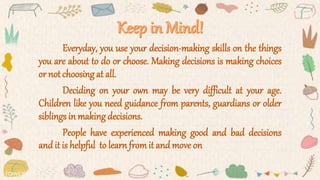
Everyday, you use your decision-making skills on the things
you are about to do or choose. Making decisions is making choices
or not choosing at all.
Deciding on your own may be very difficult at your age.
Children like you need guidance from parents, guardians or older
siblings in making decisions.
People have experienced making good and bad decisions
and it is helpful to learn fromit and move on
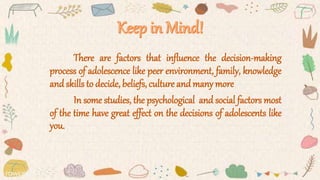
There are factors that influence the decision-making
process of adolescence like peer environment, family, knowledge
and skills to decide, beliefs, culture and many more
In some studies, the psychological and social factors most
of the time have great effect on the decisions of adolescents like
you.
1. Define the problem.
2. Gather information about the issue or problem.
3. Know your options.
4. Weigh the pros and cons of each option.
5. Take the courage to decide and act on it.
Always remember that you are a work in progress.
If you fail, the only way up is to stand and try again.
Take your failures as opportunities to become better
As American inventor Thomas Edison said
“ I have not failed, I just found 10,000 ways that won’t work.”
Think of a past or present problem that you are
comfortable to share with your Homeroom Guidance
Teacher.
Try to apply the five basic steps in making decision.
Based on the previous activity, Make a poster of
the desired outcome of your decision.
Show also in the poster how you would feel if you attain
it.
Make a Letter to yourself about decisions in the
past months. Include how you feel about it and the
things that you would try to change to improve your
decision- making skills.
Do this on a sheet of paper.
HOMEROOM GUIDANCE PROGRAM.pptx

HOMEROOM GUIDANCE PROGRAM.pptx

  • 2.
  • 4.
    At the endof this Module, You are expected to: 1. Identify steps in making sound decisions. 2. Construct your own appropriate steps to make a sound decisions. 3. Analyze possible outcome in making decisions for common good. 4. Value the importance of being responsible in making personal decision.
  • 5.
    Making choices isone of the basic things you do everyday. You make choices everywhere- at home, in school and in the community. You as a person need to decide and choose the right and best choice in life and career. But somehow, it is hard to decide on your own because there are different factors that influence your decision. In this module, try to appreciate the role of your teachers, parents and other significant persons in your life in identifying the different steps in decision making
  • 6.
    Think what kindofdecision maker you are Do you decide based on your feelings? Or you take enoughtime to think about it first? Are you someone who asks opinions of others, like your parents, siblings, friends and trustedadults? Think of two to three personal experiences that support your thought. • After 10 minutes, face the mirror and tell what kindof decision maker you are. • Tell why you shouldmaintain or change your ways of deciding. • After the activity answerthe following questions on a sheet of paper.
  • 7.
    1. How doyou feel about your answer? 2. Based on your answers in the activity, How do you make decisions? 3. Why do you need to be aware on how you make decisions? Will it help you in future decisions?
  • 8.
    Help Betty byidentifying her problemand by providing as many possible helpful solutions as you can. Use the given template as yourguide. Do this on a sheet of paper.
  • 9.
    1. How doyou rank your suggested solutions? Why? 2. What are the advantages and disadvantages of your top suggested solution? 3. Is it something worth pursuing? Why?
  • 10.
    Everyday, you useyour decision-making skills on the things you are about to do or choose. Making decisions is making choices or not choosing at all. Deciding on your own may be very difficult at your age. Children like you need guidance from parents, guardians or older siblings in making decisions. People have experienced making good and bad decisions and it is helpful to learn fromit and move on
  • 11.
    There are factorsthat influence the decision-making process of adolescence like peer environment, family, knowledge and skills to decide, beliefs, culture and many more In some studies, the psychological and social factors most of the time have great effect on the decisions of adolescents like you.
  • 12.
    1. Define theproblem. 2. Gather information about the issue or problem. 3. Know your options. 4. Weigh the pros and cons of each option. 5. Take the courage to decide and act on it.
  • 13.
    Always remember thatyou are a work in progress. If you fail, the only way up is to stand and try again. Take your failures as opportunities to become better As American inventor Thomas Edison said “ I have not failed, I just found 10,000 ways that won’t work.”
  • 14.
    Think of apast or present problem that you are comfortable to share with your Homeroom Guidance Teacher. Try to apply the five basic steps in making decision.
  • 15.
    Based on theprevious activity, Make a poster of the desired outcome of your decision. Show also in the poster how you would feel if you attain it.
  • 16.
    Make a Letterto yourself about decisions in the past months. Include how you feel about it and the things that you would try to change to improve your decision- making skills. Do this on a sheet of paper.