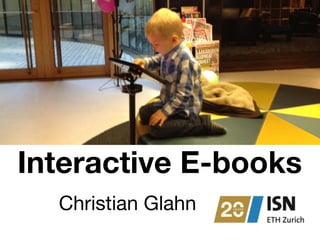
Interactive E-books 
Christian Glahn
For swiss academics 
Interactive E-books 
= 
Enhanced digital book publications
1. The Web, mobiles, and e-books 
2. Modes of interactivity 
3. Interactivity and managed learning
Once upon a time … 
the WWW and PDF were new (1993/4) 
PDF 
HTML
… but then computers went mobile 
• 1st popular smart device (1996) 
• Low resolution screen 
(160x160px) 
• Monochrome graphics 
• Sync-by-wire 
• 1st “e-book” readers (ereaders) 
• MobiPocket* 
• Documents2Go 
• Acrobat for PalmOS 
“Re spo nsive Desig n” 
appears around 10yrs later!
E-books reach out to domains 
where the WWW and PDF fail(ed) 
to meet the user-requirements. 
• Offline capability 
• Re-floatable content
E-books are “mobile first” 
resources by design! 
Web-technologies became (much) later 
part of the game. 
“Web-only e-books” 
are a b i g N o - N o !
PDFs are no e-books?? 
What is an E-Book?
E-books are content-packaging 
formats for distributing publications 
to a wide range of digital displaying 
technologies 
The content will adapt to the 
displaying capabilities of the “ereader”.
For co mpariso n … 
PDF is a content format for the 
lossless distribution of layouted 
documents to a wide range of 
printing and displaying devices. 
The content looks the same on every “ereader”.
E-books are content-packaging 
formats for distributing publications 
to a wide range of digital displaying 
technologies
E-books are content-packaging 
formats for distributing publications 
to a wide range of digital displaying 
technologies
EPUB version 2 uses XHTML + CSS2 for 
formatting. 
• Mostly text and images 
• Basic interaction 
EPUB version 3 uses HTML5 for 
formatting and interaction. 
(HTML+CSS3+Javascript) 
• Multi-media documents 
• Complex interaction (sometimes possible)
E-books are no longer 
limited to text and images. 
But many "ereaders" already 
have problems with handling 
images correctly
EPUB introduces “fixed-layout” 
documents as alternative to 
“reflowable” documents. 
Kiss Mar r y Avo i d X
EPUB3 introduces scripting 
for interactive content 
"Progressive enhancement” for 
mos t accessible content!
EPUB3 defines ereaders as 
runtime environments for 
interactive content. 
Can we publish 
apps as e-books?!
The Line Between 
Apps, Web-apps, and E-books 
Native Apps Web-Apps E-books 
Full 
Device 
Capabilities 
Online 
Business 
Logic 
Business Logic Complexity 
Interactive 
Content
E-books support different 
interactions 
• Annotations 
• References (Links) 
• Interactive graphics 
• Quizzes 
• Interactive storylines 
Ease of authoring 
Interoperability
Annotations 
• Audience-based document 
enrichment 
• All ereaders provide basic 
annotation. 
• Highlights 
• Notes 
• Many ereaders offer also 
collaborative annotations. 
• New Specifications for sharable 
annotations 
• Open Annotation 
• EPUB Content Fragment 
Identifier (epubcfi) 
Collaborative annotations in Kindle 
http://www.openannotation.org/spec/core/ 
Annotation tools in iBooks 
http://www.idpf.org/epub/linking/cfi/epub-cfi.html
Footnotes and Links 
• HTML anchors and 
links help to move 
between chapters and 
sections 
• “epub:type” links allow 
to create pop-ups 
• Footnotes 
• Glossaries 
• Bibliographies 
(Some readers require back-references)
Interactive Graphics 
• SVG or HTML5 Canvas 
graphics preferred 
• Works well for diagrams 
• PNG or JPEG if photos are 
required 
• A lot of Javascript is 
necessary! 
Many authors and 
ereaders fail here 
Example taken from Sanders Kleinfeld: HTML5 for publishers; O'Reilly
Quizzes 
• HTML form elements and 
form-like interactions 
• Some Javascript necessary! 
Most authors and 
ereaders will fail here
Interactive storylines 
• Different levels of interactivity 
• Content-level scripting 
• Changes the content in one chapter 
• Spine-level scripting 
• Changes the flow of the entire 
document 
• Javascript manipulation 
required Mos t authors and 
ereaders fail here
Supporting Ereader Capabilities 
Providing fallback content for non-scriptable 
ereaders is mandatory! 
• epub:switch, epub:case, and epub:default 
• Choose between ereader capabilities at 
content level. 
• No scripting required. 
"Progressive enhancement” means: 
start f rom the fallback pre sentation!
The Persistency Pitfall 
Persistency of interaction results does not 
come for free! 
Ereaders force reset the scripting engine when 
• Changing chapters 
• Changing layouts
The Future: Reducing Complexity 
for Authors 
New widget specification 
for EPUB 
• Organise interaction logic in 
(reusable) content blocks. 
• Separate interaction 
elements from main content. 
• Embed via iframe-elements 
http://www.idpf.org/epub/widgets/ 
Widget example in iBooks
E-books 
and 
Managed Learning
SCORM E-books are content-packaging 
formats for distributing publications 
to a wide range of digital displaying 
technologies
vs. 
• (X)HTML as the primary 
data format 
• Embedded interaction 
• Sequencing via 
pagination (and scripts) 
• No user-interaction 
handling 
• No sessions 
• Undefined back-channels 
• Mixed data-formats 
• Interaction objects (SCOs) 
• Defined sequencing via 
IMS Simple Sequencing 
• User-interaction handling 
• Session aware 
• Back-channel definition via 
CMI
Overcoming the Gap 
for Managed Learning 
EDUPUB® profile adapts the functionality of the 
EPUB® 3 format to the unique structural, semantic and 
behavioural requirements of educational publishing. 
• Metadata 
• Additional instructor notes 
• (Distributable content) 
• (Scriptable content) 
• (Assessment via IMS QTITM) 
• (Analytics via IMS Caliper AnalyticsTM) 
• (Annotations) 
Ve r y e ar ly 
working draft! 
http://www.idpf.org/epub/profiles/edu/spec
EDUPUB Assessment and 
Analytics will take some time 
• EDUPUB will require IMS LTI conformance 
for back-channels 
• IMS LTI defines service interactions not 
content interactions. 
• “Man in the middle” is 
built into the design 
Ve r y early 
working draft! 
http://www.imsglobal.org/edupub/EPUB3QTILTICaliper_BestPracticesvd8.pdf
Overcoming the Gap 
for Managed Learning 
EPUB and XAPI Integration (IEEE ADB Initiative) 
• Interactions are stored as experiences 
• No special content extensions required 
• Experiences are available throughout the 
book 
• Experiences could get exchanged with other 
systems at content level 
New, but based on exis ting 
specifications and techno logies
XAPI lo oks promising, 
but there are hidden challenges 
EPUB does not define how to 
organise back-channels. 
Not a technical problem!
Who owns the 
E-book Back-channels? 
Authors Publishers 
Readers & 
Institutions 
(teachers/learners) 
Distributors
Who owns the 
E-book Back-channels? 
Authors Publishers 
Readers & 
Institutions 
(teachers/learners) 
Distributors 
back-channels define 
The ereader the interaction complexity
X Who owns the 
E-book Back-channels? 
XX 
Authors Publishers 
Readers & 
Institutions 
(teachers/learners) 
Distributors 
Amazon 
Apple 
Google
Who owns the 
E-book Back-channels? 
X 
Authors Publishers 
Readers & 
Institutions 
(teachers/learners) 
Distributors 
Swiss Law 
XX
Who owns the 
E-book Back-channels? 
Authors 
Readers & 
Institutions 
(teachers/learners) 
Publishers 
Distributors ?
Summary 
• E-books are mobile-first resources 
• E-books are not limited to text and images, but keep the 
accessibility in mind 
• Ereaders are runtime environments for interactive e-book 
content 
• Interactive e-books require software development skills (for 
the time being) 
• E-books are very similar to SCORM Modules (and may 
replace them in some cases) 
• Access to interaction back-channels guide the 
effectiveness of e-books in education (and elsewhere)
Dr. Christian Glahn 
http://www.isn.ethz.ch 
@phish108 
http://slidesha.re/phish108 
http://lo-f.at/glahn

Interactive E-Books

  • 1.
  • 2.
    For swiss academics Interactive E-books = Enhanced digital book publications
  • 3.
    1. The Web,mobiles, and e-books 2. Modes of interactivity 3. Interactivity and managed learning
  • 4.
    Once upon atime … the WWW and PDF were new (1993/4) PDF HTML
  • 5.
    … but thencomputers went mobile • 1st popular smart device (1996) • Low resolution screen (160x160px) • Monochrome graphics • Sync-by-wire • 1st “e-book” readers (ereaders) • MobiPocket* • Documents2Go • Acrobat for PalmOS “Re spo nsive Desig n” appears around 10yrs later!
  • 6.
    E-books reach outto domains where the WWW and PDF fail(ed) to meet the user-requirements. • Offline capability • Re-floatable content
  • 7.
    E-books are “mobilefirst” resources by design! Web-technologies became (much) later part of the game. “Web-only e-books” are a b i g N o - N o !
  • 8.
    PDFs are noe-books?? What is an E-Book?
  • 9.
    E-books are content-packaging formats for distributing publications to a wide range of digital displaying technologies The content will adapt to the displaying capabilities of the “ereader”.
  • 10.
    For co mparison … PDF is a content format for the lossless distribution of layouted documents to a wide range of printing and displaying devices. The content looks the same on every “ereader”.
  • 11.
    E-books are content-packaging formats for distributing publications to a wide range of digital displaying technologies
  • 12.
    E-books are content-packaging formats for distributing publications to a wide range of digital displaying technologies
  • 13.
    EPUB version 2uses XHTML + CSS2 for formatting. • Mostly text and images • Basic interaction EPUB version 3 uses HTML5 for formatting and interaction. (HTML+CSS3+Javascript) • Multi-media documents • Complex interaction (sometimes possible)
  • 14.
    E-books are nolonger limited to text and images. But many "ereaders" already have problems with handling images correctly
  • 15.
    EPUB introduces “fixed-layout” documents as alternative to “reflowable” documents. Kiss Mar r y Avo i d X
  • 16.
    EPUB3 introduces scripting for interactive content "Progressive enhancement” for mos t accessible content!
  • 17.
    EPUB3 defines ereadersas runtime environments for interactive content. Can we publish apps as e-books?!
  • 18.
    The Line Between Apps, Web-apps, and E-books Native Apps Web-Apps E-books Full Device Capabilities Online Business Logic Business Logic Complexity Interactive Content
  • 19.
    E-books support different interactions • Annotations • References (Links) • Interactive graphics • Quizzes • Interactive storylines Ease of authoring Interoperability
  • 20.
    Annotations • Audience-baseddocument enrichment • All ereaders provide basic annotation. • Highlights • Notes • Many ereaders offer also collaborative annotations. • New Specifications for sharable annotations • Open Annotation • EPUB Content Fragment Identifier (epubcfi) Collaborative annotations in Kindle http://www.openannotation.org/spec/core/ Annotation tools in iBooks http://www.idpf.org/epub/linking/cfi/epub-cfi.html
  • 21.
    Footnotes and Links • HTML anchors and links help to move between chapters and sections • “epub:type” links allow to create pop-ups • Footnotes • Glossaries • Bibliographies (Some readers require back-references)
  • 22.
    Interactive Graphics •SVG or HTML5 Canvas graphics preferred • Works well for diagrams • PNG or JPEG if photos are required • A lot of Javascript is necessary! Many authors and ereaders fail here Example taken from Sanders Kleinfeld: HTML5 for publishers; O'Reilly
  • 23.
    Quizzes • HTMLform elements and form-like interactions • Some Javascript necessary! Most authors and ereaders will fail here
  • 24.
    Interactive storylines •Different levels of interactivity • Content-level scripting • Changes the content in one chapter • Spine-level scripting • Changes the flow of the entire document • Javascript manipulation required Mos t authors and ereaders fail here
  • 25.
    Supporting Ereader Capabilities Providing fallback content for non-scriptable ereaders is mandatory! • epub:switch, epub:case, and epub:default • Choose between ereader capabilities at content level. • No scripting required. "Progressive enhancement” means: start f rom the fallback pre sentation!
  • 26.
    The Persistency Pitfall Persistency of interaction results does not come for free! Ereaders force reset the scripting engine when • Changing chapters • Changing layouts
  • 27.
    The Future: ReducingComplexity for Authors New widget specification for EPUB • Organise interaction logic in (reusable) content blocks. • Separate interaction elements from main content. • Embed via iframe-elements http://www.idpf.org/epub/widgets/ Widget example in iBooks
  • 28.
  • 29.
    SCORM E-books arecontent-packaging formats for distributing publications to a wide range of digital displaying technologies
  • 30.
    vs. • (X)HTMLas the primary data format • Embedded interaction • Sequencing via pagination (and scripts) • No user-interaction handling • No sessions • Undefined back-channels • Mixed data-formats • Interaction objects (SCOs) • Defined sequencing via IMS Simple Sequencing • User-interaction handling • Session aware • Back-channel definition via CMI
  • 31.
    Overcoming the Gap for Managed Learning EDUPUB® profile adapts the functionality of the EPUB® 3 format to the unique structural, semantic and behavioural requirements of educational publishing. • Metadata • Additional instructor notes • (Distributable content) • (Scriptable content) • (Assessment via IMS QTITM) • (Analytics via IMS Caliper AnalyticsTM) • (Annotations) Ve r y e ar ly working draft! http://www.idpf.org/epub/profiles/edu/spec
  • 32.
    EDUPUB Assessment and Analytics will take some time • EDUPUB will require IMS LTI conformance for back-channels • IMS LTI defines service interactions not content interactions. • “Man in the middle” is built into the design Ve r y early working draft! http://www.imsglobal.org/edupub/EPUB3QTILTICaliper_BestPracticesvd8.pdf
  • 33.
    Overcoming the Gap for Managed Learning EPUB and XAPI Integration (IEEE ADB Initiative) • Interactions are stored as experiences • No special content extensions required • Experiences are available throughout the book • Experiences could get exchanged with other systems at content level New, but based on exis ting specifications and techno logies
  • 34.
    XAPI lo okspromising, but there are hidden challenges EPUB does not define how to organise back-channels. Not a technical problem!
  • 35.
    Who owns the E-book Back-channels? Authors Publishers Readers & Institutions (teachers/learners) Distributors
  • 36.
    Who owns the E-book Back-channels? Authors Publishers Readers & Institutions (teachers/learners) Distributors back-channels define The ereader the interaction complexity
  • 37.
    X Who ownsthe E-book Back-channels? XX Authors Publishers Readers & Institutions (teachers/learners) Distributors Amazon Apple Google
  • 38.
    Who owns the E-book Back-channels? X Authors Publishers Readers & Institutions (teachers/learners) Distributors Swiss Law XX
  • 39.
    Who owns the E-book Back-channels? Authors Readers & Institutions (teachers/learners) Publishers Distributors ?
  • 40.
    Summary • E-booksare mobile-first resources • E-books are not limited to text and images, but keep the accessibility in mind • Ereaders are runtime environments for interactive e-book content • Interactive e-books require software development skills (for the time being) • E-books are very similar to SCORM Modules (and may replace them in some cases) • Access to interaction back-channels guide the effectiveness of e-books in education (and elsewhere)
  • 41.
    Dr. Christian Glahn http://www.isn.ethz.ch @phish108 http://slidesha.re/phish108 http://lo-f.at/glahn