CloudSocial:A New Approach to
Enabling Open Content for Broad Reuse
Charles Severance,Ted Hanss, Joseph Hardin
University of Michigan
February 20, 2009
Disclaimer
Report on nascent projects....
Outline
• Connecting the LMS and Open Educaitonal Repositories - A brief
history
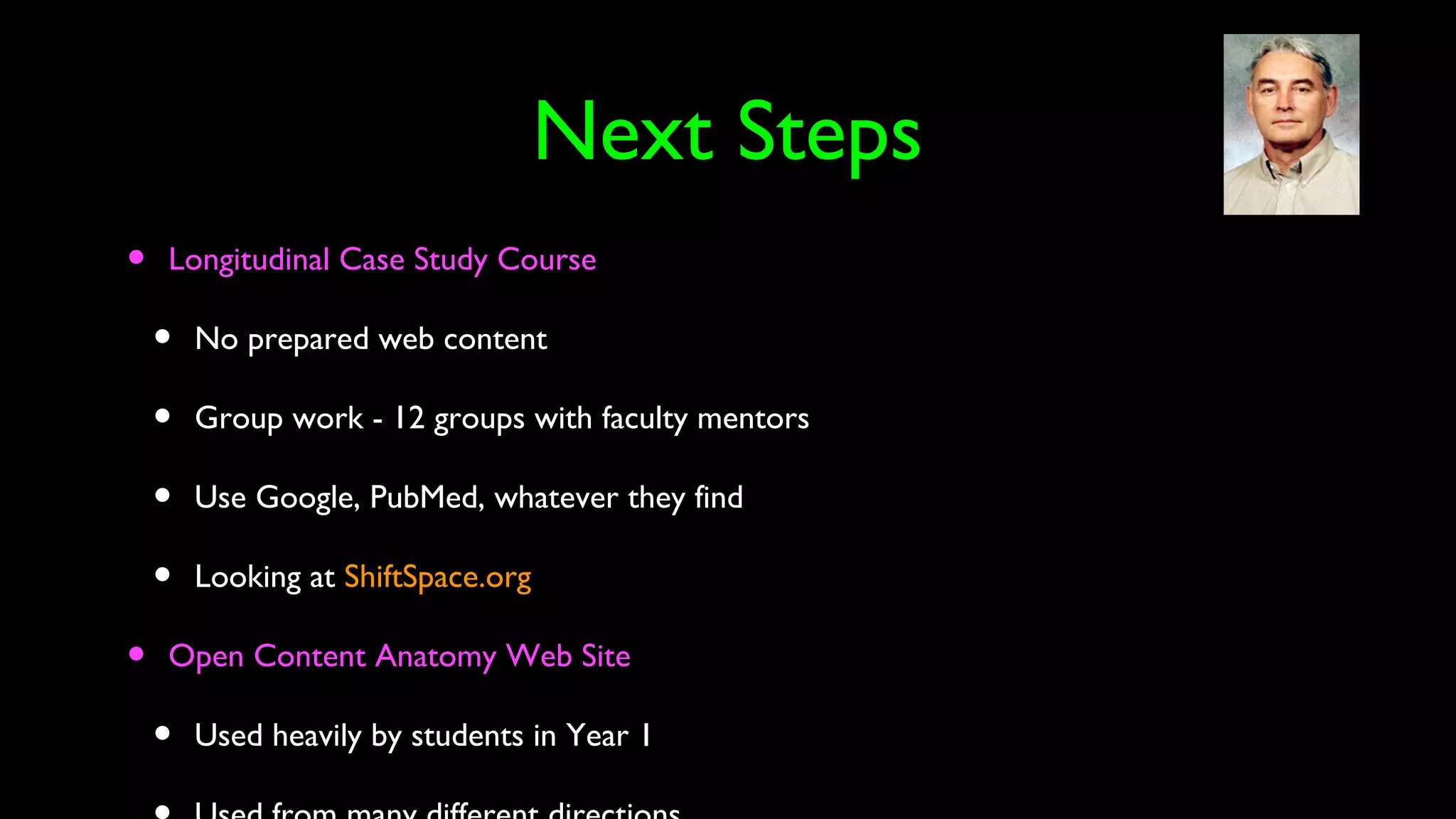
• University of Michigan Medical School - Beyond the LMS
• CloudSocial - www.cloudsocial.org
• IMS Standards - www.imsglobal.org
• CloudCollab - www.cloudcollab.com
Warning : This is all under
Timeline
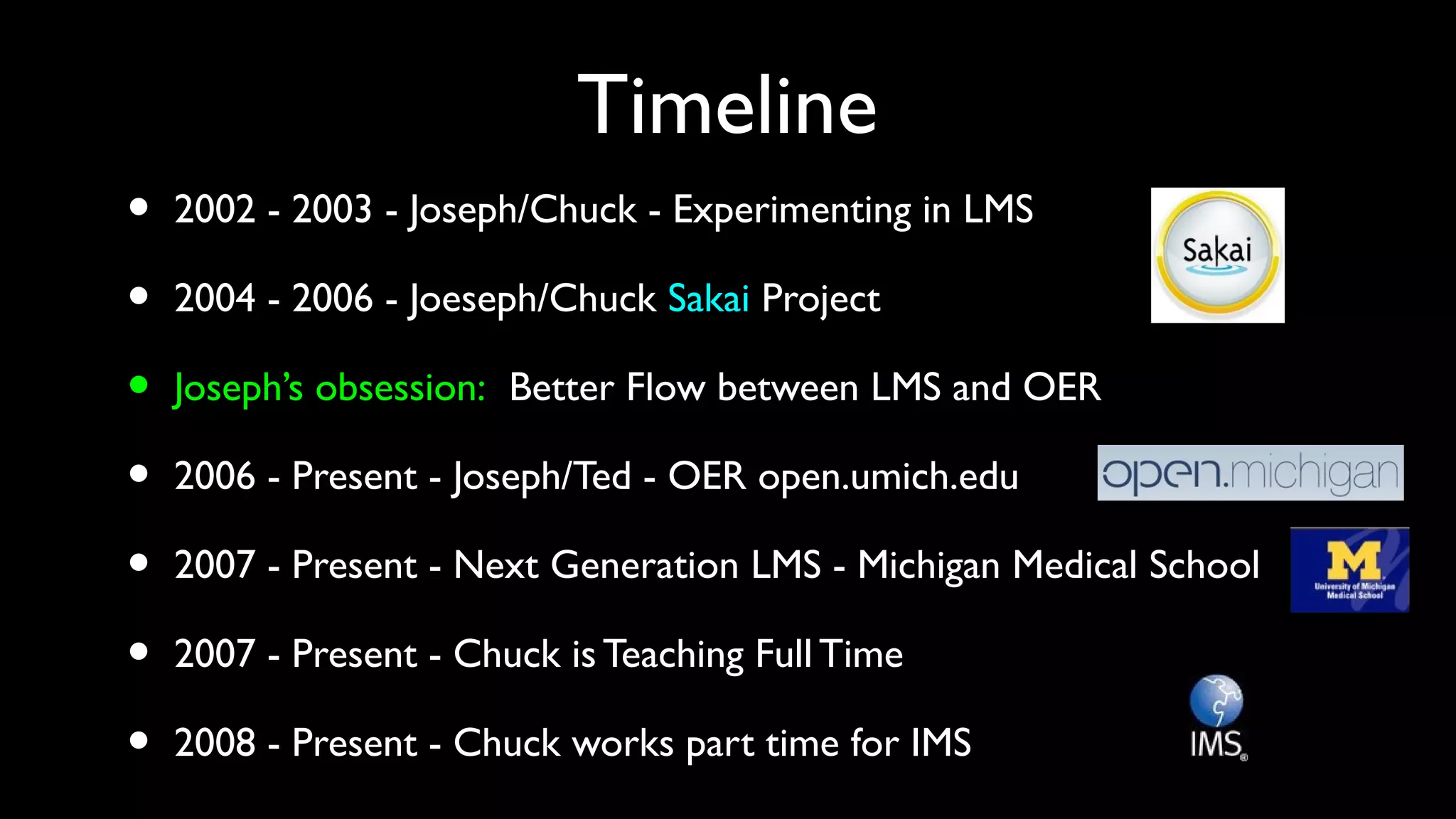
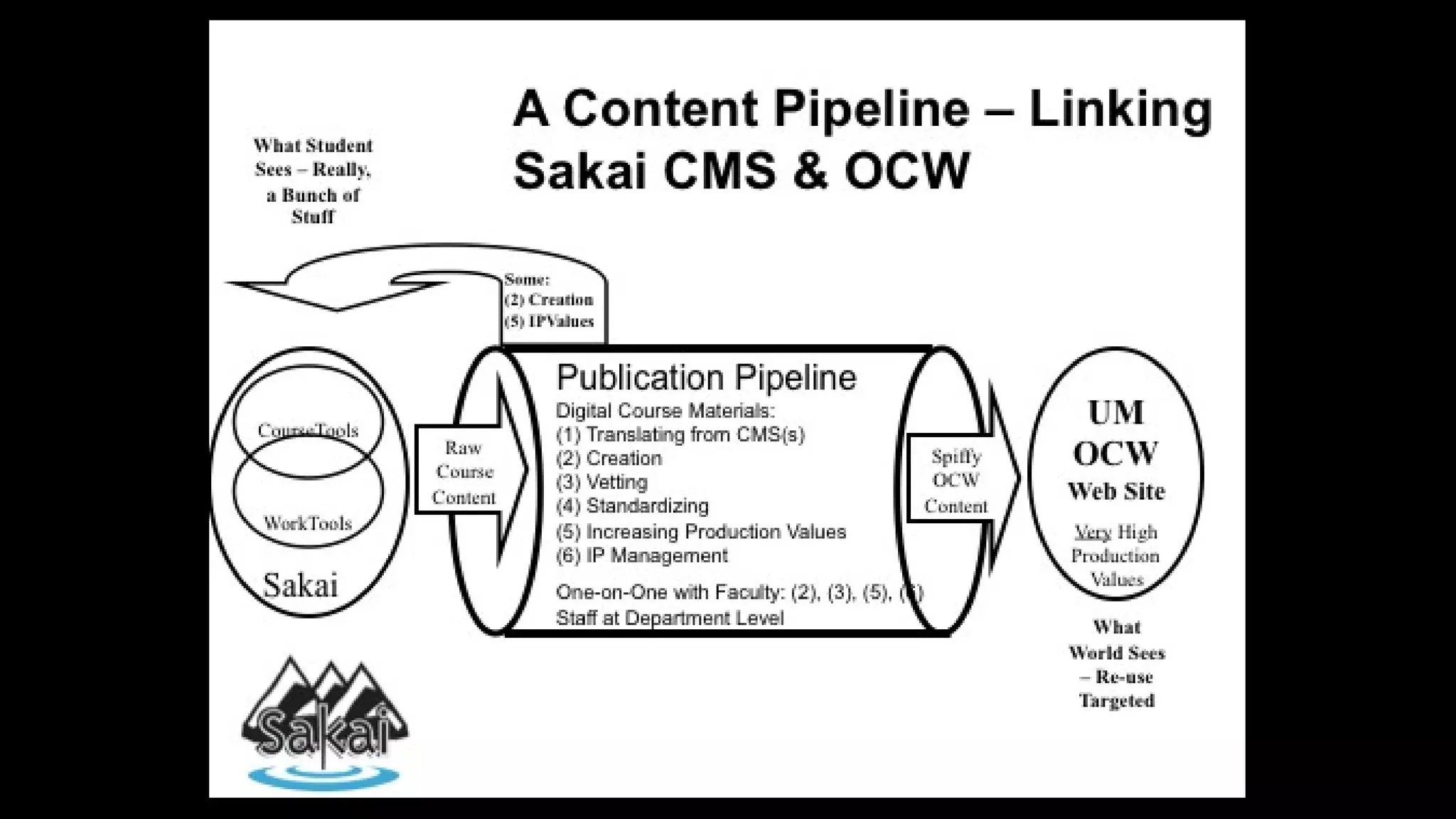
• 2002 - 2003 - Joseph/Chuck - Experimenting in LMS
• 2004 - 2006 - Joeseph/Chuck Sakai Project
• Joseph’s obsession: Better Flow between LMS and OER
• 2006 - Present - Joseph/Ted - OER open.umich.edu
• 2007 - Present - Next Generation LMS - Michigan Medical School
• 2007 - Present - Chuck is Teaching Full Time
• 2008 - Present - Chuck works part time for IMS
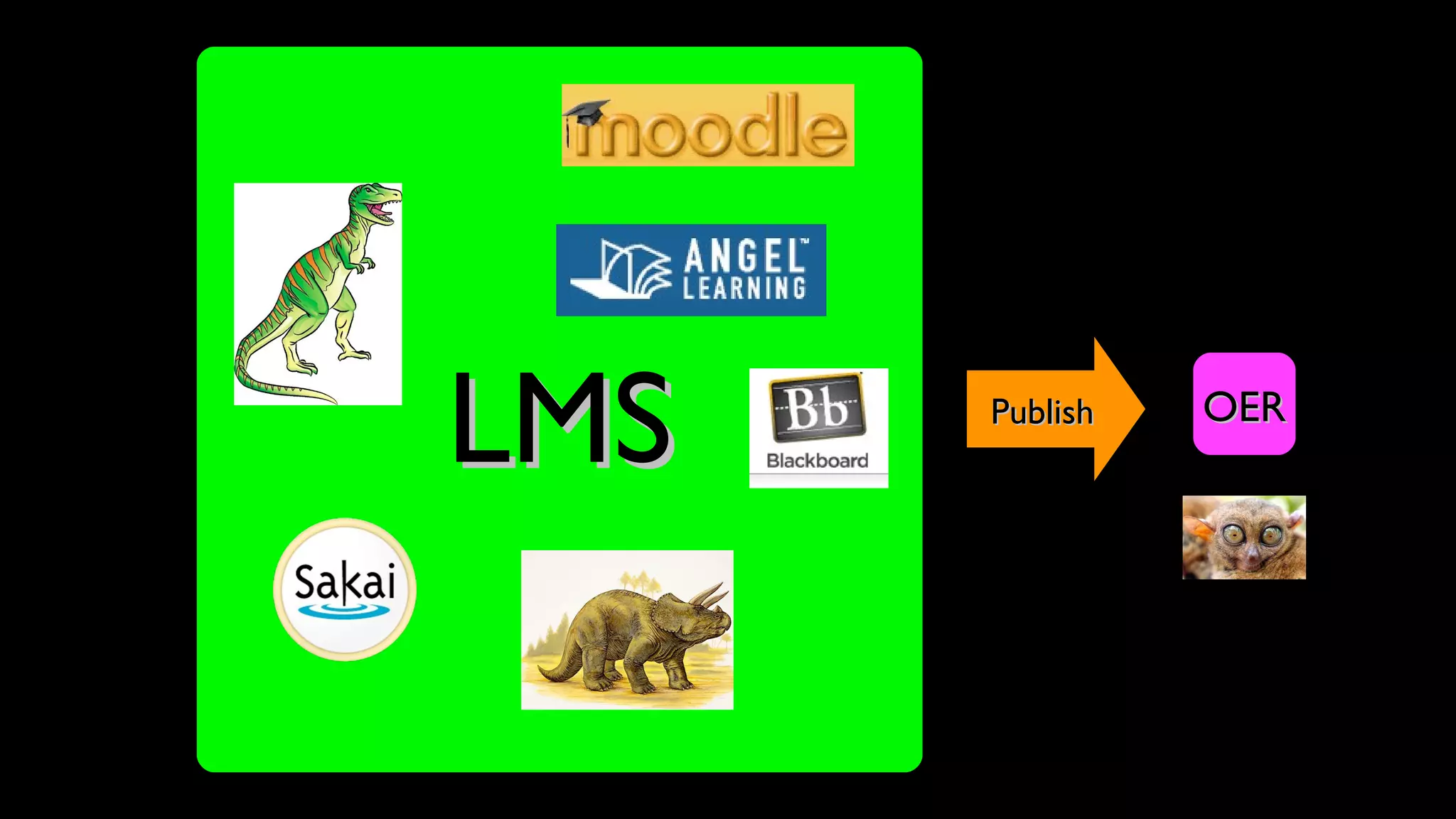
LMSLMS PublishPublish OEROER
LMSLMS PublishPublish
PublishOEROER
Share
LMSLMSImportImport
Publish
OEROER LMSLMSImportImport
ImportImport
LMSLMS PublishPublish OEROER
ImportImport
OER
OER
LMSLMS
Import
Import
Import
Import
LMSLMS
Publish
Publish
OER
OER
Import
Import
OER
OER
LMS
LMS
Import
Import
Import
Import
LMS
LMS
Publish
Publish
OER
OER
Import
Import
OEROER LMSLMSImportImport
IIm
tt
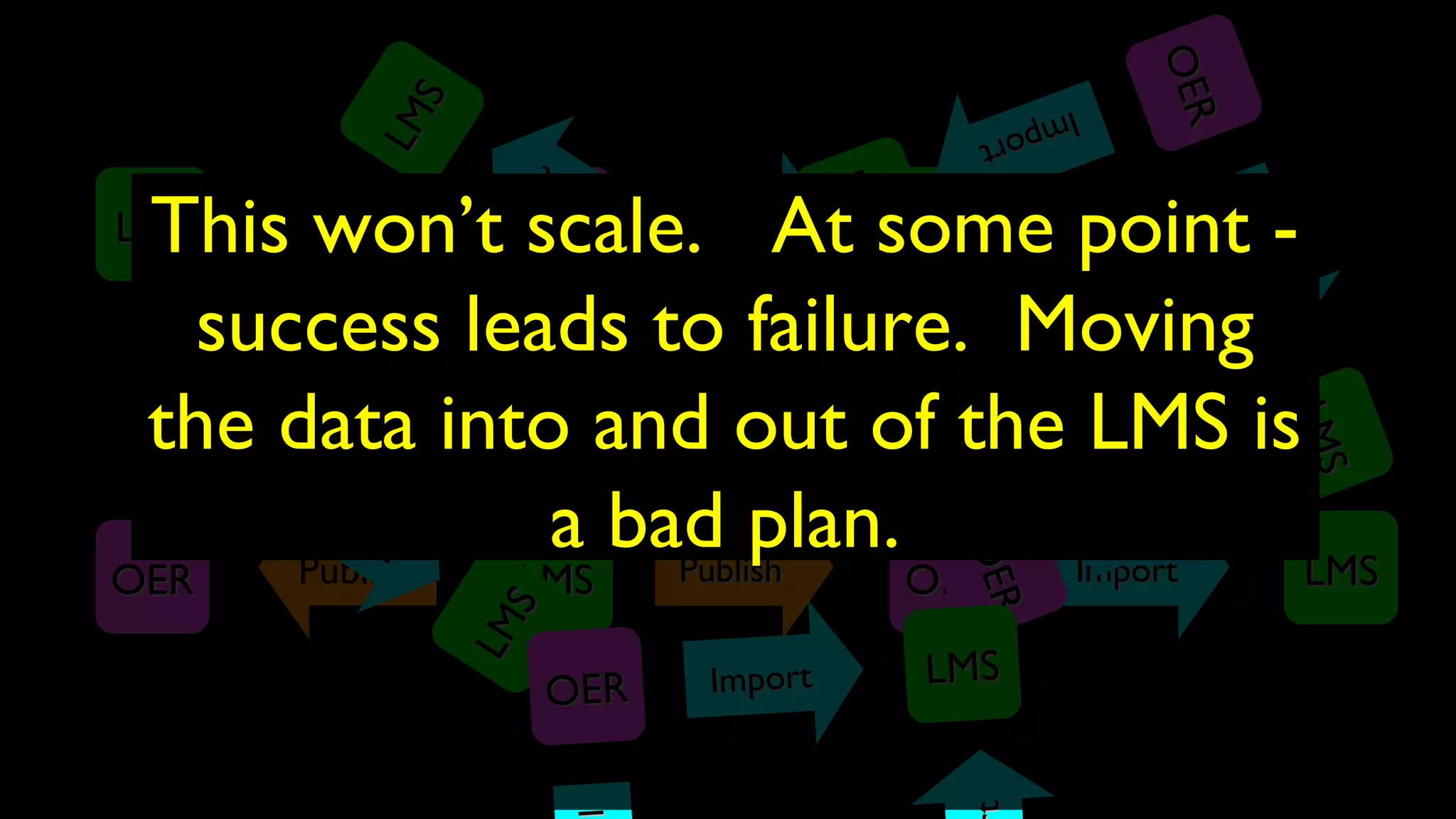
This won’t scale. At some point -
success leads to failure. Moving
the data into and out of the LMS is
a bad plan.
Brainstorming
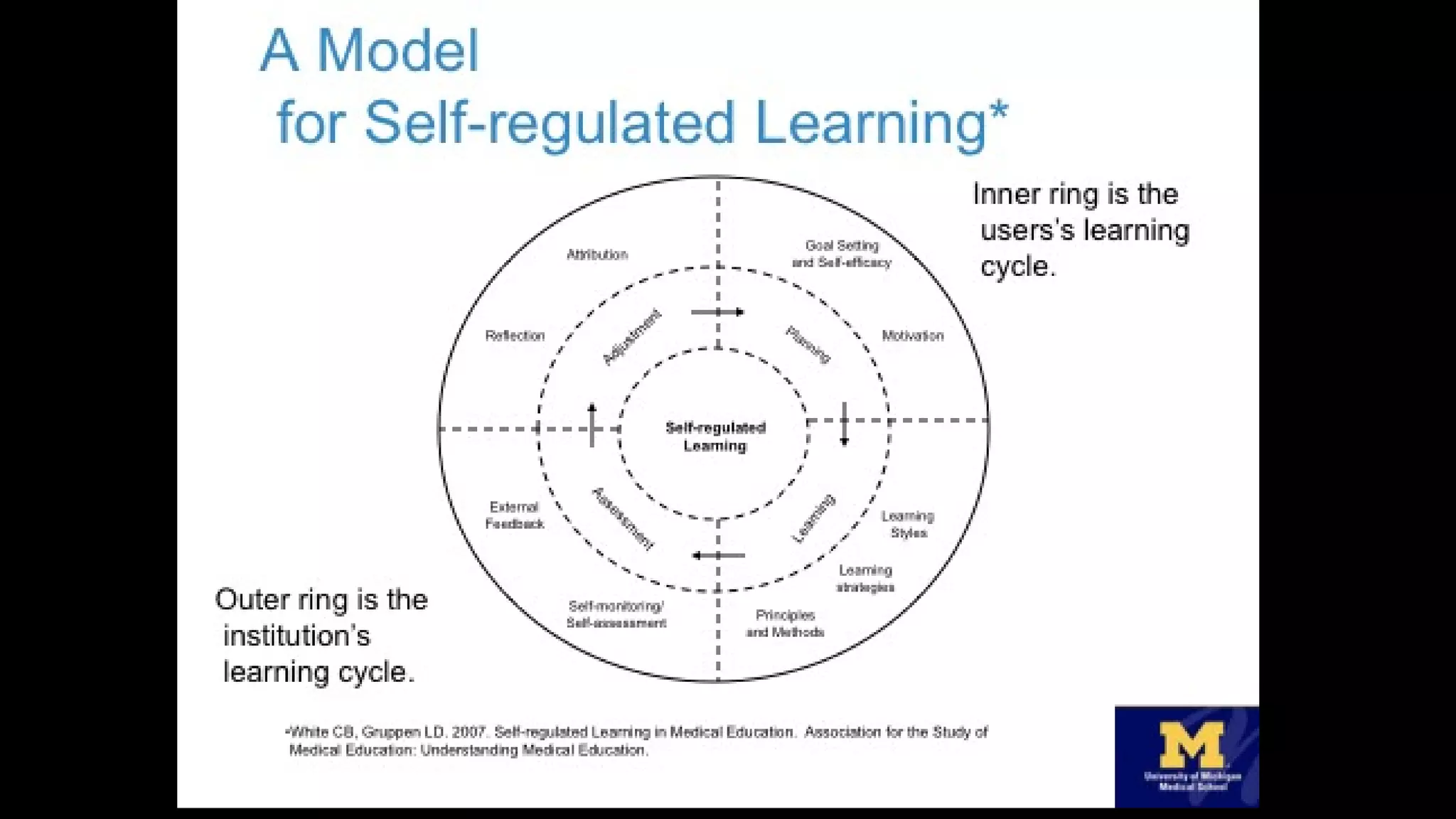
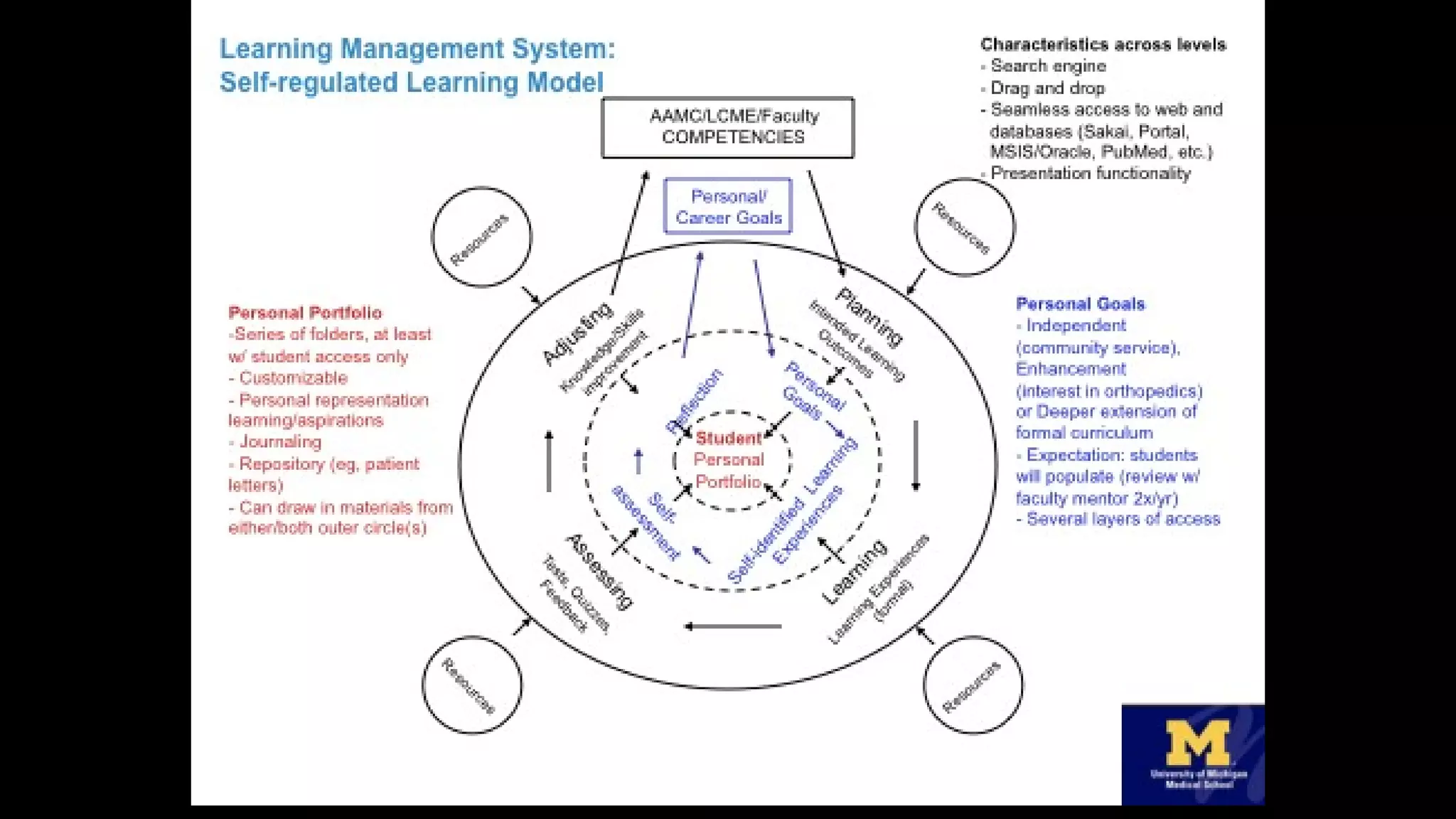
Beyond the LMS
Beyond the LMS
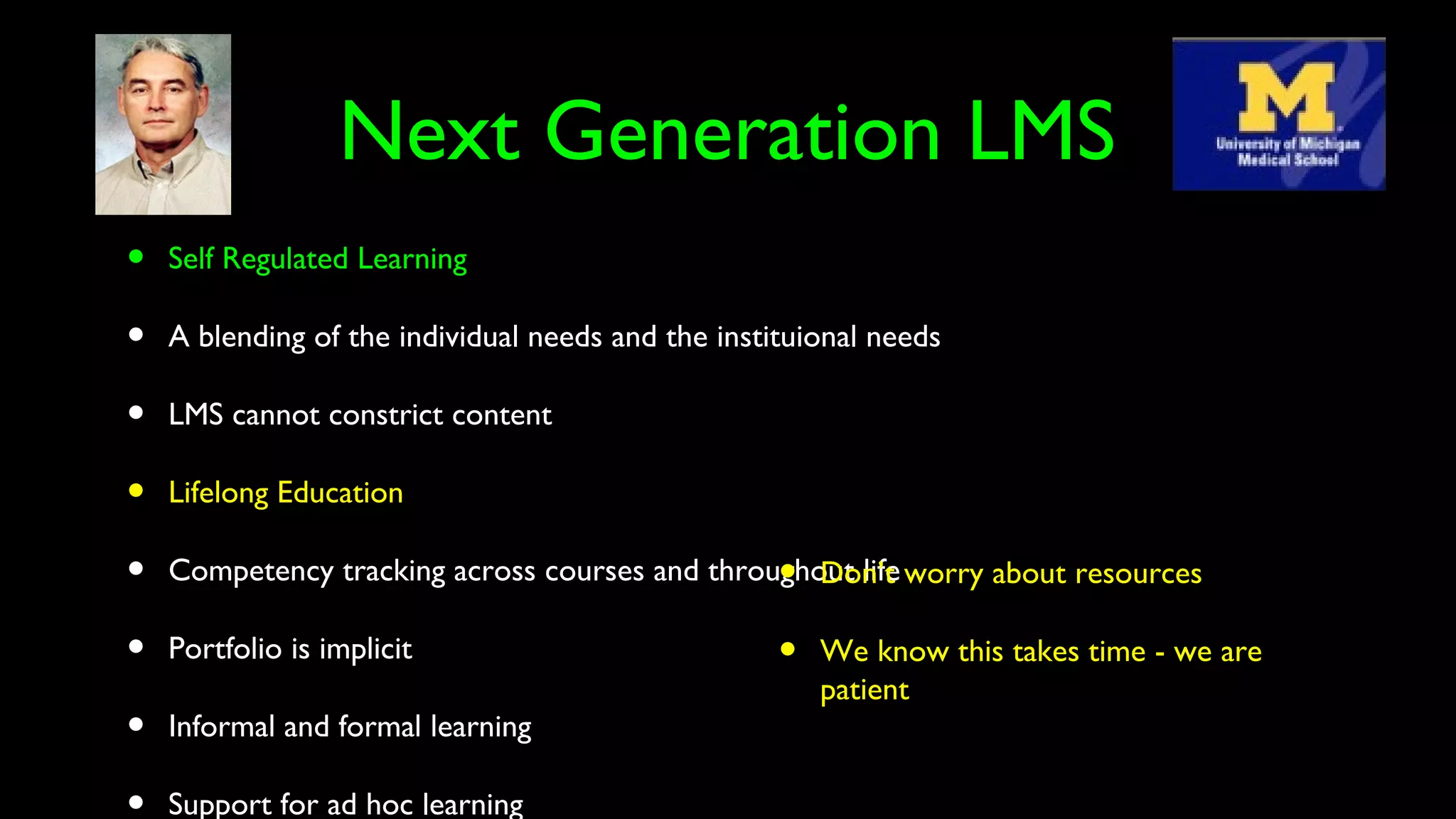
Next Generation LMS
• Self Regulated Learning
• A blending of the individual needs and the instituional needs
• LMS cannot constrict content
• Lifelong Education
• Competency tracking across courses and throughout life
• Portfolio is implicit
• Informal and formal learning
Support for ad hoc learning
• Don’t worry about resources
• We know this takes time - we are
patient
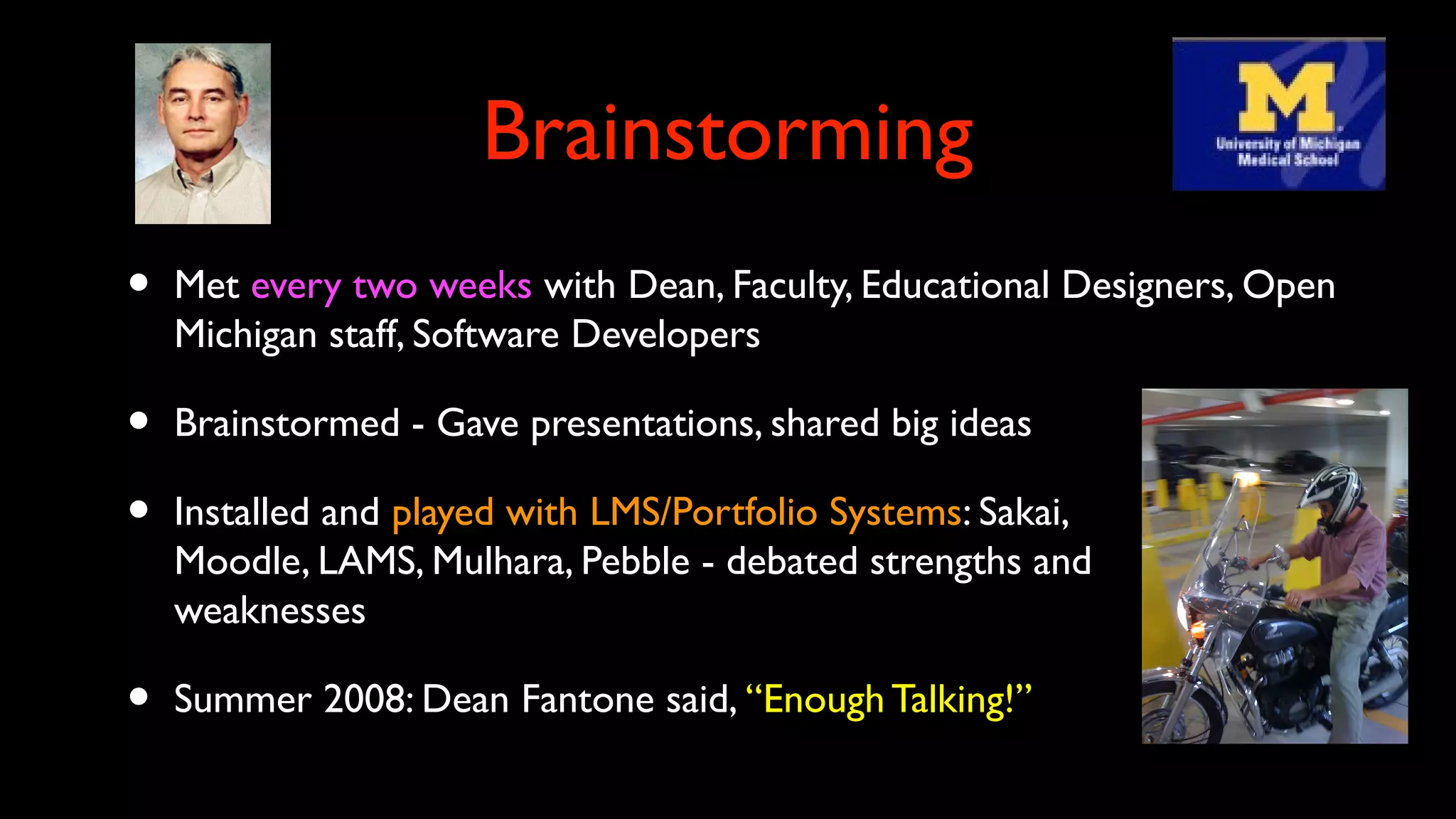
Brainstorming
• Met every two weeks with Dean, Faculty, Educational Designers, Open
Michigan staff, Software Developers
• Brainstormed - Gave presentations, shared big ideas
• Installed and played with LMS/Portfolio Systems: Sakai,
Moodle, LAMS, Mulhara, Pebble - debated strengths and
weaknesses
• Summer 2008: Dean Fantone said, “Enough Talking!”
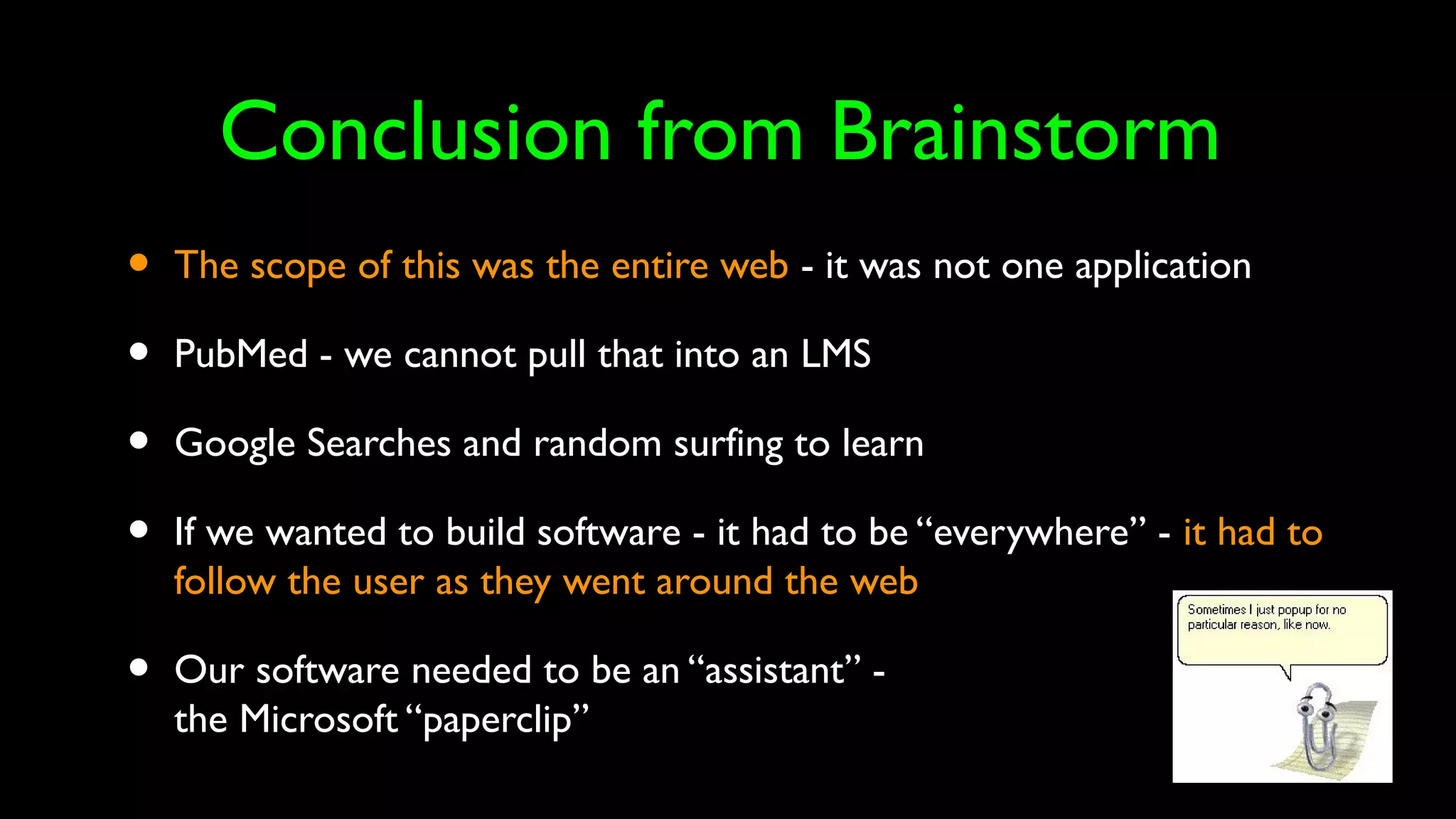
Conclusion from Brainstorm
• The scope of this was the entire web - it was not one application
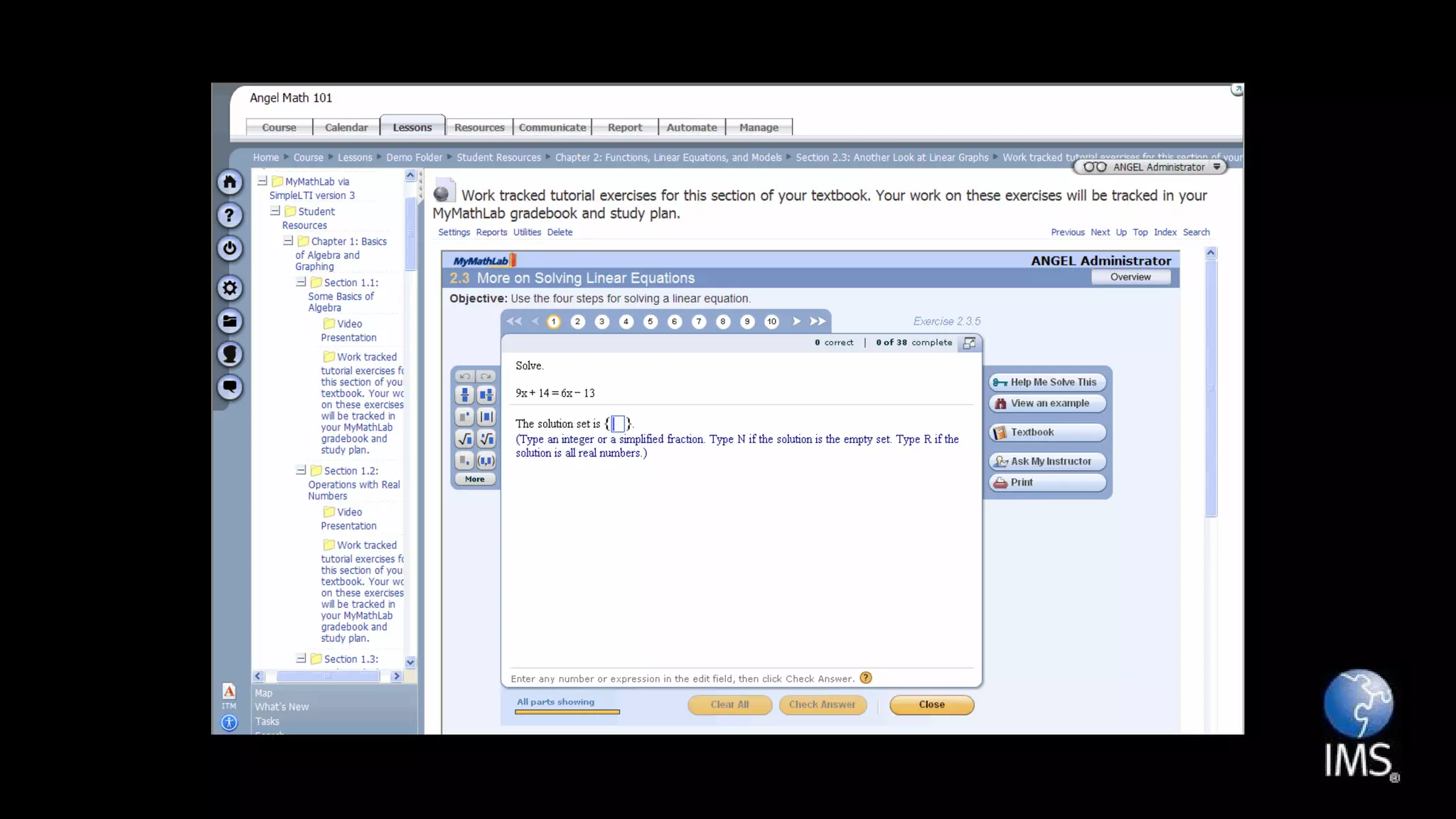
• PubMed - we cannot pull that into an LMS
• Google Searches and random surfing to learn
• If we wanted to build software - it had to be “everywhere” - it had to
follow the user as they went around the web
• Our software needed to be an “assistant” -
the Microsoft “paperclip”
The Dean’s Challenge
• Advanced Medical Therapeutics Course - FourthYear Students
• Four weeks - nearly all online - well produced web content
• Often done from hotel rooms while students interview for internships
• What could we do with that course?
• Failure *was* an option - we should push it and risk it
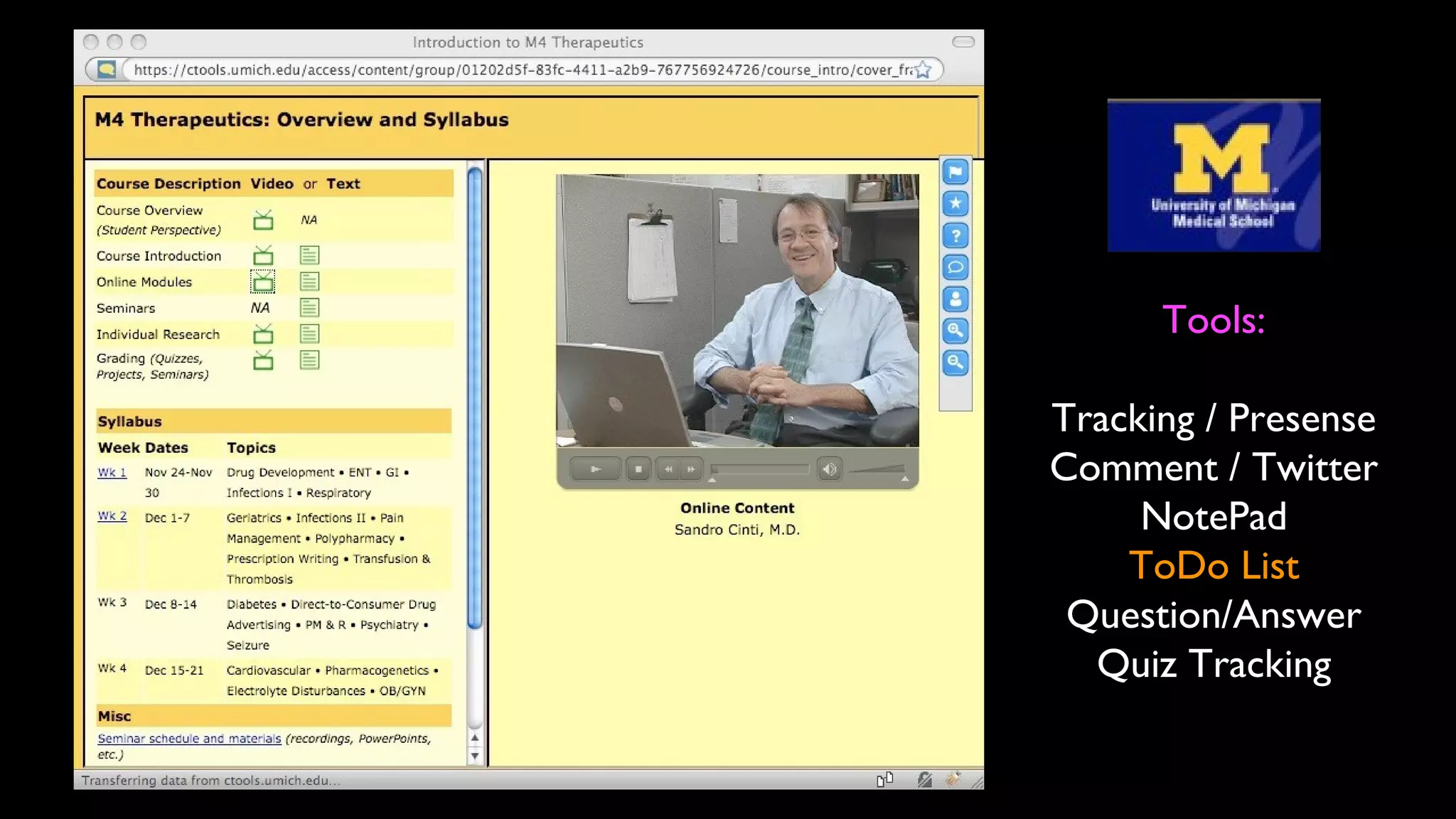
Tools:
Tracking / Presense
Comment / Twitter
NotePad
ToDo List
Question/Answer
Quiz Tracking
Results of First Pilot
• Good News
• Everything worked technically
• Faculty loved the idea
• Students loved the idea
• The TODO was the most popular tool
• We learned a lot - terriffic feedback
• Bad News
Positive Effects
• Forced us to deploy CloudSocial in production
• Built PHP Framework to allow a new tool to be written in 2 days and
a new feature to be added in a few hours
• Validated techincal the “Tool Mashup” protocol was sound
• Proved that we “caused no harm” - Medical School is more confident
• Changed our perspective from “will this work” to “what can we do”
Next Steps
• Longitudinal Case Study Course
• No prepared web content
• Group work - 12 groups with faculty mentors
• Use Google, PubMed, whatever they find
• Looking at ShiftSpace.org
• Open Content Anatomy Web Site
• Used heavily by students in Year 1
CloudSocial
(aka “the paperclip”)
www.cloudsocial.org
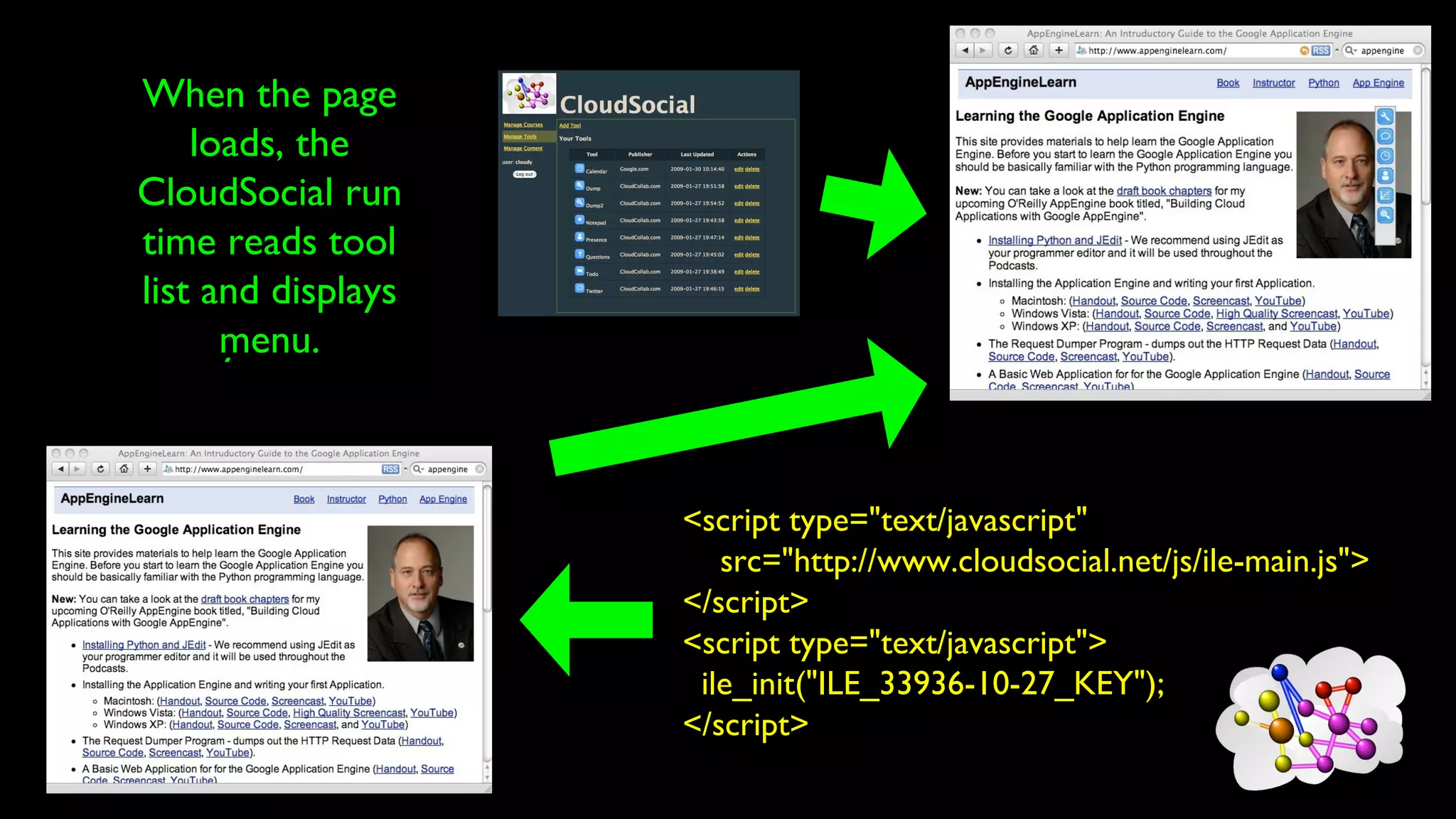
Content Owner
adds CloudSocial
Run Time to the
Content
Instrutor picks
tools for their
course. Tools
can come from
any learning
system.
<script type="text/javascript"
src="http://www.cloudsocial.net/js/ile-main.js">
</script>
<script type="text/javascript">
ile_init("ILE_33936-10-27_KEY");
</script>
When the page
loads, the
CloudSocial run
time reads tool
list and displays
menu.
CloudSocial Goals
• Stop creating/editing content in Learning Management Systems
• Stop creating content for a particular course
• Create contextualizale resources - put them on the web with decent URLs
to the page level - Add the CloudSocial RunTime to all pages
• Contextualize your own material for your students using CloudSocial *the
first time you teach*
• New Problem: How to best Collectively Create and Manage Materials
“Create Globally, Educate Locally ---
Trends in Teaching and Learning
• Move toward the “web” as the source of learning content
• Move toward open participatory learning and open educational
resources
• A hybrid approach towards learning where organizational boundaries
and educational structure is less clear
• Move toward social learning - learning and exploring
with groups
Making Content the Focus
• Content lives on the web - on any server using any technology
• Instead of moving the content into lots of LMS systems...
• Bring your LMS systems “with you” as you visit different sources of
content on the Internet
CloudSocial.org
• CloudSocial is not an LMS
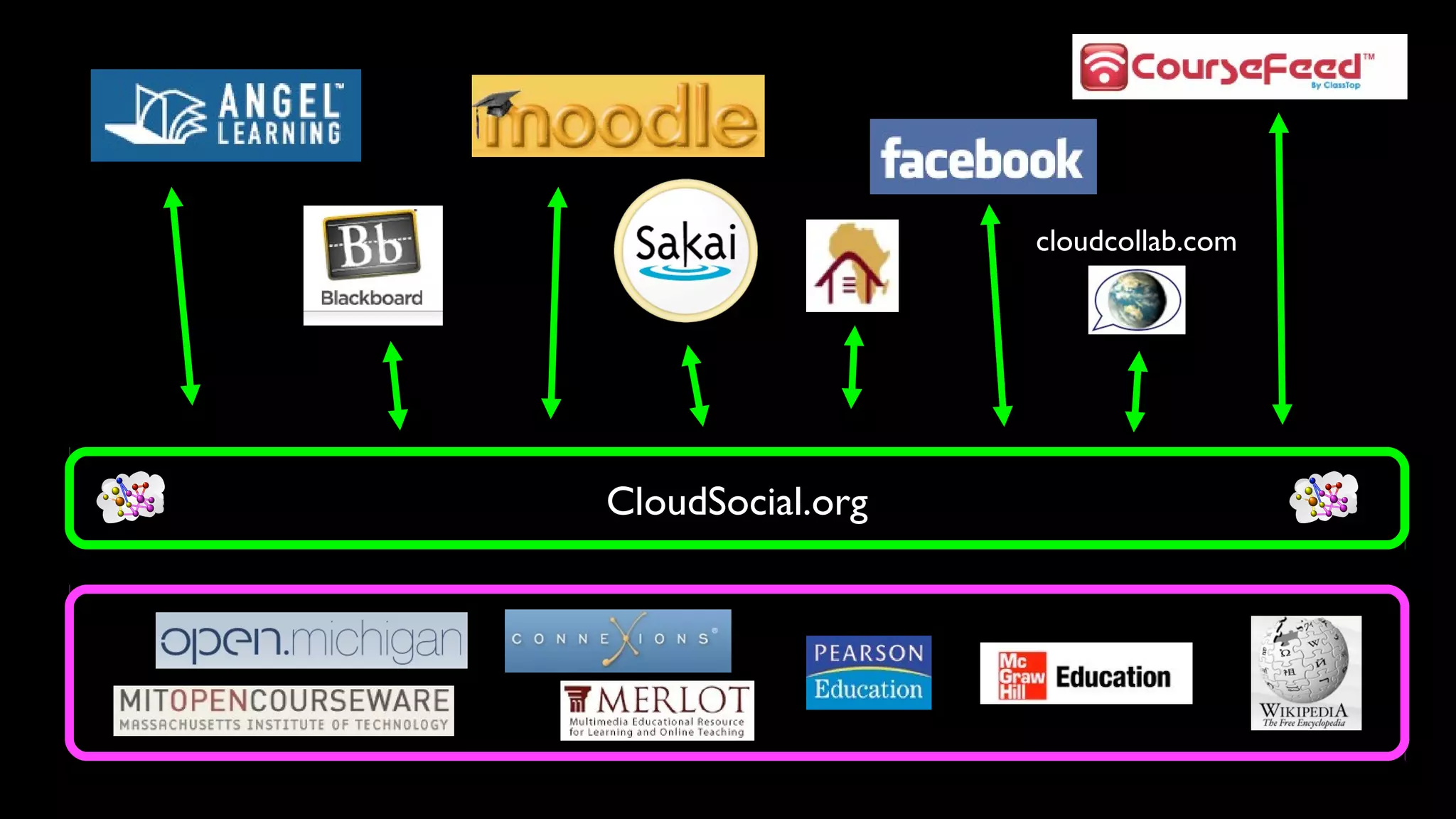
• CloudSocial acts as an intermediary between content owners and
learning systems
• CloudSocial allows any LMS to embed itself in content for learners
who visit that content launched from their LMS
• CloudSocial does not touch, store, or handle learning activity data -
learning activity data remains on the LMS systems which provide the
tools
CloudSocial.orgCloudSocial.org
cloudcollab.com
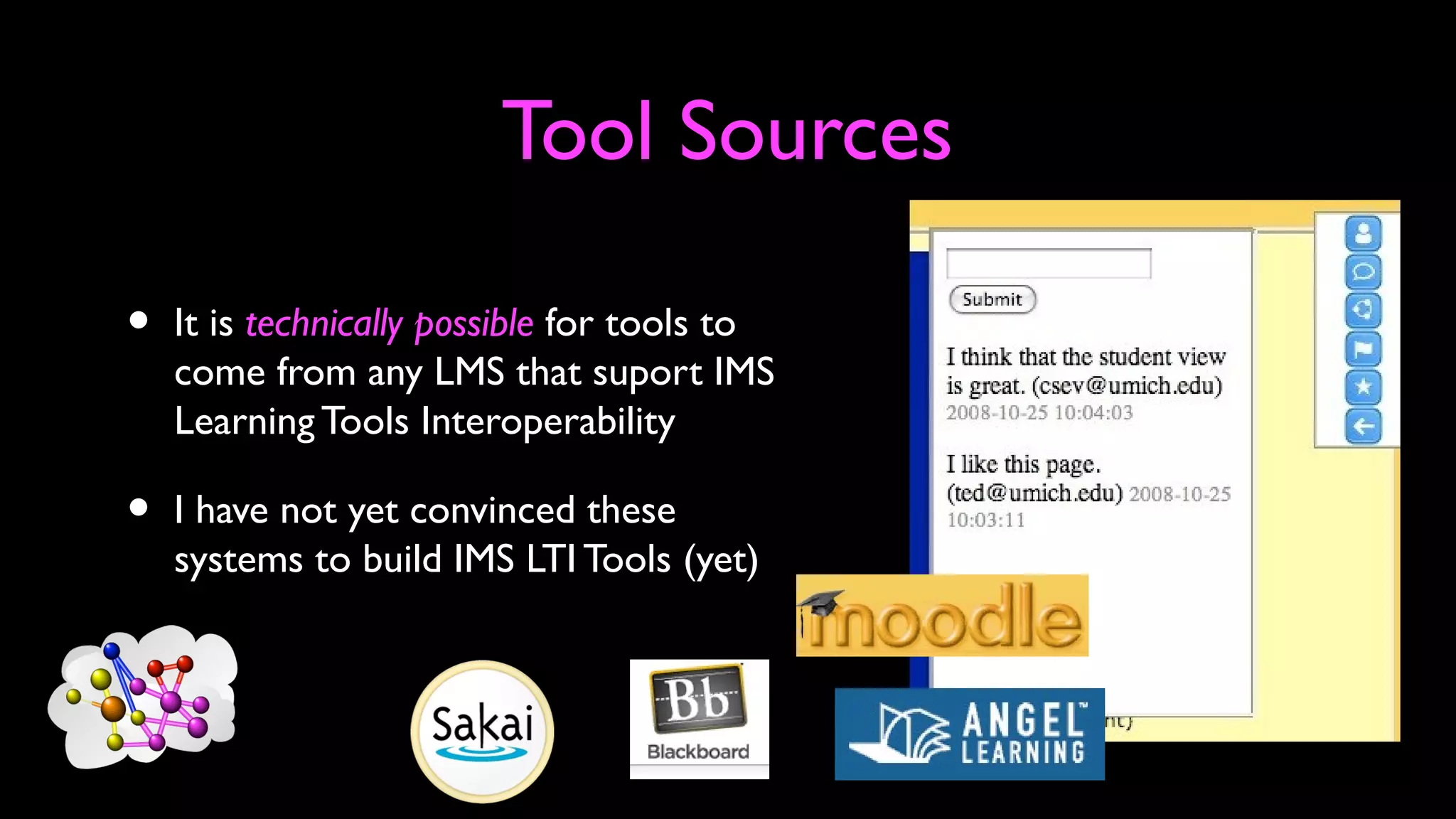
Tool Sources
• It is technically possible for tools to
come from any LMS that suport IMS
Learning Tools Interoperability
• I have not yet convinced these
systems to build IMS LTI Tools (yet)
Inverting the Content/LMS
• Today we focus on putting Content into as Many LMS systems as
possible
• In the future there will be many sources of content - not just LMS
systems - it will be hard to get interchange formats working in all
these systems (including legacy)
• So lets put the LMS Into the Content.
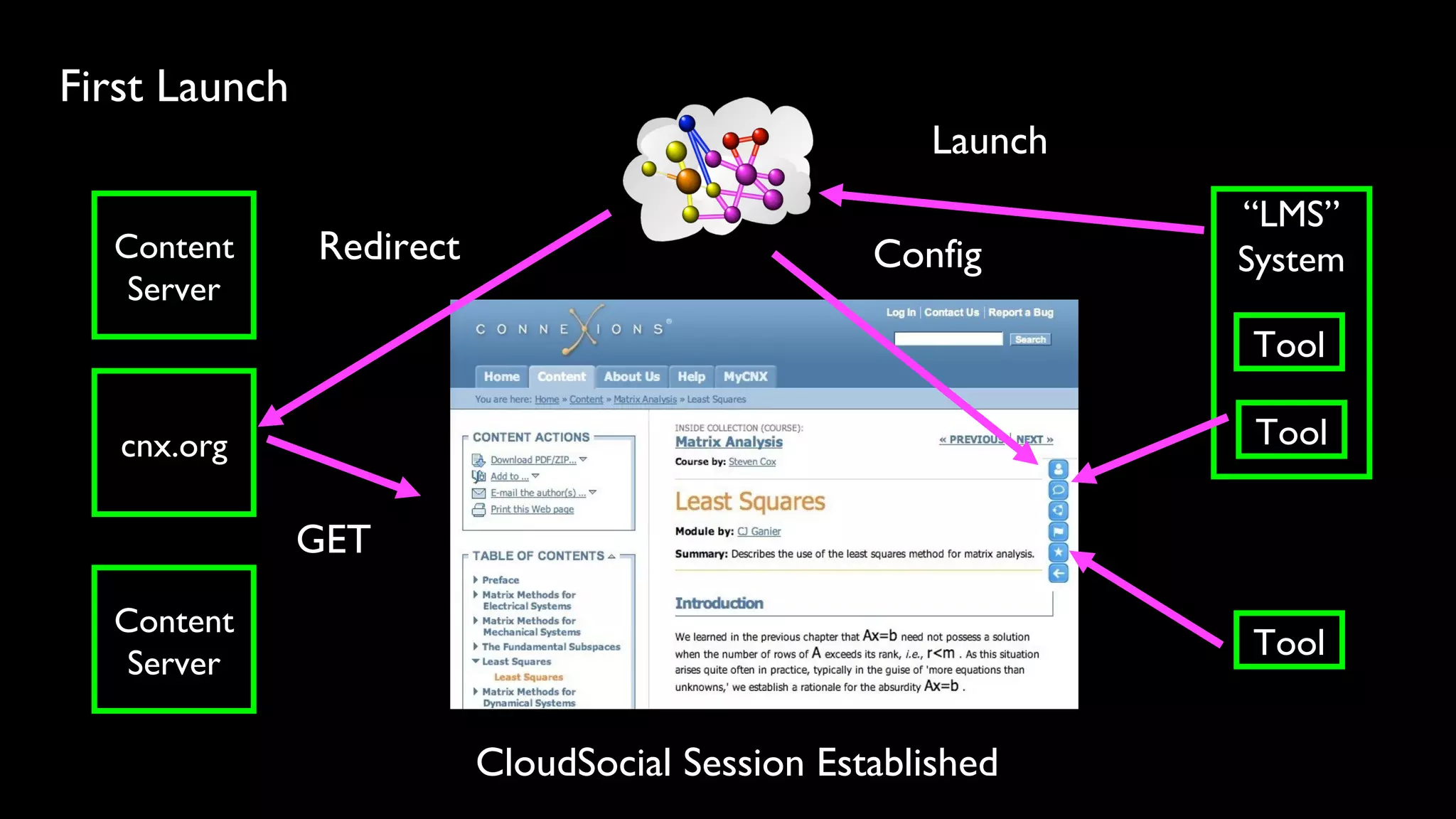
ContentContent
ServerServer
““LMS”LMS”
SystemSystem
cnx.orgcnx.org
ContentContent
ServerServer
ToolTool
ToolTool
Launch
Redirect
CloudSocial Session Established
GET
Config
First Launch
ToolTool
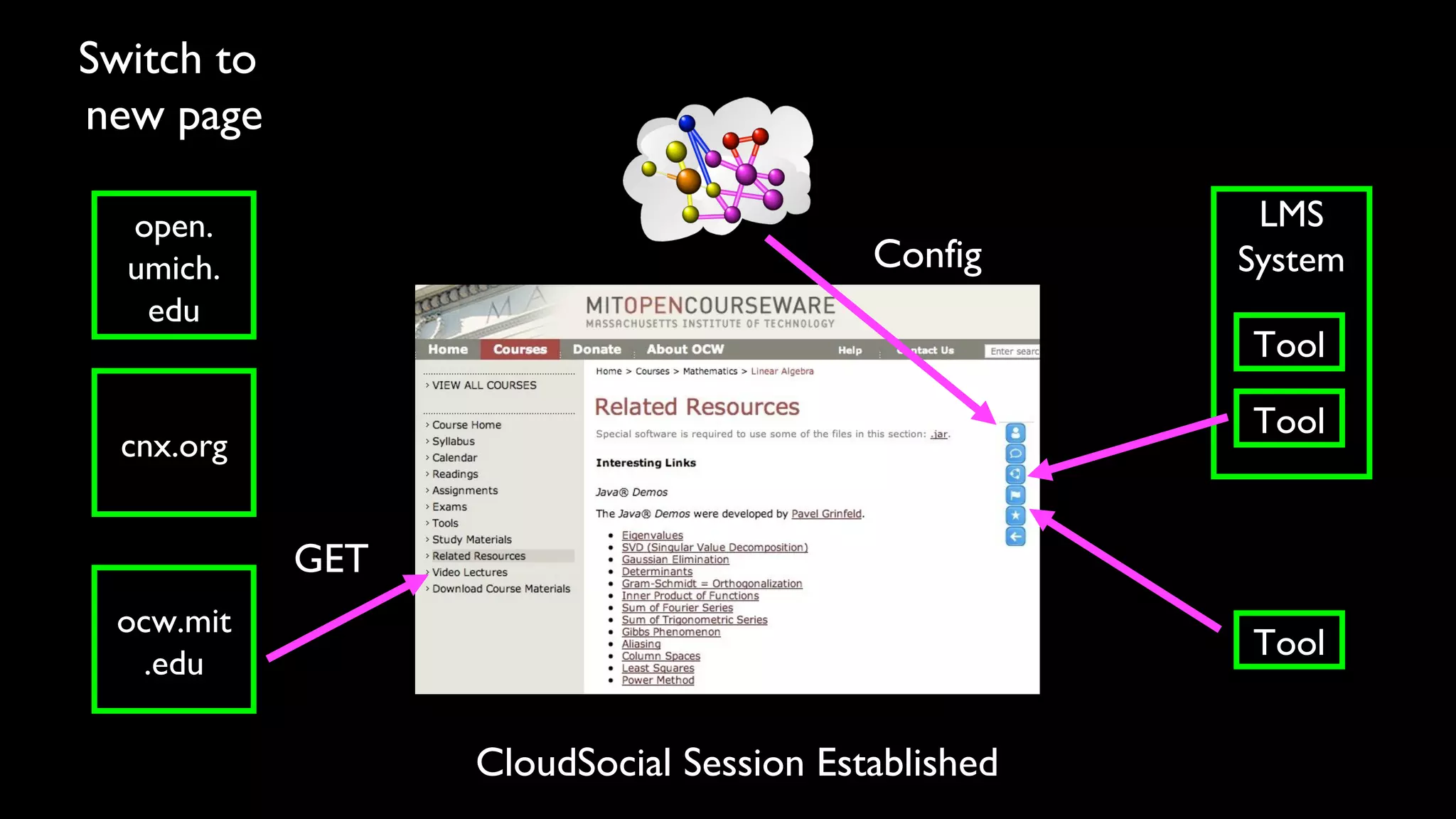
open.open.
umich.umich.
eduedu
LMSLMS
SystemSystem
cnx.orgcnx.org
ocw.mitocw.mit
.edu.edu
ToolTool
ToolTool
CloudSocial Session Established
GET
Config
Switch to
new page
ToolTool
Technical Steps
• User selects external content from within the LMS (or other
system supporting groups of people)
• LMS contacts CloudSocial servers and establishes session
context for user/course/insitution combination
• User is redirected to the content
• Content contacts CloudSocial servers using Ajax/JavaScript and
pulls down menu for course and displays
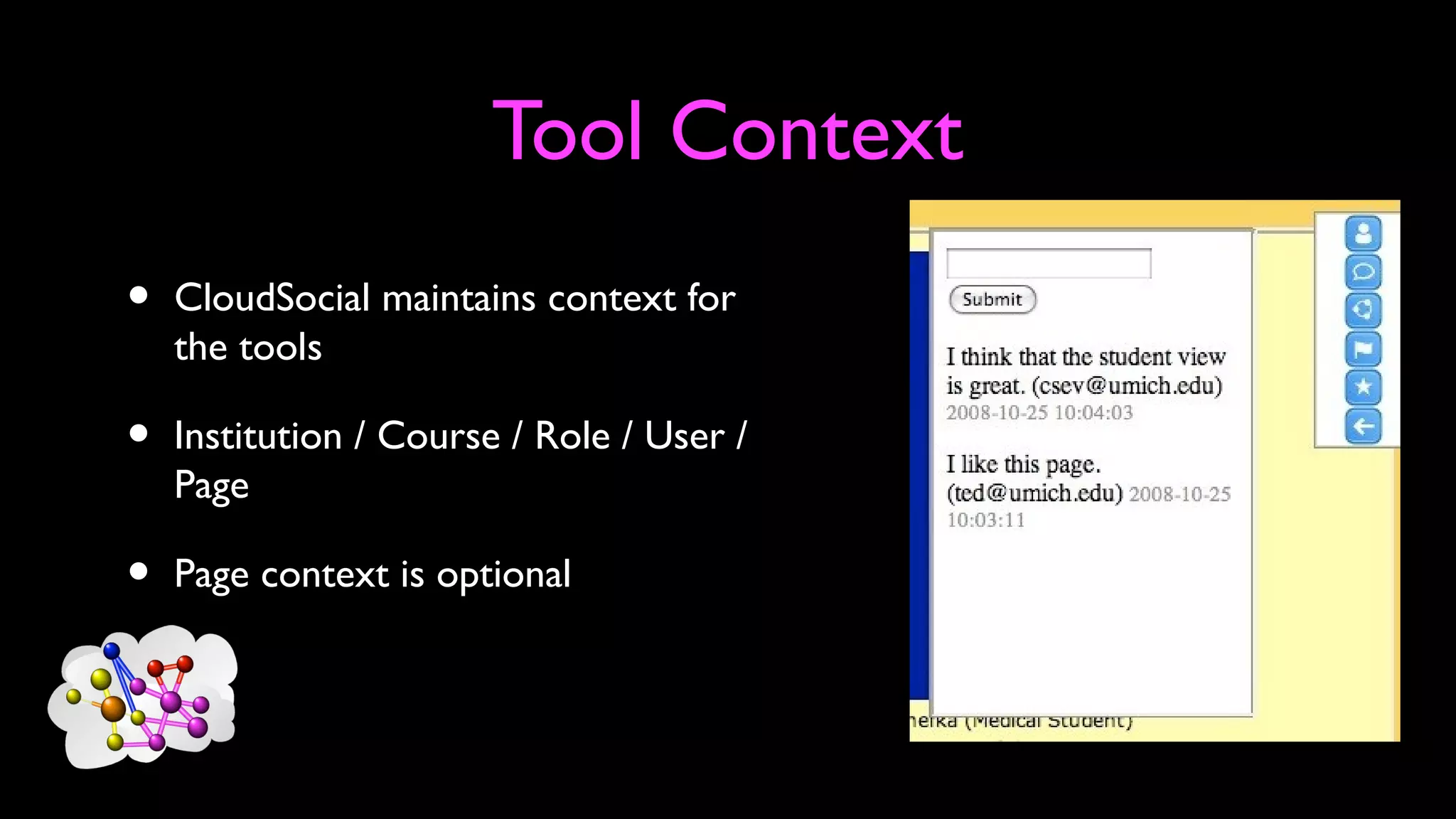
Tool Context
• CloudSocial maintains context for
the tools
• Institution / Course / Role / User /
Page
• Page context is optional
Learning Tools in the Cloud
• The CloudSocial servers only hold a tiny bit of tool configuration for a
course - they are not the “LMS”
• If done properly, the tools that follow the user around the web can be
running back on their campus.
• Think of a toolset from each of the major LMS vendors - this insures
that sensitive data stays “back home” - and that the user experience is
consistent with the rest of their learning
• The “embedded Moodle” toolset (kind of like Moodle blocks)
Underlying Technology
• This is all based on IMS Learning Tools Interoperability (LTI)
• LMS Launch into CloudSocial uses LTI
• CloudSocial launching to individual tools uses LTI
• This means that a piece of content can be used with any LMS that
makes its tools available over IMS Learning Tools Interoperability.
• A mix of tools can be supported
IMS Standards
Dr. Charles Severance
Developer Network Coordinator
IMS Global Learning Consortium
cseverance@imsglobal.org
Two IMS Standards
• IMS Learning Tools Interoperability - Tool “mash up”
• User Identity, Course, Roster, Role
• Run-Time Services
• IMS Common Cartridge - Course Import/Export/Exchange
• Web Content, Discussion Forums, QTI Materials, and LTI (soon)
• LTI in Common Cartridge allows large/high-value content to be
referenced rather than included
IMS Developer Network
• Lets not just write specs - lets write code while we write specs!
• Demos - feedback to the spec development process
• It is a “developers network” - I call folks up and we hack
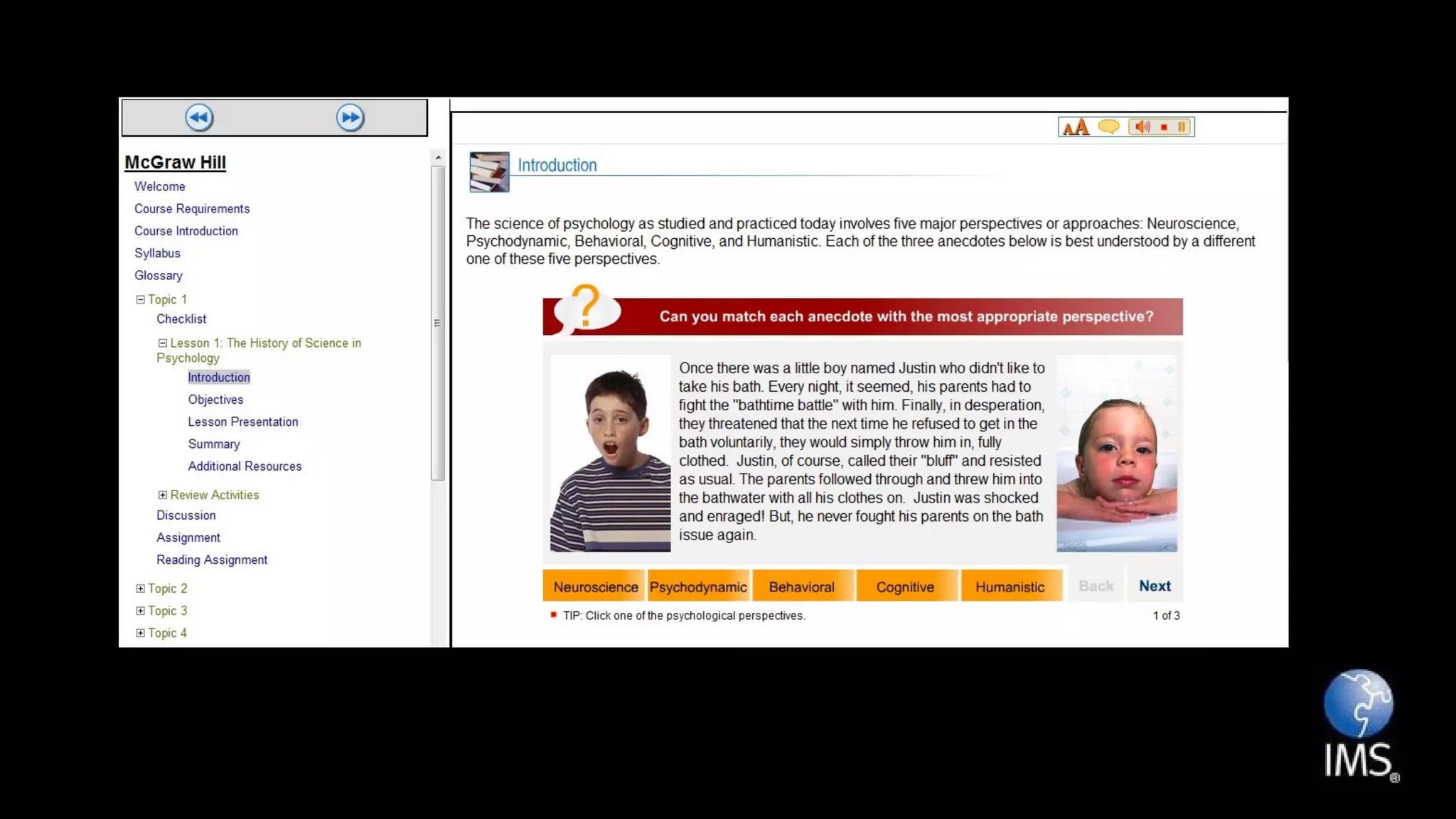
• BlackBoard,Wimba,ANGEL Learning, Sakai, Moodle, McGraw-Hill,
Pearson, Microsoft, ...
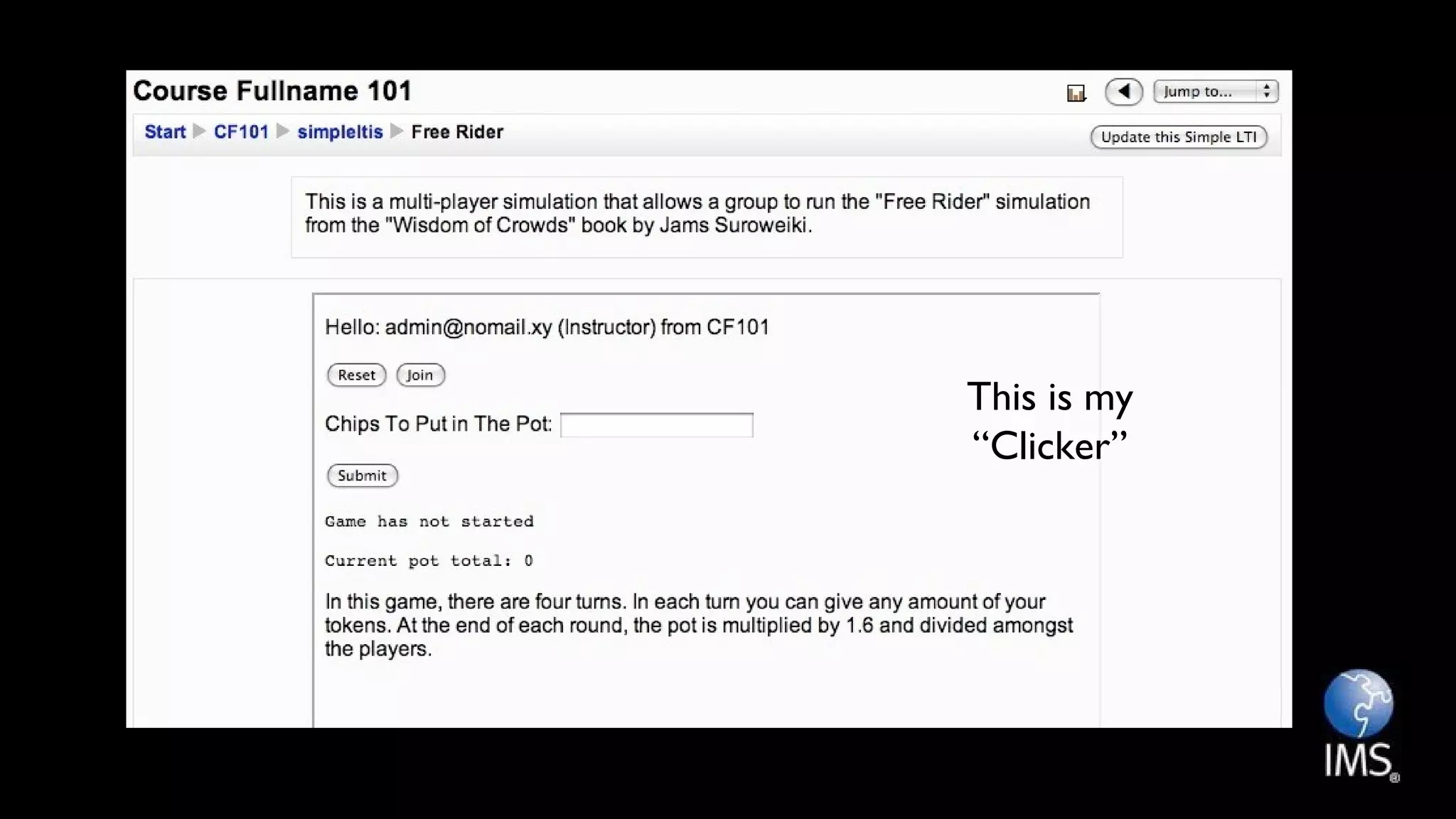
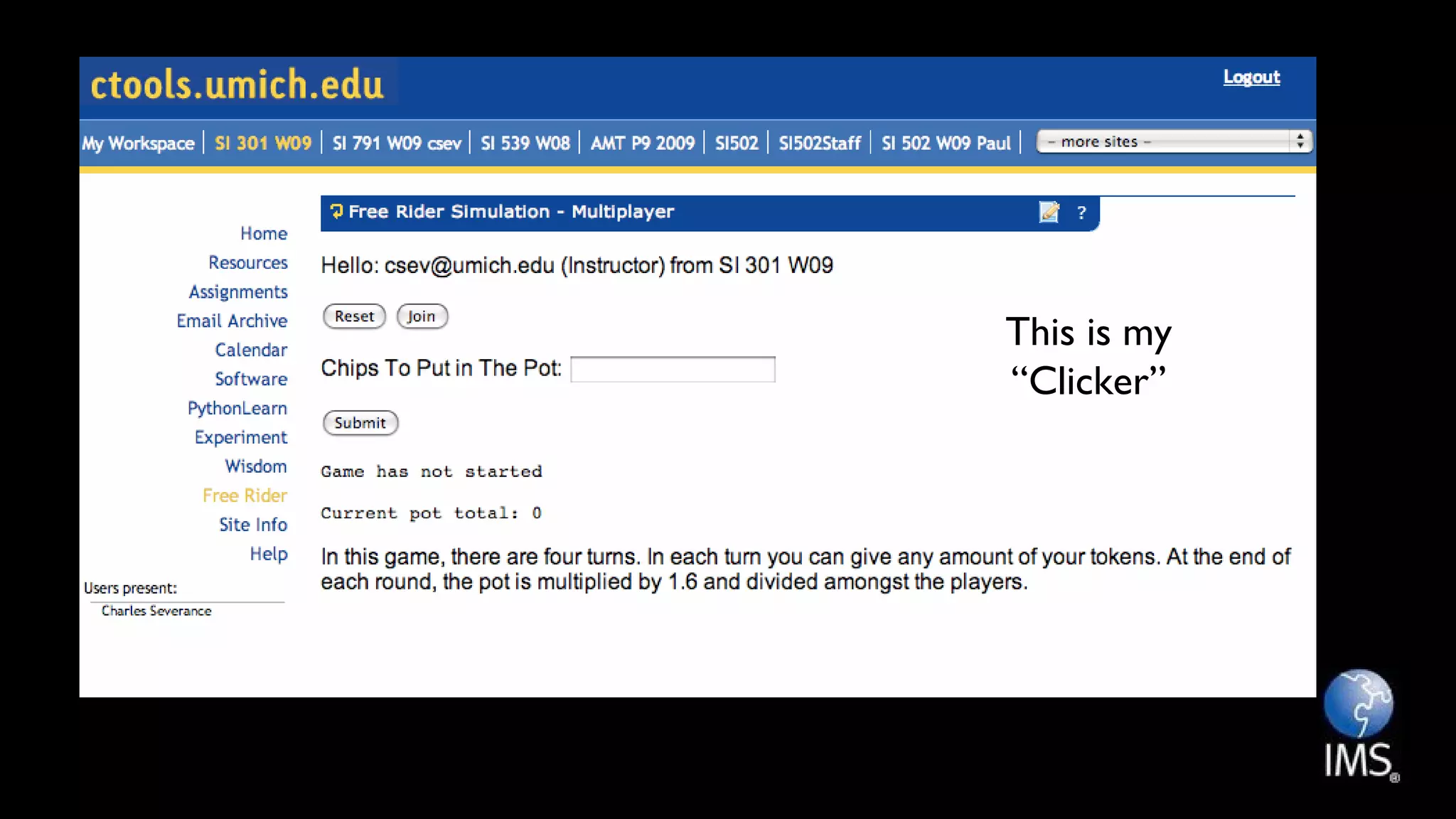
This is my
“Clicker”
This is my
“Clicker”
IMS Advertisement
• IMS needs more academic participation
• Specification development is members-only because we effectively do
it all under mutual NDA - It is kind of fun, actually
• But we feel that this is the only way to align interoperability and data
interchange specs on “Day One”
www.imsglobal.or
g
CloudCollab
Yet Another Open Source Learning Management System
www.cloudcollab.com
CloudCollab Differences
• Written in Python - Hosted on Google App Engine for free - so every
teacher and student can have their *own* LMS in production ....
• Intends to be reference implementation of IMS Standards
• Multi-Tenancy Capable using IMS LTI - Can host tool instances for
multiple LMS systems, multiple courses, and multiple organizations
• Flexibility: Can be a LTI “tool container”, personal learning
environment, small group LMS, small school LMS
More CloudCollab Differences
• Tool Development is simple - Framework takes care of the detail
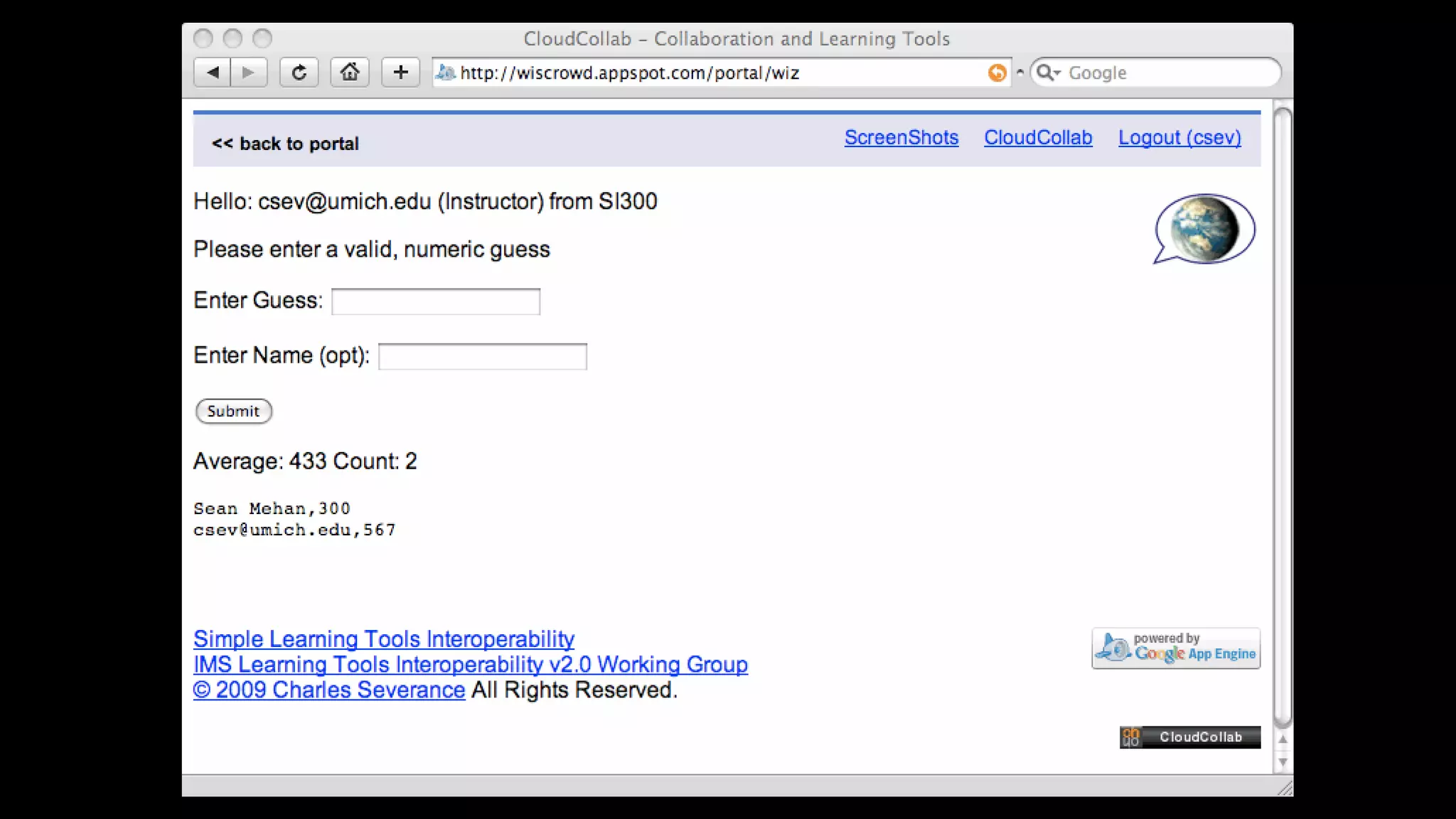
• Wisdom of Crowd guessing tool: 110 lines of Python (includes data
models) and 21 lines of HTML.
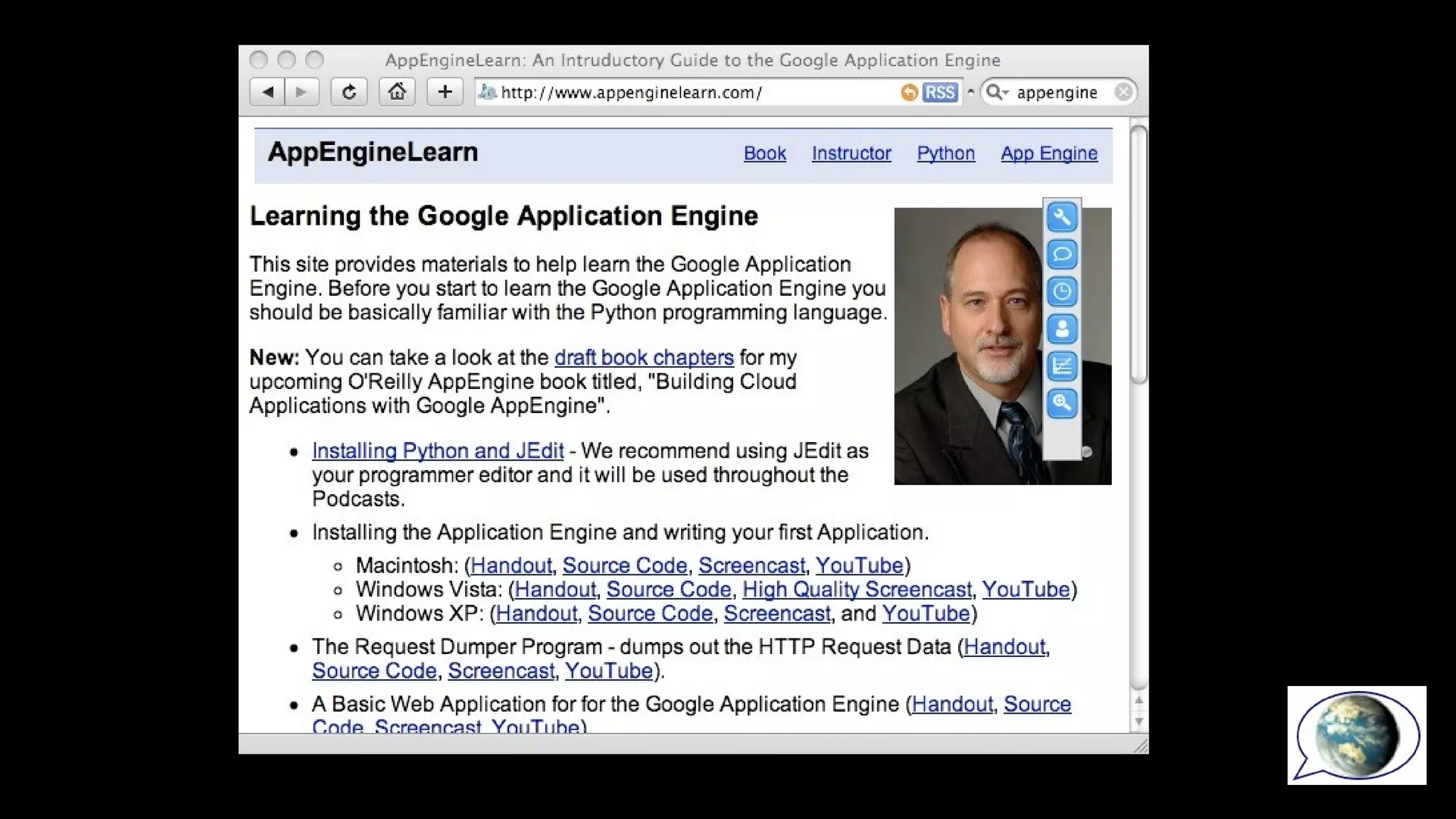
• O’Reilly Book: “Building Cloud Applications with Google AppEngine”
• May 2009
• Early version at www.appenginelearn.com
CloudCollab Summary
• Very early days - 4000 lines of code - 1 developer
• Two tools - both games for my Social Computing Course :)
• I am not in a rush - My main goal is thatI work to make development
is easy - testing with grad students who have 1 programming course
• www.cloudcollab.com
• wiscrowd.appspot.com - Demo server
Overall Summary
Distributed Learning Operating
System
• The same content can be used by millions of students simultaneously -
with each having a view that is controlled by their “course”
• A course launched from Moodle (or any LMS) could use Moodle tools
• The learning data can be kept exclusively on a campus’s servers to
comply with legal issues
• At the same time these launches can come from other
social systems like LinkedIn or Facebook
Looking Ahead
• Build and harden the technology
• Document the technology for ease of use and development
• Deploy CloudSocial services in a consortium model that is trusted and
seen to be “owned by all” - like handle.net
• Convince content owners to use the technology
• Make it easy to build new tools that can plug in
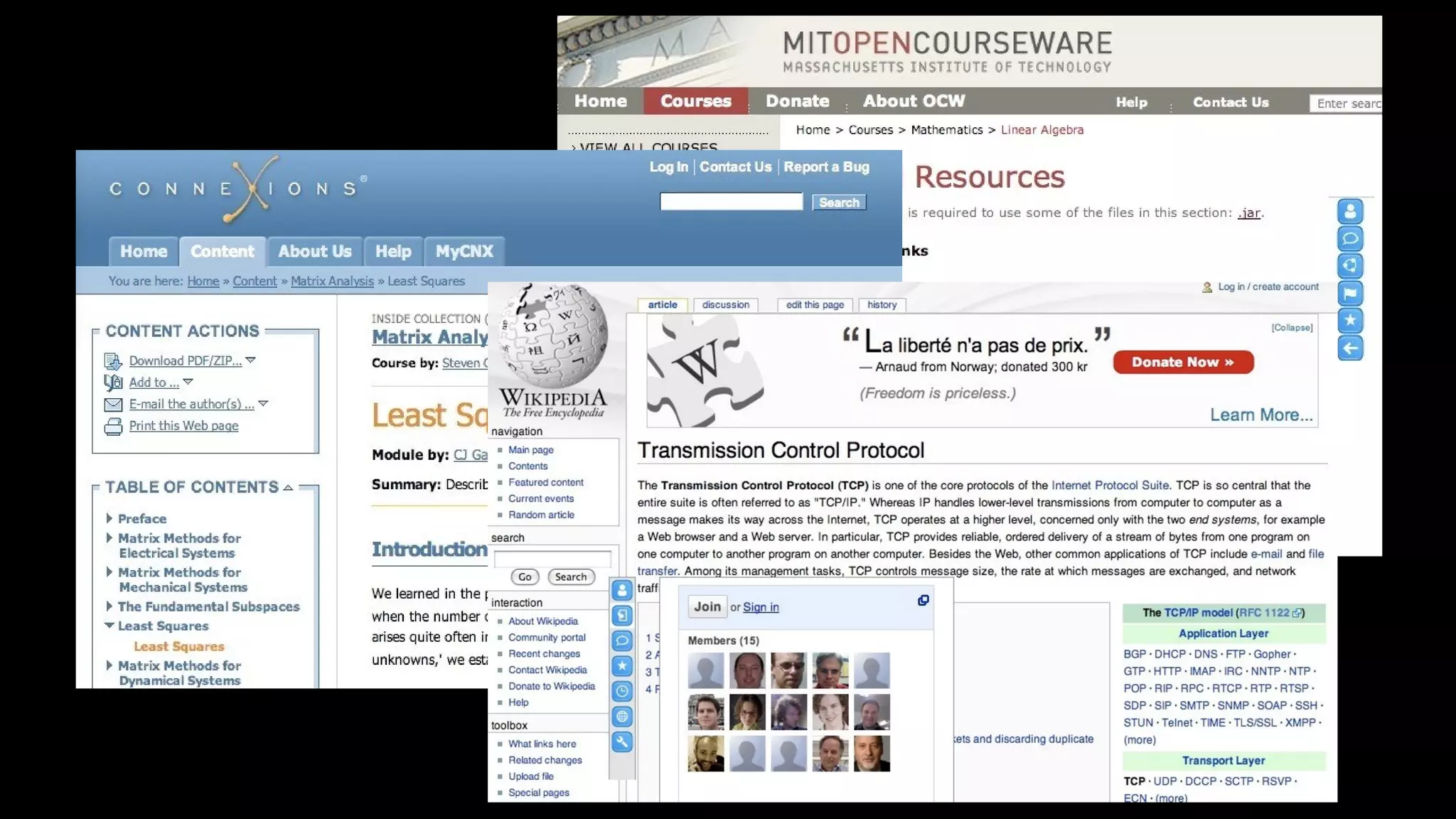
Possible Content Partners
• Individual faculty members
• open.umich.edu
• Commercial Publishers
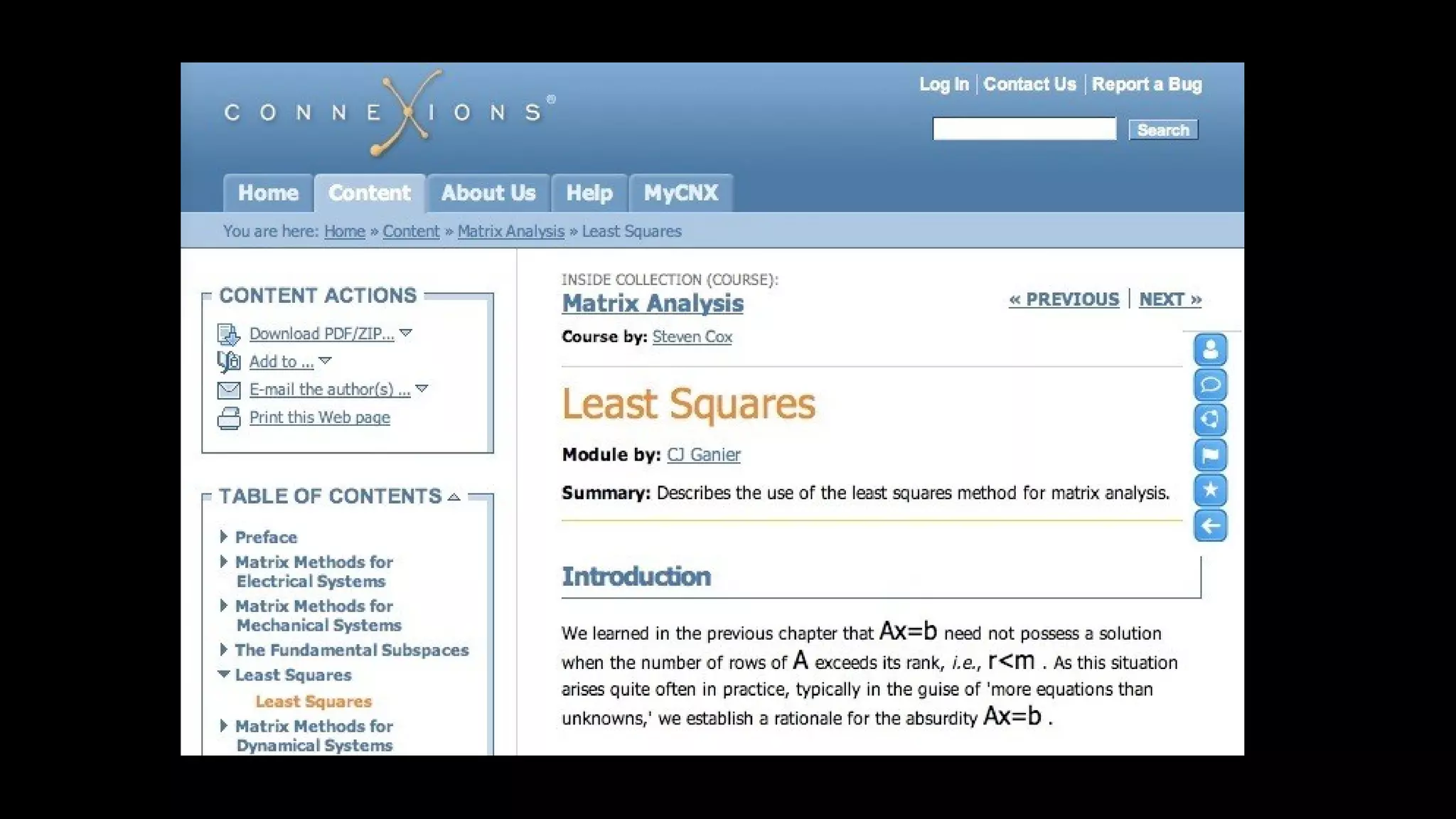
• ConneXions
• EduCommons
• MIT OCW
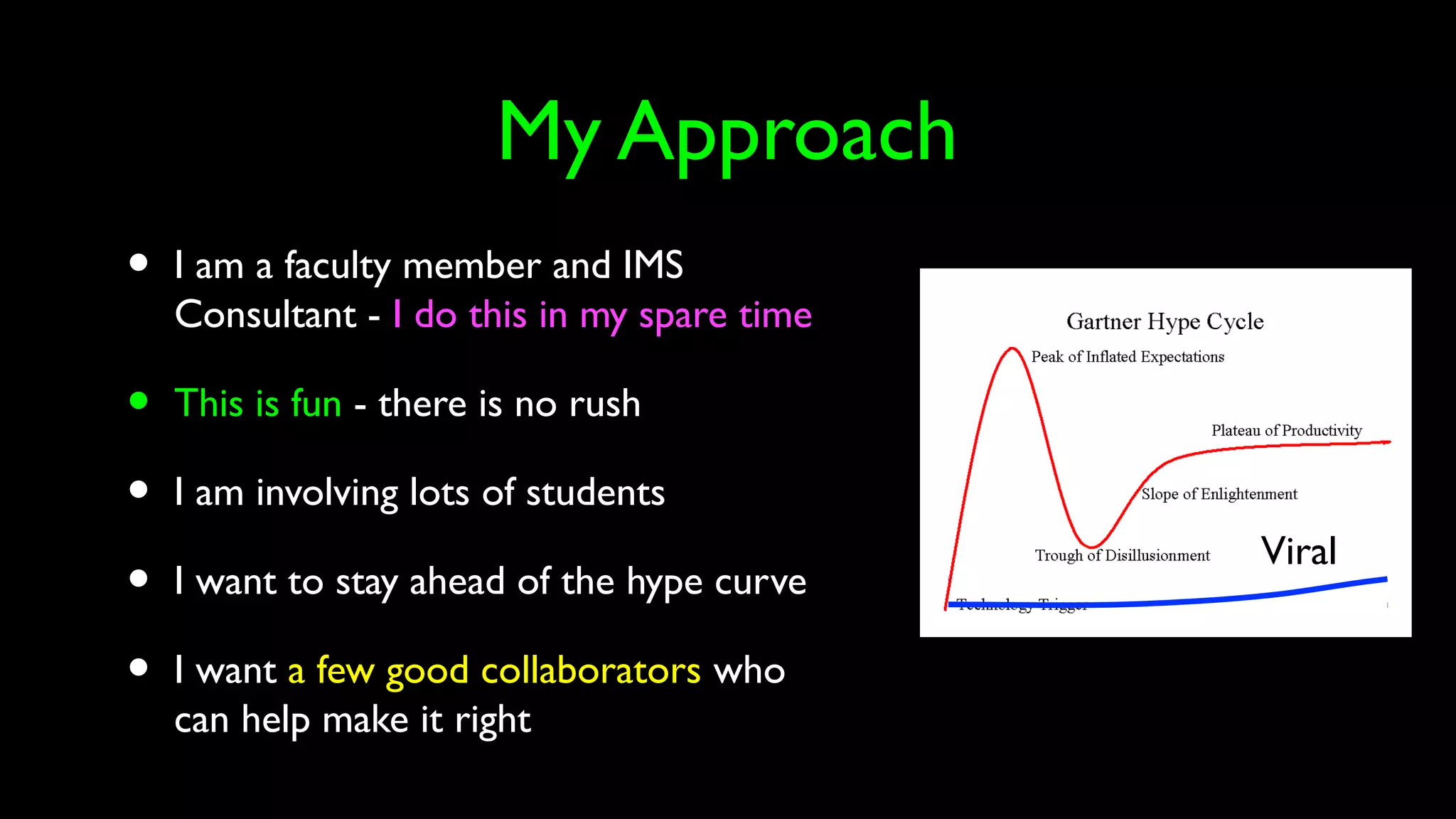
My Approach
• I am a faculty member and IMS
Consultant - I do this in my spare time
• This is fun - there is no rush
• I am involving lots of students
• I want to stay ahead of the hype curve
• I want a few good collaborators who
can help make it right
Viral
Thanks
• IMS Global Learning Consortium, the William and Flora Hewlett
Foundation, the University of Michigan Medical School, Microsoft,
Pearson Education, McGraw-Hill Higher Education,ANGEL Learning,
Blackboard, LearnGauge,Wimba, Sakai Foundation, Google Summer of
Code, and the Software Engineering for Information Systems Group
(GESSI) at Universitat Politecnica de Calalunya.
• Joseph Hardin,Ted Hanss, Joe Fantone, Casey White, Raj Mangrulkar,
Chris Chapman, Mike Bleed, Gaurav Bhatnagar, Noah Botimer,Ali Asad
Lotia, Clint Newsome, Eileen Quintero,AmandaVisconti
Summary
• CloudSocial inverts the relationship between content and LMS
• Put the LMS into the Content instead of putting the content into the
LMS
• Allows millions of learners independently walking through the same
content simultaneously viewing the material from different contexts
• This is at the formative stage - many paths forward
Summary
• CloudSocial is revolutionary and transformative
• But there is a gentle transition path from the present to the future
• So we don’t have to lose that which is comfortable to experiment
with that which is new
http://groups.google.com/group/cloudsocia
l

CloudSocial: A New Approach to Enabling Open-Content for Broad Reuse

  • 1.
    CloudSocial:A New Approachto Enabling Open Content for Broad Reuse Charles Severance,Ted Hanss, Joseph Hardin University of Michigan February 20, 2009
  • 2.
  • 3.
    Outline • Connecting theLMS and Open Educaitonal Repositories - A brief history • University of Michigan Medical School - Beyond the LMS • CloudSocial - www.cloudsocial.org • IMS Standards - www.imsglobal.org • CloudCollab - www.cloudcollab.com Warning : This is all under
  • 4.
    Timeline • 2002 -2003 - Joseph/Chuck - Experimenting in LMS • 2004 - 2006 - Joeseph/Chuck Sakai Project • Joseph’s obsession: Better Flow between LMS and OER • 2006 - Present - Joseph/Ted - OER open.umich.edu • 2007 - Present - Next Generation LMS - Michigan Medical School • 2007 - Present - Chuck is Teaching Full Time • 2008 - Present - Chuck works part time for IMS
  • 6.
  • 7.
    LMSLMS PublishPublish PublishOEROER Share LMSLMSImportImport Publish OEROER LMSLMSImportImport ImportImport LMSLMSPublishPublish OEROER ImportImport OER OER LMSLMS Import Import Import Import LMSLMS Publish Publish OER OER Import Import OER OER LMS LMS Import Import Import Import LMS LMS Publish Publish OER OER Import Import OEROER LMSLMSImportImport IIm tt This won’t scale. At some point - success leads to failure. Moving the data into and out of the LMS is a bad plan.
  • 8.
  • 11.
    Next Generation LMS •Self Regulated Learning • A blending of the individual needs and the instituional needs • LMS cannot constrict content • Lifelong Education • Competency tracking across courses and throughout life • Portfolio is implicit • Informal and formal learning Support for ad hoc learning • Don’t worry about resources • We know this takes time - we are patient
  • 12.
    Brainstorming • Met everytwo weeks with Dean, Faculty, Educational Designers, Open Michigan staff, Software Developers • Brainstormed - Gave presentations, shared big ideas • Installed and played with LMS/Portfolio Systems: Sakai, Moodle, LAMS, Mulhara, Pebble - debated strengths and weaknesses • Summer 2008: Dean Fantone said, “Enough Talking!”
  • 13.
    Conclusion from Brainstorm •The scope of this was the entire web - it was not one application • PubMed - we cannot pull that into an LMS • Google Searches and random surfing to learn • If we wanted to build software - it had to be “everywhere” - it had to follow the user as they went around the web • Our software needed to be an “assistant” - the Microsoft “paperclip”
  • 14.
    The Dean’s Challenge •Advanced Medical Therapeutics Course - FourthYear Students • Four weeks - nearly all online - well produced web content • Often done from hotel rooms while students interview for internships • What could we do with that course? • Failure *was* an option - we should push it and risk it
  • 15.
    Tools: Tracking / Presense Comment/ Twitter NotePad ToDo List Question/Answer Quiz Tracking
  • 16.
    Results of FirstPilot • Good News • Everything worked technically • Faculty loved the idea • Students loved the idea • The TODO was the most popular tool • We learned a lot - terriffic feedback • Bad News
  • 17.
    Positive Effects • Forcedus to deploy CloudSocial in production • Built PHP Framework to allow a new tool to be written in 2 days and a new feature to be added in a few hours • Validated techincal the “Tool Mashup” protocol was sound • Proved that we “caused no harm” - Medical School is more confident • Changed our perspective from “will this work” to “what can we do”
  • 18.
    Next Steps • LongitudinalCase Study Course • No prepared web content • Group work - 12 groups with faculty mentors • Use Google, PubMed, whatever they find • Looking at ShiftSpace.org • Open Content Anatomy Web Site • Used heavily by students in Year 1
  • 19.
  • 20.
    Content Owner adds CloudSocial RunTime to the Content Instrutor picks tools for their course. Tools can come from any learning system. <script type="text/javascript" src="http://www.cloudsocial.net/js/ile-main.js"> </script> <script type="text/javascript"> ile_init("ILE_33936-10-27_KEY"); </script> When the page loads, the CloudSocial run time reads tool list and displays menu.
  • 21.
    CloudSocial Goals • Stopcreating/editing content in Learning Management Systems • Stop creating content for a particular course • Create contextualizale resources - put them on the web with decent URLs to the page level - Add the CloudSocial RunTime to all pages • Contextualize your own material for your students using CloudSocial *the first time you teach* • New Problem: How to best Collectively Create and Manage Materials “Create Globally, Educate Locally ---
  • 22.
    Trends in Teachingand Learning • Move toward the “web” as the source of learning content • Move toward open participatory learning and open educational resources • A hybrid approach towards learning where organizational boundaries and educational structure is less clear • Move toward social learning - learning and exploring with groups
  • 23.
    Making Content theFocus • Content lives on the web - on any server using any technology • Instead of moving the content into lots of LMS systems... • Bring your LMS systems “with you” as you visit different sources of content on the Internet
  • 25.
    CloudSocial.org • CloudSocial isnot an LMS • CloudSocial acts as an intermediary between content owners and learning systems • CloudSocial allows any LMS to embed itself in content for learners who visit that content launched from their LMS • CloudSocial does not touch, store, or handle learning activity data - learning activity data remains on the LMS systems which provide the tools
  • 26.
  • 27.
    Tool Sources • Itis technically possible for tools to come from any LMS that suport IMS Learning Tools Interoperability • I have not yet convinced these systems to build IMS LTI Tools (yet)
  • 28.
    Inverting the Content/LMS •Today we focus on putting Content into as Many LMS systems as possible • In the future there will be many sources of content - not just LMS systems - it will be hard to get interchange formats working in all these systems (including legacy) • So lets put the LMS Into the Content.
  • 30.
  • 31.
  • 32.
    Technical Steps • Userselects external content from within the LMS (or other system supporting groups of people) • LMS contacts CloudSocial servers and establishes session context for user/course/insitution combination • User is redirected to the content • Content contacts CloudSocial servers using Ajax/JavaScript and pulls down menu for course and displays
  • 33.
    Tool Context • CloudSocialmaintains context for the tools • Institution / Course / Role / User / Page • Page context is optional
  • 34.
    Learning Tools inthe Cloud • The CloudSocial servers only hold a tiny bit of tool configuration for a course - they are not the “LMS” • If done properly, the tools that follow the user around the web can be running back on their campus. • Think of a toolset from each of the major LMS vendors - this insures that sensitive data stays “back home” - and that the user experience is consistent with the rest of their learning • The “embedded Moodle” toolset (kind of like Moodle blocks)
  • 35.
    Underlying Technology • Thisis all based on IMS Learning Tools Interoperability (LTI) • LMS Launch into CloudSocial uses LTI • CloudSocial launching to individual tools uses LTI • This means that a piece of content can be used with any LMS that makes its tools available over IMS Learning Tools Interoperability. • A mix of tools can be supported
  • 36.
    IMS Standards Dr. CharlesSeverance Developer Network Coordinator IMS Global Learning Consortium cseverance@imsglobal.org
  • 37.
    Two IMS Standards •IMS Learning Tools Interoperability - Tool “mash up” • User Identity, Course, Roster, Role • Run-Time Services • IMS Common Cartridge - Course Import/Export/Exchange • Web Content, Discussion Forums, QTI Materials, and LTI (soon) • LTI in Common Cartridge allows large/high-value content to be referenced rather than included
  • 38.
    IMS Developer Network •Lets not just write specs - lets write code while we write specs! • Demos - feedback to the spec development process • It is a “developers network” - I call folks up and we hack • BlackBoard,Wimba,ANGEL Learning, Sakai, Moodle, McGraw-Hill, Pearson, Microsoft, ...
  • 41.
  • 42.
  • 43.
    IMS Advertisement • IMSneeds more academic participation • Specification development is members-only because we effectively do it all under mutual NDA - It is kind of fun, actually • But we feel that this is the only way to align interoperability and data interchange specs on “Day One” www.imsglobal.or g
  • 44.
    CloudCollab Yet Another OpenSource Learning Management System www.cloudcollab.com
  • 45.
    CloudCollab Differences • Writtenin Python - Hosted on Google App Engine for free - so every teacher and student can have their *own* LMS in production .... • Intends to be reference implementation of IMS Standards • Multi-Tenancy Capable using IMS LTI - Can host tool instances for multiple LMS systems, multiple courses, and multiple organizations • Flexibility: Can be a LTI “tool container”, personal learning environment, small group LMS, small school LMS
  • 47.
    More CloudCollab Differences •Tool Development is simple - Framework takes care of the detail • Wisdom of Crowd guessing tool: 110 lines of Python (includes data models) and 21 lines of HTML. • O’Reilly Book: “Building Cloud Applications with Google AppEngine” • May 2009 • Early version at www.appenginelearn.com
  • 49.
    CloudCollab Summary • Veryearly days - 4000 lines of code - 1 developer • Two tools - both games for my Social Computing Course :) • I am not in a rush - My main goal is thatI work to make development is easy - testing with grad students who have 1 programming course • www.cloudcollab.com • wiscrowd.appspot.com - Demo server
  • 50.
  • 51.
    Distributed Learning Operating System •The same content can be used by millions of students simultaneously - with each having a view that is controlled by their “course” • A course launched from Moodle (or any LMS) could use Moodle tools • The learning data can be kept exclusively on a campus’s servers to comply with legal issues • At the same time these launches can come from other social systems like LinkedIn or Facebook
  • 52.
    Looking Ahead • Buildand harden the technology • Document the technology for ease of use and development • Deploy CloudSocial services in a consortium model that is trusted and seen to be “owned by all” - like handle.net • Convince content owners to use the technology • Make it easy to build new tools that can plug in
  • 53.
    Possible Content Partners •Individual faculty members • open.umich.edu • Commercial Publishers • ConneXions • EduCommons • MIT OCW
  • 54.
    My Approach • Iam a faculty member and IMS Consultant - I do this in my spare time • This is fun - there is no rush • I am involving lots of students • I want to stay ahead of the hype curve • I want a few good collaborators who can help make it right Viral
  • 55.
    Thanks • IMS GlobalLearning Consortium, the William and Flora Hewlett Foundation, the University of Michigan Medical School, Microsoft, Pearson Education, McGraw-Hill Higher Education,ANGEL Learning, Blackboard, LearnGauge,Wimba, Sakai Foundation, Google Summer of Code, and the Software Engineering for Information Systems Group (GESSI) at Universitat Politecnica de Calalunya. • Joseph Hardin,Ted Hanss, Joe Fantone, Casey White, Raj Mangrulkar, Chris Chapman, Mike Bleed, Gaurav Bhatnagar, Noah Botimer,Ali Asad Lotia, Clint Newsome, Eileen Quintero,AmandaVisconti
  • 56.
    Summary • CloudSocial invertsthe relationship between content and LMS • Put the LMS into the Content instead of putting the content into the LMS • Allows millions of learners independently walking through the same content simultaneously viewing the material from different contexts • This is at the formative stage - many paths forward
  • 57.
    Summary • CloudSocial isrevolutionary and transformative • But there is a gentle transition path from the present to the future • So we don’t have to lose that which is comfortable to experiment with that which is new http://groups.google.com/group/cloudsocia l