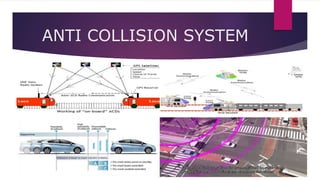
ANTI COLLISION SYSTEM
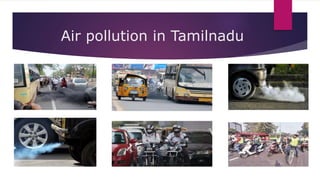
Air pollution in Tamilnadu
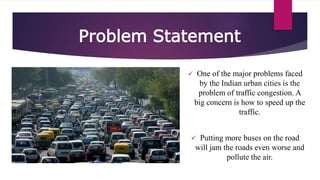
Problem Statement
 One of the major problems faced
by the Indian urban cities is the
problem of traffic congestion. A
big concern is how to speed up the
traffic.
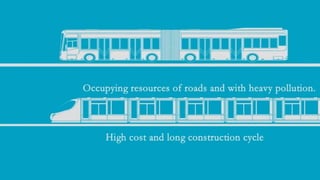
 Putting more buses on the road
will jam the roads even worse and
pollute the air.
Next Generation Transit System
straddling bus
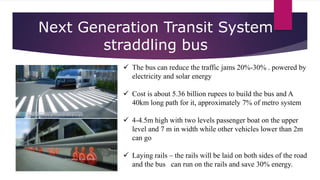
 The bus can reduce the traffic jams 20%-30% . powered by
electricity and solar energy
 Cost is about 5.36 billion rupees to build the bus and A
40km long path for it, approximately 7% of metro system
 4-4.5m high with two levels passenger boat on the upper
level and 7 m in width while other vehicles lower than 2m
can go
 Laying rails – the rails will be laid on both sides of the road
and the bus can run on the rails and save 30% energy.
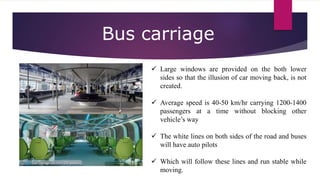
 Large windows are provided on the both lower
sides so that the illusion of car moving back, is not
created.
 Average speed is 40-50 km/hr carrying 1200-1400
passengers at a time without blocking other
vehicle’s way
 The white lines on both sides of the road and buses
will have auto pilots
 Which will follow these lines and run stable while
moving.
Bus carriage
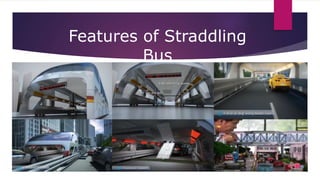
Features of Straddling
Bus
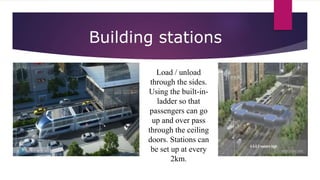
Building stations
Load / unload
through the sides.
Using the built-in-
ladder so that
passengers can go
up and over pass
through the ceiling
doors. Stations can
be set up at every
2km.
CONCLUSION
Traffic congestion is an important problem
in Indian cities. The characteristics of Indian
roads and traffic make the problem
interesting to solve. There is scope for
evaluating existing ideas in different and
challenging traffic scenario.
It can reduce up to 25-30% traffic jams on main routes.
Running at an average 40 km/h, it can take 1200 people
at a time, which means 300 passengers per cart.
It can park at its own stop without affecting the passage
of cars. This is what the interior looks like: it has huge
skylight that will eliminate passengers’ sense of
depression when enter.
Two ways to remodel the road: we can go with laying rails
on both sides of car lane, which save 30% energy; or we
can paint two white lines on both sides and use auto-pilot
technology in the bus, which will follow the lines and run
stable.
Straddling bus is completely powered by municipal
electricity and solar energy system. In terms of electricity,
the setting is called relay direct current electrification. The
bus itself is electrical conductor, two rails built on top to
allow the charging post to run along with the bus, the next
charging post will be on the rails before the earlier one
leaves, that is why we call it relay chargin
The set here is super capacitor, a device that can charge,
discharge and store electricity quickly. The power it stores
during the stop can support the bus till the next stop
where another round of charging takes place, achieving
zero toxic gas throughout the process.
About the ultrasonic waves put forth from the end of the
bus, that is to keep those high cars or trucks away from
entering the tunnel. Using laser ray to scan, cars get too
close to the passage will activate the alarm on the bus
end. Inside the bus, there are turning lights that indicate a
the bus is intending to make a turn to warn the cars inside.
Also radar scanning system is embedded on the walls to
warn cars from getting too close to the bus wheels.
This means that each station will have a conductor arm
that will drag along the roof of the TEB and connect to a
pair of rails, providing power to the bus as it moves
through the station.
The TEB is a completely electric vehicle. The main
engineering challenge would normally the size of the
batteries required to give it a usable range. However,
because the TEB will only be travelling short distances
between station is has been designed to work off a
system of “direct relay charging systems”.

Intelligent Transportation System

  • 1.
  • 2.
  • 3.
    Problem Statement  Oneof the major problems faced by the Indian urban cities is the problem of traffic congestion. A big concern is how to speed up the traffic.  Putting more buses on the road will jam the roads even worse and pollute the air.
  • 5.
    Next Generation TransitSystem straddling bus  The bus can reduce the traffic jams 20%-30% . powered by electricity and solar energy  Cost is about 5.36 billion rupees to build the bus and A 40km long path for it, approximately 7% of metro system  4-4.5m high with two levels passenger boat on the upper level and 7 m in width while other vehicles lower than 2m can go  Laying rails – the rails will be laid on both sides of the road and the bus can run on the rails and save 30% energy.
  • 6.
     Large windowsare provided on the both lower sides so that the illusion of car moving back, is not created.  Average speed is 40-50 km/hr carrying 1200-1400 passengers at a time without blocking other vehicle’s way  The white lines on both sides of the road and buses will have auto pilots  Which will follow these lines and run stable while moving. Bus carriage
  • 7.
  • 8.
    Building stations Load /unload through the sides. Using the built-in- ladder so that passengers can go up and over pass through the ceiling doors. Stations can be set up at every 2km.
  • 9.
    CONCLUSION Traffic congestion isan important problem in Indian cities. The characteristics of Indian roads and traffic make the problem interesting to solve. There is scope for evaluating existing ideas in different and challenging traffic scenario.
  • 11.
    It can reduceup to 25-30% traffic jams on main routes. Running at an average 40 km/h, it can take 1200 people at a time, which means 300 passengers per cart. It can park at its own stop without affecting the passage of cars. This is what the interior looks like: it has huge skylight that will eliminate passengers’ sense of depression when enter. Two ways to remodel the road: we can go with laying rails on both sides of car lane, which save 30% energy; or we can paint two white lines on both sides and use auto-pilot technology in the bus, which will follow the lines and run stable. Straddling bus is completely powered by municipal electricity and solar energy system. In terms of electricity, the setting is called relay direct current electrification. The bus itself is electrical conductor, two rails built on top to allow the charging post to run along with the bus, the next charging post will be on the rails before the earlier one leaves, that is why we call it relay chargin
  • 12.
    The set hereis super capacitor, a device that can charge, discharge and store electricity quickly. The power it stores during the stop can support the bus till the next stop where another round of charging takes place, achieving zero toxic gas throughout the process. About the ultrasonic waves put forth from the end of the bus, that is to keep those high cars or trucks away from entering the tunnel. Using laser ray to scan, cars get too close to the passage will activate the alarm on the bus end. Inside the bus, there are turning lights that indicate a the bus is intending to make a turn to warn the cars inside. Also radar scanning system is embedded on the walls to warn cars from getting too close to the bus wheels.
  • 13.
    This means thateach station will have a conductor arm that will drag along the roof of the TEB and connect to a pair of rails, providing power to the bus as it moves through the station. The TEB is a completely electric vehicle. The main engineering challenge would normally the size of the batteries required to give it a usable range. However, because the TEB will only be travelling short distances between station is has been designed to work off a system of “direct relay charging systems”.