SURESH ANGADI EDUCATION FOUNDATION'S
ANGADI INSTITUTE OF TECHNOLOGY & MANAGEMENT
(Approved by AICTE,New Delhi,Affiliated to Visvesvaraya Technological University,Belagavi)
Savagaon Road Belagavi-590009
Technical Paper Presentation
on
INTELLIGENT REVERSE BRAKING SYSTEM
Presented by
ROHIT R . MAKATE
USN: 2AG14ME048
Seminar Guide
Mr. VIKRAM G. PADAGURI
CONTENT
1. Introduction
2. Literature Survey
3. Methodology
4. Components and Description
5. Advantages
6. Limitations
7. Future Scope
8. Conclusion
9. References
INTRODUCTION
 The main target for this project is that, cars can run reverse automatic
braking due to obstacles when the sensor senses the obstacles.
 The braking circuit function is to brake the car automatically after
receiving the signal from the sensor.
 Need of Automatic Reverse Braking
 Benefits to the Customers
LITERATURE SURVEY
 The Reverse Alert System was first developed by Surveillance Guard
Corporation (SVG). It was the world’s first aftermarket automatic
braking system that can be fitted to any vehicle.
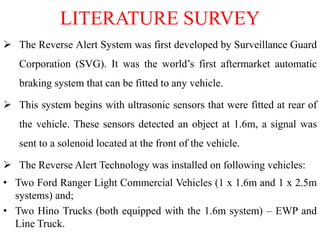
 This system begins with ultrasonic sensors that were fitted at rear of
the vehicle. These sensors detected an object at 1.6m, a signal was
sent to a solenoid located at the front of the vehicle.
 The Reverse Alert Technology was installed on following vehicles:
• Two Ford Ranger Light Commercial Vehicles (1 x 1.6m and 1 x 2.5m
systems) and;
• Two Hino Trucks (both equipped with the 1.6m system) – EWP and
Line Truck.
METHODOLOGY
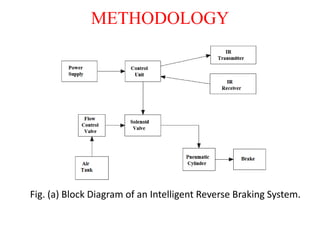
Fig. (a) Block Diagram of an Intelligent Reverse Braking System.
 IR transmitter transmits ultrasonic waves continuously.
 When a car gets too close to an obstacle, the ultrasonic waves reflect
back which is then received by the IR receiver.
 This control unit switches ON the solenoid valve. These complete
processes are electronic based which require electric supply.
 A continuous supply of compressed air through tank is supplied to
solenoid valve.
 When signal from control unit is received by solenoid valve,
compressed air is supplied to pneumatic single acting cylinder.
 Then the piston moves forward and consequently brake is applied to
the wheel. This stops the car and accident is avoided.
COMPONENTS AND
DESCRIPTION
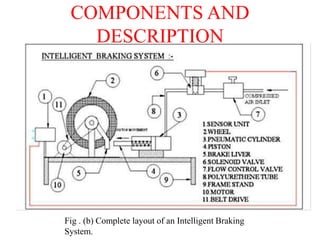
Fig . (b) Complete layout of an Intelligent Braking
System.
 A control unit supplies the power to the IR sensors. A 24V DC
supply is required for IR sensors.
 Sensor unit consist of IR transmitter for generating the
ultrasonic rays and IR receiver to receive ultrasonic rays when
they reflect back from the obstacle and is then sent to control
unit.
 The control unit then determines the distance of obstacle from
the car and if the distance is within certain range it sends
signal to solenoid valve.
 A continuous supply of compressed air is required by solenoid
valve to operate the brakes whenever needed.
 It converts the mechanical energy from motors and engines
into the potential energy through compressed air.
 When flow from the input port enters into the cylinder, due to
the pressure force the piston moves forward to compensate the
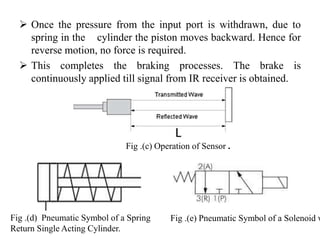
 Once the pressure from the input port is withdrawn, due to
spring in the cylinder the piston moves backward. Hence for
reverse motion, no force is required.
 This completes the braking processes. The brake is
continuously applied till signal from IR receiver is obtained.
Fig .(e) Pneumatic Symbol of a Solenoid vFig .(d) Pneumatic Symbol of a Spring
Return Single Acting Cylinder.
Fig .(c) Operation of Sensor .
ADVANTAGES
• Simple design.
• Less operating force is required.
• Greater safety in Reverse Braking.
• Automated operation.
• Can be used in running as well as Parking Mode.
• Quick response and easy operation.
LIMITATIONS
• Relatively low accuracy.
• Proper maintenance and checkup required before use.
• Creates Noise.
• Preferred for light weight operations.
FUTURE SCOPE
 The actual importance for the safety increases the value of this
system.
 Automobile industries are about to launch various intelligent
braking systems to increase the safety of customers.
 National and international organizations evaluate Motorcycle
ABS as an important factor to increase safety and reduce
motorcycle accident numbers.
 The European Commission passed legislation in 2012 that
made the fitment with ABS for all new motorcycles above
125cc to be mandatory from 1st January 2016.
CONCLUSION
 The Intelligent reverse Braking System, if executed in auto it
deflects heaps of mishaps and can spare human lives and property.
 Execution of such a propelled framework can be made mandatory
like wearing of safety belts with the goal that mischances can be
deflected to some degree.
 The fate of car security is more than simply building up another
innovation; it is moving the way to deal with wellbeing.
 INTELLIGENT BRAKING SYSTEM approach speaks to a huge
movement from the conventional way to deal with wellbeing, yet it
REFERENCES
1. Intelligent Reverse Braking System “ IRJET” Volume 5,
Issue 2, Feb 2018 .
2. Bimba Manufacturing Company, Pneumatic Application and
Reference Handbook, PP 5-12, 2012.
3. Thiess Field Trials- Reverse Alert Technology, Automatic
Braking System, Reverse Alert Australia, PP 1-12, 2013.
4. Automatic Reverse Braking with Blindspot detection “
IJESRT” June 2017.
Thank You

Intelligent Reverse Braking System

  • 1.
    SURESH ANGADI EDUCATIONFOUNDATION'S ANGADI INSTITUTE OF TECHNOLOGY & MANAGEMENT (Approved by AICTE,New Delhi,Affiliated to Visvesvaraya Technological University,Belagavi) Savagaon Road Belagavi-590009 Technical Paper Presentation on INTELLIGENT REVERSE BRAKING SYSTEM Presented by ROHIT R . MAKATE USN: 2AG14ME048 Seminar Guide Mr. VIKRAM G. PADAGURI
  • 2.
    CONTENT 1. Introduction 2. LiteratureSurvey 3. Methodology 4. Components and Description 5. Advantages 6. Limitations 7. Future Scope 8. Conclusion 9. References
  • 3.
    INTRODUCTION  The maintarget for this project is that, cars can run reverse automatic braking due to obstacles when the sensor senses the obstacles.  The braking circuit function is to brake the car automatically after receiving the signal from the sensor.  Need of Automatic Reverse Braking  Benefits to the Customers
  • 4.
    LITERATURE SURVEY  TheReverse Alert System was first developed by Surveillance Guard Corporation (SVG). It was the world’s first aftermarket automatic braking system that can be fitted to any vehicle.  This system begins with ultrasonic sensors that were fitted at rear of the vehicle. These sensors detected an object at 1.6m, a signal was sent to a solenoid located at the front of the vehicle.  The Reverse Alert Technology was installed on following vehicles: • Two Ford Ranger Light Commercial Vehicles (1 x 1.6m and 1 x 2.5m systems) and; • Two Hino Trucks (both equipped with the 1.6m system) – EWP and Line Truck.
  • 5.
    METHODOLOGY Fig. (a) BlockDiagram of an Intelligent Reverse Braking System.
  • 6.
     IR transmittertransmits ultrasonic waves continuously.  When a car gets too close to an obstacle, the ultrasonic waves reflect back which is then received by the IR receiver.  This control unit switches ON the solenoid valve. These complete processes are electronic based which require electric supply.  A continuous supply of compressed air through tank is supplied to solenoid valve.  When signal from control unit is received by solenoid valve, compressed air is supplied to pneumatic single acting cylinder.  Then the piston moves forward and consequently brake is applied to the wheel. This stops the car and accident is avoided.
  • 7.
    COMPONENTS AND DESCRIPTION Fig .(b) Complete layout of an Intelligent Braking System.
  • 8.
     A controlunit supplies the power to the IR sensors. A 24V DC supply is required for IR sensors.  Sensor unit consist of IR transmitter for generating the ultrasonic rays and IR receiver to receive ultrasonic rays when they reflect back from the obstacle and is then sent to control unit.  The control unit then determines the distance of obstacle from the car and if the distance is within certain range it sends signal to solenoid valve.  A continuous supply of compressed air is required by solenoid valve to operate the brakes whenever needed.  It converts the mechanical energy from motors and engines into the potential energy through compressed air.  When flow from the input port enters into the cylinder, due to the pressure force the piston moves forward to compensate the
  • 9.
     Once thepressure from the input port is withdrawn, due to spring in the cylinder the piston moves backward. Hence for reverse motion, no force is required.  This completes the braking processes. The brake is continuously applied till signal from IR receiver is obtained. Fig .(e) Pneumatic Symbol of a Solenoid vFig .(d) Pneumatic Symbol of a Spring Return Single Acting Cylinder. Fig .(c) Operation of Sensor .
  • 10.
    ADVANTAGES • Simple design. •Less operating force is required. • Greater safety in Reverse Braking. • Automated operation. • Can be used in running as well as Parking Mode. • Quick response and easy operation.
  • 11.
    LIMITATIONS • Relatively lowaccuracy. • Proper maintenance and checkup required before use. • Creates Noise. • Preferred for light weight operations.
  • 12.
    FUTURE SCOPE  Theactual importance for the safety increases the value of this system.  Automobile industries are about to launch various intelligent braking systems to increase the safety of customers.  National and international organizations evaluate Motorcycle ABS as an important factor to increase safety and reduce motorcycle accident numbers.  The European Commission passed legislation in 2012 that made the fitment with ABS for all new motorcycles above 125cc to be mandatory from 1st January 2016.
  • 13.
    CONCLUSION  The Intelligentreverse Braking System, if executed in auto it deflects heaps of mishaps and can spare human lives and property.  Execution of such a propelled framework can be made mandatory like wearing of safety belts with the goal that mischances can be deflected to some degree.  The fate of car security is more than simply building up another innovation; it is moving the way to deal with wellbeing.  INTELLIGENT BRAKING SYSTEM approach speaks to a huge movement from the conventional way to deal with wellbeing, yet it
  • 14.
    REFERENCES 1. Intelligent ReverseBraking System “ IRJET” Volume 5, Issue 2, Feb 2018 . 2. Bimba Manufacturing Company, Pneumatic Application and Reference Handbook, PP 5-12, 2012. 3. Thiess Field Trials- Reverse Alert Technology, Automatic Braking System, Reverse Alert Australia, PP 1-12, 2013. 4. Automatic Reverse Braking with Blindspot detection “ IJESRT” June 2017.
  • 15.