Proving Your Value: The Librarians’
Contribution to the Promotion and Tenure
                 Process

               ACRL 2013
Contact Information
       Susan Ariew
       sariew@usf.edu
       Twitter: @EdLib

       Vera Lux
       vlux@bgsu.edu
       Twitter: @thetruelight

       Matt Torrence
       torrence@usf.edu
       Twitter: @torrence42
Join the Discussion on Twitter


          #acrlimpact
The Value of the Academic Librarian to the
        Promotion/Tenure Process
• Offer expertise and information in using
  bibliometric tools
• Helps researchers decide where to submit
  manuscripts for publication
• Provide direct support to faculty in preparing
  promotion/tenure portfolios
• Keep abreast of new trends
The Importance of Understanding Impact

Scholarly Impact
• The value of faculty research for purposes of
  retention, promotion, tenure decisions.
• “Research visibility that enhances institutional
  stature among peers.” (Alpert, 1985)
Understanding Impact

Bibliometrics
• A set of methods used to study or measure texts and
  information, often toward to goal of assessing
  scholarly impact.
• “Impact Factor is not a perfect tool to measure the
  quality of articles but there is nothing better… and is,
  therefore, a good technique for scientific evaluation.”
  (Garfield, 2007)
Common Impact Measures

• Cited references to an author’s work
  – Who is citing that author as an authority
  – How much or how often an author is cited

• Journal rankings
  – Quantitative data about journals, including impact
    factors

• Reviews of an author’s work
  – Qualitative information on the quality of more
    extensive works, such as books and portfolios.
Measuring Impact Across the Disciplines

• Traditional bibliometric tools remain essential for
  faculty, despite flaws and disciplinary variance.
• Alternative bibliometric tools become a widely
  acceptable means of capturing impact, particularly in the
  social sciences and humanities.
• Altmetrics are a fast-emerging area with high potential
  for digitally savvy faculty, but are still imperfect and
  untested in most tenure cases.
Which disciplines do you think publish most
     heavily in books/monographs?
  • Medical & Biological Sciences
  • Physical Sciences & Maths
  • Engineering & Computing
  • Social Sciences, Business & Economics
  • Humanities
  • Education & Sport
  • Interdisciplinary
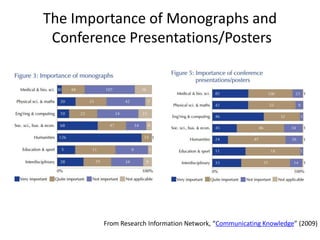
The Importance of Monographs and
 Conference Presentations/Posters


        From Research Information Network, “Communicating Knowledge” (2009)
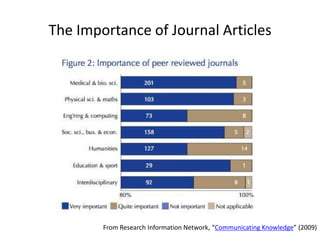
The Importance of Journal Articles


        From Research Information Network, “Communicating Knowledge” (2009)
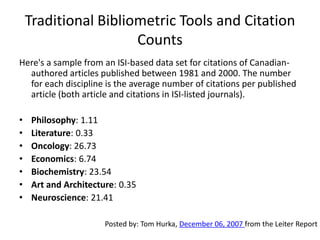
Traditional Bibliometric Tools and Citation
                      Counts
Here's a sample from an ISI-based data set for citations of Canadian-
  authored articles published between 1981 and 2000. The number
  for each discipline is the average number of citations per published
  article (both article and citations in ISI-listed journals).

•    Philosophy: 1.11
•    Literature: 0.33
•    Oncology: 26.73
•    Economics: 6.74
•    Biochemistry: 23.54
•    Art and Architecture: 0.35
•    Neuroscience: 21.41

                       Posted by: Tom Hurka, December 06, 2007 from the Leiter Report
Traditional Bibliometric Tools that
             Favor the Sciences
• Web of Science, aka Web of Knowledge
  – A combination of resources and resource types
  – A database that does more than just “find”
    articles
  – Tracking the articles that cite other articles…
  – Links to articles contained in these bibliographies
    (some are outside the ISI “universe”)


• Journal Citation Reports (JCR)
Traditional Bibliometric Tools – Web of Science
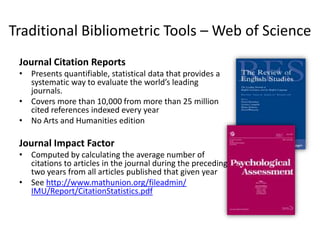
 Journal Citation Reports
 • Presents quantifiable, statistical data that provides a
   systematic way to evaluate the world’s leading
   journals.
 • Covers more than 10,000 from more than 25 million
   cited references indexed every year
 • No Arts and Humanities edition

 Journal Impact Factor
 • Computed by calculating the average number of
   citations to articles in the journal during the preceding
   two years from all articles published that given year
 • See http://www.mathunion.org/fileadmin/
   IMU/Report/CitationStatistics.pdf
Traditional Bibliometric Tools – Web of Science
Traditional Bibliometric Tools - SCOPUS

• Scopus & SciVerse
  – A database known as an alternative to Web of
    Knowledge
  – Offers similar metrics, but uses slightly different
    algorithms
     • SCImago Journal Rankings (SJR)
     • Source Normalized Impact per Paper (SNIP)
  – Offers a much wider range of journals, but still
    fairly limited for humanities scholars
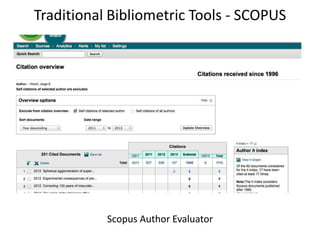
Traditional Bibliometric Tools - SCOPUS


           Scopus Author Evaluator
Alternative Bibliometric Tools

• Books & Book Chapters
  – Google Books
  – Google Scholar Citations
  – WorldCat Identities
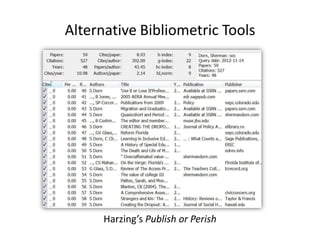
  – Anne Harzing’s Publish or Perish
Alternative Bibliometric Tools

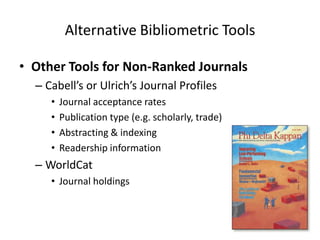
• Other Tools for Non-Ranked Journals
  – Cabell’s or Ulrich’s Journal Profiles
     •   Journal acceptance rates
     •   Publication type (e.g. scholarly, trade)
     •   Abstracting & indexing
     •   Readership information
  – WorldCat
     • Journal holdings
Alternative Bibliometric Tools


      Harzing’s Publish or Perish
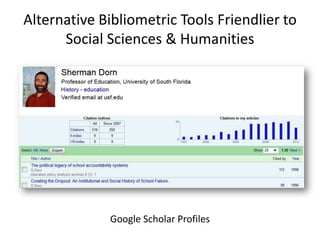
Alternative Bibliometric Tools Friendlier to
      Social Sciences & Humanities


             Google Scholar Profiles
Emerging Altmetrics Tools

Altmetrics
• The creation and study of new metrics based on the
  Social Web for analyzing, and informing scholarship
• “We rely on filters to make sense of the scholarly
  literature, but the narrow, traditional filters are being
  swamped. However, the growth of new, online
  scholarly tools allows us to make new filters; these
  altmetrics reflect the broad, rapid impact of
  scholarship in this burgeoning ecosystem.”
  (Altmetrics.org)
Emerging Altmetric Tools

• Article-Level Metrics
  – PLoS Article-Level Metrics (Views & Downloads)
  – SSRN (Views & Downloads)
  – Altmetric It Bookmarklet
• Social Media Metrics
  – Twitter API
  – Impact Story (aka Total Impact)
• Readership Metrics
  – Mendeley API
  – ReaderMeter
Would altmetrics be acceptable measures of
  impact for the tenure and promotion
      process at your institution?
   – Yes
   – No
   – Depends on the department/discipline
   – Maybe in the future
Outreach

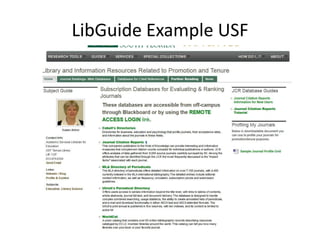
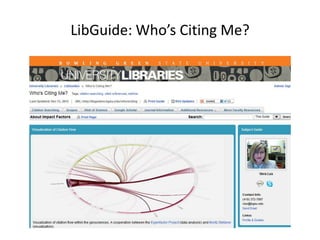
Promoting Professional Expertise on Campus
through LibGuides

Library and Information Resources Related to
Promotion and Tenure (USF)
Who’s Citing Me? (Bowling Green)
Citation Analysis (South Dakota)
LibGuide Example USF
LibGuide: Who’s Citing Me?
Workshops/Orientations

• Orientations for New Faculty
• Workshops for upper level graduate students
  and junior faculty members.
• USF’s “Beyond the Basics” series,
  “Documenting Scholarly Impact with Cited
  References, Journal Rankings, and
  Bibliometrics.”
Consultations

• One-on-One meetings with faculty who need
  support looking up journal rankings and using
  bibliometric tools to document their citations.
How do librarians at your institution support
faculty with the promotion tenure process?
  • LibGuides
  • Workshops
  • Consultations
  • Tutorials
  • Nothing currently
  • Other
Works Cited
•   Alpert, D. (1985). Performance and paralysis: the organizational context of the
    American research university. Journal of Higher Education, 56, 241-281.

•   Garfield E. (2007). Journal impact factor: A brief overview. Canadian Medical
    Association Journal, 161(8), 979–80. Retrieved August 21, 2012, from
    www.cmaj.ca/content/161/8/979

•   Hurka, T. (6 December 2007). ISI Philosophy journals and promotion decisions.
    Leither Reports: A Philsophy Blog. Retrieved December 3, 2012 from
    http://leiterreports.typepad.com/blog/2007/12/isi-philosophy.html

•   Research Information Network (19 September 2009). Communicating
    knowledge: How and why UK researchers publish & disseminate their findings.
    JISC. Retrieved December 1, 2012 from
    http://www.jisc.ac.uk/publications/research/2009/communicatingknowledger
    eport.aspx
Additional Resources
•   Altmetrics: a manifeto. Altmetrics.
      – http://altmetrics.org/manifesto/
•   Ariew, S. Library & information resources related to promotion & tenure. USF.
      – http://guides.lib.usf.edu/promotion-tenure
•   Ariew, S. Sample spreadsheet for evaluating journal significance.
      – http://guides.lib.usf.edu/loader.php?type=d&id=615329
•   Chin Roemer, R. & Borchardt, R. (2012). From bibliometrics to altmetrics: a changing scholarly
    landscape. College & Research Libraries News, 73(10), 596-600.
      – http://crln.acrl.org/content/73/10/596.full
•   Cited reference search example. ISI Web of Knowledge.
      – http://images.webofknowledge.com/WOK46/help/WOS/hcr_search.html#hcr_search
•   JCR Tutorials. Thompson Reuters.
      – http://scientific.thomson.com/tutorials/jcr4/
•   Kear R. & Colbert-Lewis D. (2011). Citation searching and bibliometric measures. College &
    Research Libraries News, 72 (8), 470–474.
      – http://crln.acrl.org/content/72/8/470.full.pdf+html
•   SCImago Journal & Country Rank.
      – http://www.scimagojr.com/

Proving Your Value: The Librarians’ Contribution to the Promotion and Tenure Process

  • 1.
    Proving Your Value:The Librarians’ Contribution to the Promotion and Tenure Process ACRL 2013
  • 2.
    Contact Information Susan Ariew sariew@usf.edu Twitter: @EdLib Vera Lux vlux@bgsu.edu Twitter: @thetruelight Matt Torrence torrence@usf.edu Twitter: @torrence42
  • 3.
    Join the Discussionon Twitter #acrlimpact
  • 4.
    The Value ofthe Academic Librarian to the Promotion/Tenure Process • Offer expertise and information in using bibliometric tools • Helps researchers decide where to submit manuscripts for publication • Provide direct support to faculty in preparing promotion/tenure portfolios • Keep abreast of new trends
  • 5.
    The Importance ofUnderstanding Impact Scholarly Impact • The value of faculty research for purposes of retention, promotion, tenure decisions. • “Research visibility that enhances institutional stature among peers.” (Alpert, 1985)
  • 6.
    Understanding Impact Bibliometrics • Aset of methods used to study or measure texts and information, often toward to goal of assessing scholarly impact. • “Impact Factor is not a perfect tool to measure the quality of articles but there is nothing better… and is, therefore, a good technique for scientific evaluation.” (Garfield, 2007)
  • 7.
    Common Impact Measures •Cited references to an author’s work – Who is citing that author as an authority – How much or how often an author is cited • Journal rankings – Quantitative data about journals, including impact factors • Reviews of an author’s work – Qualitative information on the quality of more extensive works, such as books and portfolios.
  • 8.
    Measuring Impact Acrossthe Disciplines • Traditional bibliometric tools remain essential for faculty, despite flaws and disciplinary variance. • Alternative bibliometric tools become a widely acceptable means of capturing impact, particularly in the social sciences and humanities. • Altmetrics are a fast-emerging area with high potential for digitally savvy faculty, but are still imperfect and untested in most tenure cases.
  • 9.
    Which disciplines doyou think publish most heavily in books/monographs? • Medical & Biological Sciences • Physical Sciences & Maths • Engineering & Computing • Social Sciences, Business & Economics • Humanities • Education & Sport • Interdisciplinary
  • 10.
    The Importance ofMonographs and Conference Presentations/Posters From Research Information Network, “Communicating Knowledge” (2009)
  • 11.
    The Importance ofJournal Articles From Research Information Network, “Communicating Knowledge” (2009)
  • 12.
    Traditional Bibliometric Toolsand Citation Counts Here's a sample from an ISI-based data set for citations of Canadian- authored articles published between 1981 and 2000. The number for each discipline is the average number of citations per published article (both article and citations in ISI-listed journals). • Philosophy: 1.11 • Literature: 0.33 • Oncology: 26.73 • Economics: 6.74 • Biochemistry: 23.54 • Art and Architecture: 0.35 • Neuroscience: 21.41 Posted by: Tom Hurka, December 06, 2007 from the Leiter Report
  • 13.
    Traditional Bibliometric Toolsthat Favor the Sciences • Web of Science, aka Web of Knowledge – A combination of resources and resource types – A database that does more than just “find” articles – Tracking the articles that cite other articles… – Links to articles contained in these bibliographies (some are outside the ISI “universe”) • Journal Citation Reports (JCR)
  • 14.
    Traditional Bibliometric Tools– Web of Science Journal Citation Reports • Presents quantifiable, statistical data that provides a systematic way to evaluate the world’s leading journals. • Covers more than 10,000 from more than 25 million cited references indexed every year • No Arts and Humanities edition Journal Impact Factor • Computed by calculating the average number of citations to articles in the journal during the preceding two years from all articles published that given year • See http://www.mathunion.org/fileadmin/ IMU/Report/CitationStatistics.pdf
  • 15.
  • 16.
    Traditional Bibliometric Tools- SCOPUS • Scopus & SciVerse – A database known as an alternative to Web of Knowledge – Offers similar metrics, but uses slightly different algorithms • SCImago Journal Rankings (SJR) • Source Normalized Impact per Paper (SNIP) – Offers a much wider range of journals, but still fairly limited for humanities scholars
  • 17.
    Traditional Bibliometric Tools- SCOPUS Scopus Author Evaluator
  • 18.
    Alternative Bibliometric Tools •Books & Book Chapters – Google Books – Google Scholar Citations – WorldCat Identities – Anne Harzing’s Publish or Perish
  • 19.
    Alternative Bibliometric Tools •Other Tools for Non-Ranked Journals – Cabell’s or Ulrich’s Journal Profiles • Journal acceptance rates • Publication type (e.g. scholarly, trade) • Abstracting & indexing • Readership information – WorldCat • Journal holdings
  • 20.
    Alternative Bibliometric Tools Harzing’s Publish or Perish
  • 21.
    Alternative Bibliometric ToolsFriendlier to Social Sciences & Humanities Google Scholar Profiles
  • 22.
    Emerging Altmetrics Tools Altmetrics •The creation and study of new metrics based on the Social Web for analyzing, and informing scholarship • “We rely on filters to make sense of the scholarly literature, but the narrow, traditional filters are being swamped. However, the growth of new, online scholarly tools allows us to make new filters; these altmetrics reflect the broad, rapid impact of scholarship in this burgeoning ecosystem.” (Altmetrics.org)
  • 23.
    Emerging Altmetric Tools •Article-Level Metrics – PLoS Article-Level Metrics (Views & Downloads) – SSRN (Views & Downloads) – Altmetric It Bookmarklet • Social Media Metrics – Twitter API – Impact Story (aka Total Impact) • Readership Metrics – Mendeley API – ReaderMeter
  • 24.
    Would altmetrics beacceptable measures of impact for the tenure and promotion process at your institution? – Yes – No – Depends on the department/discipline – Maybe in the future
  • 25.
    Outreach Promoting Professional Expertiseon Campus through LibGuides Library and Information Resources Related to Promotion and Tenure (USF) Who’s Citing Me? (Bowling Green) Citation Analysis (South Dakota)
  • 26.
  • 27.
  • 28.
    Workshops/Orientations • Orientations forNew Faculty • Workshops for upper level graduate students and junior faculty members. • USF’s “Beyond the Basics” series, “Documenting Scholarly Impact with Cited References, Journal Rankings, and Bibliometrics.”
  • 29.
    Consultations • One-on-One meetingswith faculty who need support looking up journal rankings and using bibliometric tools to document their citations.
  • 30.
    How do librariansat your institution support faculty with the promotion tenure process? • LibGuides • Workshops • Consultations • Tutorials • Nothing currently • Other
  • 31.
    Works Cited • Alpert, D. (1985). Performance and paralysis: the organizational context of the American research university. Journal of Higher Education, 56, 241-281. • Garfield E. (2007). Journal impact factor: A brief overview. Canadian Medical Association Journal, 161(8), 979–80. Retrieved August 21, 2012, from www.cmaj.ca/content/161/8/979 • Hurka, T. (6 December 2007). ISI Philosophy journals and promotion decisions. Leither Reports: A Philsophy Blog. Retrieved December 3, 2012 from http://leiterreports.typepad.com/blog/2007/12/isi-philosophy.html • Research Information Network (19 September 2009). Communicating knowledge: How and why UK researchers publish & disseminate their findings. JISC. Retrieved December 1, 2012 from http://www.jisc.ac.uk/publications/research/2009/communicatingknowledger eport.aspx
  • 32.
    Additional Resources • Altmetrics: a manifeto. Altmetrics. – http://altmetrics.org/manifesto/ • Ariew, S. Library & information resources related to promotion & tenure. USF. – http://guides.lib.usf.edu/promotion-tenure • Ariew, S. Sample spreadsheet for evaluating journal significance. – http://guides.lib.usf.edu/loader.php?type=d&id=615329 • Chin Roemer, R. & Borchardt, R. (2012). From bibliometrics to altmetrics: a changing scholarly landscape. College & Research Libraries News, 73(10), 596-600. – http://crln.acrl.org/content/73/10/596.full • Cited reference search example. ISI Web of Knowledge. – http://images.webofknowledge.com/WOK46/help/WOS/hcr_search.html#hcr_search • JCR Tutorials. Thompson Reuters. – http://scientific.thomson.com/tutorials/jcr4/ • Kear R. & Colbert-Lewis D. (2011). Citation searching and bibliometric measures. College & Research Libraries News, 72 (8), 470–474. – http://crln.acrl.org/content/72/8/470.full.pdf+html • SCImago Journal & Country Rank. – http://www.scimagojr.com/

Editor's Notes

  • #3 Welcome and panelists each introduce themselves
  • #5 Matt
  • #6 Vera--Introductory content before we move into specifics. The first and most important point to be made along the way here is the fact that librarians need to understand impact and why it is such an important part of faculty survival at higher education institutions. Becoming an expert in the tools and measures related to impact is key to “proving your value” to faculty. SusieI would like to talk out the key points of this and the following slide. I just want to make sure I know everything we want to get across here. Thanks for the notes Susie! --VeraVera will add to this to further emphasize the value of librarians (Matt 03082013)
  • #7 More introductory content before we move into specifics. Vera
  • #8 Matt
  • #9 Topic: thoughts on the value of metrics, the future of metrics, disciplines & metrics. Matt
  • #10 <?xml version="1.0" encoding="ISO-8859-1" ?><poll url="http://www.polleverywhere.com/multiple_choice_polls/irXtcvU3814sKph"> <!-- This snippet was inserted via the Poll Everywhere Mac Presenter --> <!-- The presence of this snippet is used to indicate that a poll will be shown during the slideshow --> <!-- TIP: You can draw a solid, filled rectangle on your slide and the Mac Presenter will automatically display your poll in that area. --> <!-- The Mac Presenter application must also be running and logged in for this to work. --> <!-- To remove this, simply delete it from the notes yourself or use the Mac Presenter to remove it for you. --> <title>Which discipline(s) do you think publishes most heavily in books/monographs?</title></poll>
  • #11 SusieVisual example of the differences in the value of certain scholarly outputs by discipline. The point to librarians is that you need to know the impact measures most important to the disciplines you serve in order to be able to assist faculty.
  • #12 Added slide (Matt 03082013)Susie can continue with this slide
  • #13 SusieHow each discipline is unique in number of cites that occur and how faculty publish—the variations particularly with ISI
  • #14 Matt: Topic: Traditional bibliometric tools – Web of Science/Knowledge & Journal Citation ReportsGeneral discussion of how this product combines databases with bibliometric tools and citation information
  • #15 Matt Traditional bibliometric tools – Web of Science/Knowledge & Journal Citation Reports (also mention Book Citation Index)Intro about ISI’s JCR. Don’t need to go into detail because some schools have these tools and some don’t, but do want to talk about ISI’s role as the first and the most prestigious, especially at the beginning when metrics creeped into the promotion/tenure process. Susie: Caveats about SSCI and JCR--criteria and reasons for inclusion/exclusion of journals in SSCI and the JCR. Currently there are now 1181 journals indexed in ERIC and the percentage in SSCI and ISI coverage is only about 20-25%. 206 r “Education and Educational Research” another 37 under “Education, Special” and another 51 under “Psychology, Educational.” 304 total.
  • #16 Per our discussion, I removed the image of the Book Citation Index. Matt will put in new images, etc. I also moved this to follow the intro slide (Matt 03082013)
  • #17 Topics: Traditional bibliometric tools extended – Scopus, Book Citation Index, Data Citation IndexVera: Scopus, SJR, Move Web of Knowledge points to another slide Matt
  • #18 Topics: Traditional bibliometric tools extended – Scopus, Book Citation Index*, Data Citation Index, Vera Needs images screen shot from Vera (Matt 03082013)
  • #19 SusieTopics: Shift from traditional bibliometrics to alternative bibliometrics based on scholarly needs. These are tools mostly used with monographs more than with book chapters which present unique challenges for authors in terms of demonstrating impact.
  • #20 Other tools used to profile publications. Here I can show journal profiles table. --SAA
  • #21 SusieTopic: Google Scholar Profiles, Harzing’s Publish or PerishHarzing example. I can’t show the software live on my computer. This slide is hard to read, though.
  • #22 SusieTopic: Google Scholar Citations, Harzing’s Publish or PerishGoogle Scholar Citations feature is proving to be very popular with faculty in all fields, but particularly education, humanities, social sciences.The h-index is an index that attempts to measure both the productivity and impact of the published work of a scientist or scholar. The index is based on the set of the scholar’s most cited papers and the number of citations that they have received in other publications. The index can also be applied to the productivity and impact of a group of scientists, such as a department or university or country, as well as a scholarly journal. The index was suggested by Jorge E. Hirsch, a physicist at UCSD, as a tool for determining theoretical physicists' relative quality[1] and is sometimes called the Hirsch index or Hirsch number.
  • #23 Vera Not sure how much of this material we actually want to cover in depth.
  • #24 Again, look at this and decide what we might include and revise accordingly. Matt? Vera?Based on our discussion, I removed the two slides (Impact Story and Altmetric It Bookmarklet). Vera can do both slides on Altmetrics here, and/or add more. If not, I’m happy to talk about some elements, or just Mendeley (Matt 03082013)
  • #25 version="1.0" encoding="ISO-8859-1" ?><poll url="http://www.polleverywhere.com/multiple_choice_polls/SGKqCmTpaWkZFJi"> <!-- This snippet was inserted via the Poll Everywhere Mac Presenter --> <!-- The presence of this snippet is used to indicate that a poll will be shown during the slideshow --> <!-- TIP: You can draw a solid, filled rectangle on your slide and the Mac Presenter will automatically display your poll in that area. --> <!-- The Mac Presenter application must also be running and logged in for this to work. --> <!-- To remove this, simply delete it from the notes yourself or use the Mac Presenter to remove it for you. --> <title>Would altmetrics be acceptable measures of impact for the tenure and promotion process at your institution?</title></poll>
  • #26 Vera
  • #27 SAA
  • #28 Vera
  • #29 Susie“This Webinar is for faculty and graduate students interested in how scholars can profile the impact of their work through cited references and journal rankings. The session will cover bibliometric tools that assist researchers in deciding where to submit their manuscripts, how to determine the impact of their journal publications, and finally how to build a strong tenure/promotion portfolio in documenting their cited references.” Matt and Susie
  • #30 Might want to talk about the number of consults we do and the purpose of those consults. Susie, Vera
  • #31 <?xml version="1.0" encoding="ISO-8859-1" ?><poll url="http://www.polleverywhere.com/multiple_choice_polls/lFxw4yYdDPoubSx"> <!-- This snippet was inserted via the Poll Everywhere Mac Presenter --> <!-- The presence of this snippet is used to indicate that a poll will be shown during the slideshow --> <!-- TIP: You can draw a solid, filled rectangle on your slide and the Mac Presenter will automatically display your poll in that area. --> <!-- The Mac Presenter application must also be running and logged in for this to work. --> <!-- To remove this, simply delete it from the notes yourself or use the Mac Presenter to remove it for you. --> <title>How do librarians at your institution support faculty with the promotion tenure process?</title></poll>
  • #32 Do we want to create a LibGuide? A handout? Where do we want to highlight more resources?