Intel
Deepinder Singh - 12020841074
Tushar Limaje - 12020841051
Advait Bhobe – 12020841116
Pranesh Shrestha - 12020841150
Abhigya Srivastava - 12020841061
Amanjot Babrah - 12020841064
Binal Kanabar - 12020841129
Rounak Vasandani - 12020841071
Group 7
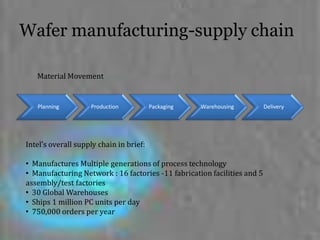
Wafer manufacturing-supply chain
Planning Production Packaging Warehousing Delivery
Material Movement
Intel’s overall supply chain in brief:
• Manufactures Multiple generations of process technology
• Manufacturing Network : 16 factories -11 fabrication facilities and 5
assembly/test factories
• 30 Global Warehouses
• Ships 1 million PC units per day
• 750,000 orders per year
Challenges and Impacts
Other Industry and Market driven
supply chain challenges:
• New and shifting market
conditions
• Expanding product offerings
• Shrinking product life cycles
• Emerging New Regulations
Transforming Intel’s supply chain
• Intel’s IT plays a key role in transforming and
maintaining Intel’s supply chain to meet these
challenges.
• Just Say Yes Program (2005 – 2007)
• Just Say Yes Program (2008 – 2010)
• Specific IT-Enabled Supply chain solutions 2011
and beyond
I. Intel IT role
• Developing a centralized workflow data system to manage CPU
and chipset product planning data with much improved data-
quality monitoring capability.
• Re-engineering the overall planning and other processes: mid-
range and tactical demand forecasting, production planning
schedule, order fulfilment and warehousing logistics.
• Re-engineering large amounts of data and data flows.
• Consolidating the data related to customers, suppliers,
locations and products into a centrally managed master data
systems.
• Consolidating many legacy systems across all business
functional areas into a more efficient ERP system.
II. Just Say Yes Program
(2005–2007)
• Goal: To Improve the business processes based on real customer
needs
• Feedback by Customers: Dissatisfaction with the order fulfilment
process - A typical response to changing an order could take up to 1.5
weeks
• Response: Just Say Yes program
Implementation of Just say Yes
Focus on Four elements:
• Improve Intel’s ability to respond quickly and positively to change
order requests
• Reduce errors in demand forecasting
• Reduce inventory levels
• Respond to customers within 24 hours with a committed dock date
(CDD)
III. Just Say Yes Program
(2008–2010)
The success of the Just Say Yes program from 2005 to 2007
led to a continued focus on improving more customer
responsiveness through several other new initiatives
mentioned as follows:
• Improving “internal efficiency” of processes
• Reducing the time between when a customer places an
order and when the product is received, known as the
“order horizon”
• Replacing manual processes with “automated processes”
Improving internal efficiency by
• Re-alignment of legacy planning processes to use
actual orders in the system, combined with demand
forecasts, as the primary signal to build product
Realigning
• Redefinition of the supply planning process,
eliminating or redesigning 15 of the 21 steps.Redefining
• Streamlining of the decision making process, the
cycle time and ownership.
Re-
engineering
Improving Internal Efficiency
Reducing Order Horizon
• Intel IT analytics helped to identify that three-quarters of all
customer change requests occur in the last four weeks prior to the
shipment.
• Asking customers to book orders several months prior to their need
and then managing these orders through the multiple change
requests.
• Pilot Project for the same held in 2007 and 2008:
 Shortened the order horizon
 High responsiveness to the initial orders
 40% reduction in the change order requests
Increase responsiveness through
Automation
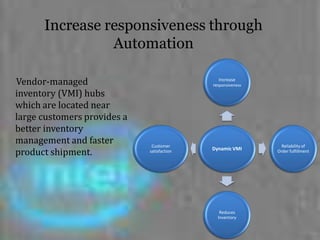
Vendor-managed
inventory (VMI) hubs
which are located near
large customers provides a
better inventory
management and faster
product shipment. Dynamic VMI
Increase
responsiveness
Reliability of
Order fulfillment
Reduces
Inventory
Customer
satisfaction
Contd…
Improvement on Supply chain responsiveness:
• Low-touch, automated response to customer forecast changes
Supply Targets
• Supply planners can respond more precisely to support
business goals when supply or demand varies
Supply Planers
• Supply planners can recommend the use of inventory to
support current or near-term customer forecast needs, while
not using up inventory or builds that are already committed
Inventory Management
IV. Specific Intel IT-Enabled Supply
Chain Solutions: 2011 and Beyond
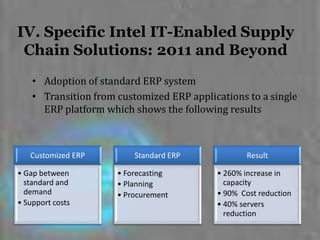
• Adoption of standard ERP system
• Transition from customized ERP applications to a single
ERP platform which shows the following results
Customized ERP
• Gap between
standard and
demand
• Support costs
Standard ERP
• Forecasting
• Planning
• Procurement
Result
• 260% increase in
capacity
• 90% Cost reduction
• 40% servers
reduction
Contd…
ERP system has provided the foundation for improvements:
• Better inventory management using simulation and modelling
• A more dynamic and automated order management system
• A more efficient supply chain that is cross-organizational and
automated
• Optimized transportation
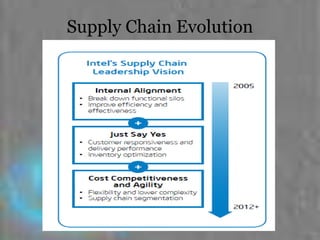
Supply Chain Evolution
Results
Business velocity:
• Improved by 50% the time it takes to start the new process,
including 25% in the supplier build times & 95% reduction in
orders.
• There is 65% shorter order-fulfillment lead time through
automated allocation management & booking.
Business responsiveness:
•There is 50% faster order to delivery time through the use of
VMI Hub, supporting the Hub business processes & information
visibility through IT businesses solutions.
•300% faster response to customers orders & change request
through integrates ERP & automation of various processes in order
to manage the business.
Contd…
Business Efficiency:
•32% reduction in the inventory through automation VMI hub.
•21% in the production CPU units produced per head count.
•16% increased in CPU units produced per dollar head.
Benefits
Implementation of agile and adaptable IT solutions
that can be used across multiple supply chains to
address the emerging modern supply chain
problems like:
• Increasing portfolio of products
• Emerging markets
• Environmental sustainability
• Infrastructure
• Regulations
Conclusion
• Intel IT plays a key role in maintaining and
transforming Intel’s supply chain to meet market
challenges.
• Some measurable effects are as follows:
– 3x-increase in responsiveness to customers
– 16-21% increase in productivity
– 32% reduction in inventory
– 50% faster order-to-delivery
– 65% reduction in order-fulfilment lead times
– Decrease in the time by half to ramp up a new
manufacturing process
Thank You

Intel group7 marketing

  • 1.
    Intel Deepinder Singh -12020841074 Tushar Limaje - 12020841051 Advait Bhobe – 12020841116 Pranesh Shrestha - 12020841150 Abhigya Srivastava - 12020841061 Amanjot Babrah - 12020841064 Binal Kanabar - 12020841129 Rounak Vasandani - 12020841071 Group 7
  • 2.
    Wafer manufacturing-supply chain PlanningProduction Packaging Warehousing Delivery Material Movement Intel’s overall supply chain in brief: • Manufactures Multiple generations of process technology • Manufacturing Network : 16 factories -11 fabrication facilities and 5 assembly/test factories • 30 Global Warehouses • Ships 1 million PC units per day • 750,000 orders per year
  • 3.
    Challenges and Impacts OtherIndustry and Market driven supply chain challenges: • New and shifting market conditions • Expanding product offerings • Shrinking product life cycles • Emerging New Regulations
  • 4.
    Transforming Intel’s supplychain • Intel’s IT plays a key role in transforming and maintaining Intel’s supply chain to meet these challenges. • Just Say Yes Program (2005 – 2007) • Just Say Yes Program (2008 – 2010) • Specific IT-Enabled Supply chain solutions 2011 and beyond
  • 5.
    I. Intel ITrole • Developing a centralized workflow data system to manage CPU and chipset product planning data with much improved data- quality monitoring capability. • Re-engineering the overall planning and other processes: mid- range and tactical demand forecasting, production planning schedule, order fulfilment and warehousing logistics. • Re-engineering large amounts of data and data flows. • Consolidating the data related to customers, suppliers, locations and products into a centrally managed master data systems. • Consolidating many legacy systems across all business functional areas into a more efficient ERP system.
  • 6.
    II. Just SayYes Program (2005–2007) • Goal: To Improve the business processes based on real customer needs • Feedback by Customers: Dissatisfaction with the order fulfilment process - A typical response to changing an order could take up to 1.5 weeks • Response: Just Say Yes program
  • 7.
    Implementation of Justsay Yes Focus on Four elements: • Improve Intel’s ability to respond quickly and positively to change order requests • Reduce errors in demand forecasting • Reduce inventory levels • Respond to customers within 24 hours with a committed dock date (CDD)
  • 8.
    III. Just SayYes Program (2008–2010) The success of the Just Say Yes program from 2005 to 2007 led to a continued focus on improving more customer responsiveness through several other new initiatives mentioned as follows: • Improving “internal efficiency” of processes • Reducing the time between when a customer places an order and when the product is received, known as the “order horizon” • Replacing manual processes with “automated processes”
  • 9.
    Improving internal efficiencyby • Re-alignment of legacy planning processes to use actual orders in the system, combined with demand forecasts, as the primary signal to build product Realigning • Redefinition of the supply planning process, eliminating or redesigning 15 of the 21 steps.Redefining • Streamlining of the decision making process, the cycle time and ownership. Re- engineering Improving Internal Efficiency
  • 10.
    Reducing Order Horizon •Intel IT analytics helped to identify that three-quarters of all customer change requests occur in the last four weeks prior to the shipment. • Asking customers to book orders several months prior to their need and then managing these orders through the multiple change requests. • Pilot Project for the same held in 2007 and 2008:  Shortened the order horizon  High responsiveness to the initial orders  40% reduction in the change order requests
  • 11.
    Increase responsiveness through Automation Vendor-managed inventory(VMI) hubs which are located near large customers provides a better inventory management and faster product shipment. Dynamic VMI Increase responsiveness Reliability of Order fulfillment Reduces Inventory Customer satisfaction
  • 12.
    Contd… Improvement on Supplychain responsiveness: • Low-touch, automated response to customer forecast changes Supply Targets • Supply planners can respond more precisely to support business goals when supply or demand varies Supply Planers • Supply planners can recommend the use of inventory to support current or near-term customer forecast needs, while not using up inventory or builds that are already committed Inventory Management
  • 13.
    IV. Specific IntelIT-Enabled Supply Chain Solutions: 2011 and Beyond • Adoption of standard ERP system • Transition from customized ERP applications to a single ERP platform which shows the following results Customized ERP • Gap between standard and demand • Support costs Standard ERP • Forecasting • Planning • Procurement Result • 260% increase in capacity • 90% Cost reduction • 40% servers reduction
  • 14.
    Contd… ERP system hasprovided the foundation for improvements: • Better inventory management using simulation and modelling • A more dynamic and automated order management system • A more efficient supply chain that is cross-organizational and automated • Optimized transportation
  • 15.
  • 16.
    Results Business velocity: • Improvedby 50% the time it takes to start the new process, including 25% in the supplier build times & 95% reduction in orders. • There is 65% shorter order-fulfillment lead time through automated allocation management & booking. Business responsiveness: •There is 50% faster order to delivery time through the use of VMI Hub, supporting the Hub business processes & information visibility through IT businesses solutions. •300% faster response to customers orders & change request through integrates ERP & automation of various processes in order to manage the business.
  • 17.
    Contd… Business Efficiency: •32% reductionin the inventory through automation VMI hub. •21% in the production CPU units produced per head count. •16% increased in CPU units produced per dollar head.
  • 18.
    Benefits Implementation of agileand adaptable IT solutions that can be used across multiple supply chains to address the emerging modern supply chain problems like: • Increasing portfolio of products • Emerging markets • Environmental sustainability • Infrastructure • Regulations
  • 19.
    Conclusion • Intel ITplays a key role in maintaining and transforming Intel’s supply chain to meet market challenges. • Some measurable effects are as follows: – 3x-increase in responsiveness to customers – 16-21% increase in productivity – 32% reduction in inventory – 50% faster order-to-delivery – 65% reduction in order-fulfilment lead times – Decrease in the time by half to ramp up a new manufacturing process
  • 20.