Submitted by Group 7
Deepinder Singh - 12020841074
Tushar Limaje - 12020841051
Advait Bhobe – 12020841116
Pranesh Shrestha - 12020841150
Abhigya Srivastava - 12020841061
Amanjot Babrah - 12020841064
Binal Kanabar - 12020841129
Rounak Vasandani - 12020841071
SUPPLY CHAIN MANAGEMENT ASSIGNMENT
Introduction to the Company
 Jubilant FoodWorks Limited (the Company) is a Jubilant Bhartia
Group Company. The Company was incorporated in 1995 and
initiated operations in 1996.
 The Company & its subsidiary operates Domino’s Pizza brand with
the exclusive rights for India, Nepal, Bangladesh and Sri Lanka.
 The company launched Dunkin’ Donuts in India in April 2012 in Delhi.
 The company is now well poised to address two distinct non-
competing segments of the Food Service Industry in India the home
delivery of Pizza’s market and the all day part food and beverage
market.
Operations Highlights
 The company runs 576 Domino's Pizza outlets in 123 cities, 10 Dunkin'
Donuts outlets in India, 2 Domino's Pizza outlets in Sri Lanka as of 31
March 2013.
 Eight out of the top 10 Domino's restaurants in the world by volume
(number of pizzas sold) are located in India.
 Delivers an average of 1 million pizzas per day.
 Dominos Pizza offers a service guarantee of "less than 30 minutes or free".
 The company operates in three segments:
1. Domestic stores
2. Domestic supply chain
3. International
 About 90% of the company's 5,155 domestic stores are franchised.
Operations Highlights
(Continued)
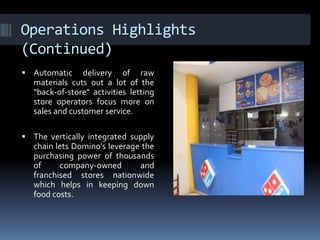
 Automatic delivery of raw
materials cuts out a lot of the
"back-of-store" activities letting
store operators focus more on
sales and customer service.
 The vertically integrated supply
chain lets Domino's leverage the
purchasing power of thousands
of company-owned and
franchised stores nationwide
which helps in keeping down
food costs.
Execution
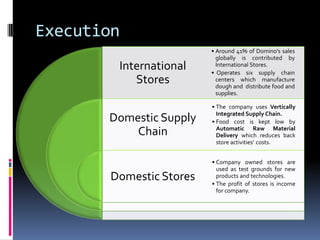
International
Stores
Domestic Supply
Chain
Domestic Stores
• Around 41% of Domino’s sales
globally is contributed by
International Stores.
• Operates six supply chain
centers which manufacture
dough and distribute food and
supplies.
• The company uses Vertically
Integrated Supply Chain.
• Food cost is kept low by
Automatic Raw Material
Delivery which reduces back
store activities’ costs.
• Company owned stores are
used as test grounds for new
products and technologies.
• The profit of stores is income
for company.
Problem faced ( Domino’s)
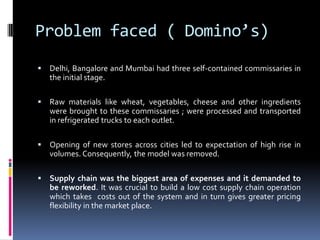
 Delhi, Bangalore and Mumbai had three self-contained commissaries in
the initial stage.
 Raw materials like wheat, vegetables, cheese and other ingredients
were brought to these commissaries ; were processed and transported
in refrigerated trucks to each outlet.
 Opening of new stores across cities led to expectation of high rise in
volumes. Consequently, the model was removed.
 Supply chain was the biggest area of expenses and it demanded to
be reworked. It was crucial to build a low cost supply chain operation
which takes costs out of the system and in turn gives greater pricing
flexibility in the market place.
Supply Chain Initiative
Strategy for procurement
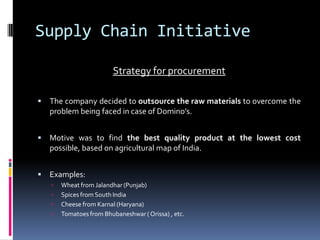
 The company decided to outsource the raw materials to overcome the
problem being faced in case of Domino’s.
 Motive was to find the best quality product at the lowest cost
possible, based on agricultural map of India.
 Examples:
 Wheat from Jalandhar(Punjab)
 Spices from South India
 Cheese from Karnal (Haryana)
 Tomatoes from Bhubaneshwar( Orissa) , etc.
Supply Chain Initiative
(continued)
Finding regions with certain crops as their specialty
 Specialty crop regions were identified throughout the country.
 The task of processing was allocated to commissary in that region.
 For instance, the commissary for the eastern region in Kolkata was responsible for
buying tomatoes (sourced from Bhubaneswar), processing them and then sending
them to all the other commissaries. Similarly, the northern commissary had
to deliver pizza bases.
 This strategy reduced the issue of duplication as well as perishability.
Supply Chain Initiative
(continued)
Strategy forVendors
 Initially, many ingredients used to be imported by the company.
 Nowadays, the whole process of procurement is localised.
 The vendors are regularly visited by company executives to supervise
the functioning between the two sides.
 Once a quarter, there are random unannounced audits and vendors keep
complying to be on the supply map.
 Cheese, poultry, lamb, pepperoni, sauces, canned veggies and
condiments, dips and a bevy of choices move from vendor factories to
the four Domino's factories or commissaries in Noida, Mumbai, Kolkata
and Bangalore.
 The processing of raw materials is done at respective commissaries.
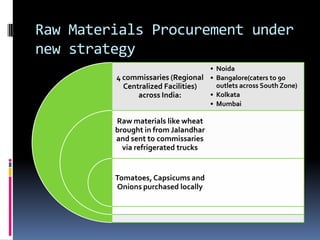
Raw Materials Procurement under
new strategy
4 commissaries (Regional
Centralized Facilities)
across India:
Raw materials like wheat
brought in from Jalandhar
and sent to commissaries
via refrigerated trucks
Tomatoes, Capsicums and
Onions purchased locally
• Noida
• Bangalore(caters to 90
outlets across South Zone)
• Kolkata
• Mumbai
Supply Chain Initiative
(continued)
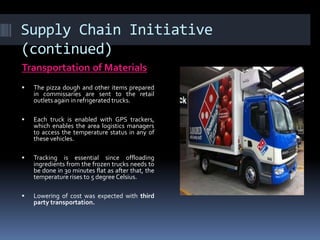
Transportation of Materials
 The pizza dough and other items prepared
in commissaries are sent to the retail
outlets again in refrigerated trucks.
 Each truck is enabled with GPS trackers,
which enables the area logistics managers
to access the temperature status in any of
these vehicles.
 Tracking is essential since offloading
ingredients from the frozen trucks needs to
be done in 30 minutes flat as after that, the
temperature rises to 5 degree Celsius.
 Lowering of cost was expected with third
party transportation.
Supply Chain Initiative
(continued)
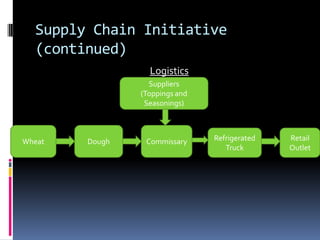
Logistics
Wheat Dough
Suppliers
(Toppings and
Seasonings)
Commissary Refrigerated
Truck
Retail
Outlet
Supply Chain Initiative
(continued)
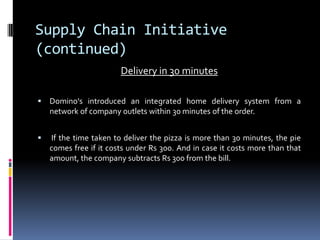
Delivery in 30 minutes
 Domino's introduced an integrated home delivery system from a
network of company outlets within 30 minutes of the order.
 If the time taken to deliver the pizza is more than 30 minutes, the pie
comes free if it costs under Rs 300. And in case it costs more than that
amount, the company subtracts Rs 300 from the bill.
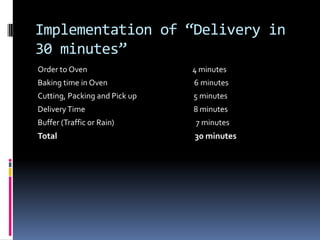
Implementation of “Delivery in
30 minutes”
Order to Oven 4 minutes
Baking time in Oven 6 minutes
Cutting, Packing and Pick up 5 minutes
Delivery Time 8 minutes
Buffer (Traffic or Rain) 7 minutes
Total 30 minutes
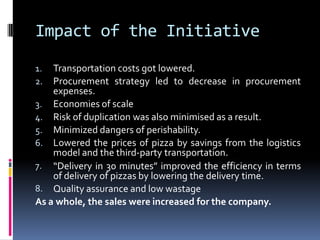
Impact of the Initiative
1. Transportation costs got lowered.
2. Procurement strategy led to decrease in procurement
expenses.
3. Economies of scale
4. Risk of duplication was also minimised as a result.
5. Minimized dangers of perishability.
6. Lowered the prices of pizza by savings from the logistics
model and the third-party transportation.
7. “Delivery in 30 minutes” improved the efficiency in terms
of delivery of pizzas by lowering the delivery time.
8. Quality assurance and low wastage
As a whole, the sales were increased for the company.
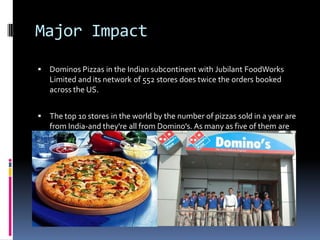
Major Impact
 Dominos Pizzas in the Indian subcontinent with Jubilant FoodWorks
Limited and its network of 552 stores does twice the orders booked
across the US.
 The top 10 stores in the world by the number of pizzas sold in a year are
from India-and they're all from Domino's. As many as five of them are
from Delhi NCR.
Thank you!

Jubilant foodworks group7_marketing

  • 1.
    Submitted by Group7 Deepinder Singh - 12020841074 Tushar Limaje - 12020841051 Advait Bhobe – 12020841116 Pranesh Shrestha - 12020841150 Abhigya Srivastava - 12020841061 Amanjot Babrah - 12020841064 Binal Kanabar - 12020841129 Rounak Vasandani - 12020841071 SUPPLY CHAIN MANAGEMENT ASSIGNMENT
  • 2.
    Introduction to theCompany  Jubilant FoodWorks Limited (the Company) is a Jubilant Bhartia Group Company. The Company was incorporated in 1995 and initiated operations in 1996.  The Company & its subsidiary operates Domino’s Pizza brand with the exclusive rights for India, Nepal, Bangladesh and Sri Lanka.  The company launched Dunkin’ Donuts in India in April 2012 in Delhi.  The company is now well poised to address two distinct non- competing segments of the Food Service Industry in India the home delivery of Pizza’s market and the all day part food and beverage market.
  • 3.
    Operations Highlights  Thecompany runs 576 Domino's Pizza outlets in 123 cities, 10 Dunkin' Donuts outlets in India, 2 Domino's Pizza outlets in Sri Lanka as of 31 March 2013.  Eight out of the top 10 Domino's restaurants in the world by volume (number of pizzas sold) are located in India.  Delivers an average of 1 million pizzas per day.  Dominos Pizza offers a service guarantee of "less than 30 minutes or free".  The company operates in three segments: 1. Domestic stores 2. Domestic supply chain 3. International  About 90% of the company's 5,155 domestic stores are franchised.
  • 4.
    Operations Highlights (Continued)  Automaticdelivery of raw materials cuts out a lot of the "back-of-store" activities letting store operators focus more on sales and customer service.  The vertically integrated supply chain lets Domino's leverage the purchasing power of thousands of company-owned and franchised stores nationwide which helps in keeping down food costs.
  • 5.
    Execution International Stores Domestic Supply Chain Domestic Stores •Around 41% of Domino’s sales globally is contributed by International Stores. • Operates six supply chain centers which manufacture dough and distribute food and supplies. • The company uses Vertically Integrated Supply Chain. • Food cost is kept low by Automatic Raw Material Delivery which reduces back store activities’ costs. • Company owned stores are used as test grounds for new products and technologies. • The profit of stores is income for company.
  • 6.
    Problem faced (Domino’s)  Delhi, Bangalore and Mumbai had three self-contained commissaries in the initial stage.  Raw materials like wheat, vegetables, cheese and other ingredients were brought to these commissaries ; were processed and transported in refrigerated trucks to each outlet.  Opening of new stores across cities led to expectation of high rise in volumes. Consequently, the model was removed.  Supply chain was the biggest area of expenses and it demanded to be reworked. It was crucial to build a low cost supply chain operation which takes costs out of the system and in turn gives greater pricing flexibility in the market place.
  • 7.
    Supply Chain Initiative Strategyfor procurement  The company decided to outsource the raw materials to overcome the problem being faced in case of Domino’s.  Motive was to find the best quality product at the lowest cost possible, based on agricultural map of India.  Examples:  Wheat from Jalandhar(Punjab)  Spices from South India  Cheese from Karnal (Haryana)  Tomatoes from Bhubaneshwar( Orissa) , etc.
  • 8.
    Supply Chain Initiative (continued) Findingregions with certain crops as their specialty  Specialty crop regions were identified throughout the country.  The task of processing was allocated to commissary in that region.  For instance, the commissary for the eastern region in Kolkata was responsible for buying tomatoes (sourced from Bhubaneswar), processing them and then sending them to all the other commissaries. Similarly, the northern commissary had to deliver pizza bases.  This strategy reduced the issue of duplication as well as perishability.
  • 9.
    Supply Chain Initiative (continued) StrategyforVendors  Initially, many ingredients used to be imported by the company.  Nowadays, the whole process of procurement is localised.  The vendors are regularly visited by company executives to supervise the functioning between the two sides.  Once a quarter, there are random unannounced audits and vendors keep complying to be on the supply map.  Cheese, poultry, lamb, pepperoni, sauces, canned veggies and condiments, dips and a bevy of choices move from vendor factories to the four Domino's factories or commissaries in Noida, Mumbai, Kolkata and Bangalore.  The processing of raw materials is done at respective commissaries.
  • 10.
    Raw Materials Procurementunder new strategy 4 commissaries (Regional Centralized Facilities) across India: Raw materials like wheat brought in from Jalandhar and sent to commissaries via refrigerated trucks Tomatoes, Capsicums and Onions purchased locally • Noida • Bangalore(caters to 90 outlets across South Zone) • Kolkata • Mumbai
  • 11.
    Supply Chain Initiative (continued) Transportationof Materials  The pizza dough and other items prepared in commissaries are sent to the retail outlets again in refrigerated trucks.  Each truck is enabled with GPS trackers, which enables the area logistics managers to access the temperature status in any of these vehicles.  Tracking is essential since offloading ingredients from the frozen trucks needs to be done in 30 minutes flat as after that, the temperature rises to 5 degree Celsius.  Lowering of cost was expected with third party transportation.
  • 12.
    Supply Chain Initiative (continued) Logistics WheatDough Suppliers (Toppings and Seasonings) Commissary Refrigerated Truck Retail Outlet
  • 13.
    Supply Chain Initiative (continued) Deliveryin 30 minutes  Domino's introduced an integrated home delivery system from a network of company outlets within 30 minutes of the order.  If the time taken to deliver the pizza is more than 30 minutes, the pie comes free if it costs under Rs 300. And in case it costs more than that amount, the company subtracts Rs 300 from the bill.
  • 14.
    Implementation of “Deliveryin 30 minutes” Order to Oven 4 minutes Baking time in Oven 6 minutes Cutting, Packing and Pick up 5 minutes Delivery Time 8 minutes Buffer (Traffic or Rain) 7 minutes Total 30 minutes
  • 15.
    Impact of theInitiative 1. Transportation costs got lowered. 2. Procurement strategy led to decrease in procurement expenses. 3. Economies of scale 4. Risk of duplication was also minimised as a result. 5. Minimized dangers of perishability. 6. Lowered the prices of pizza by savings from the logistics model and the third-party transportation. 7. “Delivery in 30 minutes” improved the efficiency in terms of delivery of pizzas by lowering the delivery time. 8. Quality assurance and low wastage As a whole, the sales were increased for the company.
  • 16.
    Major Impact  DominosPizzas in the Indian subcontinent with Jubilant FoodWorks Limited and its network of 552 stores does twice the orders booked across the US.  The top 10 stores in the world by the number of pizzas sold in a year are from India-and they're all from Domino's. As many as five of them are from Delhi NCR.
  • 17.