How Intel® is Managing Information
 Technology through the Downturn
       Server and DC Optimization


                        2009
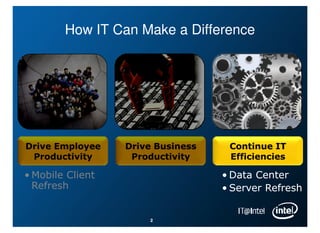
How IT Can Make a Difference


Drive Employee    Drive Business    Continue IT
 Productivity      Productivity     Efficiencies

• Mobile Client                    • Data Center
  Refresh                          • Server Refresh


                      2
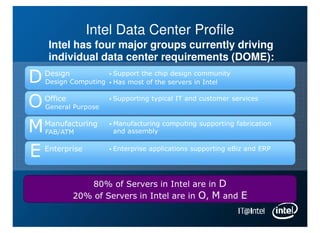
Intel Data Center Profile
    Intel has four major groups currently driving
    individual data center requirements (DOME):

D  Design
   Design Computing
                      Support the chip design community
                      Has most of the servers in Intel


O Office
   General Purpose
                      Supporting typical IT and customer services


M Manufacturing
   FAB/ATM
                      Manufacturing computing supporting fabrication
                      and assembly


E Enterprise          Enterprise applications supporting eBiz and ERP


                80% of Servers in Intel are in D
            20% of Servers in Intel are in O, M and E
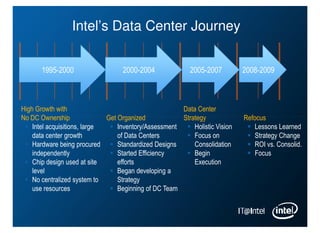
Intel’s Data Center Journey


       1995-2000                   2000-2004               2005-2007         2008-2009


High Growth with                                       Data Center
No DC Ownership               Get Organized            Strategy              Refocus
    Intel acquisitions, large     Inventory/Assessment     Holistic Vision      Lessons Learned
    data center growth            of Data Centers          Focus on             Strategy Change
    Hardware being procured       Standardized Designs     Consolidation        ROI vs. Consolid.
    independently                 Started Efficiency       Begin                Focus
    Chip design used at site      efforts                  Execution
    level                         Began developing a
    No centralized system to      Strategy
    use resources                 Beginning of DC Team
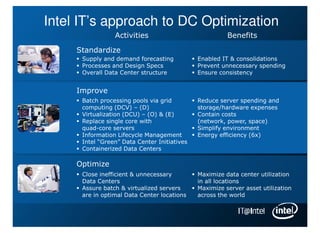
Intel IT’s approach to DC Optimization
                 Activities                             Benefits

     Standardize
      Supply and demand forecasting           Enabled IT & consolidations
      Processes and Design Specs              Prevent unnecessary spending
      Overall Data Center structure           Ensure consistency


     Improve
      Batch processing pools via grid         Reduce server spending and
      computing (DCV) – (D)                   storage/hardware expenses
      Virtualization (DCU) – (O) & (E)        Contain costs
      Replace single core with                (network, power, space)
      quad-core servers                       Simplify environment
      Information Lifecycle Management        Energy efficiency (6x)
      Intel “Green” Data Center Initiatives
      Containerized Data Centers

     Optimize
      Close inefficient & unnecessary         Maximize data center utilization
      Data Centers                            in all locations
      Assure batch & virtualized servers      Maximize server asset utilization
      are in optimal Data Center locations    across the world
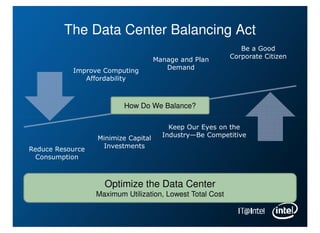
The Data Center Balancing Act
                                                              Be a Good
                                     Manage and Plan       Corporate Citizen

           Improve Computing            Demand
              Affordability


                          How Do We Balance?

                                         Keep Our Eyes on the
                  Minimize Capital     Industry—Be Competitive

Reduce Resource    Investments
  Consumption


                    Optimize the Data Center
                  Maximum Utilization, Lowest Total Cost
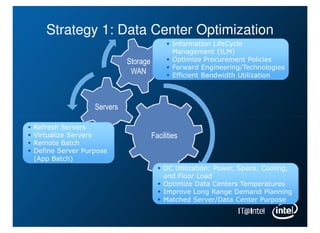
Strategy 1: Data Center Optimization
                                             Information LifeCycle
                                             Management (ILM)
                           Storage           Optimize Procurement Policies
                                             Forward Engineering/Technologies
                            WAN              Efficient Bandwidth Utilization


                 Servers

Refresh Servers
Virtualize Servers                   Facilities
Remote Batch
Define Server Purpose
(App Batch)
                                         DC Utilization: Power, Space, Cooling,
                                         and Floor Load
                                         Optimize Data Centers Temperatures
                                         Improve Long Range Demand Planning
                                         Matched Server/Data Center Purpose
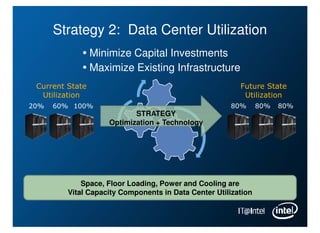
Strategy 2: Data Center Utilization
                 Minimize Capital Investments
                 Maximize Existing Infrastructure
 Current State                                           Future State
  Utilization                                             Utilization
20%   60% 100%                                        80%       80%   80%
                            STRATEGY
                     Optimization + Technology


             Space, Floor Loading, Power and Cooling are
         Vital Capacity Components in Data Center Utilization
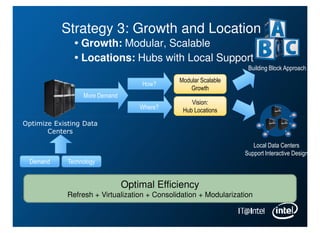
Strategy 3: Growth and Location
                 Growth: Modular, Scalable
                 Locations: Hubs with Local Support
                                                                    Building Block Approach
                                               Modular Scalable
                                    How?
                                                   Growth
                  More Demand
                                                   Vision:
                                    Where?      Hub Locations

Optimize Existing Data
       Centers

                                                                      Local Data Centers
                                                                   Support Interactive Design
  Demand     Technology


                                Optimal Efficiency
             Refresh + Virtualization + Consolidation + Modularization
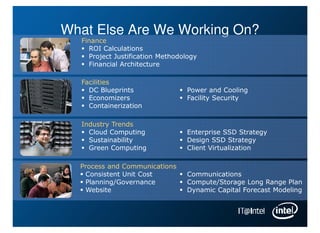
What Else Are We Working On?
  Finance
    ROI Calculations
    Project Justification Methodology
    Financial Architecture

  Facilities
    DC Blueprints                 Power and Cooling
    Economizers                   Facility Security
    Containerization

  Industry Trends
    Cloud Computing               Enterprise SSD Strategy
    Sustainability                Design SSD Strategy
    Green Computing               Client Virtualization

  Process and Communications
   Consistent Unit Cost           Communications
   Planning/Governance            Compute/Storage Long Range Plan
   Website                        Dynamic Capital Forecast Modeling
“Green” Data Center Considerations
Air-Flow Management and
Optimization
Economizers
Rack Level Cooling
High Ambient Temp Operation
Power Efficient Systems
dc Power Distribution
Application Productivity Link
Server Power Management
Containerization
(CC Systems Integration)
Intel IT’s Server Environment and
          Refresh Strategy


              12
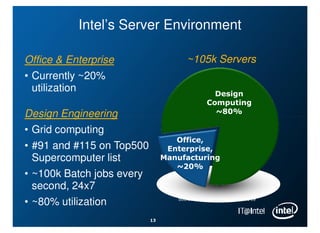
Intel’s Server Environment

Office & Enterprise                    ~105k Servers
• Currently ~20%
  utilization                                      Design
                                                 Computing
Design Engineering                                 ~80%

• Grid computing
                                   Office,
• #91 and #115 on Top500         Enterprise,
  Supercomputer list            Manufacturing
                                   ~20%
• ~100k Batch jobs every
  second, 24x7
• ~80% utilization                 Source: Internal Intel data as of Feb’09


                           13
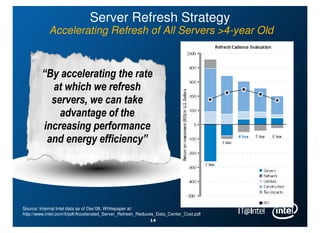
Server Refresh Strategy
            Accelerating Refresh of All Servers >4-year Old


         “By accelerating the rate
           at which we refresh
           servers, we can take
             advantage of the
         increasing performance
          and energy efficiency”


Source: Internal Intel data as of Dec’08, Whitepaper at:
http://www.intel.com/it/pdf/Accelerated_Server_Refresh_Reduces_Data_Center_Cost.pdf
                                                           14
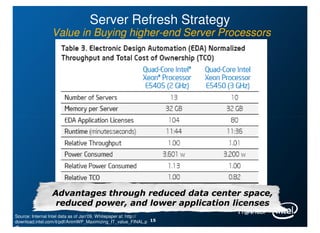
Server Refresh Strategy
                Value in Buying higher-end Server Processors


                Advantages through reduced data center space,
                 reduced power, and lower application licenses
Source: Internal Intel data as of Jan’09, Whitepaper at: http://
download.intel.com/it/pdf/AnimWP_Maximizing_IT_value_FINAL.p 15
df
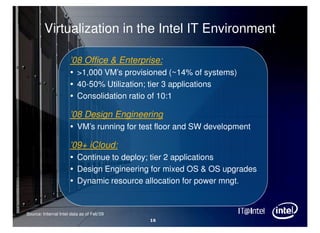
Virtualization in the Intel IT Environment

                      ’08 Office & Enterprise:
                          >1,000 VM’s provisioned (~14% of systems)
                          40-50% Utilization; tier 3 applications
                          Consolidation ratio of 10:1

                      ’08 Design Engineering
                          VM’s running for test floor and SW development

                      ’09+ iCloud:
                          Continue to deploy; tier 2 applications
                          Design Engineering for mixed OS & OS upgrades
                          Dynamic resource allocation for power mngt.


Source: Internal Intel data as of Feb’09
                                             16
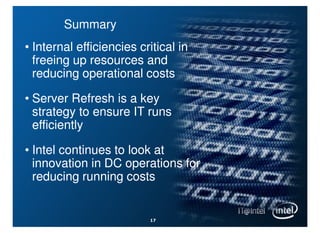
Summary
• Internal efficiencies critical in
  freeing up resources and
  reducing operational costs

• Server Refresh is a key
  strategy to ensure IT runs
  efficiently

• Intel continues to look at
  innovation in DC operations for
  reducing running costs


                          17
Other Resources Available:
        intel.com/it/              http://communities.intel.com/community/openportit/it

• Increasing the Business Value of Mobility
 http://download.intel.com/it/pdf/Increasing_the_Business_Value_of_Mobility.pdf

• Proactive PC Support Improves Service and Lowers TCO
 http://download.intel.com/it/pdf/320075.pdf

• Improving the Mobile Experience with Solid-State Drives
 http://download.intel.com/it/pdf/Improving_the_Mobile_Experience_with_Solid_State_Drives_2009.pdf

• Accelerated Server Refresh Reduces Data Center Cost
  http://www.intel.com/it/pdf/Accelerated_Server_Refresh_Reduces_Data_Center_Cost.pdf

• Maximizing IT Value by Using High-End Server processors
 http://download.intel.com/it/pdf/AnimWP_Maximizing_IT_value_FINAL.pdf

• Reducing Storage Growth and Cost; A Comprehensive
  Approach to Storage Optimizations
 http://download.intel.com/it/pdf/320947_en.pdf

• Reducing Data Center Cost with an Air Economizer
 http://www.intel.com/it/pdf/Reducing_Data_Center_Cost_with_an_Air_Economizer.pdf

• Intel IT Annul Performance Report
 http://www.intel.com/it/apr.htm

                                                   18

Intel Server & Data Center Optimization Plan

  • 1.
    How Intel® isManaging Information Technology through the Downturn Server and DC Optimization 2009
  • 2.
    How IT CanMake a Difference Drive Employee Drive Business Continue IT Productivity Productivity Efficiencies • Mobile Client • Data Center Refresh • Server Refresh 2
  • 3.
    Intel Data CenterProfile Intel has four major groups currently driving individual data center requirements (DOME): D Design Design Computing Support the chip design community Has most of the servers in Intel O Office General Purpose Supporting typical IT and customer services M Manufacturing FAB/ATM Manufacturing computing supporting fabrication and assembly E Enterprise Enterprise applications supporting eBiz and ERP 80% of Servers in Intel are in D 20% of Servers in Intel are in O, M and E
  • 4.
    Intel’s Data CenterJourney 1995-2000 2000-2004 2005-2007 2008-2009 High Growth with Data Center No DC Ownership Get Organized Strategy Refocus Intel acquisitions, large Inventory/Assessment Holistic Vision Lessons Learned data center growth of Data Centers Focus on Strategy Change Hardware being procured Standardized Designs Consolidation ROI vs. Consolid. independently Started Efficiency Begin Focus Chip design used at site efforts Execution level Began developing a No centralized system to Strategy use resources Beginning of DC Team
  • 5.
    Intel IT’s approachto DC Optimization Activities Benefits Standardize Supply and demand forecasting Enabled IT & consolidations Processes and Design Specs Prevent unnecessary spending Overall Data Center structure Ensure consistency Improve Batch processing pools via grid Reduce server spending and computing (DCV) – (D) storage/hardware expenses Virtualization (DCU) – (O) & (E) Contain costs Replace single core with (network, power, space) quad-core servers Simplify environment Information Lifecycle Management Energy efficiency (6x) Intel “Green” Data Center Initiatives Containerized Data Centers Optimize Close inefficient & unnecessary Maximize data center utilization Data Centers in all locations Assure batch & virtualized servers Maximize server asset utilization are in optimal Data Center locations across the world
  • 6.
    The Data CenterBalancing Act Be a Good Manage and Plan Corporate Citizen Improve Computing Demand Affordability How Do We Balance? Keep Our Eyes on the Minimize Capital Industry—Be Competitive Reduce Resource Investments Consumption Optimize the Data Center Maximum Utilization, Lowest Total Cost
  • 7.
    Strategy 1: DataCenter Optimization Information LifeCycle Management (ILM) Storage Optimize Procurement Policies Forward Engineering/Technologies WAN Efficient Bandwidth Utilization Servers Refresh Servers Virtualize Servers Facilities Remote Batch Define Server Purpose (App Batch) DC Utilization: Power, Space, Cooling, and Floor Load Optimize Data Centers Temperatures Improve Long Range Demand Planning Matched Server/Data Center Purpose
  • 8.
    Strategy 2: DataCenter Utilization Minimize Capital Investments Maximize Existing Infrastructure Current State Future State Utilization Utilization 20% 60% 100% 80% 80% 80% STRATEGY Optimization + Technology Space, Floor Loading, Power and Cooling are Vital Capacity Components in Data Center Utilization
  • 9.
    Strategy 3: Growthand Location Growth: Modular, Scalable Locations: Hubs with Local Support Building Block Approach Modular Scalable How? Growth More Demand Vision: Where? Hub Locations Optimize Existing Data Centers Local Data Centers Support Interactive Design Demand Technology Optimal Efficiency Refresh + Virtualization + Consolidation + Modularization
  • 10.
    What Else AreWe Working On? Finance ROI Calculations Project Justification Methodology Financial Architecture Facilities DC Blueprints Power and Cooling Economizers Facility Security Containerization Industry Trends Cloud Computing Enterprise SSD Strategy Sustainability Design SSD Strategy Green Computing Client Virtualization Process and Communications Consistent Unit Cost Communications Planning/Governance Compute/Storage Long Range Plan Website Dynamic Capital Forecast Modeling
  • 11.
    “Green” Data CenterConsiderations Air-Flow Management and Optimization Economizers Rack Level Cooling High Ambient Temp Operation Power Efficient Systems dc Power Distribution Application Productivity Link Server Power Management Containerization (CC Systems Integration)
  • 12.
    Intel IT’s ServerEnvironment and Refresh Strategy 12
  • 13.
    Intel’s Server Environment Office& Enterprise ~105k Servers • Currently ~20% utilization Design Computing Design Engineering ~80% • Grid computing Office, • #91 and #115 on Top500 Enterprise, Supercomputer list Manufacturing ~20% • ~100k Batch jobs every second, 24x7 • ~80% utilization Source: Internal Intel data as of Feb’09 13
  • 14.
    Server Refresh Strategy Accelerating Refresh of All Servers >4-year Old “By accelerating the rate at which we refresh servers, we can take advantage of the increasing performance and energy efficiency” Source: Internal Intel data as of Dec’08, Whitepaper at: http://www.intel.com/it/pdf/Accelerated_Server_Refresh_Reduces_Data_Center_Cost.pdf 14
  • 15.
    Server Refresh Strategy Value in Buying higher-end Server Processors Advantages through reduced data center space, reduced power, and lower application licenses Source: Internal Intel data as of Jan’09, Whitepaper at: http:// download.intel.com/it/pdf/AnimWP_Maximizing_IT_value_FINAL.p 15 df
  • 16.
    Virtualization in theIntel IT Environment ’08 Office & Enterprise: >1,000 VM’s provisioned (~14% of systems) 40-50% Utilization; tier 3 applications Consolidation ratio of 10:1 ’08 Design Engineering VM’s running for test floor and SW development ’09+ iCloud: Continue to deploy; tier 2 applications Design Engineering for mixed OS & OS upgrades Dynamic resource allocation for power mngt. Source: Internal Intel data as of Feb’09 16
  • 17.
    Summary • Internal efficienciescritical in freeing up resources and reducing operational costs • Server Refresh is a key strategy to ensure IT runs efficiently • Intel continues to look at innovation in DC operations for reducing running costs 17
  • 18.
    Other Resources Available: intel.com/it/ http://communities.intel.com/community/openportit/it • Increasing the Business Value of Mobility http://download.intel.com/it/pdf/Increasing_the_Business_Value_of_Mobility.pdf • Proactive PC Support Improves Service and Lowers TCO http://download.intel.com/it/pdf/320075.pdf • Improving the Mobile Experience with Solid-State Drives http://download.intel.com/it/pdf/Improving_the_Mobile_Experience_with_Solid_State_Drives_2009.pdf • Accelerated Server Refresh Reduces Data Center Cost http://www.intel.com/it/pdf/Accelerated_Server_Refresh_Reduces_Data_Center_Cost.pdf • Maximizing IT Value by Using High-End Server processors http://download.intel.com/it/pdf/AnimWP_Maximizing_IT_value_FINAL.pdf • Reducing Storage Growth and Cost; A Comprehensive Approach to Storage Optimizations http://download.intel.com/it/pdf/320947_en.pdf • Reducing Data Center Cost with an Air Economizer http://www.intel.com/it/pdf/Reducing_Data_Center_Cost_with_an_Air_Economizer.pdf • Intel IT Annul Performance Report http://www.intel.com/it/apr.htm 18