Geology 103
Field Assignment
Alyssa Lopez
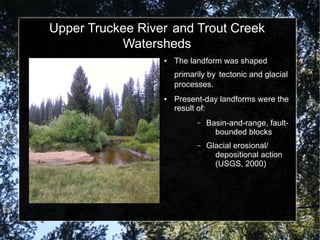
Upper Truckee River and Trout Creek
Watersheds
● The landform was shaped
primarily by tectonic and glacial
processes.
● Present-day landforms were the
result of:
– Basin-and-range, fault-
bounded blocks
– Glacial erosional/
depositional action
(USGS, 2000)
Glaciation
● Deep, basin filled deposits
● Steep mountain slopes
● Large, lateral moraines that divide the Trout Creek
watershed from the Upper Truckee River watershed
● Basin filled deposits of Trout Creek include stream and
glacial deposits (USGS, 2000)
Deterioration
● 1870- Early settlers began logging resulting in:
– Stream flow alteration
– Erosion
– Loss of native flora and fisheries
– Modified habitats
● For the past 8,000 years, little is known about
Native American impact on the environment
(Elliott-Fisk, n.d.)
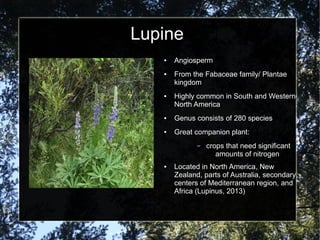
Lupine
● Angiosperm
● From the Fabaceae family/ Plantae
kingdom
● Highly common in South and Western
North America
● Genus consists of 280 species
● Great companion plant:
– crops that need significant
amounts of nitrogen
● Located in North America, New
Zealand, parts of Australia, secondary
centers of Mediterranean region, and
Africa (Lupinus, 2013)
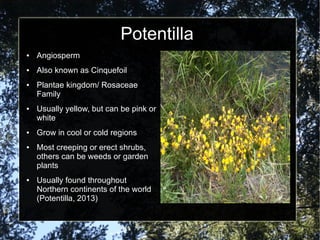
Potentilla
● Angiosperm
● Also known as Cinquefoil
● Plantae kingdom/ Rosaceae
Family
● Usually yellow, but can be pink or
white
● Grow in cool or cold regions
● Most creeping or erect shrubs,
others can be weeds or garden
plants
● Usually found throughout
Northern continents of the world
(Potentilla, 2013)
Angiosperms
● Flowering plants
● During the Early Cretaceous, the dominance of seedless plants and
gymnosperms ended.
● Early Cretaceous, possibly Late Jurassic, angiosperms replaced dominant
plants
● Closely related to gymnosperms, but precise ancestry of angiosperms is
still unclear
● Since evolution, angiosperms have adapted to nearly every terrestrial
habitats including shallow, coastal waters (Monroe, 2009, p.593)
● Continued to diversify throughout the Cenozoic Era along with seedless
vascular plants and gymnosperms (Monroe, 2009, P.632)
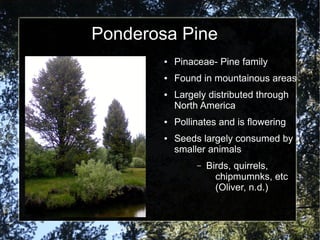
Ponderosa Pine
● Pinaceae- Pine family
● Found in mountainous areas
● Largely distributed through
North America
● Pollinates and is flowering
● Seeds largely consumed by
smaller animals
– Birds, quirrels,
chipmumnks, etc
(Oliver, n.d.)
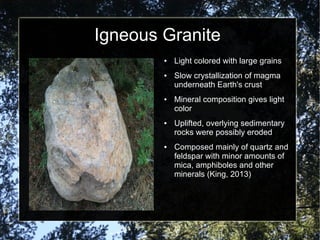
Igneous Granite
● Light colored with large grains
● Slow crystallization of magma
underneath Earth's crust
● Mineral composition gives light
color
● Uplifted, overlying sedimentary
rocks were possibly eroded
● Composed mainly of quartz and
feldspar with minor amounts of
mica, amphiboles and other
minerals (King, 2013)
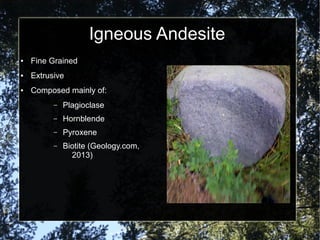
Igneous Andesite
● Fine Grained
● Extrusive
● Composed mainly of:
– Plagioclase
– Hornblende
– Pyroxene
– Biotite (Geology.com,
2013)
References
Elliott-Fisk, D.L. (n.d.) Lake Tahoe Case Study. Retrieved from
http://nature.berkeley.edu/stephens-lab/Publications/Elliot%20Fisk%20et
%20al%20Tahoe%20SNEP%20Tahoe%2096.pdf
Geology.com. (2013). Andesite. Retrieved from
http://geology.com/rocks/andesite.shtml
King, H. (2013). Granite. Retrieved from
http://geology.com/rocks/granite.shtml
Lupinus. (2013, May 31). en.Wikipedia.org. Retrieved from
http://en.wikipedia.org/wiki/Lupin
Monroe, J., & Wicander, R. (2009). The Changing Earth: Exploring Geology
and Evolution. Belmont: CA: Brooks/ Cole, Cengage Learning.
Oliver, W.W., & Ryker, R.A. (n.d.). Ponderosa Pine. Retrieved from
http://www.na.fs.fed.us/SPFO/PUBS/SILVICS_MANUAL/Volume_1/pinus/
ponderosa.htm
Potentilla. (2013, May 29). en.Wikipedia.org. Retrieved from
http://en.wikipedia.org/wiki/Potentilla
USGS. (2000, April 12). Surface and Ground Water Characteristics in the
Upper Truckee River and Trout Creek Watersheds. Retrieved from
http://pubs.usgs.gov/wri/wri004001/Text/description.htm
* All pictures taken by author, Alyssa Lopez

Field assignment

  • 1.
  • 2.
    Upper Truckee Riverand Trout Creek Watersheds ● The landform was shaped primarily by tectonic and glacial processes. ● Present-day landforms were the result of: – Basin-and-range, fault- bounded blocks – Glacial erosional/ depositional action (USGS, 2000)
  • 3.
    Glaciation ● Deep, basinfilled deposits ● Steep mountain slopes ● Large, lateral moraines that divide the Trout Creek watershed from the Upper Truckee River watershed ● Basin filled deposits of Trout Creek include stream and glacial deposits (USGS, 2000)
  • 4.
    Deterioration ● 1870- Earlysettlers began logging resulting in: – Stream flow alteration – Erosion – Loss of native flora and fisheries – Modified habitats ● For the past 8,000 years, little is known about Native American impact on the environment (Elliott-Fisk, n.d.)
  • 5.
    Lupine ● Angiosperm ● Fromthe Fabaceae family/ Plantae kingdom ● Highly common in South and Western North America ● Genus consists of 280 species ● Great companion plant: – crops that need significant amounts of nitrogen ● Located in North America, New Zealand, parts of Australia, secondary centers of Mediterranean region, and Africa (Lupinus, 2013)
  • 6.
    Potentilla ● Angiosperm ● Alsoknown as Cinquefoil ● Plantae kingdom/ Rosaceae Family ● Usually yellow, but can be pink or white ● Grow in cool or cold regions ● Most creeping or erect shrubs, others can be weeds or garden plants ● Usually found throughout Northern continents of the world (Potentilla, 2013)
  • 7.
    Angiosperms ● Flowering plants ●During the Early Cretaceous, the dominance of seedless plants and gymnosperms ended. ● Early Cretaceous, possibly Late Jurassic, angiosperms replaced dominant plants ● Closely related to gymnosperms, but precise ancestry of angiosperms is still unclear ● Since evolution, angiosperms have adapted to nearly every terrestrial habitats including shallow, coastal waters (Monroe, 2009, p.593) ● Continued to diversify throughout the Cenozoic Era along with seedless vascular plants and gymnosperms (Monroe, 2009, P.632)
  • 8.
    Ponderosa Pine ● Pinaceae-Pine family ● Found in mountainous areas ● Largely distributed through North America ● Pollinates and is flowering ● Seeds largely consumed by smaller animals – Birds, quirrels, chipmumnks, etc (Oliver, n.d.)
  • 9.
    Igneous Granite ● Lightcolored with large grains ● Slow crystallization of magma underneath Earth's crust ● Mineral composition gives light color ● Uplifted, overlying sedimentary rocks were possibly eroded ● Composed mainly of quartz and feldspar with minor amounts of mica, amphiboles and other minerals (King, 2013)
  • 10.
    Igneous Andesite ● FineGrained ● Extrusive ● Composed mainly of: – Plagioclase – Hornblende – Pyroxene – Biotite (Geology.com, 2013)
  • 11.
    References Elliott-Fisk, D.L. (n.d.)Lake Tahoe Case Study. Retrieved from http://nature.berkeley.edu/stephens-lab/Publications/Elliot%20Fisk%20et %20al%20Tahoe%20SNEP%20Tahoe%2096.pdf Geology.com. (2013). Andesite. Retrieved from http://geology.com/rocks/andesite.shtml King, H. (2013). Granite. Retrieved from http://geology.com/rocks/granite.shtml
  • 12.
    Lupinus. (2013, May31). en.Wikipedia.org. Retrieved from http://en.wikipedia.org/wiki/Lupin Monroe, J., & Wicander, R. (2009). The Changing Earth: Exploring Geology and Evolution. Belmont: CA: Brooks/ Cole, Cengage Learning. Oliver, W.W., & Ryker, R.A. (n.d.). Ponderosa Pine. Retrieved from http://www.na.fs.fed.us/SPFO/PUBS/SILVICS_MANUAL/Volume_1/pinus/ ponderosa.htm
  • 13.
    Potentilla. (2013, May29). en.Wikipedia.org. Retrieved from http://en.wikipedia.org/wiki/Potentilla USGS. (2000, April 12). Surface and Ground Water Characteristics in the Upper Truckee River and Trout Creek Watersheds. Retrieved from http://pubs.usgs.gov/wri/wri004001/Text/description.htm * All pictures taken by author, Alyssa Lopez