


Education as an Integrated Function in
Ministry of Health and Medical
Education
Dr. Shahram Yazdani
๏ถOver the past two decades, significant
steps were taken to improve the quality of
health care delivery in Iran.
๏ถOne major step was the stepwise
integration of medical education into
health services.
Early Years after Islamic Revolution
๏ถIn early years after Islamic revolution, the
need for greater medical workforce was
critically felt because in some area there
was only one physician per 18,000
population, and that was why foreign
doctors were on the ground to render
medical services.
๏ถIn addition, medical students were trained
in specialized hospitals with no affiliation
to the health care ministry and society.
The 1985 Reform
๏ถIn 1985 The Parliament of the I.R.Iran
approved of the law integrating medical
and health education with the health
services forming the Ministry of Health and
Medical Education
๏ถWithin this context, the main mission of
the Ministry of Health, Treatment and
Medical Education, set out in 1985, has
been to upgrade the quality of the health
care system of the country in the areas of
health, treatment, education and research.
The 1985 Reform
๏ถIn terms of health, the aim was to improve the
overall health index. In terms of education,
the aim was to have an increase in medical
and paramedical student enrolment in the
universities to provide the necessary health
manpower.
๏ถIt also included the revision of the curriculum
of undergraduate and postgraduate courses,
based on community needs. In terms of
treatment, there had to be an upgrade in the
quality of medical care services as well as a
better distribution of medical services over
the country.
The 1993 Reform
๏ถIn 1993 The Supreme Council of
Government Administration declared the
integration of all Provincial Health
Organizations into the Universities of
Medical Sciences present in the province
and the outcome was the Province
University of Medical Sciences and Health
Services
The 1993 Reform
๏ถIn 1995 a ministerial decree approved that
in each province the existing university of
Medical Sciences take over all
educational, research and health services
activities
Objectives of Integration
๏ถTo improve the quality of community
oriented medical education
๏ถTo improve the quality of health care
services
๏ถTo decentralize
๏ถTo utilize the resources of the provinces for
establishing new teaching bases
๏ถTo support newly established universities
๏ถTo increase the patient capacity of hospitals
๏ถTo unify management and decision-making.
๏ถTo expand research activities.
Organizational Changes
๏ถIn organizational terms the integration is
expressed at the central level in the dual
role of the Minister and then the existence
of Deputy Ministers for both Education and
University Affairs and Health.
๏ถAt the provincial level it is the role of the
Chancellor of the Universities of Medical
Sciences and Health Services to integrate
the two functions.
Organizational Changes
๏ถIt should be said that in international
terms, such functional integration is far
from being common.
๏ถMedical universities and faculties are
usually under a formal relationship with the
Ministry of Education but enjoy a special
relationship with the government health
services.
Universities of Medical Sciences and Health
Services
๏ถAs an important point, Article 29 of the
Constitution of the Islamic Republic of Iran
emphasizes that every Iranian has the right to
enjoy the highest attainable level of health.
๏ถThe Ministry of Health and Medical Education
is mandated to fulfill this goal through
designing and implementing a national-level
health policy.
๏ถYet, the Ministry of Health and Medical
Education delegates its implementation to
medical universities across the country.
Universities of Medical Sciences and Health
Services
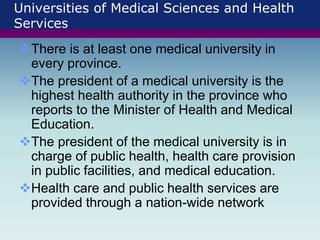
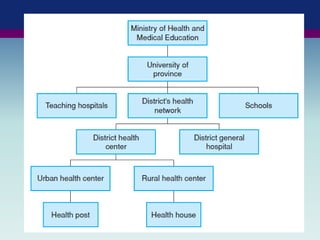
๏ถThere is at least one medical university in
every province.
๏ถThe president of a medical university is the
highest health authority in the province who
reports to the Minister of Health and Medical
Education.
๏ถThe president of the medical university is in
charge of public health, health care provision
in public facilities, and medical education.
๏ถHealth care and public health services are
provided through a nation-wide network
Functional Integration in Health
System through Cross-boundary
Process Management
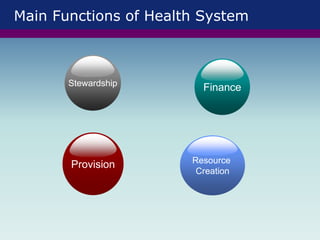
Main Functions of Health System
Provision
Stewardship
Finance
Resource
Creation
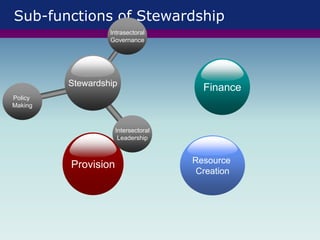
Sub-functions of Stewardship
Provision
Stewardship
Intersectoral
Leadership
Intrasectoral
Governance
Policy
Making
Finance
Resource
Creation
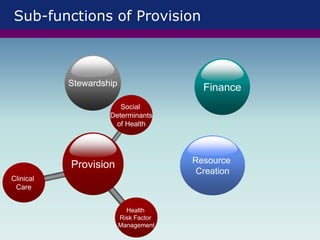
Sub-functions of Provision
Provision
Clinical
Care
Health
Risk Factor
Management
Social
Determinants
of Health
Stewardship
Finance
Resource
Creation
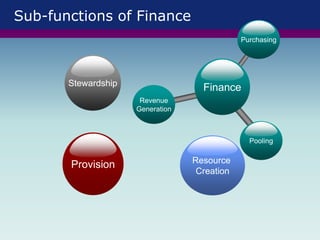
Sub-functions of Finance
Provision
Stewardship
Finance
Pooling
Revenue
Generation
Purchasing
Resource
Creation
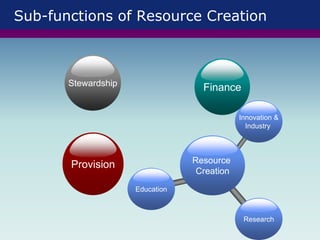
Sub-functions of Resource Creation
Provision
Stewardship
Finance
Resource
Creation
Research
Innovation &
Industry
Education
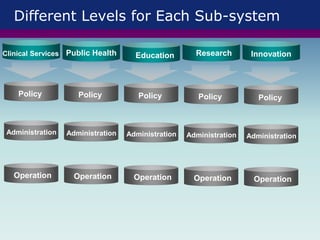
Different Levels for Each Sub-system
Clinical Services Public Health Education Innovation
Policy Policy Policy Policy Policy
Administration Administration Administration Administration Administration
Operation Operation Operation Operation Operation
Research
Operation Operation Operation Operation Operation
Administration Administration Administration Administration Administration
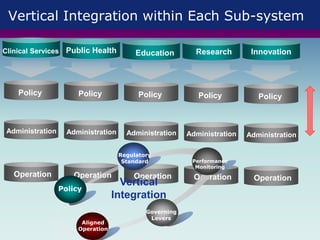
Vertical Integration within Each Sub-system
Clinical Services Public Health Education Innovation
Policy Policy Policy Policy Policy
Research
Vertical
Integration
Policy
Regulatory
Standard Performance
Monitoring
Governing
Levers
Aligned
Operation
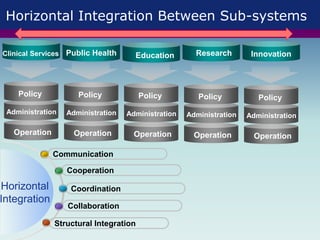
Horizontal Integration Between Sub-systems
Operation
Administration
Education
Policy
Horizontal
Integration
Communication
Cooperation
Coordination
Collaboration
Structural Integration
Operation
Administration
Public Health
Policy
Operation
Administration
Policy
Research
Operation
Administration
Clinical Services
Policy
Operation
Administration
Innovation
Policy
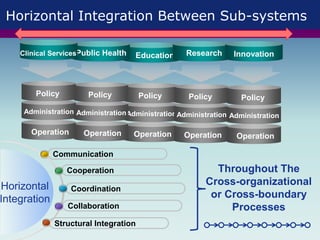
Horizontal Integration Between Sub-systems
Horizontal
Integration
Operation
Administration
Education
Policy
Communication
Cooperation
Coordination
Collaboration
Structural Integration
Operation
Administration
Public Health
Policy
Operation
Administration
Policy
Research
Operation
Administration
Clinical Services
Policy
Operation
Administration
Innovation
Policy
Throughout The
Cross-organizational
or Cross-boundary
Processes
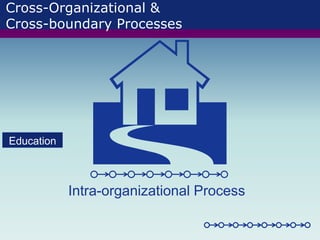
Cross-Organizational &
Cross-boundary Processes
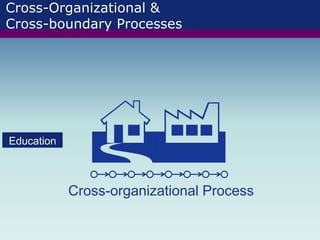
Education
Intra-organizational Process
Cross-Organizational &
Cross-boundary Processes
๏ˆ๏†Education
Cross-organizational Process
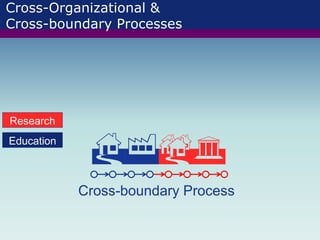
Cross-Organizational &
Cross-boundary Processes
๏ˆ๏†๏‚๏‡
Research
Education
Cross-boundary Process
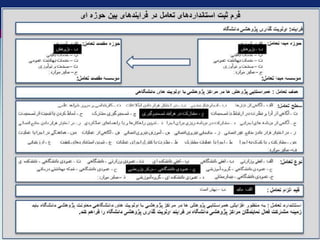
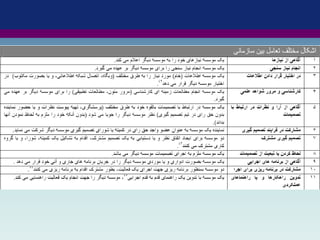
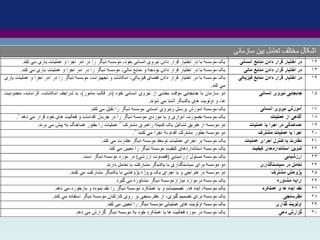
Project Steps
๏ถListing Main Processes in MOHME & UMS
(more than 500 processes)
๏ถSelecting Main Cross-organizational and
Cross-boundary processes (more than
150 CO&CB Processes
Research Sub-system: CO&CB Process
๏ถ Feedback of health system to academy about research
needs
๏ถ Involvement of health system in the process of research
priority setting in academy
๏ถ Research on policies of health system in academy
๏ถ Research on management (administration) of health
system in academy
๏ถ Funding of academic research by health system
๏ถ Joint research projects and corporate R&D by academy
and health system
๏ถ Knowledge management (appraisal, synthesis and
customization) by academy for health system usage
๏ถ Utilization of new academically generated knowledge by
health system
Innovation & Industry Sub-system:
CO&CB Process
๏ถ Role of academy in protecting intellectual property (e.g. patent office)
๏ถ Venture nurturing activities and units in academy (Searching for ideas
that can be commercialized, creating fertile ground for spin-off activity,
protecting the technology base, business coaching, and facility
management)
๏ถ Science and technology parks, business parks
๏ถ University consultancy and contracting services
๏ถ Knowledge brokering in academy
๏ถ Knowledge purveyering in Academy
๏ถ Supply of scientific and technical services to third parties (business
sector and public administration)
๏ถ Diffusion of information, knowledge and technology towards economic
and public operators acting at the interface between suppliers and
users. (Innovation centers and liaison units at universities)
๏ถ Technology Policy making (technology assessment offices)
๏ถ Diffusion of scientific culture through science museums, science
centers
Education Sub-system: CO&CB Process
๏ถ Involvement of academy in community needs
assessment
๏ถ Involvement of academy in workforce planning
๏ถ Involvement of academy in service gap analysis
๏ถ Defining and approving new educational programs
according to community needs
๏ถ Community orientation (alignment of objectives and
content with community needs) in academic educational
programs
๏ถ Community based (authentic educational settings) in
academic educational programs
๏ถ Continuous education of providers or producers by
academy
๏ถ Continuous professional development of providers or
producers by academy
Provision Sub-system: CO&CB Process
๏ถAcademy role in Setting standards and
norms of services
๏ถAcademy role in Licensure and
certification of providers
๏ถAcademy role in Distribution of workforce
๏ถAcademy role in Monitoring and control of
service performance or quality
๏ถAcademy role in Coordination of services
Project Steps
๏ถListing Main Processes in MOHME & UMS
(more than 500 processes)
๏ถSelecting Main Cross-organizational and
Cross-boundary processes (more than
150 CO&CB Processes
๏ถIdentifying main interventions to improve
integrity of Cross-organizational and
Cross-boundary processes (more than
300 interventions)
Integration in health system

Integration in health system

  • 1.
    Education as anIntegrated Function in Ministry of Health and Medical Education Dr. Shahram Yazdani
  • 2.
    ๏ถOver the pasttwo decades, significant steps were taken to improve the quality of health care delivery in Iran. ๏ถOne major step was the stepwise integration of medical education into health services.
  • 3.
    Early Years afterIslamic Revolution ๏ถIn early years after Islamic revolution, the need for greater medical workforce was critically felt because in some area there was only one physician per 18,000 population, and that was why foreign doctors were on the ground to render medical services. ๏ถIn addition, medical students were trained in specialized hospitals with no affiliation to the health care ministry and society.
  • 4.
    The 1985 Reform ๏ถIn1985 The Parliament of the I.R.Iran approved of the law integrating medical and health education with the health services forming the Ministry of Health and Medical Education ๏ถWithin this context, the main mission of the Ministry of Health, Treatment and Medical Education, set out in 1985, has been to upgrade the quality of the health care system of the country in the areas of health, treatment, education and research.
  • 5.
    The 1985 Reform ๏ถInterms of health, the aim was to improve the overall health index. In terms of education, the aim was to have an increase in medical and paramedical student enrolment in the universities to provide the necessary health manpower. ๏ถIt also included the revision of the curriculum of undergraduate and postgraduate courses, based on community needs. In terms of treatment, there had to be an upgrade in the quality of medical care services as well as a better distribution of medical services over the country.
  • 6.
    The 1993 Reform ๏ถIn1993 The Supreme Council of Government Administration declared the integration of all Provincial Health Organizations into the Universities of Medical Sciences present in the province and the outcome was the Province University of Medical Sciences and Health Services
  • 7.
    The 1993 Reform ๏ถIn1995 a ministerial decree approved that in each province the existing university of Medical Sciences take over all educational, research and health services activities
  • 8.
    Objectives of Integration ๏ถToimprove the quality of community oriented medical education ๏ถTo improve the quality of health care services ๏ถTo decentralize ๏ถTo utilize the resources of the provinces for establishing new teaching bases ๏ถTo support newly established universities ๏ถTo increase the patient capacity of hospitals ๏ถTo unify management and decision-making. ๏ถTo expand research activities.
  • 9.
    Organizational Changes ๏ถIn organizationalterms the integration is expressed at the central level in the dual role of the Minister and then the existence of Deputy Ministers for both Education and University Affairs and Health. ๏ถAt the provincial level it is the role of the Chancellor of the Universities of Medical Sciences and Health Services to integrate the two functions.
  • 10.
    Organizational Changes ๏ถIt shouldbe said that in international terms, such functional integration is far from being common. ๏ถMedical universities and faculties are usually under a formal relationship with the Ministry of Education but enjoy a special relationship with the government health services.
  • 11.
    Universities of MedicalSciences and Health Services ๏ถAs an important point, Article 29 of the Constitution of the Islamic Republic of Iran emphasizes that every Iranian has the right to enjoy the highest attainable level of health. ๏ถThe Ministry of Health and Medical Education is mandated to fulfill this goal through designing and implementing a national-level health policy. ๏ถYet, the Ministry of Health and Medical Education delegates its implementation to medical universities across the country.
  • 12.
    Universities of MedicalSciences and Health Services ๏ถThere is at least one medical university in every province. ๏ถThe president of a medical university is the highest health authority in the province who reports to the Minister of Health and Medical Education. ๏ถThe president of the medical university is in charge of public health, health care provision in public facilities, and medical education. ๏ถHealth care and public health services are provided through a nation-wide network
  • 14.
    Functional Integration inHealth System through Cross-boundary Process Management
  • 15.
    Main Functions ofHealth System Provision Stewardship Finance Resource Creation
  • 16.
  • 17.
    Sub-functions of Provision Provision Clinical Care Health RiskFactor Management Social Determinants of Health Stewardship Finance Resource Creation
  • 18.
  • 19.
    Sub-functions of ResourceCreation Provision Stewardship Finance Resource Creation Research Innovation & Industry Education
  • 20.
    Different Levels forEach Sub-system Clinical Services Public Health Education Innovation Policy Policy Policy Policy Policy Administration Administration Administration Administration Administration Operation Operation Operation Operation Operation Research
  • 21.
    Operation Operation OperationOperation Operation Administration Administration Administration Administration Administration Vertical Integration within Each Sub-system Clinical Services Public Health Education Innovation Policy Policy Policy Policy Policy Research Vertical Integration Policy Regulatory Standard Performance Monitoring Governing Levers Aligned Operation
  • 22.
    Horizontal Integration BetweenSub-systems Operation Administration Education Policy Horizontal Integration Communication Cooperation Coordination Collaboration Structural Integration Operation Administration Public Health Policy Operation Administration Policy Research Operation Administration Clinical Services Policy Operation Administration Innovation Policy
  • 23.
    Horizontal Integration BetweenSub-systems Horizontal Integration Operation Administration Education Policy Communication Cooperation Coordination Collaboration Structural Integration Operation Administration Public Health Policy Operation Administration Policy Research Operation Administration Clinical Services Policy Operation Administration Innovation Policy Throughout The Cross-organizational or Cross-boundary Processes
  • 24.
  • 25.
  • 26.
  • 27.
    Project Steps ๏ถListing MainProcesses in MOHME & UMS (more than 500 processes) ๏ถSelecting Main Cross-organizational and Cross-boundary processes (more than 150 CO&CB Processes
  • 28.
    Research Sub-system: CO&CBProcess ๏ถ Feedback of health system to academy about research needs ๏ถ Involvement of health system in the process of research priority setting in academy ๏ถ Research on policies of health system in academy ๏ถ Research on management (administration) of health system in academy ๏ถ Funding of academic research by health system ๏ถ Joint research projects and corporate R&D by academy and health system ๏ถ Knowledge management (appraisal, synthesis and customization) by academy for health system usage ๏ถ Utilization of new academically generated knowledge by health system
  • 29.
    Innovation & IndustrySub-system: CO&CB Process ๏ถ Role of academy in protecting intellectual property (e.g. patent office) ๏ถ Venture nurturing activities and units in academy (Searching for ideas that can be commercialized, creating fertile ground for spin-off activity, protecting the technology base, business coaching, and facility management) ๏ถ Science and technology parks, business parks ๏ถ University consultancy and contracting services ๏ถ Knowledge brokering in academy ๏ถ Knowledge purveyering in Academy ๏ถ Supply of scientific and technical services to third parties (business sector and public administration) ๏ถ Diffusion of information, knowledge and technology towards economic and public operators acting at the interface between suppliers and users. (Innovation centers and liaison units at universities) ๏ถ Technology Policy making (technology assessment offices) ๏ถ Diffusion of scientific culture through science museums, science centers
  • 30.
    Education Sub-system: CO&CBProcess ๏ถ Involvement of academy in community needs assessment ๏ถ Involvement of academy in workforce planning ๏ถ Involvement of academy in service gap analysis ๏ถ Defining and approving new educational programs according to community needs ๏ถ Community orientation (alignment of objectives and content with community needs) in academic educational programs ๏ถ Community based (authentic educational settings) in academic educational programs ๏ถ Continuous education of providers or producers by academy ๏ถ Continuous professional development of providers or producers by academy
  • 31.
    Provision Sub-system: CO&CBProcess ๏ถAcademy role in Setting standards and norms of services ๏ถAcademy role in Licensure and certification of providers ๏ถAcademy role in Distribution of workforce ๏ถAcademy role in Monitoring and control of service performance or quality ๏ถAcademy role in Coordination of services
  • 32.
    Project Steps ๏ถListing MainProcesses in MOHME & UMS (more than 500 processes) ๏ถSelecting Main Cross-organizational and Cross-boundary processes (more than 150 CO&CB Processes ๏ถIdentifying main interventions to improve integrity of Cross-organizational and Cross-boundary processes (more than 300 interventions)