Inter-professional Practice in Health Care
Jennifer Illes, DC, MS
What is an interprofessional team?
• People from several professions
• Each trained to use different tools and
concepts
• Whose labor organized around a common
problem
• With continuous communication and frequent
reflection on both the groups work and its
process
• Usually with group responsibility for the final
product
BENEFITS OF
INTERPROFESSIONAL WORKING
• The way in which healthcare is delivered has become
increasingly dependent on team and interagency
working and it is reassuring that evidence suggests that
interprofessional teamworking does improve
patient/client outcomes. (Borrill et al. 2001)
In a study of healthcare teams, concluded that there is a
significant and negative relationship between the
percentage of staff working in Interprofessional teams and
patient mortality.
Taking Care of the Elderly
• As people get older, the likelihood of developing multiple and longer-
term needs increases.
• An ageing population in many western countries means that the
need for collaboration between professionals will become
increasingly important.
• Healthcare professionals must therefore develop the knowledge and
skills required to collaborate effectively at an interagency and
interprofessional level.
Not Just in Health Care
• Collaboration can occur between different professionals
within one organization or increasingly between
professionals who belong to a range of organizations
from the public, private and third sectors.
• Collaboration is not necessarily only required between
health workers. Social workers, police, lawyers,
teachers, probation officers and charity workers, for
example, are also part of the wider interprofessional
team involved in the support of an older persons needs.
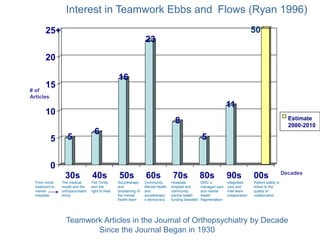
Interest in Teamwork Ebbs and Flows (Ryan 1996)
From moral
treatment to
mental
hospitals
The medical
model and the
orthopsychiatric
trinity
The Trinity
won the
right to treat
Sociotherapy
and
broadening of
the mental
health team
Community
Mental Health
and
sociotherapy’
s democracy
Hospitals
emptied and
community
mental health
funding dwindled
DRG’s
managed care
and mental
health
fragmentation
Integrated
care and
inter-team
collaboration
# of
Articles
Decades
Patient safety is
linked to the
quality of
collaboration
5
6
16
23
8
5
11
50
0
5
10
15
20
25+
30s 40s 50s 60s 70s 80s 90s 00s
Estimate
2000-2010
Teamwork Articles in the Journal of Orthopsychiatry by Decade
Since the Journal Began in 1930
Chronic Disease and Frailty
Patient Safety
Success of Quality Improvement
The Quality of Working Life
Local Health Integration Networks
Primary Care and Family Health Teams
Why Interprofessional Practice? Why Now?
Province-Wide investment in Inter-Professional Education
Inter-professional Mentoring
Inter-professional Coaching
Inter-professional Preceptorships
Inter-professional prevention of delirium in the ED
Impact inter-professional practice within primary care groups
Inter-Professional Practice and Hospital/LTC accreditation
The Journal of Inter-Professional Care
GiiC – the geriatrics, inter-professional practice & inter-organizational
collaboration initiative for family health teams and community health
centers
Current Initiatives in Interprofessional Care
Barriers to interprofessional teamwork: practice
based issues
• There is a lack of preparation for interdisciplinary hostility . . . If
the practice of this specialized form of aggression is to be placed
on a higher level, at least as high as professional wrestling…the
subtle arts of patronage, insult and innuendo must be taught.
• Unrealistic expectations, lack of knowledge and perceived threats
to autonomy Fried & Leatt, 1986
• Professional jealousies and role boundary issues Strasser et al 1994
• We practice together but we train apart
Barriers to teamwork: professions think differently (from
Qualls and Czirr, 1988)
Logic of assessment: from ruling out to ruling in
Focus of efforts: from acute episodes to quality of life
Locus of Responsibility: from executive to collaborative
Pace of Action
Focus of attention: from task to process
Interprofessional stereotypes
Decision making expectations: from executive to consensus
Beliefs about professional independence: from autonomy to
interdependence
Barriers to teamwork: Though we practice together until recently we
trained apart (from Cleary & Howell, 2003)
History of Teamwork in Health Care
The Original Team - Romantic Era (circa 1900)
General Practitioner
History of Teamwork in Health Care
Classic Sequential Teamwork and the Specialist Era
(circa 1920)
Specialist Specialist
Nurse Nurse
History of Teamwork in Health Care
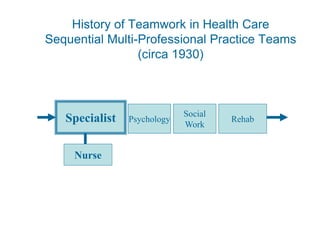
Sequential Multi-Professional Practice Teams
(circa 1930)
Specialist
Nurse
Psychology
Social
Work
Rehab
History of Teamwork in Health Care
Dynamic Multi-Professional Team (circa 1960)
from a cadre of professionals
Physician
Nutrition
Psychology
Physio
Nurse Social Work
Chiro
OT
Pharmacy
Dentist Recreation
History of Teamwork in Health Care
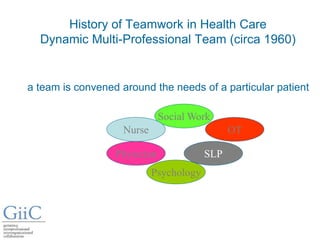
Dynamic Multi-Professional Team (circa 1960)
a team is convened around the needs of a particular patient
Physician
Social Work
Nurse
Psychology
OT
SLP
History of Teamwork in Health Care
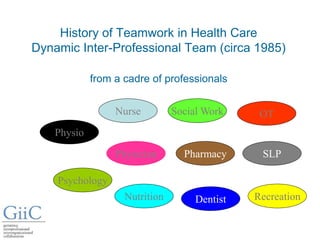
Dynamic Inter-Professional Team (circa 1985)
from a cadre of professionals
Physician
Nutrition
Psychology
Physio
Nurse Social Work
SLP
OT
Pharmacy
Dentist Recreation
History of Teamwork in Health Care
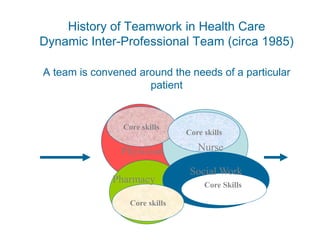
Dynamic Inter-Professional Team (circa 1985)
A team is convened around the needs of a particular
patient
Core skills
Core skills
Core Skills
Core skills
Social Work
Physician
Pharmacy
Nurse
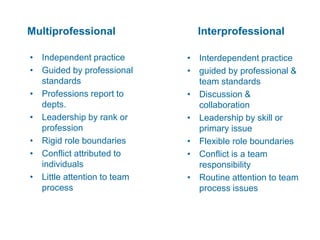
Multiprofessional Interprofessional
• Independent practice
• Guided by professional
standards
• Professions report to
depts.
• Leadership by rank or
profession
• Rigid role boundaries
• Conflict attributed to
individuals
• Little attention to team
process
• Interdependent practice
• guided by professional &
team standards
• Discussion &
collaboration
• Leadership by skill or
primary issue
• Flexible role boundaries
• Conflict is a team
responsibility
• Routine attention to team
process issues
Myths about Teamwork
• There are no leaders on teams; everyone is equal
• If we just work together, we will eventually become a
high performance team
• Everyone is accountable for everything on teams
• Teams take a long time to get up and running
• All team decisions must be made by consensus
• Conflict must be worked out for a team to be productive
• On the best teams, everyone likes everyone else
• The most important work takes place in team meetings
• Confrontation means conflict
Just putting people together to work in teams doesn’t
necessarily produce effective interprofessional teamwork
• CASE REPORT: CHIRO AND SURGEON

interprofessional communication W2020.pptx

  • 1.
    Inter-professional Practice inHealth Care Jennifer Illes, DC, MS
  • 2.
    What is aninterprofessional team? • People from several professions • Each trained to use different tools and concepts • Whose labor organized around a common problem • With continuous communication and frequent reflection on both the groups work and its process • Usually with group responsibility for the final product
  • 3.
    BENEFITS OF INTERPROFESSIONAL WORKING •The way in which healthcare is delivered has become increasingly dependent on team and interagency working and it is reassuring that evidence suggests that interprofessional teamworking does improve patient/client outcomes. (Borrill et al. 2001) In a study of healthcare teams, concluded that there is a significant and negative relationship between the percentage of staff working in Interprofessional teams and patient mortality.
  • 4.
    Taking Care ofthe Elderly • As people get older, the likelihood of developing multiple and longer- term needs increases. • An ageing population in many western countries means that the need for collaboration between professionals will become increasingly important. • Healthcare professionals must therefore develop the knowledge and skills required to collaborate effectively at an interagency and interprofessional level.
  • 5.
    Not Just inHealth Care • Collaboration can occur between different professionals within one organization or increasingly between professionals who belong to a range of organizations from the public, private and third sectors. • Collaboration is not necessarily only required between health workers. Social workers, police, lawyers, teachers, probation officers and charity workers, for example, are also part of the wider interprofessional team involved in the support of an older persons needs.
  • 6.
    Interest in TeamworkEbbs and Flows (Ryan 1996) From moral treatment to mental hospitals The medical model and the orthopsychiatric trinity The Trinity won the right to treat Sociotherapy and broadening of the mental health team Community Mental Health and sociotherapy’ s democracy Hospitals emptied and community mental health funding dwindled DRG’s managed care and mental health fragmentation Integrated care and inter-team collaboration # of Articles Decades Patient safety is linked to the quality of collaboration 5 6 16 23 8 5 11 50 0 5 10 15 20 25+ 30s 40s 50s 60s 70s 80s 90s 00s Estimate 2000-2010 Teamwork Articles in the Journal of Orthopsychiatry by Decade Since the Journal Began in 1930
  • 7.
    Chronic Disease andFrailty Patient Safety Success of Quality Improvement The Quality of Working Life Local Health Integration Networks Primary Care and Family Health Teams Why Interprofessional Practice? Why Now?
  • 8.
    Province-Wide investment inInter-Professional Education Inter-professional Mentoring Inter-professional Coaching Inter-professional Preceptorships Inter-professional prevention of delirium in the ED Impact inter-professional practice within primary care groups Inter-Professional Practice and Hospital/LTC accreditation The Journal of Inter-Professional Care GiiC – the geriatrics, inter-professional practice & inter-organizational collaboration initiative for family health teams and community health centers Current Initiatives in Interprofessional Care
  • 9.
    Barriers to interprofessionalteamwork: practice based issues • There is a lack of preparation for interdisciplinary hostility . . . If the practice of this specialized form of aggression is to be placed on a higher level, at least as high as professional wrestling…the subtle arts of patronage, insult and innuendo must be taught. • Unrealistic expectations, lack of knowledge and perceived threats to autonomy Fried & Leatt, 1986 • Professional jealousies and role boundary issues Strasser et al 1994 • We practice together but we train apart
  • 10.
    Barriers to teamwork:professions think differently (from Qualls and Czirr, 1988) Logic of assessment: from ruling out to ruling in Focus of efforts: from acute episodes to quality of life Locus of Responsibility: from executive to collaborative Pace of Action Focus of attention: from task to process Interprofessional stereotypes Decision making expectations: from executive to consensus Beliefs about professional independence: from autonomy to interdependence
  • 11.
    Barriers to teamwork:Though we practice together until recently we trained apart (from Cleary & Howell, 2003)
  • 12.
    History of Teamworkin Health Care The Original Team - Romantic Era (circa 1900) General Practitioner
  • 13.
    History of Teamworkin Health Care Classic Sequential Teamwork and the Specialist Era (circa 1920) Specialist Specialist Nurse Nurse
  • 14.
    History of Teamworkin Health Care Sequential Multi-Professional Practice Teams (circa 1930) Specialist Nurse Psychology Social Work Rehab
  • 15.
    History of Teamworkin Health Care Dynamic Multi-Professional Team (circa 1960) from a cadre of professionals Physician Nutrition Psychology Physio Nurse Social Work Chiro OT Pharmacy Dentist Recreation
  • 16.
    History of Teamworkin Health Care Dynamic Multi-Professional Team (circa 1960) a team is convened around the needs of a particular patient Physician Social Work Nurse Psychology OT SLP
  • 17.
    History of Teamworkin Health Care Dynamic Inter-Professional Team (circa 1985) from a cadre of professionals Physician Nutrition Psychology Physio Nurse Social Work SLP OT Pharmacy Dentist Recreation
  • 18.
    History of Teamworkin Health Care Dynamic Inter-Professional Team (circa 1985) A team is convened around the needs of a particular patient Core skills Core skills Core Skills Core skills Social Work Physician Pharmacy Nurse
  • 19.
    Multiprofessional Interprofessional • Independentpractice • Guided by professional standards • Professions report to depts. • Leadership by rank or profession • Rigid role boundaries • Conflict attributed to individuals • Little attention to team process • Interdependent practice • guided by professional & team standards • Discussion & collaboration • Leadership by skill or primary issue • Flexible role boundaries • Conflict is a team responsibility • Routine attention to team process issues
  • 20.
    Myths about Teamwork •There are no leaders on teams; everyone is equal • If we just work together, we will eventually become a high performance team • Everyone is accountable for everything on teams • Teams take a long time to get up and running • All team decisions must be made by consensus • Conflict must be worked out for a team to be productive • On the best teams, everyone likes everyone else • The most important work takes place in team meetings • Confrontation means conflict
  • 21.
    Just putting peopletogether to work in teams doesn’t necessarily produce effective interprofessional teamwork
  • 23.
    • CASE REPORT:CHIRO AND SURGEON