CLINICAL GOVERNANACE
Dr.D.Venoden; Medical Administrator
Ministry of Health
Contents
Clinical Governance
Seven pillars of Clinical Governance
Patient and public involvement (PPI)
Risk management
Staffing and staff management
Education and Training
Clinical effectiveness and research
Using clinical information & IT
Clinical Audit
11/22/2017 2
11/22/2017 3
11/22/2017 4
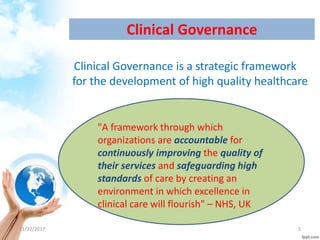
Clinical Governance
Clinical Governance is a strategic framework
for the development of high quality healthcare
"A framework through which
organizations are accountable for
continuously improving the quality of
their services and safeguarding high
standards of care by creating an
environment in which excellence in
clinical care will flourish" – NHS, UK
11/22/2017 5
“clinical governance is a way of making sure that
everyone who passes through health system is well
cared for”
or
System that enable staff to work in the best possible
way
+
Staff performing to the highest possible standards
11/22/2017 6
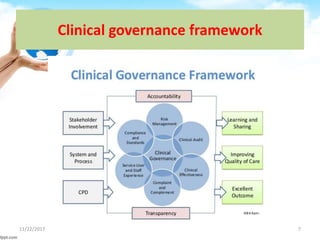
Clinical governance framework
11/22/2017 7
Clinical Governance Components
Seven pillars of Clinical Governance
 Patient and public involvement (PPI)
 Risk management
 Staffing and staff management
 Education and training
 Clinical effectiveness & Research
 Using clinical information & IT
 Clinical audit
11/22/2017 8
Patient and public involvement
PPI is about
 Ensuring services meet the need of the
patients
 Patient and public feedback is used to
improve services
 Patients and the public are involved in the
development of services and the
monitoring of treatment outcomes
11/22/2017 9
Risk management
Risk Management involves having robust
systems in place to understand, monitor and
minimise the risks to patients and staff and to
learn from mistakes
 Complying with protocols
 Learning from mistakes and near-misses
 Reporting adverse events
 Assessing the risks – probability of occurrence, impact
 Promoting blame free culture
11/22/2017 10
Staffing and staff management
Appropriate recruitment and
management of staff
Ensuring that underperformance is
identified and addressed
Encouraging staff retention by
motivating and developing staff
Providing good working conditions
11/22/2017 11
Education and Training
Providing appropriate support available to
enable staff to be competent in doing their
jobs and to develop their skills so that they
are up to date
Professional development needs to
continue through lifelong learning
11/22/2017 12
Education and Training
 Attending courses and conferences
(commonly referred to as CPD – Continuous
Professional Development)
 Taking relevant exams
 Regular assessment, designed to ensure that
training is appropriate
 Appraisals (which are a means of identifying
and discussing weaknesses, and
opportunities for personal development)
11/22/2017 13
Clinical effectiveness & Research
Clinical effectiveness implies ensuring that
everything we do is designed to provide the best
outcomes for patients.
"the right thing to the right person at the
right time in the right place”
11/22/2017 14
Clinical effectiveness & Research
In practice, it means:
• Adopting an evidence-based approach in the
management of patients
• Changing your practice, developing new protocols
or guidelines based on experience and evidence if
current practice is shown inadequate.
• Implementing guidelines, protocols and other
national standards to ensure optimal care
• Conducting research to develop the body of
evidence available and therefore enhancing the
level of care provided to patients in future
11/22/2017 15
Using clinical information & IT
This is to ensure that
• Patient data is accurate and up-to-date
• Confidentiality of patient data is respected
• Full and appropriate use of the date is made to
measure quality of outcomes (e.g. through
audits) and to develop services tailored to local
needs
11/22/2017 16
Clinical audit
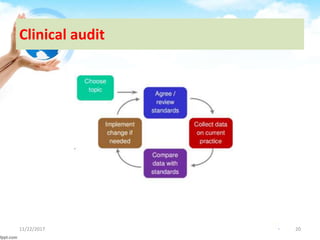
Clinical audit is a quality improvement cycle that
involves measurement of the effectiveness of
healthcare against agreed and proven standards
for high quality, and taking action to bring
practice in line with these standards so as to
improve the quality of care and health outcomes
Clinical audit is a systematic process of looking at your practice
and asking:
What should we be doing?
Are we doing it?
If not, how can we improve?
11/22/2017 17
Clinical audit
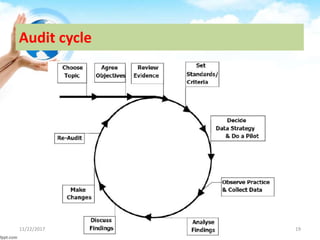
Audit cycle
1) Selecting a topic
2) Agreeing standards of best practice (audit criteria)
3) Collecting data.
4) Analysing data against standards
5) Feeding back results.
6) Discussing possible changes.
7) Implementing agreed changes
8) Allowing time for changes to embed before re-auditing.
9) Collecting a second set of data
10) Analysing the re-audit data
11) Feeding back the re-audit results.
12) Discussing whether practice has improved
11/22/2017 18
Audit cycle
11/22/2017 19
Clinical audit
11/22/2017 20
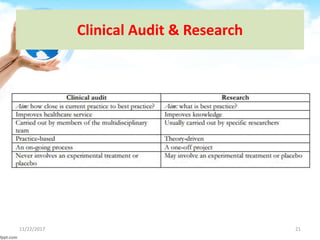
Clinical Audit & Research
11/22/2017 21
11/22/2017 22

Clinical Governance

  • 1.
    CLINICAL GOVERNANACE Dr.D.Venoden; MedicalAdministrator Ministry of Health
  • 2.
    Contents Clinical Governance Seven pillarsof Clinical Governance Patient and public involvement (PPI) Risk management Staffing and staff management Education and Training Clinical effectiveness and research Using clinical information & IT Clinical Audit 11/22/2017 2
  • 3.
  • 4.
  • 5.
    Clinical Governance Clinical Governanceis a strategic framework for the development of high quality healthcare "A framework through which organizations are accountable for continuously improving the quality of their services and safeguarding high standards of care by creating an environment in which excellence in clinical care will flourish" – NHS, UK 11/22/2017 5
  • 6.
    “clinical governance isa way of making sure that everyone who passes through health system is well cared for” or System that enable staff to work in the best possible way + Staff performing to the highest possible standards 11/22/2017 6
  • 7.
  • 8.
    Clinical Governance Components Sevenpillars of Clinical Governance  Patient and public involvement (PPI)  Risk management  Staffing and staff management  Education and training  Clinical effectiveness & Research  Using clinical information & IT  Clinical audit 11/22/2017 8
  • 9.
    Patient and publicinvolvement PPI is about  Ensuring services meet the need of the patients  Patient and public feedback is used to improve services  Patients and the public are involved in the development of services and the monitoring of treatment outcomes 11/22/2017 9
  • 10.
    Risk management Risk Managementinvolves having robust systems in place to understand, monitor and minimise the risks to patients and staff and to learn from mistakes  Complying with protocols  Learning from mistakes and near-misses  Reporting adverse events  Assessing the risks – probability of occurrence, impact  Promoting blame free culture 11/22/2017 10
  • 11.
    Staffing and staffmanagement Appropriate recruitment and management of staff Ensuring that underperformance is identified and addressed Encouraging staff retention by motivating and developing staff Providing good working conditions 11/22/2017 11
  • 12.
    Education and Training Providingappropriate support available to enable staff to be competent in doing their jobs and to develop their skills so that they are up to date Professional development needs to continue through lifelong learning 11/22/2017 12
  • 13.
    Education and Training Attending courses and conferences (commonly referred to as CPD – Continuous Professional Development)  Taking relevant exams  Regular assessment, designed to ensure that training is appropriate  Appraisals (which are a means of identifying and discussing weaknesses, and opportunities for personal development) 11/22/2017 13
  • 14.
    Clinical effectiveness &Research Clinical effectiveness implies ensuring that everything we do is designed to provide the best outcomes for patients. "the right thing to the right person at the right time in the right place” 11/22/2017 14
  • 15.
    Clinical effectiveness &Research In practice, it means: • Adopting an evidence-based approach in the management of patients • Changing your practice, developing new protocols or guidelines based on experience and evidence if current practice is shown inadequate. • Implementing guidelines, protocols and other national standards to ensure optimal care • Conducting research to develop the body of evidence available and therefore enhancing the level of care provided to patients in future 11/22/2017 15
  • 16.
    Using clinical information& IT This is to ensure that • Patient data is accurate and up-to-date • Confidentiality of patient data is respected • Full and appropriate use of the date is made to measure quality of outcomes (e.g. through audits) and to develop services tailored to local needs 11/22/2017 16
  • 17.
    Clinical audit Clinical auditis a quality improvement cycle that involves measurement of the effectiveness of healthcare against agreed and proven standards for high quality, and taking action to bring practice in line with these standards so as to improve the quality of care and health outcomes Clinical audit is a systematic process of looking at your practice and asking: What should we be doing? Are we doing it? If not, how can we improve? 11/22/2017 17
  • 18.
    Clinical audit Audit cycle 1)Selecting a topic 2) Agreeing standards of best practice (audit criteria) 3) Collecting data. 4) Analysing data against standards 5) Feeding back results. 6) Discussing possible changes. 7) Implementing agreed changes 8) Allowing time for changes to embed before re-auditing. 9) Collecting a second set of data 10) Analysing the re-audit data 11) Feeding back the re-audit results. 12) Discussing whether practice has improved 11/22/2017 18
  • 19.
  • 20.
  • 21.
    Clinical Audit &Research 11/22/2017 21
  • 22.