
Yerevan State Medical University
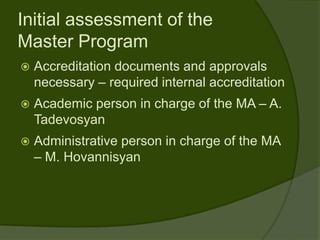
Initial assessment of the
Master Program
   Accreditation documents and approvals
    necessary – required internal accreditation
   Academic person in charge of the MA – A.
    Tadevosyan
   Administrative person in charge of the MA
    – M. Hovannisyan
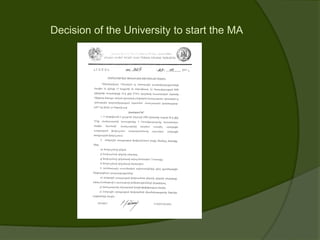
Decision of the University to start the MA
Status quo report
   Analysis of the existing national legislation
     Since 2010 Armenia has introduced Bologna
      process
       Three cycle system (bachelor-master-
        doctorate)
       Credit transfer system
       Students’ and academics’ mobility
       Accreditation of European quality assurance
        standards
       Continuous education
Status quo report

 Listof existing Master programs at
  university
    ○ MD in General medicine
    ○ MD in Stomatology
    ○ MS in Pharmacy
    ○ MPH
    ○ MD in Military medicine


 Integrated   Bachelor
Status quo report
 Curricula   of existing MD (last year)
    Specialization in preventive medicine
    available thru residency
   Epidemiology – 1 year
   Hygiene - 1 year
   Organization of Health Care – 2 years
Status quo report
   Internal regulations of the University
    regarding Master programs
    procedures of grading assessment
    procedures of ongoing knowledge
    assessment
    regulative documents of teaching
    methods
    procedures of admission and expulsion of
    students
 Analysis of the political framework
      Education Quality assessment and assurance
center was established in 2011.
Functions
     Analyzes of all components of quality of education
      processes and assurance of their compliance with
      strategy of university.
     Internal audit of education processes
Status quo report
   Analysis of existing resources in the
    university
       Facilities – 9 own, 8 – rented
       12 auditoria in central campus
       administrative staff – 101
       academic staff – 643
       PC – 674, scanner – 48, fax – 7, TV – 278,
       projector – 85, audio/video player – 29,
        Cameras – 230, photo camera – 12,
       Xerox – 52
Library
 Books   and journals – 91.595 names
 Total issue - 523.359 units


   18 Universities, Republican Medical and
    National Academy of Science Libraries
    Network

   Digitalization of library in a process
Basic Resources
   Faculty of Public Health

     Chair of Hygiene and Ecology
     Chair of Social Medicine and Medical Law
     Chair of Epidemiology
     Chair of Organization of Health Care and
     Economics
Additional Resources
   Faculty of General Medicine
     Chair of Philosophy (Bioethics)
     Chair of Medical Psychology
     Chair of Infectious Diseases


   Faculty of Military Medicine
Curricula characteristics

 Hygiene
   Environment and Health – 4.5 ECTS
   Occupational Health – 3 ECTS
   Nutrition and Health – 3 ECTS
   Children and Adolescent Health – 1.5 ECTS


   Total 12 ECTS
Hygiene
Learning outcomes
   Knowledge
     Environmental factors and their influence on health.
     Adaptation processes of human in different environmental
      conditions.
     Use of environmental factors for preventive purposes.
     Principles of prevention of the negative consequences of work.
     Influence of occupational specific factors on health.
     Assessment of occupational factors.
     Alimentary diseases.
     Nutrition as a social factor.
     Assessment methods of health status of children and adolescent.
     Specific factors influencing on health of children and adolescent.
Hygiene
Learning outcomes

   Skills

     To be able to measure and assess the
      environmental factors
     To be able to use environmental factors for
      preventive purposes
     To be able to measure and assess occupational
      factors
     To be able to assess quality of food.
     To be able to provide hygienic assessment of
      children populaion
Curricula characteristics

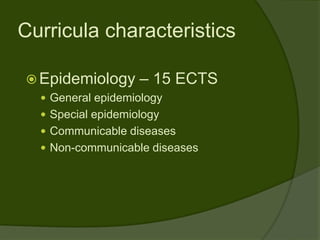
 Epidemiology      – 15 ECTS
   General epidemiology
   Special epidemiology
   Communicable diseases
   Non-communicable diseases
Curricula characteristics
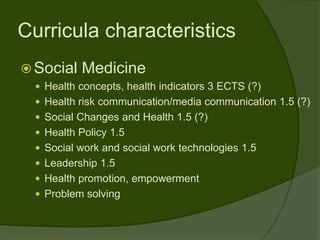
 Social   Medicine
   Health concepts, health indicators 3 ECTS (?)
   Health risk communication/media communication 1.5 (?)
   Social Changes and Health 1.5 (?)
   Health Policy 1.5
   Social work and social work technologies 1.5
   Leadership 1.5
   Health promotion, empowerment
   Problem solving
Social Medicine
Learning outcomes
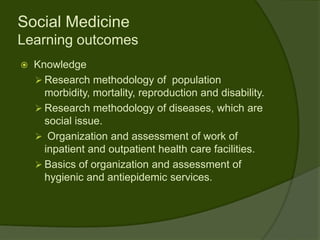
   Knowledge
     Research methodology of population
      morbidity, mortality, reproduction and disability.
     Research methodology of diseases, which are
      social issue.
     Organization and assessment of work of
      inpatient and outpatient health care facilities.
     Basics of organization and assessment of
      hygienic and antiepidemic services.
Social Medicine
Learning outcomes
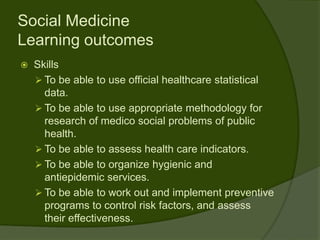
   Skills
     To be able to use official healthcare statistical
      data.
     To be able to use appropriate methodology for
      research of medico social problems of public
      health.
     To be able to assess health care indicators.
     To be able to organize hygienic and
      antiepidemic services.
     To be able to work out and implement preventive
      programs to control risk factors, and assess
      their effectiveness.
Curricula characteristics
 Management        and Marketing
  Marketing and social marketing
  Health economics
  Hospital administration
  Organization of Health Care Delivery
  Health Care Systems – comparative Study
Marketing
Learning outcomes
   Knowledge
     Basics of marketing, main staitments and problems.
     Pecularities of market of medical servicies.
     Mechanisms and pecularities of price formation of
      medical servicies and items.
     Demend of medical servicies and items.
     Mechanisms and methods of advertising of medical
      servicies.
     Leasing in healthcare system.
     Content and characteristics of social marketing.
Marketing
Learning outcomes
   Skills
     To be able to organize and implement marketing
      researches in healthcare field.
     To be able to assess demand of medical servicies
      and items, to organize their development and
      advertisment.
     To be able to chose appropriate methods of price
      formation and to form competitive prices for medical
      servicies and items.
     To be able to organize leasing in healthcare system.
     To be able to organize social marketing procedures.
Management
Learning outcomes
   Knowledge
     Basic rules of organization development
     Basic rules of collisions and problem development in
      organization and managment methods.
     Basic procedures and methods of managment.
     Ensurance of comunication wihtin organization.
     Quality assessment of medical servicies and goods.
     Basics of managment of material and financial
      resourses.
     Technology and forms of formation of managerial
      decision-making.
Management
Learning outcomes
   Skills
     To be able to use official healthcare report data.
     To be able to analyze and assess morbidity of population, to
        determine demand of different medical services.
       To be able to plan activity of department of curative and
        preventive service.
       To be able to make rational decisions for reaching appropriate
        results.
       To be able to increase competiveness and viability of
        organization.
       To be able to assess the quality of services and design
        measures for continuous development.
       To be able to manage collectives, to use encourage methods, to
        have communicating skills.
       To be able to manage conflicts and problems within collective.
       To be able to ensure supervision of paper circulation in
        organization.
Curricula characteristics
 Biostatistics    and Evidence Based
  Medicine
   Study Design
   Methods of Qualitative Research
   Methods of Quantitative Research
   Database management
Biostatistics and Evidence Based
Medicine
Learning outcome
   Knowledge
     Basics of biostatistics
     Methods and structure peculiarities of research program and
      planning.
     Peculiarities of statistical methods and basics of choosing of
      methods.
     Statistical PC programs.


   Skills
     To be able to use official healthcare report data.
     To be able to plan research program and to implement it.
     To be able to choose appropriate design of research, analyzing
       methods and statistical tools.
     To be able to implement statistical methods in research.
     To be able to design statistical report.
Mandatory Modules
 Military medicine (field therapy)
 Medicine of Disasters
Other Disciplines
 Medical Law
 Bioethics
 Mental and Behavioral Health
   Methods of teaching used in each course
     seminars,
     lectures,
     research,
     small group works,
     laboratory work
   Grading scheme
     10 point scoring (Letter equivalents in diploma)learning
      outcome based assessment of knowledge and skills of
      students
     3 stage assessment (test, skills, oral examination, thesis)
 Number     of ECTS
  30 ECTS per semester.
  120 ECTS - two years of MP,
Students of the new Master
Program
   Entrance requirements
    Only students with medical background (at least Bachelor
    of medicine) and knowledge of English may apply for
    master courses.

   Selection criteria for new students
    Admission examination
    English skills – reading, writing and speaking
    Computer skills – Windows OS or Macintosh OS, MS
                        office
Students of the new Master Program

   Potential career paths on the labor market for graduates
        CDC, antiepidemic and hygienic inspectorate, local
        and federal public health departments, managers of
        Health Care Organizations, Graduates may        apply
        for other master or postgraduateprograms within
        YSMU.

   System of student evaluation of the courses
       Oral examination, test, assessment of thesis and
       presentation, skills assessment.
ICT

 Installed ICT resources
  Notebooks, multifunctional printers, projector and screen
  are installed and ready to be used with photo
       cameras and camcorders in teaching process
 Project website
  www.ysmu.am
Cooperation with TEMPUS
Partners

   Student mobility plan involving the other TEMPUS
    partners
    One module (Social work and social work
    technologies) will be held at YSU.
Any questions?

   THANK YOU

Cluj Report YSMU

  • 1.
  • 2.
    Initial assessment ofthe Master Program  Accreditation documents and approvals necessary – required internal accreditation  Academic person in charge of the MA – A. Tadevosyan  Administrative person in charge of the MA – M. Hovannisyan
  • 3.
    Decision of theUniversity to start the MA
  • 4.
    Status quo report  Analysis of the existing national legislation  Since 2010 Armenia has introduced Bologna process  Three cycle system (bachelor-master- doctorate)  Credit transfer system  Students’ and academics’ mobility  Accreditation of European quality assurance standards  Continuous education
  • 5.
    Status quo report Listof existing Master programs at university ○ MD in General medicine ○ MD in Stomatology ○ MS in Pharmacy ○ MPH ○ MD in Military medicine  Integrated Bachelor
  • 6.
    Status quo report Curricula of existing MD (last year) Specialization in preventive medicine available thru residency  Epidemiology – 1 year  Hygiene - 1 year  Organization of Health Care – 2 years
  • 7.
    Status quo report  Internal regulations of the University regarding Master programs procedures of grading assessment procedures of ongoing knowledge assessment regulative documents of teaching methods procedures of admission and expulsion of students
  • 8.
     Analysis ofthe political framework Education Quality assessment and assurance center was established in 2011. Functions  Analyzes of all components of quality of education processes and assurance of their compliance with strategy of university.  Internal audit of education processes
  • 9.
    Status quo report  Analysis of existing resources in the university Facilities – 9 own, 8 – rented 12 auditoria in central campus administrative staff – 101 academic staff – 643 PC – 674, scanner – 48, fax – 7, TV – 278, projector – 85, audio/video player – 29, Cameras – 230, photo camera – 12, Xerox – 52
  • 10.
    Library  Books and journals – 91.595 names  Total issue - 523.359 units  18 Universities, Republican Medical and National Academy of Science Libraries Network  Digitalization of library in a process
  • 11.
    Basic Resources  Faculty of Public Health  Chair of Hygiene and Ecology  Chair of Social Medicine and Medical Law  Chair of Epidemiology  Chair of Organization of Health Care and Economics
  • 12.
    Additional Resources  Faculty of General Medicine  Chair of Philosophy (Bioethics)  Chair of Medical Psychology  Chair of Infectious Diseases  Faculty of Military Medicine
  • 13.
    Curricula characteristics  Hygiene Environment and Health – 4.5 ECTS Occupational Health – 3 ECTS Nutrition and Health – 3 ECTS Children and Adolescent Health – 1.5 ECTS Total 12 ECTS
  • 14.
    Hygiene Learning outcomes  Knowledge  Environmental factors and their influence on health.  Adaptation processes of human in different environmental conditions.  Use of environmental factors for preventive purposes.  Principles of prevention of the negative consequences of work.  Influence of occupational specific factors on health.  Assessment of occupational factors.  Alimentary diseases.  Nutrition as a social factor.  Assessment methods of health status of children and adolescent.  Specific factors influencing on health of children and adolescent.
  • 15.
    Hygiene Learning outcomes  Skills  To be able to measure and assess the environmental factors  To be able to use environmental factors for preventive purposes  To be able to measure and assess occupational factors  To be able to assess quality of food.  To be able to provide hygienic assessment of children populaion
  • 16.
    Curricula characteristics  Epidemiology – 15 ECTS  General epidemiology  Special epidemiology  Communicable diseases  Non-communicable diseases
  • 17.
    Curricula characteristics  Social Medicine  Health concepts, health indicators 3 ECTS (?)  Health risk communication/media communication 1.5 (?)  Social Changes and Health 1.5 (?)  Health Policy 1.5  Social work and social work technologies 1.5  Leadership 1.5  Health promotion, empowerment  Problem solving
  • 18.
    Social Medicine Learning outcomes  Knowledge  Research methodology of population morbidity, mortality, reproduction and disability.  Research methodology of diseases, which are social issue.  Organization and assessment of work of inpatient and outpatient health care facilities.  Basics of organization and assessment of hygienic and antiepidemic services.
  • 19.
    Social Medicine Learning outcomes  Skills  To be able to use official healthcare statistical data.  To be able to use appropriate methodology for research of medico social problems of public health.  To be able to assess health care indicators.  To be able to organize hygienic and antiepidemic services.  To be able to work out and implement preventive programs to control risk factors, and assess their effectiveness.
  • 20.
    Curricula characteristics  Management and Marketing  Marketing and social marketing  Health economics  Hospital administration  Organization of Health Care Delivery  Health Care Systems – comparative Study
  • 21.
    Marketing Learning outcomes  Knowledge  Basics of marketing, main staitments and problems.  Pecularities of market of medical servicies.  Mechanisms and pecularities of price formation of medical servicies and items.  Demend of medical servicies and items.  Mechanisms and methods of advertising of medical servicies.  Leasing in healthcare system.  Content and characteristics of social marketing.
  • 22.
    Marketing Learning outcomes  Skills  To be able to organize and implement marketing researches in healthcare field.  To be able to assess demand of medical servicies and items, to organize their development and advertisment.  To be able to chose appropriate methods of price formation and to form competitive prices for medical servicies and items.  To be able to organize leasing in healthcare system.  To be able to organize social marketing procedures.
  • 23.
    Management Learning outcomes  Knowledge  Basic rules of organization development  Basic rules of collisions and problem development in organization and managment methods.  Basic procedures and methods of managment.  Ensurance of comunication wihtin organization.  Quality assessment of medical servicies and goods.  Basics of managment of material and financial resourses.  Technology and forms of formation of managerial decision-making.
  • 24.
    Management Learning outcomes  Skills  To be able to use official healthcare report data.  To be able to analyze and assess morbidity of population, to determine demand of different medical services.  To be able to plan activity of department of curative and preventive service.  To be able to make rational decisions for reaching appropriate results.  To be able to increase competiveness and viability of organization.  To be able to assess the quality of services and design measures for continuous development.  To be able to manage collectives, to use encourage methods, to have communicating skills.  To be able to manage conflicts and problems within collective.  To be able to ensure supervision of paper circulation in organization.
  • 25.
    Curricula characteristics  Biostatistics and Evidence Based Medicine  Study Design  Methods of Qualitative Research  Methods of Quantitative Research  Database management
  • 26.
    Biostatistics and EvidenceBased Medicine Learning outcome  Knowledge  Basics of biostatistics  Methods and structure peculiarities of research program and planning.  Peculiarities of statistical methods and basics of choosing of methods.  Statistical PC programs.  Skills  To be able to use official healthcare report data.  To be able to plan research program and to implement it.  To be able to choose appropriate design of research, analyzing methods and statistical tools.  To be able to implement statistical methods in research.  To be able to design statistical report.
  • 27.
    Mandatory Modules  Militarymedicine (field therapy)  Medicine of Disasters
  • 28.
    Other Disciplines  MedicalLaw  Bioethics  Mental and Behavioral Health
  • 29.
    Methods of teaching used in each course  seminars,  lectures,  research,  small group works,  laboratory work  Grading scheme  10 point scoring (Letter equivalents in diploma)learning outcome based assessment of knowledge and skills of students  3 stage assessment (test, skills, oral examination, thesis)
  • 30.
     Number of ECTS  30 ECTS per semester.  120 ECTS - two years of MP,
  • 31.
    Students of thenew Master Program  Entrance requirements Only students with medical background (at least Bachelor of medicine) and knowledge of English may apply for master courses.  Selection criteria for new students Admission examination English skills – reading, writing and speaking Computer skills – Windows OS or Macintosh OS, MS office
  • 32.
    Students of thenew Master Program  Potential career paths on the labor market for graduates CDC, antiepidemic and hygienic inspectorate, local and federal public health departments, managers of Health Care Organizations, Graduates may apply for other master or postgraduateprograms within YSMU.  System of student evaluation of the courses Oral examination, test, assessment of thesis and presentation, skills assessment.
  • 33.
    ICT  Installed ICTresources Notebooks, multifunctional printers, projector and screen are installed and ready to be used with photo cameras and camcorders in teaching process  Project website www.ysmu.am
  • 34.
    Cooperation with TEMPUS Partners  Student mobility plan involving the other TEMPUS partners One module (Social work and social work technologies) will be held at YSU.
  • 35.
    Any questions? THANK YOU