Team Training in
Virtual Worlds© 2008, IIL: Dev Overview Presentation
Virtual Reality for Team Training
Parvati Dev
Innovation in Learning Inc.
http://www.InnovationinLearning.com/
Team Training in
Virtual Worlds© 2008, IIL: Dev Overview Presentation
What is a Virtual World?
• It is an online environment, usually 3D
• Each ‘player’ is represented by an ‘avatar’ in the
world
– You see other people as their avatars. Use voice or text chat
• It is immersive
– You have a sense of ‘presence’ or ‘being there’
• It is social.
– You talk with others and interact with them.
• It may be game-like, have goal-oriented
activities, or not.
• Building and customization is a popular activity
Team Training in
Virtual Worlds© 2008, IIL: Dev Overview Presentation
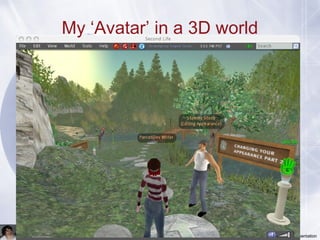
My ‘Avatar’ in a 3D world
Team Training in
Virtual Worlds© 2008, IIL: Dev Overview Presentation
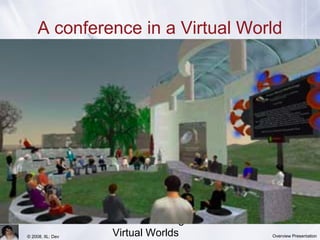
A conference in a Virtual World
Team Training in
Virtual Worlds© 2008, IIL: Dev Overview Presentation
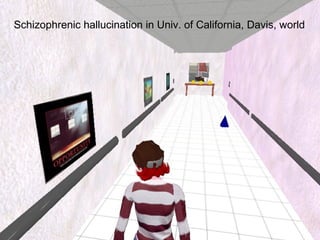
Schizophrenic hallucination in Univ. of California, Davis, world
Team Training in
Virtual Worlds© 2008, IIL: Dev Overview Presentation
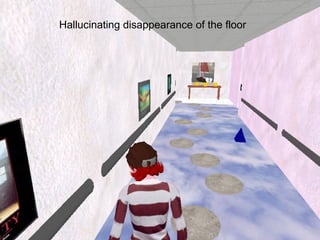
Hallucinating disappearance of the floor
Team Training in
Virtual Worlds© 2008, IIL: Dev Overview Presentation
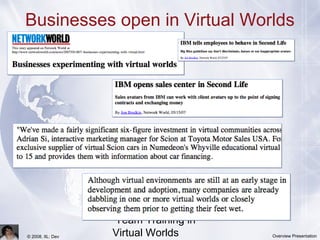
Businesses open in Virtual Worlds
Team Training in
Virtual Worlds© 2008, IIL: Dev Overview Presentation
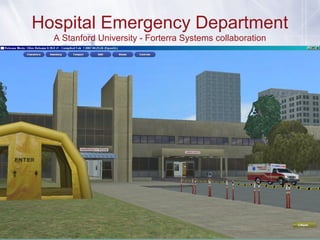
Hospital Emergency Department
A Stanford University - Forterra Systems collaboration
Team Training in
Virtual Worlds© 2008, IIL: Dev Overview Presentation
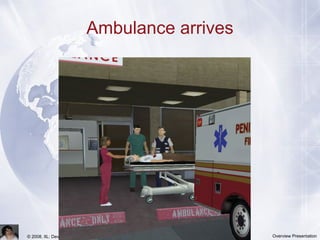
Ambulance arrives
Team Training in
Virtual Worlds© 2008, IIL: Dev Overview Presentation
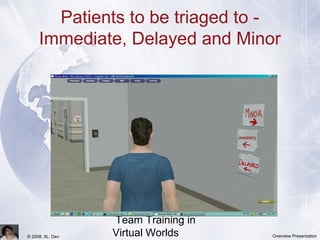
Patients to be triaged to -
Immediate, Delayed and Minor
Team Training in
Virtual Worlds© 2008, IIL: Dev Overview Presentation
Photo-inspired
Virtual 3D
Environment
– – –
Photos taken in
Adult ED at
Stanford
University
Medical Center
July 2006
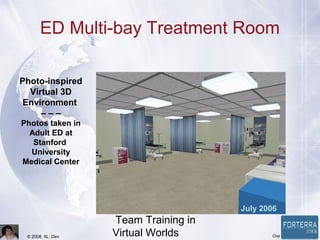
ED Multi-bay Treatment Room
Team Training in
Virtual Worlds© 2008, IIL: Dev Overview Presentation
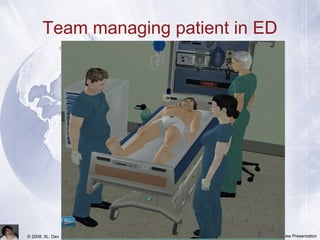
Team managing patient in ED
Team Training in
Virtual Worlds© 2008, IIL: Dev Overview Presentation
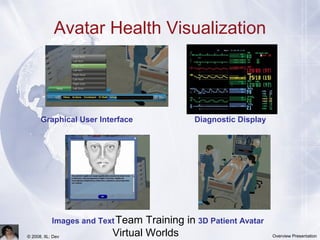
Avatar Health Visualization
Graphical User Interface Diagnostic Display
Images and Text 3D Patient Avatar
Team Training in
Virtual Worlds© 2008, IIL: Dev Overview Presentation
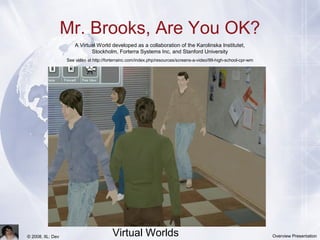
Mr. Brooks, Are You OK?
A Virtual World developed as a collaboration of the Karolinska Institutet,
Stockholm, Forterra Systems Inc, and Stanford University
See video at http://forterrainc.com/index.php/resources/screens-a-video/99-high-school-cpr-wm
Team Training in
Virtual Worlds© 2008, IIL: Dev Overview Presentation
Team Training in
Virtual Worlds© 2008, IIL: Dev Overview Presentation
Clinical Scenarios for Virtual ED
1. Male: pneumothorax and femur fracture after auto collision
2. Male; bicycle rider falls from bike path, suffers spleen rupture
3. Male; car driver, hypoglycemia and femur fracture
4. Male; ethanol induced fall, with head injury, obstructed airway
5. Female;(2nd
trimester pregnancy); with renal laceration after auto
collision
6. Male; construction worker fall, liver rupture, fracture of femur
7. Male: construction worker, flail chest and dislocated shoulder
8. Male: bicycle rider with severe hand and abdominal injury after
auto collision and being ‘run-over’
9. Female; elderly pedestrian with facial fractures and
unconsciousness after auto collision.
10. Female (3rd
trimester pregnancy); auto collision with femoral
neck fracture, and vaginal bleeding (placental abruption)
Team Training in
Virtual Worlds© 2008, IIL: Dev Overview Presentation
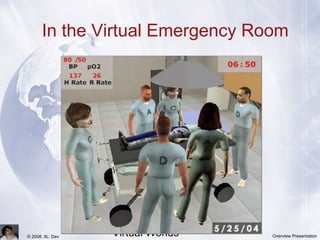
In the Virtual Emergency Room
Team Training in
Virtual Worlds© 2008, IIL: Dev Overview Presentation
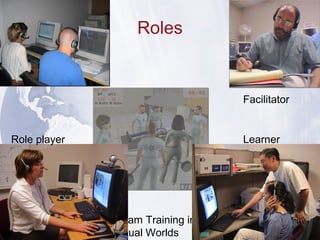
Roles
Role player Learner
Facilitator
Team Training in
Virtual Worlds© 2008, IIL: Dev Overview Presentation
Principles of EMCRM
(Emergency Medicine Crisis Resource Management)
1. Know your environment
2. Anticipate and plan for crises
3. Assume a leadership role
4. Communicate effectively with other team members
5. Call for help early enough
6. Distribute workload optimally
7. Allocate attention wisely
8. Utilize all available resources
9. Utilize all available information
10. Maintain a professional behavior
Team Training in
Virtual Worlds© 2008, IIL: Dev Overview Presentation
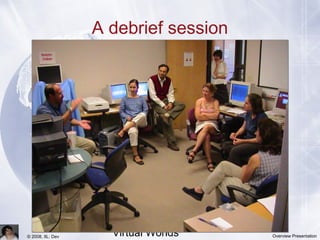
A debrief session
Team Training in
Virtual Worlds© 2008, IIL: Dev Overview Presentation
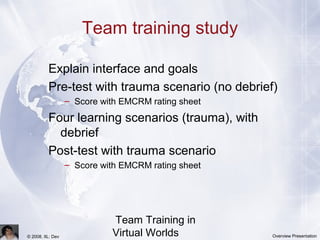
Team training study
Explain interface and goals
Pre-test with trauma scenario (no debrief)
– Score with EMCRM rating sheet
Four learning scenarios (trauma), with
debrief
Post-test with trauma scenario
– Score with EMCRM rating sheet
Team Training in
Virtual Worlds© 2008, IIL: Dev Overview Presentation
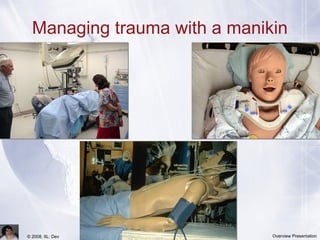
Managing trauma with a manikin
Team Training in
Virtual Worlds© 2008, IIL: Dev Overview Presentation
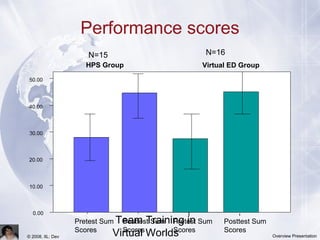
Performance scores
0.00
10.00
20.00
30.00
40.00
50.00
HPS Group
Pretest Sum
Scores
Posttest Sum
Scores
Pretest Sum
Scores
Posttest Sum
Scores
Virtual ED Group
N=15 N=16
Team Training in
Virtual Worlds© 2008, IIL: Dev Overview Presentation
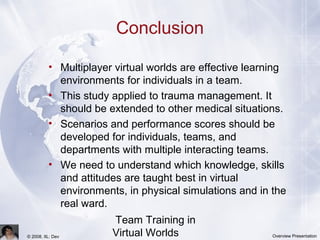
Conclusion
• Multiplayer virtual worlds are effective learning
environments for individuals in a team.
• This study applied to trauma management. It
should be extended to other medical situations.
• Scenarios and performance scores should be
developed for individuals, teams, and
departments with multiple interacting teams.
• We need to understand which knowledge, skills
and attitudes are taught best in virtual
environments, in physical simulations and in the
real ward.
Team Training in
Virtual Worlds© 2008, IIL: Dev Overview Presentation
parvati@parvatidev.org
Thanks for your attention !
http://www.InnovationInLearning.com/

Virtual Medical Worlds for Team Training (please see updated version)

  • 1.
    Team Training in VirtualWorlds© 2008, IIL: Dev Overview Presentation Virtual Reality for Team Training Parvati Dev Innovation in Learning Inc. http://www.InnovationinLearning.com/
  • 2.
    Team Training in VirtualWorlds© 2008, IIL: Dev Overview Presentation What is a Virtual World? • It is an online environment, usually 3D • Each ‘player’ is represented by an ‘avatar’ in the world – You see other people as their avatars. Use voice or text chat • It is immersive – You have a sense of ‘presence’ or ‘being there’ • It is social. – You talk with others and interact with them. • It may be game-like, have goal-oriented activities, or not. • Building and customization is a popular activity
  • 3.
    Team Training in VirtualWorlds© 2008, IIL: Dev Overview Presentation My ‘Avatar’ in a 3D world
  • 4.
    Team Training in VirtualWorlds© 2008, IIL: Dev Overview Presentation A conference in a Virtual World
  • 5.
    Team Training in VirtualWorlds© 2008, IIL: Dev Overview Presentation Schizophrenic hallucination in Univ. of California, Davis, world
  • 6.
    Team Training in VirtualWorlds© 2008, IIL: Dev Overview Presentation Hallucinating disappearance of the floor
  • 7.
    Team Training in VirtualWorlds© 2008, IIL: Dev Overview Presentation Businesses open in Virtual Worlds
  • 8.
    Team Training in VirtualWorlds© 2008, IIL: Dev Overview Presentation Hospital Emergency Department A Stanford University - Forterra Systems collaboration
  • 9.
    Team Training in VirtualWorlds© 2008, IIL: Dev Overview Presentation Ambulance arrives
  • 10.
    Team Training in VirtualWorlds© 2008, IIL: Dev Overview Presentation Patients to be triaged to - Immediate, Delayed and Minor
  • 11.
    Team Training in VirtualWorlds© 2008, IIL: Dev Overview Presentation Photo-inspired Virtual 3D Environment – – – Photos taken in Adult ED at Stanford University Medical Center July 2006 ED Multi-bay Treatment Room
  • 12.
    Team Training in VirtualWorlds© 2008, IIL: Dev Overview Presentation Team managing patient in ED
  • 13.
    Team Training in VirtualWorlds© 2008, IIL: Dev Overview Presentation Avatar Health Visualization Graphical User Interface Diagnostic Display Images and Text 3D Patient Avatar
  • 14.
    Team Training in VirtualWorlds© 2008, IIL: Dev Overview Presentation Mr. Brooks, Are You OK? A Virtual World developed as a collaboration of the Karolinska Institutet, Stockholm, Forterra Systems Inc, and Stanford University See video at http://forterrainc.com/index.php/resources/screens-a-video/99-high-school-cpr-wm
  • 15.
    Team Training in VirtualWorlds© 2008, IIL: Dev Overview Presentation
  • 16.
    Team Training in VirtualWorlds© 2008, IIL: Dev Overview Presentation Clinical Scenarios for Virtual ED 1. Male: pneumothorax and femur fracture after auto collision 2. Male; bicycle rider falls from bike path, suffers spleen rupture 3. Male; car driver, hypoglycemia and femur fracture 4. Male; ethanol induced fall, with head injury, obstructed airway 5. Female;(2nd trimester pregnancy); with renal laceration after auto collision 6. Male; construction worker fall, liver rupture, fracture of femur 7. Male: construction worker, flail chest and dislocated shoulder 8. Male: bicycle rider with severe hand and abdominal injury after auto collision and being ‘run-over’ 9. Female; elderly pedestrian with facial fractures and unconsciousness after auto collision. 10. Female (3rd trimester pregnancy); auto collision with femoral neck fracture, and vaginal bleeding (placental abruption)
  • 17.
    Team Training in VirtualWorlds© 2008, IIL: Dev Overview Presentation In the Virtual Emergency Room
  • 18.
    Team Training in VirtualWorlds© 2008, IIL: Dev Overview Presentation Roles Role player Learner Facilitator
  • 19.
    Team Training in VirtualWorlds© 2008, IIL: Dev Overview Presentation Principles of EMCRM (Emergency Medicine Crisis Resource Management) 1. Know your environment 2. Anticipate and plan for crises 3. Assume a leadership role 4. Communicate effectively with other team members 5. Call for help early enough 6. Distribute workload optimally 7. Allocate attention wisely 8. Utilize all available resources 9. Utilize all available information 10. Maintain a professional behavior
  • 20.
    Team Training in VirtualWorlds© 2008, IIL: Dev Overview Presentation A debrief session
  • 21.
    Team Training in VirtualWorlds© 2008, IIL: Dev Overview Presentation Team training study Explain interface and goals Pre-test with trauma scenario (no debrief) – Score with EMCRM rating sheet Four learning scenarios (trauma), with debrief Post-test with trauma scenario – Score with EMCRM rating sheet
  • 22.
    Team Training in VirtualWorlds© 2008, IIL: Dev Overview Presentation Managing trauma with a manikin
  • 23.
    Team Training in VirtualWorlds© 2008, IIL: Dev Overview Presentation Performance scores 0.00 10.00 20.00 30.00 40.00 50.00 HPS Group Pretest Sum Scores Posttest Sum Scores Pretest Sum Scores Posttest Sum Scores Virtual ED Group N=15 N=16
  • 24.
    Team Training in VirtualWorlds© 2008, IIL: Dev Overview Presentation Conclusion • Multiplayer virtual worlds are effective learning environments for individuals in a team. • This study applied to trauma management. It should be extended to other medical situations. • Scenarios and performance scores should be developed for individuals, teams, and departments with multiple interacting teams. • We need to understand which knowledge, skills and attitudes are taught best in virtual environments, in physical simulations and in the real ward.
  • 25.
    Team Training in VirtualWorlds© 2008, IIL: Dev Overview Presentation parvati@parvatidev.org Thanks for your attention ! http://www.InnovationInLearning.com/

Editor's Notes

  • #2 Multi-player virtual worlds are well-suited to training teams to work together.
  • #3 There are many types of virtual worlds but they all share most of the above characteristics.
  • #4 This is my first attempt entering a popular virtual world, Second Life. It is a vast, three-dimensional space, with many very realistic landscapes and some fantastically unrealistic spaces.
  • #5 Many universities and companies have developed spaces in Second Life for meetings and presentations.
  • #6 An unusual medical use is to present experiences that are very difficult to present in real life. The University of California, Davis, has developed a space where you can experience a variety of visual and auditory hallucinations. Here my avatar believes that she is walking down a hallway but …
  • #7 … in the next instant, the floor appears to disappear. I am walking on air, a common hallucination. In my schizophrenic hallucination, I step very carefully on the stepping stones because I my experience says that the hallway is now a dangerous space.
  • #8 These news items indicate the many companies that opened virtual offices in spaces such as Second Life. Actually the situation has changed somewhat since this slide was made in 2007. Now, in late 2008, many companies have become more cautious about their business expectations in virtual worlds. Universities and other learning organizations, on the other hand, continue to adopt virtual worlds as important new learning environments.
  • #9 My research group at Stanford University, SUMMIT, partnered with Forterra Systems to create a 3D medical space using their multiplayer virtual world engine, OLIVE, to create a Virtual Emergency Department. The simulaton was used to train for mass casualty emergencies including chemical exposures that required decontamination using the ‘decon’ tent seen here outside the VED.
  • #10 The VED includes the road and parking area outside, so ambulances can pull up and discharge patients. In the mass casualty scenario, numerous ambulances arrive, creating a scene of urgency and chaos that requires skilful management of medical resources and teams. It should be noted that each of the people seen in this picture is an ‘avatar’, managed by a different real person, who may be physically located anywhere in the world.
  • #11 In a mass casualty, the arriving patients are ‘triaged’, that is, they udergo rapid diagnosis, outside the Emergency Department. Those determined to be ‘Immediate’ are sent to the Emergency Department beds for treatment by a team of doctors and nurses (each played by a real resident or nurse). ‘Minor’ and ‘Delayed’ do not need treatment right away and are sent to holding areas.
  • #12 <number> This is a view of the inside of the Emergency Department. The 3D space is developed from photos of a real Emergency Department.
  • #13 Each ‘Immediate’ patient is managed by a medical team. Part of the learning objective is for the team to learn communication, leadership, followership, correct treatment protocol, and the ability to prioritize.The devices on the headboard and by the side of the bed are all active and allow the team to mange the patient medically.
  • #14 The user interface supports examination of the patient, application of physical treatments such as cleaning a wound and applying compression bandages, administration of medications, and supplying blood or a saline drip. Themonitor gives the minute-by-minute health status of the patient.
  • #15 <number> We developed a different 3D world to teach high school students the decision making surrounding the use of CPR (cardio-pulmonary resuscitation). The link connects to a brief movie about this virtual world.
  • #16 Before we embarked on extensive development of virtual worlds, we studied the efficacy of one of our early virtual worlds in 2004. This one was built on Adobe Systems’ Atmosphere engine, which is no longer available. We used that world to compare the learning in the virtual world with that using the current gold standard, the physical manikin.
  • #17 Ten trauma situations were developed.
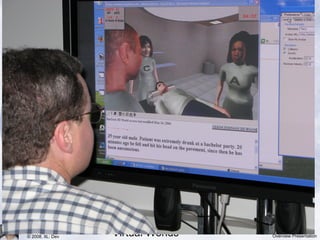
  • #18 The patient’s vital signs were shown in the text box in the upper left (not on a simulated monitor). Treatment was via menu selections.
  • #19 The team around the bed included Learners and Role Players. The role players played supporting roles in the team, while the learners took the role of the lead physician and the supporting physician. A Facilitator observed the performance of the team members in the virtual world and could, if necessary issue comments, suggestions or instructions.All team members wore headsets with microphones, allowing them to sit in different rooms but to be virtually in a common space, around the patient’s bed.
  • #20 All team members knew the learning objectives of the exercise, the ability to follow the principles of appropriate resource management while providing correct medical management of the patient’s condition.
  • #21 Each learning session consisted of one of the trauma scenarios, followed by a debrief session with the facilitator. During the debrief, the facilitator led a non-judgmental discussion about the actions taken during the scenario, with the learners discussing their thoughts, concerns and opinions, Typically, most of the learning takes place during this discussion rather than during the scenario itself.
  • #22 The full study consisted of a training session, where the interface and goals were taught. Then the team went through 6 scenarios. The first and last were test scenarios. There was no debrief after these test scenarios. The middle four scenarios were learning scenarios, with debrief sessions. The performance was scored in all six scenarios.
  • #23 Meanwhile, a ‘control’ team underwent the same scenarios but using a physical manikin instead of a virtual world. In this situation, the physical manikin is in a physical simulated operating room. The team works around the real bed. The manikin is realistic in that it has a pulse, breathes, and can have its vital signs measured. Air, blood, fluids and medication can be administered. The experience is close to that os working with a real patient.
  • #24 The two groups were termed the HPS group (Human Patient Simulator, or the physical manikin) and the VED group (the Virtual Emergency Department). The pre-test and post-test performance was measured for both the groups. The results are graphed above. Two conclusions can be drawn. First, in both the HPS and VED groups, learning occurs, as shown by the improved performance during the post-test compared to the pre-test. Second, both HPS and VED groups show similar improvement from pre- to post-test, indicating that the virtual environment has resulted in learning comparable to that with the gold standard, the physical manikin. This key result encouraged us to continue our development of virtual learning environments,and we will continue to test the efficacy of these new learning environments.
  • #25 From this somewhat stylized study, we can derive a range of conclusions and possible future directions.