
WEED MANAGEMENT
P R E S E N T E D B Y –
A r c h a n a K u m a r i ( R 2 0 3 2 1 0 7 )
S a t a n i k S i l ( R 2 0 3 2 1 2 6 )
S U B M I T T E D T O –
D r . P a n k a j K u m a r M i s h r a
( A s s i s t a n t P r o f e s s o r o f P l a n t P a t h o l o g y )
RAMAKRISHNA MISSION VIVEKANANDA EDUCATIONAL AND RESEARCH INSTITUTE
( RKMVERI )
What is weed ?
" A weed is an unwanted plant growing
where is not desired. " - Jethro Tull
Unwanted undesirable plant that interfere
with the utilization of land , water resources
and thus adversely affect the crop
production and human welfare.
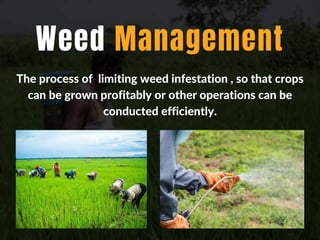
Weed Management
The process of limiting weed infestation , so that crops
can be grown profitably or other operations can be
conducted efficiently.
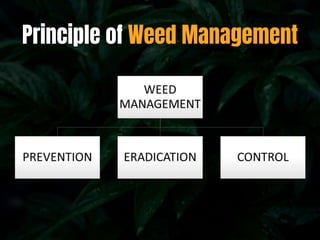
Principle of Weed Management
It is a long term planning so that the
weeds could be controlled or managed
more effectively and economically than
is possible where these are allowed to
disperse freely
Prevention
• Sowing of weed free clean seed
• Use of clean implements
• Removal of weeds along canal and
irrigation channel
• Care in transplanting of seedling /
plantlets
• Avoiding passing of cattle from weed
infested area
It refers that a given weed species, it's
seed and vegetative part has been killed
or completely removed from a given
area and that weed will not reappear
unless reintroduced in that area.
Eradication
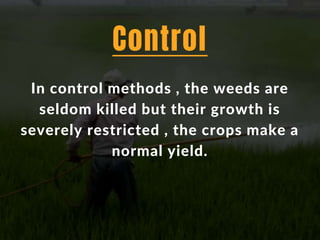
In control methods , the weeds are
seldom killed but their growth is
severely restricted , the crops make a
normal yield.
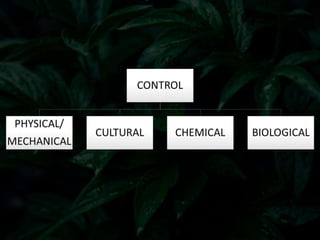
Control
P H Y S I C A L
M E T H O D S
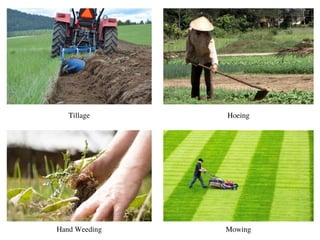
Tillage Hoeing
Mowing
Hand Weeding
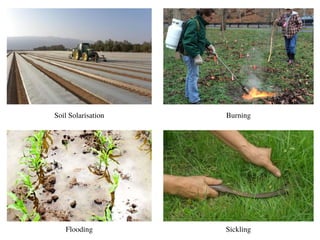
Soil Solarisation Burning
Sickling
Flooding
C U L T U R A L
M E T H O D S
• Principle behind this is giving competitive
advantage to the crop.
• Cultural methods alone cannot control
weeds, but help in reducing weed
population.
• They should, therefore be used in
combination with other methods.
C H E M I C A L
M E T H O D S
• Herbicides are chemicals capable of killing
or inhibiting the growth of plants.
• Today we have 150 herbicides in common
use for selective and non selective control
in different areas.
BIOLOGICAL
M E T H O D S
Utilization of natural living organism, such
as insects, herbivorous fish, other animals,
disease organisms and competitive plants
to limit their growth.
THANK YOU

Weed management

  • 1.
    WEED MANAGEMENT P RE S E N T E D B Y – A r c h a n a K u m a r i ( R 2 0 3 2 1 0 7 ) S a t a n i k S i l ( R 2 0 3 2 1 2 6 ) S U B M I T T E D T O – D r . P a n k a j K u m a r M i s h r a ( A s s i s t a n t P r o f e s s o r o f P l a n t P a t h o l o g y ) RAMAKRISHNA MISSION VIVEKANANDA EDUCATIONAL AND RESEARCH INSTITUTE ( RKMVERI )
  • 2.
    What is weed? " A weed is an unwanted plant growing where is not desired. " - Jethro Tull Unwanted undesirable plant that interfere with the utilization of land , water resources and thus adversely affect the crop production and human welfare.
  • 3.
    Weed Management The processof limiting weed infestation , so that crops can be grown profitably or other operations can be conducted efficiently.
  • 4.
  • 5.
    It is along term planning so that the weeds could be controlled or managed more effectively and economically than is possible where these are allowed to disperse freely Prevention
  • 6.
    • Sowing ofweed free clean seed • Use of clean implements • Removal of weeds along canal and irrigation channel • Care in transplanting of seedling / plantlets • Avoiding passing of cattle from weed infested area
  • 7.
    It refers thata given weed species, it's seed and vegetative part has been killed or completely removed from a given area and that weed will not reappear unless reintroduced in that area. Eradication
  • 8.
    In control methods, the weeds are seldom killed but their growth is severely restricted , the crops make a normal yield. Control
  • 10.
    P H YS I C A L M E T H O D S
  • 11.
  • 12.
  • 13.
    C U LT U R A L M E T H O D S
  • 14.
    • Principle behindthis is giving competitive advantage to the crop. • Cultural methods alone cannot control weeds, but help in reducing weed population. • They should, therefore be used in combination with other methods.
  • 16.
    C H EM I C A L M E T H O D S
  • 17.
    • Herbicides arechemicals capable of killing or inhibiting the growth of plants. • Today we have 150 herbicides in common use for selective and non selective control in different areas.
  • 18.
  • 19.
    Utilization of naturalliving organism, such as insects, herbivorous fish, other animals, disease organisms and competitive plants to limit their growth.
  • 20.