INTEGRATED WEED MANAGEMENT
CONTENTS
1. Introduction
2. Weed
3. Weed Problems
4. Why integrated weed management
5. Concept & Advantages of IWM
6. Method of Weed Management
7. Components of IWM
8. Summary
9. Reference
INTRODUCTION
An integrated weed management may be defined as the
combination of two or more weed-control methods at low input
levels to reduce weed competition in a given cropping system
below the economical threshold level. It has proved to be a
valuable concept in a few cases, though much is still to be done
to extend it to the small farmers’ level.
Integrated Weed Management (IWM) approach aims at
minimizing the residue problem in plant, soil, air and water. An
IWM involves the utilization of a combination of mechanical,
chemical and cultural practices of weed management in a
planned sequence, so designed as not to affect the ecosystem.
The nature and intensity of the species to be controlled, the
sequence of crops that are raised in the rotation, the standard of
crop husbandry, and the ready and timely availability of any
method and the economics of different weed-management
techniques are some of the potent considerations that determine
the success for the exploitation of the IWM approach
WEED
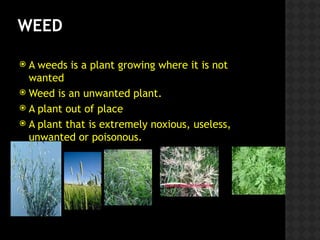
 A weeds is a plant growing where it is not
wanted
 Weed is an unwanted plant.
 A plant out of place
 A plant that is extremely noxious, useless,
unwanted or poisonous.
WEED PROBLEMS
The total annual loss of agricultural produce
various due various parts in India is as below
1) Weeds: 45%
2) Insects: 30%
3) Diseases: 20%
4) Other pests (Rats, wild animals)
A recent estimate shows that weeds cause annual
loss of Rs. 1980 crores to Indian Agricultural which is more
than combined losses caused by insects, pests and disease.
Weeds depleted crop’s environment of nutrients,
water, light and space. Crop yields are reduced
considerably. In addition, weeds interfere and cause
inconvenience to agriculture operations. The quality of
produce is reduced by weed infestation .
Weed management is an important component of
plant protection improving the production potential of
crops.
20%
30%
45%
5%
WHY INTEGRATE WEED MANAGEMENT
 One method of weed control may be effective and economical in
a situation and it may not be so in other situation.
 No single herbicide is effective in controlling wide range of weed
flora
 Continuous use of same herbicide creates resistance in escaped
weed flora or causes shift in the flora.
 Continuous use of only one practice may result in some
undesirable effects. Eg. Rice –wheat cropping system – Philaris
minor
 Only one method of weed control may lead to increase in
population of particular weed.
 Indiscriminate herbicide use and its effects on the environment
and human health
 The continuous use of the same method leads to build up of
tolerant weeds. Therefore, the suitable combination of different
methods of weed control or integrated weed management (System
Approach) should be practiced for minimizing the losses caused by
weeds in different crops and also for protection of the
environment.
 ecosystems, herbicides have become one of the most importance
components in weed control, there are two region to explain the
increased use of herbicides, the first veins being the wised plead
adoption of high yielding varieties which created economic
incentive for farmer to reduce weed infestation.
 Weed can be controlled by adopting different methods however,
each weed control methods has advantages and disadvantages or
limitations.
 The continuous use of the same method leads to build up of In
most tolerant weeds.
Concept
 Uses a variety of technologies in a single weed management with
the objective to produce optimum crop yield at a minimum cost
taking in to consideration ecological and socio-economic
constraints under a given agro-ecosystem.
 A system in which two or more methods are used to control a
weed. These methods may include cultural practices, natural
enemies and selective herbicides.
Advantages of IWM
 It shifts the crop-weed competition in favour of crop
 Prevents weed shift towards perennial nature
 Prevents resistance in weeds to herbicides
 No danger of herbicide residue in soil or plant
 No environmental pollution
 Gives higher net return
 Suitable for high cropping intensity
For designing any weed control programme in a given area, one must
know the nature & habitat of the weeds in that area, how they react to
environmental changes & how they respond to herbicides.
Principles of weed management are;
 Prevention
 Eradication
 Control
METHODS OF WEED
MANAGEMENT
a. Preventive weed control
It is a long term planning so that the weeds could be controlled or
managed more effectively and economically than is possible where
these are allowed to disperse freely.
Following preventive control measures are suggested for adoption
wherever possible & practicable.
1. Avoid using crop that are infested with weed seeds for sowing
2. Avoid feeding screenings and other material containing weed
seeds to the farm animals.
3. Avoid adding weeds to the manure pits.
4. Clean the farm machinery thoroughly before moving it from one
field to another. This is particularly important for seed drills
5. Avoid the use of gravel sand and soil from weed-infested
Cont…
6. Inspect nursery stock for the presence of weed seedlings,
tubers, rhizomes, etc.
7. Keep irrigation channels, fence-lines, and un-cropped areas
clean
8.Use vigilance. Inspect your farm frequently for any strange
looking weed seedlings. Destroy such patches of a new weed
by digging deep and burning the weed along with its roots.
Sterilize the spot with suitable chemical
9. Quarantine regulations are available in almost all countries to
deny the entry of weed seeds and other propagules into a
country through airports and shipyards.
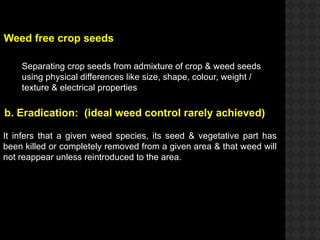
Weed free crop seeds
Separating crop seeds from admixture of crop & weed seeds
using physical differences like size, shape, colour, weight /
texture & electrical properties
b. Eradication: (ideal weed control rarely achieved)
It infers that a given weed species, its seed & vegetative part has
been killed or completely removed from a given area & that weed will
not reappear unless reintroduced to the area.
c. Control
In control methods, the weeds are seldom killed but their growth is
severely restricted, the crop makes a normal yield.
Weed control aims at only putting down the weeds present by some
kind of physical or chemical means while weed management is a
system approach whereby whole land use planning is done in
advance to minimize the very invasion of weeds in aggressive forms
and give crop plants a strongly competitive advantage over the
weeds.
Weed control methods are grouped into cultural, physical, chemical
and biological.
Every method of weed control has its own advantages and
disadvantages.
No single method is successful under all weed situations. Many a
time, a combination of these methods gives effective and economic
control than a single method.
COMPONENTS OF IWM
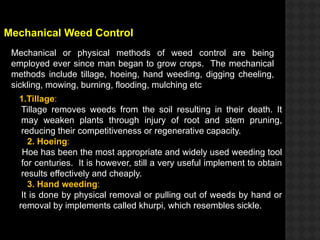
Mechanical Weed Control
Mechanical or physical methods of weed control are being
employed ever since man began to grow crops. The mechanical
methods include tillage, hoeing, hand weeding, digging cheeling,
sickling, mowing, burning, flooding, mulching etc
1.Tillage:
Tillage removes weeds from the soil resulting in their death. It
may weaken plants through injury of root and stem pruning,
reducing their competitiveness or regenerative capacity.
2. Hoeing:
Hoe has been the most appropriate and widely used weeding tool
for centuries. It is however, still a very useful implement to obtain
results effectively and cheaply.
3. Hand weeding:
It is done by physical removal or pulling out of weeds by hand or
removal by implements called khurpi, which resembles sickle.
4. Digging:
Digging is very useful in the case of perennial weeds to remove
the underground propagating parts of weeds from the deeper
layer of the soil.
5. Sickling and mowing:
Sickling is also done by hand with the help of sickle to remove the
top growth of weeds to prevent seed production and to starve the
underground parts.Mowing is a machine-operated practice
mostly done on roadsides and in lawns.
6. Burning:
Burning or fire is often an economical and practical means of
controlling weeds.
8. Flooding:
Flooding kills plants by reducing oxygen availability for plant
growth. The success of flooding depends upon complete
submergence of weeds for longer periods.
Mechanical weeders
 Dry Land Weeder
 Power rotary weeder
 Tractor operated multi row rotary weeder
 Cono weeder
CULTURAL WEED CONTROL
Several cultural practices like tillage, planting, fertiliser application,
irrigation etc., are employed for creating favourable condition for the
crop. These practices if used properly, help in controlling weeds.
1.Field preparation:
The field has to be kept weed free. Flowering of weeds should not
be allowed. This helps in prevention of build up of weed seed
population.
2. Summer tillage:
The practice of summer tillage or off-season tillage is one of the
effective cultural methods to check the growth of perennial weed
population in crop cultivation.
3. Maintenance of optimum plant population:
Lack of adequate plant population is prone to heavy weed
infestation, which becomes, difficult to control later
4. Irrigation and Drainage:
Frequent irrigation or rain during initial stage of crop growth
induced several flushes of weed. In lowland rice, where standing
water is present most of the time, germination of weeds is less.
5. Crop rotation:
The possibility of a certain weed species or group of species
occurring is greater if the same crop is grown year after year.
6. Growing of intercrops:
Inter cropping suppresses weeds better than sole cropping and thus
provides an opportunity to utilize crops themselves as tools of weed
management.
7. Mulching:
Mulch is a protective covering of material maintained on soil
surface. Mulching has smothering effect on weed control by
excluding light from the photosynthetic portions of a plant and thus
inhibiting the top growth.
8. Varieties :
Short statured erect leave varieties permit more light compared to
tall and leafy traditional varieties. Weeds continue germinate for
long time in dwarf varieties resulting in high weed growth.
9. Intercultivation:
It is a very effective and cheap method of weed control in line sown
crop. Most of the intercultivation implements have a blade which
cuts the weeds just below the soil surface and thus kill weeds.
7. Solarisation:
This is another method of utilisation of solar energy for the
desiccation of weeds. In this method, the soil temperature is further
raised by 5 – 10 ºC by covering a pre-soaked fallow field with thin
transparent plastic sheet.
8. Stale seedbed:
A stale seedbed is one where initial one or two flushes of weeds
are destroyed before planting of a crop. This is achieved by
soaking a well prepared field with either irrigation or rain and
allowing the weeds to germinate.
9. Blind tillage:
The tillage of the soil after sowing a crop before the crop plants
emerge is known as blind tillage.
10. Crop management practices:
Good crop management practices that play an important role in
weed management.Vigorous and fast growing crop varieties are
better competitors with weeds
Chemical Control
Chemicals that are used to kill plants or weeds are called herbicides.
Their use has been increasing rapidly since 1944 when 2,4-D was first use
as herbicide. In many instance, they offer most practical, effective and
economic means for controlling weeds.
Pre emergence treatment with herbicides provide early season
weed control. In addition they reduce drudgery of hand weeding.
example :-
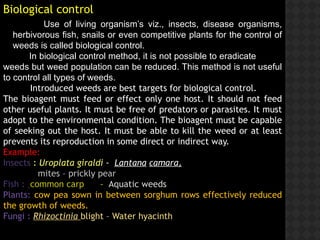
Biological control
Use of living organism’s viz., insects, disease organisms,
herbivorous fish, snails or even competitive plants for the control of
weeds is called biological control.
In biological control method, it is not possible to eradicate
weeds but weed population can be reduced. This method is not useful
to control all types of weeds.
Introduced weeds are best targets for biological control.
The bioagent must feed or effect only one host. It should not feed
other useful plants. It must be free of predators or parasites. It must
adopt to the environmental condition. The bioagent must be capable
of seeking out the host. It must be able to kill the weed or at least
prevents its reproduction in some direct or indirect way.
Example:
Insects : Uroplata giraldi - Lantana camara,
mites – prickly pear
Fish : common carp - Aquatic weeds
Plants: cow pea sown in between sorghum rows effectively reduced
the growth of weeds.
Fungi : Rhizoctinia blight – Water hyacinth
A BRIEF SUMMARY
 •Problems with traditional approaches to weed
management.
 •Among others:
•Resistance
•Global climate change
•Definition of a weed
Plants that thrive in frequently disturbed
environments •Understand why we have weeds
•Replace a “few large hammers” with “many little
hammers”
•Develop and Integrated Weed Management program
REFERENCES
 Reddy, T. Y. and Reddy,G. H. 2005 Principles
of Agronomy,
 Ahlawat, I.P.S and Om Prakash 2004
Introduction of Agronomy
 Katyayan, A. 2012 Fundamentals of
Agriculture
 My Agriculture Information Bank, (
www.agriinfo.in)
 Development of agriculture e-coursing, (
www.tnau.ac.in)
 Ikishan (www.ikisan.com)
BIOLOGICAL WEED MANAGEMENT         .pptx

BIOLOGICAL WEED MANAGEMENT .pptx

  • 1.
  • 2.
    CONTENTS 1. Introduction 2. Weed 3.Weed Problems 4. Why integrated weed management 5. Concept & Advantages of IWM 6. Method of Weed Management 7. Components of IWM 8. Summary 9. Reference
  • 3.
    INTRODUCTION An integrated weedmanagement may be defined as the combination of two or more weed-control methods at low input levels to reduce weed competition in a given cropping system below the economical threshold level. It has proved to be a valuable concept in a few cases, though much is still to be done to extend it to the small farmers’ level. Integrated Weed Management (IWM) approach aims at minimizing the residue problem in plant, soil, air and water. An IWM involves the utilization of a combination of mechanical, chemical and cultural practices of weed management in a planned sequence, so designed as not to affect the ecosystem. The nature and intensity of the species to be controlled, the sequence of crops that are raised in the rotation, the standard of crop husbandry, and the ready and timely availability of any method and the economics of different weed-management techniques are some of the potent considerations that determine the success for the exploitation of the IWM approach
  • 4.
    WEED  A weedsis a plant growing where it is not wanted  Weed is an unwanted plant.  A plant out of place  A plant that is extremely noxious, useless, unwanted or poisonous.
  • 5.
    WEED PROBLEMS The totalannual loss of agricultural produce various due various parts in India is as below 1) Weeds: 45% 2) Insects: 30% 3) Diseases: 20% 4) Other pests (Rats, wild animals) A recent estimate shows that weeds cause annual loss of Rs. 1980 crores to Indian Agricultural which is more than combined losses caused by insects, pests and disease. Weeds depleted crop’s environment of nutrients, water, light and space. Crop yields are reduced considerably. In addition, weeds interfere and cause inconvenience to agriculture operations. The quality of produce is reduced by weed infestation . Weed management is an important component of plant protection improving the production potential of crops. 20% 30% 45% 5%
  • 6.
    WHY INTEGRATE WEEDMANAGEMENT  One method of weed control may be effective and economical in a situation and it may not be so in other situation.  No single herbicide is effective in controlling wide range of weed flora  Continuous use of same herbicide creates resistance in escaped weed flora or causes shift in the flora.  Continuous use of only one practice may result in some undesirable effects. Eg. Rice –wheat cropping system – Philaris minor  Only one method of weed control may lead to increase in population of particular weed.  Indiscriminate herbicide use and its effects on the environment and human health
  • 7.
     The continuoususe of the same method leads to build up of tolerant weeds. Therefore, the suitable combination of different methods of weed control or integrated weed management (System Approach) should be practiced for minimizing the losses caused by weeds in different crops and also for protection of the environment.  ecosystems, herbicides have become one of the most importance components in weed control, there are two region to explain the increased use of herbicides, the first veins being the wised plead adoption of high yielding varieties which created economic incentive for farmer to reduce weed infestation.  Weed can be controlled by adopting different methods however, each weed control methods has advantages and disadvantages or limitations.  The continuous use of the same method leads to build up of In most tolerant weeds.
  • 8.
    Concept  Uses avariety of technologies in a single weed management with the objective to produce optimum crop yield at a minimum cost taking in to consideration ecological and socio-economic constraints under a given agro-ecosystem.  A system in which two or more methods are used to control a weed. These methods may include cultural practices, natural enemies and selective herbicides. Advantages of IWM  It shifts the crop-weed competition in favour of crop  Prevents weed shift towards perennial nature  Prevents resistance in weeds to herbicides  No danger of herbicide residue in soil or plant  No environmental pollution  Gives higher net return  Suitable for high cropping intensity
  • 9.
    For designing anyweed control programme in a given area, one must know the nature & habitat of the weeds in that area, how they react to environmental changes & how they respond to herbicides. Principles of weed management are;  Prevention  Eradication  Control METHODS OF WEED MANAGEMENT
  • 10.
    a. Preventive weedcontrol It is a long term planning so that the weeds could be controlled or managed more effectively and economically than is possible where these are allowed to disperse freely. Following preventive control measures are suggested for adoption wherever possible & practicable. 1. Avoid using crop that are infested with weed seeds for sowing 2. Avoid feeding screenings and other material containing weed seeds to the farm animals. 3. Avoid adding weeds to the manure pits. 4. Clean the farm machinery thoroughly before moving it from one field to another. This is particularly important for seed drills 5. Avoid the use of gravel sand and soil from weed-infested Cont…
  • 11.
    6. Inspect nurserystock for the presence of weed seedlings, tubers, rhizomes, etc. 7. Keep irrigation channels, fence-lines, and un-cropped areas clean 8.Use vigilance. Inspect your farm frequently for any strange looking weed seedlings. Destroy such patches of a new weed by digging deep and burning the weed along with its roots. Sterilize the spot with suitable chemical 9. Quarantine regulations are available in almost all countries to deny the entry of weed seeds and other propagules into a country through airports and shipyards.
  • 12.
    Weed free cropseeds Separating crop seeds from admixture of crop & weed seeds using physical differences like size, shape, colour, weight / texture & electrical properties b. Eradication: (ideal weed control rarely achieved) It infers that a given weed species, its seed & vegetative part has been killed or completely removed from a given area & that weed will not reappear unless reintroduced to the area.
  • 13.
    c. Control In controlmethods, the weeds are seldom killed but their growth is severely restricted, the crop makes a normal yield. Weed control aims at only putting down the weeds present by some kind of physical or chemical means while weed management is a system approach whereby whole land use planning is done in advance to minimize the very invasion of weeds in aggressive forms and give crop plants a strongly competitive advantage over the weeds. Weed control methods are grouped into cultural, physical, chemical and biological. Every method of weed control has its own advantages and disadvantages. No single method is successful under all weed situations. Many a time, a combination of these methods gives effective and economic control than a single method.
  • 14.
  • 15.
    Mechanical Weed Control Mechanicalor physical methods of weed control are being employed ever since man began to grow crops. The mechanical methods include tillage, hoeing, hand weeding, digging cheeling, sickling, mowing, burning, flooding, mulching etc 1.Tillage: Tillage removes weeds from the soil resulting in their death. It may weaken plants through injury of root and stem pruning, reducing their competitiveness or regenerative capacity. 2. Hoeing: Hoe has been the most appropriate and widely used weeding tool for centuries. It is however, still a very useful implement to obtain results effectively and cheaply. 3. Hand weeding: It is done by physical removal or pulling out of weeds by hand or removal by implements called khurpi, which resembles sickle.
  • 16.
    4. Digging: Digging isvery useful in the case of perennial weeds to remove the underground propagating parts of weeds from the deeper layer of the soil. 5. Sickling and mowing: Sickling is also done by hand with the help of sickle to remove the top growth of weeds to prevent seed production and to starve the underground parts.Mowing is a machine-operated practice mostly done on roadsides and in lawns. 6. Burning: Burning or fire is often an economical and practical means of controlling weeds. 8. Flooding: Flooding kills plants by reducing oxygen availability for plant growth. The success of flooding depends upon complete submergence of weeds for longer periods.
  • 17.
    Mechanical weeders  DryLand Weeder  Power rotary weeder  Tractor operated multi row rotary weeder  Cono weeder
  • 18.
    CULTURAL WEED CONTROL Severalcultural practices like tillage, planting, fertiliser application, irrigation etc., are employed for creating favourable condition for the crop. These practices if used properly, help in controlling weeds. 1.Field preparation: The field has to be kept weed free. Flowering of weeds should not be allowed. This helps in prevention of build up of weed seed population. 2. Summer tillage: The practice of summer tillage or off-season tillage is one of the effective cultural methods to check the growth of perennial weed population in crop cultivation. 3. Maintenance of optimum plant population: Lack of adequate plant population is prone to heavy weed infestation, which becomes, difficult to control later 4. Irrigation and Drainage: Frequent irrigation or rain during initial stage of crop growth induced several flushes of weed. In lowland rice, where standing water is present most of the time, germination of weeds is less.
  • 19.
    5. Crop rotation: Thepossibility of a certain weed species or group of species occurring is greater if the same crop is grown year after year. 6. Growing of intercrops: Inter cropping suppresses weeds better than sole cropping and thus provides an opportunity to utilize crops themselves as tools of weed management. 7. Mulching: Mulch is a protective covering of material maintained on soil surface. Mulching has smothering effect on weed control by excluding light from the photosynthetic portions of a plant and thus inhibiting the top growth. 8. Varieties : Short statured erect leave varieties permit more light compared to tall and leafy traditional varieties. Weeds continue germinate for long time in dwarf varieties resulting in high weed growth. 9. Intercultivation: It is a very effective and cheap method of weed control in line sown crop. Most of the intercultivation implements have a blade which cuts the weeds just below the soil surface and thus kill weeds.
  • 20.
    7. Solarisation: This isanother method of utilisation of solar energy for the desiccation of weeds. In this method, the soil temperature is further raised by 5 – 10 ºC by covering a pre-soaked fallow field with thin transparent plastic sheet. 8. Stale seedbed: A stale seedbed is one where initial one or two flushes of weeds are destroyed before planting of a crop. This is achieved by soaking a well prepared field with either irrigation or rain and allowing the weeds to germinate. 9. Blind tillage: The tillage of the soil after sowing a crop before the crop plants emerge is known as blind tillage. 10. Crop management practices: Good crop management practices that play an important role in weed management.Vigorous and fast growing crop varieties are better competitors with weeds
  • 21.
    Chemical Control Chemicals thatare used to kill plants or weeds are called herbicides. Their use has been increasing rapidly since 1944 when 2,4-D was first use as herbicide. In many instance, they offer most practical, effective and economic means for controlling weeds. Pre emergence treatment with herbicides provide early season weed control. In addition they reduce drudgery of hand weeding. example :-
  • 22.
    Biological control Use ofliving organism’s viz., insects, disease organisms, herbivorous fish, snails or even competitive plants for the control of weeds is called biological control. In biological control method, it is not possible to eradicate weeds but weed population can be reduced. This method is not useful to control all types of weeds. Introduced weeds are best targets for biological control. The bioagent must feed or effect only one host. It should not feed other useful plants. It must be free of predators or parasites. It must adopt to the environmental condition. The bioagent must be capable of seeking out the host. It must be able to kill the weed or at least prevents its reproduction in some direct or indirect way. Example: Insects : Uroplata giraldi - Lantana camara, mites – prickly pear Fish : common carp - Aquatic weeds Plants: cow pea sown in between sorghum rows effectively reduced the growth of weeds. Fungi : Rhizoctinia blight – Water hyacinth
  • 23.
    A BRIEF SUMMARY •Problems with traditional approaches to weed management.  •Among others: •Resistance •Global climate change •Definition of a weed Plants that thrive in frequently disturbed environments •Understand why we have weeds •Replace a “few large hammers” with “many little hammers” •Develop and Integrated Weed Management program
  • 24.
    REFERENCES  Reddy, T.Y. and Reddy,G. H. 2005 Principles of Agronomy,  Ahlawat, I.P.S and Om Prakash 2004 Introduction of Agronomy  Katyayan, A. 2012 Fundamentals of Agriculture  My Agriculture Information Bank, ( www.agriinfo.in)  Development of agriculture e-coursing, ( www.tnau.ac.in)  Ikishan (www.ikisan.com)