Integrated Urban Water Management (IUWM)
African Water Week
Dakar 27th May 2014
Kala Vairavamoorthy
Patel College of Global Sustainability
UNIVERSITY OF SOUTH FLORIDA
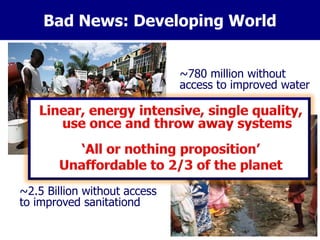
~2.5 Billion without access
to improved sanitationd
~780 million without
access to improved water
Bad News: Developing World
Managing urban water will become
more challenging in the future
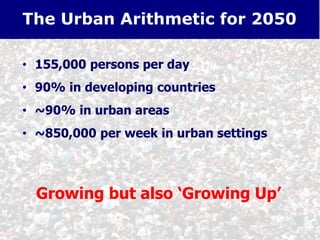
• 155,000 persons per day
• 90% in developing countries
• ~90% in urban areas
• ~850,000 per week in urban settings
The Urban Arithmetic for 2050
Growing but also ‘Growing Up’
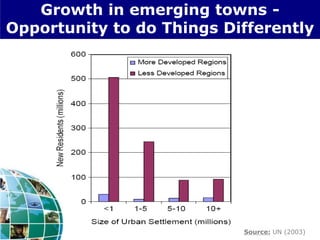
Source: UN (2003)
Growth in emerging towns -
Opportunity to do Things Differently
Source: World Bank (2010) World Development Report 2009 Reshaping Economic Geography , second edition, pp. 35
Opportunity to do Things
In Africa and Asia
Shenzhen
Fishing village of
several thousand
City of 7 million – big in
electronic manufacturing
1980 Today
Rapid Urbanization in Africa and Asia
Need to think differently
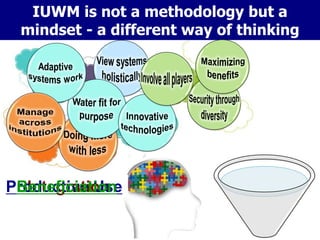
IUWM is not a methodology but a
mindset - a different way of thinking
IntegrationProductive UseBeneficiation
Doing more with less
‘Integration the key’
Holistic systems approach
to the urban watershed
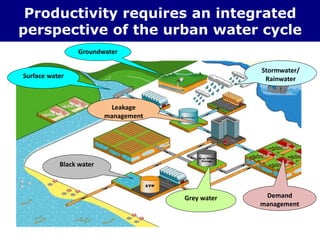
Surface water
Demand
management
Leakage
management
Stormwater/
Rainwater
Black water
Groundwater
Grey water
Productivity requires an integrated
perspective of the urban water cycle
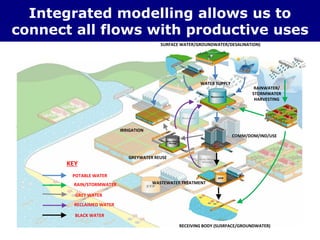
Integrated modelling allows us to
connect all flows with productive uses
SURFACE WATER/GROUNDWATER/DESALINATION)
WATER SUPPLY
COMM/DOM/IND/USE
IRRIGATION
GREYWATER REUSE
WASTEWATER TREATMENT
RECEIVING BODY (SUSRFACE/GROUNDWATER)
RAINWATER/
STORMWATER
HARVESTING
POTABLE WATER
RAIN/STORMWATER
GREY WATER
BLACK WATER
KEY
RECLAIMED WATER
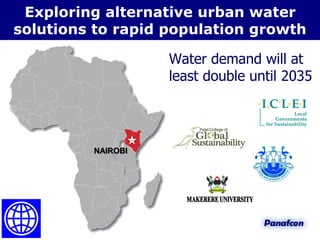
TransitioningExploring alternative urban water
solutions to rapid population growth
Water demand will at
least double until 2035
NAIROBI
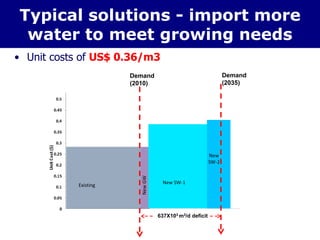
Typical solutions - import more
water to meet growing needs
• Unit costs of US$ 0.36/m3
NewGW
Existing
Demand
(2010)
637X103 m3/d deficit
New SW-1
New
SW-2
Demand
(2035)
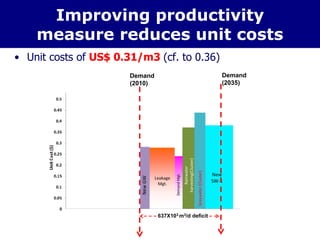
Improving productivity
measure reduces unit costs
• Unit costs of US$ 0.31/m3 (cf. to 0.36)
Demand
(2035)
New
SW-1
Rainwater
harvesting(Cluster)
NewGW
DemandMgt.Leakage
Mgt.
Greywater(Cluster)
Demand
(2010)
637X103 m3/d deficit
Further productivity measures
can postpone investments
• Unit costs of US$ 0.40/m3 (cf. to 0.36)
Rainwater
harvesting(Cluster)
NewGW
DemandMgt.Leakage
Mgt.
Greywater(Cluster)
Demand
(2010)
637X103 m3/d deficit
Reclaimwater(Cluster)
Rainwater(HH)
Greywater(Household)
Demand
(2035)
1.21
WN
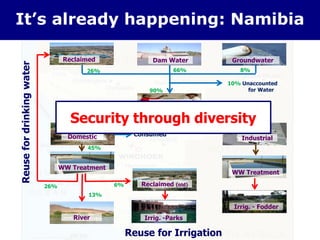
It’s already happening: Namibia
Reclaimed Dam Water Groundwater
Domestic
Consumers
Industrial
Irrig. -Parks
WW Treatment
26% 66% 8%
45%
7%
6%
10% Unaccounted
for Water
WW Treatment
Irrig. - Fodder
River
Reuse for Irrigation
Reusefordrinkingwater
Reclaimed (old)
13%
83%
Consumed
38%
26%
90%
Security through diversity
Conveyance
Treatm.(pump)
Treatm.(process)
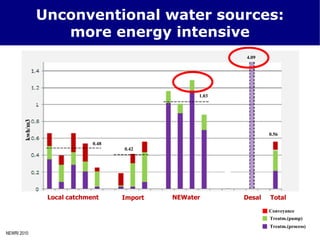
Local catchment Import NEWater Desal Total
0.48
0.42
1.03
kwh/m3
0.56
4.09
NEWRI 2010
Unconventional water sources:
more energy intensive
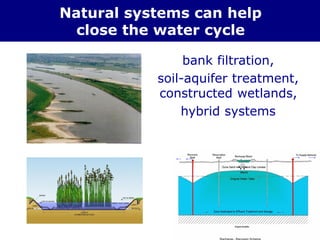
bank filtration,
soil-aquifer treatment,
constructed wetlands,
hybrid systems
Natural systems can help
close the water cycle
River
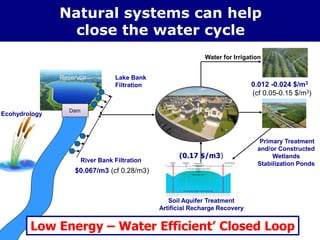
Natural systems can help
close the water cycle
$0.067/m3 (cf 0.28/m3)
0.012 -0.024 $/m3
(cf 0.05-0.15 $/m3)
(0.17 $/m3)
Lake Bank
Filtration
River Bank Filtration
Primary Treatment
and/or Constructed
Wetlands
Stabilization Ponds
Water for Irrigation
River
Dam
Reservoir
Ecohydrology
Low Energy – Water Efficient’ Closed Loop
Soil Aquifer Treatment
Artificial Recharge Recovery
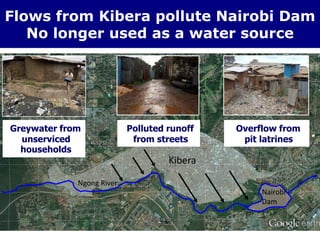
Kibera
Nairobi
Dam
Ngong River
Greywater from
unserviced
households
Polluted runoff
from streets
Overflow from
pit latrines
Flows from Kibera pollute Nairobi Dam
No longer used as a water source
Cost for provision of drainage and
sanitation for Kibera
• EAC US$ 1.0M
Condominium sewers
Condominium sewers
DEWATS
DEWATS
Potential water resources after
slum improvement
• Yield 17,300m3/d
• Cost of water (0.16$/m3)
• US$800,000/year reduction
SUDS
SUDS
Urban water infrastructure provision
to Kibera benefit all of Nairobi
Ben
Manage water supply, wastewater & stormwater
together (one urban water cycle)……. and think
creatively about what could be your water
sources (and don’t focus on the obvious ones).
Take home message
(educate future urban leaders on the integrated perspective
of the urban water cycle and contextualize each component
of the water system within this perspective)
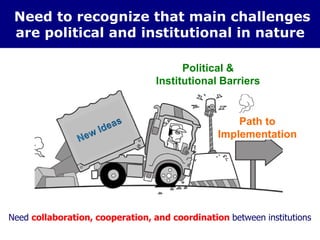
Need to recognize that main challenges
are political and institutional in nature
Path to
Implementation
Political &
Institutional Barriers
Need collaboration, cooperation, and coordination between institutions
The water sector can’t do it alone
Land planners
Architects
Developers
Gov’t officials
Financiers
Energy experts
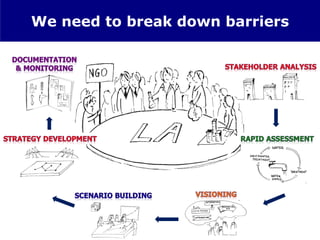
We need to break down barriers
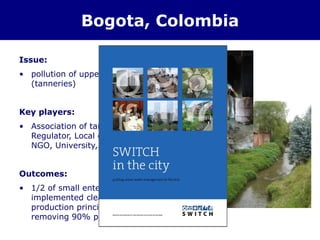
Bogota, Colombia
Issue:
• pollution of upper Rio Bogota
(tanneries)
Key players:
• Association of tanners,
Regulator, Local government,
NGO, University,…
Outcomes:
• 1/2 of small enterprises
implemented cleaner
production principles
removing 90% pollution
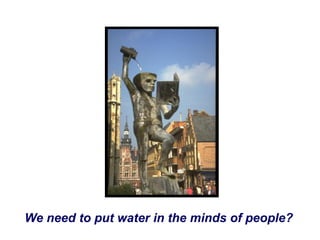
We need to put water in the minds of people?
Create a favorable enabling environment
(institutional landscape, regulations etc.) that
allows the effective and sustainable urban
water management
Take home message
Think about Harvesting
Looking from downstream up
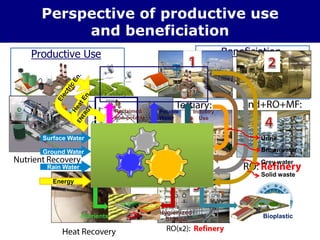
Perspective of productive use
and beneficiation
Productive Use Beneficiation
Quality
B
Quality
A
Quality
C
Grey water
Brownwater
Urine
Solid waste
Surface Water
Ground Water
Rain Water
Energy
Potable
Water
Reclaimed
non-potable
Industry
Use
Hygienized
Sludge
Nutrients Bioplastic
These perspectives lead to a more
decentralized type of thinking?
Decentralization well suited for:
• Energy recovery (heat recovered
and used close to source)
• Minimizing energy consumption
(for moving water)
• Source separation (to maximize
nutrient recovery)
• Adjusted growth (to deal with
rapid growing cities)
• Increased resiliency (dampens the
propagation of failures)
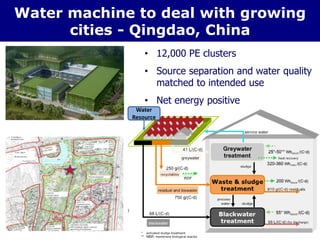
Water machine to deal with growing
cities - Qingdao, China
• 12,000 PE clusters
• Source separation and water quality
matched to intended use
• Net energy positive
Water
Resource
Look for opportunities to create new
paradigms (not extended old ones)
Formalised
Water System
Small scale providers
Growth
Decentralized
community based
Expansion of existing
system to serve new
demand
New
demand
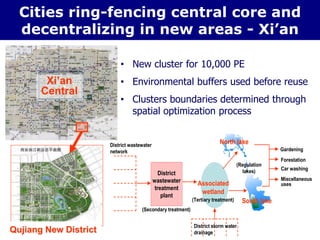
Qujiang New District
North lake
South lake
Associated
wetland
District
wastewater
treatment
plant
District wastewater
network
District storm water
drainage
(Secondary treatment)
(Tertiary treatment)
(Regulation
lakes)
Gardening
Forestation
Miscellaneous
uses
Car washing
• New cluster for 10,000 PE
• Environmental buffers used before reuse
• Clusters boundaries determined through
spatial optimization process
Cities ring-fencing central core and
decentralizing in new areas - Xi’an
Xi’an
Central
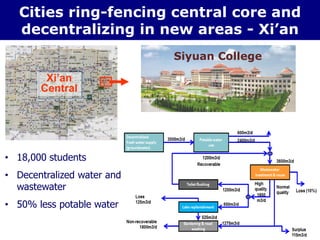
Cities ring-fencing central core and
decentralizing in new areas - Xi’an
Siyuan College
• 18,000 students
• Decentralized water and
wastewater
• 50% less potable water
Xi’an
Central
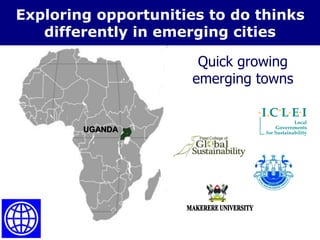
Quick growing
emerging towns
Exploring opportunities to do thinks
differently in emerging cities
UGANDA
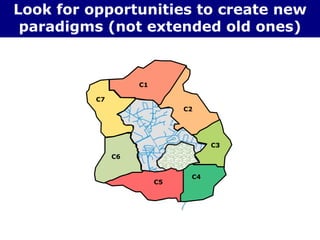
C1
C2
C3
C4
C7
C6
C5
Look for opportunities to create new
paradigms (not extended old ones)
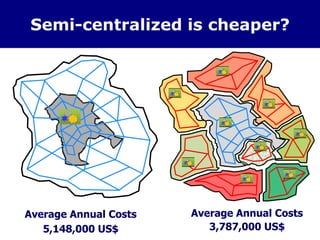
Semi-centralized is cheaper?
Average Annual Costs
3,787,000 US$
Average Annual Costs
5,148,000 US$
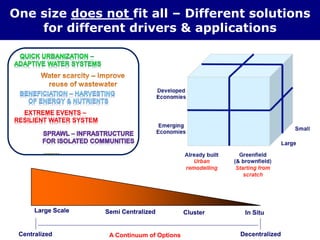
One size does not fit all – Different solutions
for different drivers & applications
Centralized Decentralized
Cluster In SituSemi CentralizedLarge Scale
A Continuum of Options
EXTREME EVENTS –
RESILIENT WATER SYSTEM
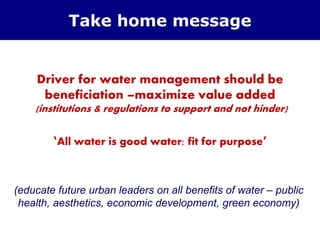
Driver for water management should be
beneficiation –maximize value added
(institutions & regulations to support and not hinder)
‘All water is good water: fit for purpose’
Take home message
(educate future urban leaders on all benefits of water – public
health, aesthetics, economic development, green economy)
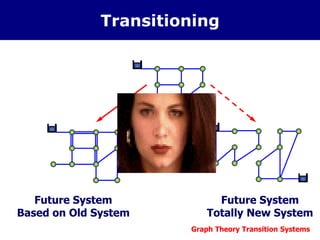
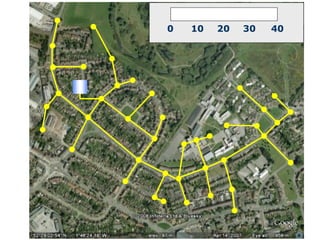
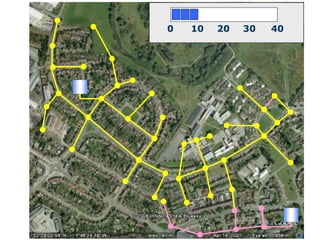
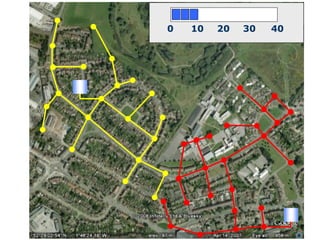
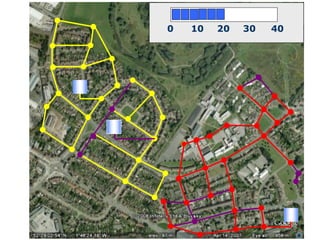
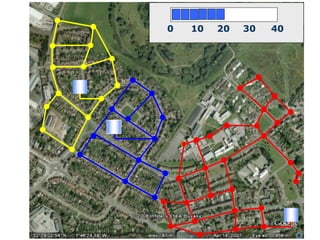
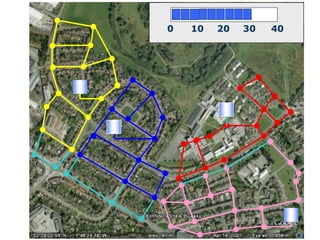
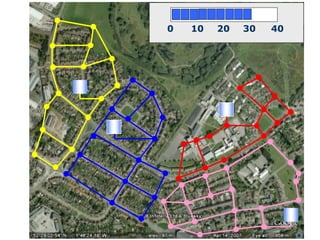
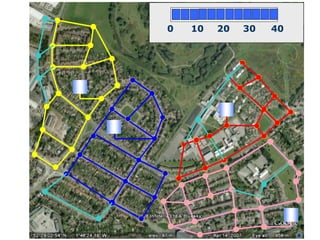
Transitioning
Graph Theory Transition Systems
Existing System
Future System
Based on Old System
Future System
Totally New System
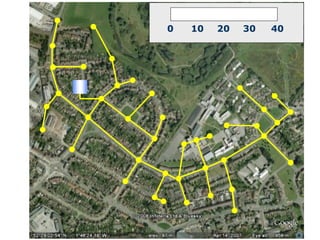
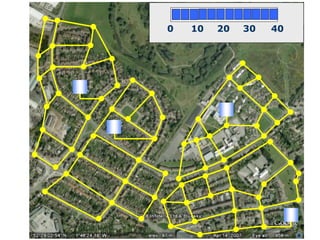
Transitioning
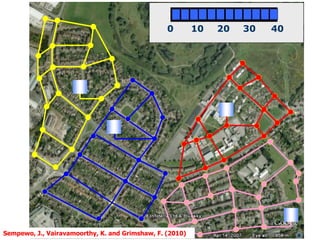
0 10 20 30 40
0 10 20 30 40
0 10 20 30 40
0 10 20 30 40
0 10 20 30 40
0 10 20 30 40
0 10 20 30 40
0 10 20 30 40
0 10 20 30 40
0 10 20 30 40
0 10 20 30 40
Sempewo, J., Vairavamoorthy, K. and Grimshaw, F. (2010)
We need Champions of Change
Train new urban leaders!
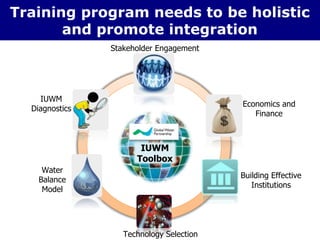
Training program needs to be holistic
and promote integration
Technology Selection
Building Effective
Institutions
Stakeholder Engagement
Economics and
Finance
IUWM
Toolbox
IUWM
Diagnostics
Water
Balance
Model
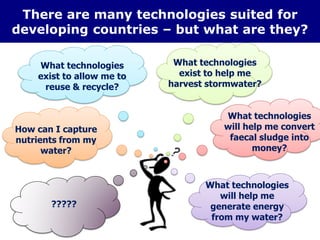
There are many technologies suited for
developing countries – but what are they?
What technologies
exist to allow me to
reuse & recycle?
How can I capture
nutrients from my
water?
What technologies
will help me
generate energy
from my water?
What technologies
exist to help me
harvest stormwater?
What technologies
will help me convert
faecal sludge into
money?
?????
Greywater Treatment:Household
DEWATS
Horizontal Flow Wetlands Algal Culture Ponds:
Harvest Micro-algae
Fecal sludge into safe fertilizer:
LaDePa machine (Durban)
We need a catalogue to help us understand what
technologies exist (and where/when to apply)
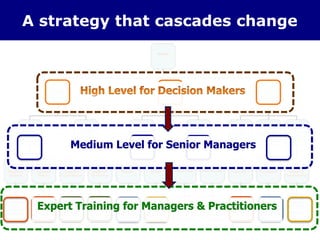
Medium Level for Senior Managers
Expert Training for Managers & Practitioners
A strategy that cascades change
Choices Before Us
What You
Know..
What You
Don’t Know..
What You
Know..
Stay in Lane
Business as
Usual
Try Harder
Spend More for
Traditional Sys
Paradigm Shift
Truly Different
Approach
Kalanithy Vairavamoorthy
vairavk@usf.edu
Thank You
Global Challenges, Global Research, Global Solutions

Integrated Urban Water Management, by Kala Vairavamoorthy

  • 1.
    Integrated Urban WaterManagement (IUWM) African Water Week Dakar 27th May 2014 Kala Vairavamoorthy Patel College of Global Sustainability UNIVERSITY OF SOUTH FLORIDA
  • 2.
    ~2.5 Billion withoutaccess to improved sanitationd ~780 million without access to improved water Bad News: Developing World
  • 3.
    Managing urban waterwill become more challenging in the future
  • 4.
    • 155,000 personsper day • 90% in developing countries • ~90% in urban areas • ~850,000 per week in urban settings The Urban Arithmetic for 2050 Growing but also ‘Growing Up’
  • 5.
    Source: UN (2003) Growthin emerging towns - Opportunity to do Things Differently
  • 6.
    Source: World Bank(2010) World Development Report 2009 Reshaping Economic Geography , second edition, pp. 35 Opportunity to do Things In Africa and Asia
  • 7.
    Shenzhen Fishing village of severalthousand City of 7 million – big in electronic manufacturing 1980 Today Rapid Urbanization in Africa and Asia
  • 8.
    Need to thinkdifferently
  • 9.
    IUWM is nota methodology but a mindset - a different way of thinking IntegrationProductive UseBeneficiation
  • 10.
    Doing more withless ‘Integration the key’ Holistic systems approach to the urban watershed
  • 11.
    Surface water Demand management Leakage management Stormwater/ Rainwater Black water Groundwater Greywater Productivity requires an integrated perspective of the urban water cycle
  • 12.
    Integrated modelling allowsus to connect all flows with productive uses SURFACE WATER/GROUNDWATER/DESALINATION) WATER SUPPLY COMM/DOM/IND/USE IRRIGATION GREYWATER REUSE WASTEWATER TREATMENT RECEIVING BODY (SUSRFACE/GROUNDWATER) RAINWATER/ STORMWATER HARVESTING POTABLE WATER RAIN/STORMWATER GREY WATER BLACK WATER KEY RECLAIMED WATER
  • 13.
    TransitioningExploring alternative urbanwater solutions to rapid population growth Water demand will at least double until 2035 NAIROBI
  • 14.
    Typical solutions -import more water to meet growing needs • Unit costs of US$ 0.36/m3 NewGW Existing Demand (2010) 637X103 m3/d deficit New SW-1 New SW-2 Demand (2035)
  • 15.
    Improving productivity measure reducesunit costs • Unit costs of US$ 0.31/m3 (cf. to 0.36) Demand (2035) New SW-1 Rainwater harvesting(Cluster) NewGW DemandMgt.Leakage Mgt. Greywater(Cluster) Demand (2010) 637X103 m3/d deficit
  • 16.
    Further productivity measures canpostpone investments • Unit costs of US$ 0.40/m3 (cf. to 0.36) Rainwater harvesting(Cluster) NewGW DemandMgt.Leakage Mgt. Greywater(Cluster) Demand (2010) 637X103 m3/d deficit Reclaimwater(Cluster) Rainwater(HH) Greywater(Household) Demand (2035) 1.21 WN
  • 17.
    It’s already happening:Namibia Reclaimed Dam Water Groundwater Domestic Consumers Industrial Irrig. -Parks WW Treatment 26% 66% 8% 45% 7% 6% 10% Unaccounted for Water WW Treatment Irrig. - Fodder River Reuse for Irrigation Reusefordrinkingwater Reclaimed (old) 13% 83% Consumed 38% 26% 90% Security through diversity
  • 18.
    Conveyance Treatm.(pump) Treatm.(process) Local catchment ImportNEWater Desal Total 0.48 0.42 1.03 kwh/m3 0.56 4.09 NEWRI 2010 Unconventional water sources: more energy intensive
  • 19.
    bank filtration, soil-aquifer treatment, constructedwetlands, hybrid systems Natural systems can help close the water cycle
  • 20.
    River Natural systems canhelp close the water cycle $0.067/m3 (cf 0.28/m3) 0.012 -0.024 $/m3 (cf 0.05-0.15 $/m3) (0.17 $/m3) Lake Bank Filtration River Bank Filtration Primary Treatment and/or Constructed Wetlands Stabilization Ponds Water for Irrigation River Dam Reservoir Ecohydrology Low Energy – Water Efficient’ Closed Loop Soil Aquifer Treatment Artificial Recharge Recovery
  • 21.
    Kibera Nairobi Dam Ngong River Greywater from unserviced households Pollutedrunoff from streets Overflow from pit latrines Flows from Kibera pollute Nairobi Dam No longer used as a water source
  • 22.
    Cost for provisionof drainage and sanitation for Kibera • EAC US$ 1.0M Condominium sewers Condominium sewers DEWATS DEWATS Potential water resources after slum improvement • Yield 17,300m3/d • Cost of water (0.16$/m3) • US$800,000/year reduction SUDS SUDS Urban water infrastructure provision to Kibera benefit all of Nairobi Ben
  • 23.
    Manage water supply,wastewater & stormwater together (one urban water cycle)……. and think creatively about what could be your water sources (and don’t focus on the obvious ones). Take home message (educate future urban leaders on the integrated perspective of the urban water cycle and contextualize each component of the water system within this perspective)
  • 24.
    Need to recognizethat main challenges are political and institutional in nature Path to Implementation Political & Institutional Barriers Need collaboration, cooperation, and coordination between institutions
  • 25.
    The water sectorcan’t do it alone Land planners Architects Developers Gov’t officials Financiers Energy experts
  • 26.
    We need tobreak down barriers
  • 27.
    Bogota, Colombia Issue: • pollutionof upper Rio Bogota (tanneries) Key players: • Association of tanners, Regulator, Local government, NGO, University,… Outcomes: • 1/2 of small enterprises implemented cleaner production principles removing 90% pollution
  • 28.
    We need toput water in the minds of people?
  • 29.
    Create a favorableenabling environment (institutional landscape, regulations etc.) that allows the effective and sustainable urban water management Take home message
  • 30.
  • 31.
    Perspective of productiveuse and beneficiation Productive Use Beneficiation Quality B Quality A Quality C Grey water Brownwater Urine Solid waste Surface Water Ground Water Rain Water Energy Potable Water Reclaimed non-potable Industry Use Hygienized Sludge Nutrients Bioplastic
  • 32.
    These perspectives leadto a more decentralized type of thinking? Decentralization well suited for: • Energy recovery (heat recovered and used close to source) • Minimizing energy consumption (for moving water) • Source separation (to maximize nutrient recovery) • Adjusted growth (to deal with rapid growing cities) • Increased resiliency (dampens the propagation of failures)
  • 33.
    Water machine todeal with growing cities - Qingdao, China • 12,000 PE clusters • Source separation and water quality matched to intended use • Net energy positive Water Resource
  • 34.
    Look for opportunitiesto create new paradigms (not extended old ones) Formalised Water System Small scale providers Growth Decentralized community based Expansion of existing system to serve new demand New demand
  • 35.
    Qujiang New District Northlake South lake Associated wetland District wastewater treatment plant District wastewater network District storm water drainage (Secondary treatment) (Tertiary treatment) (Regulation lakes) Gardening Forestation Miscellaneous uses Car washing • New cluster for 10,000 PE • Environmental buffers used before reuse • Clusters boundaries determined through spatial optimization process Cities ring-fencing central core and decentralizing in new areas - Xi’an Xi’an Central
  • 36.
    Cities ring-fencing centralcore and decentralizing in new areas - Xi’an Siyuan College • 18,000 students • Decentralized water and wastewater • 50% less potable water Xi’an Central
  • 37.
    Quick growing emerging towns Exploringopportunities to do thinks differently in emerging cities UGANDA
  • 38.
    C1 C2 C3 C4 C7 C6 C5 Look for opportunitiesto create new paradigms (not extended old ones)
  • 39.
    Semi-centralized is cheaper? AverageAnnual Costs 3,787,000 US$ Average Annual Costs 5,148,000 US$
  • 40.
    One size doesnot fit all – Different solutions for different drivers & applications Centralized Decentralized Cluster In SituSemi CentralizedLarge Scale A Continuum of Options EXTREME EVENTS – RESILIENT WATER SYSTEM
  • 41.
    Driver for watermanagement should be beneficiation –maximize value added (institutions & regulations to support and not hinder) ‘All water is good water: fit for purpose’ Take home message (educate future urban leaders on all benefits of water – public health, aesthetics, economic development, green economy)
  • 42.
    Transitioning Graph Theory TransitionSystems Existing System Future System Based on Old System Future System Totally New System Transitioning
  • 43.
    0 10 2030 40
  • 44.
    0 10 2030 40
  • 45.
    0 10 2030 40
  • 46.
    0 10 2030 40
  • 47.
    0 10 2030 40
  • 48.
    0 10 2030 40
  • 49.
    0 10 2030 40
  • 50.
    0 10 2030 40
  • 51.
    0 10 2030 40
  • 52.
    0 10 2030 40
  • 53.
    0 10 2030 40 Sempewo, J., Vairavamoorthy, K. and Grimshaw, F. (2010)
  • 54.
    We need Championsof Change Train new urban leaders!
  • 55.
    Training program needsto be holistic and promote integration Technology Selection Building Effective Institutions Stakeholder Engagement Economics and Finance IUWM Toolbox IUWM Diagnostics Water Balance Model
  • 56.
    There are manytechnologies suited for developing countries – but what are they? What technologies exist to allow me to reuse & recycle? How can I capture nutrients from my water? What technologies will help me generate energy from my water? What technologies exist to help me harvest stormwater? What technologies will help me convert faecal sludge into money? ?????
  • 57.
    Greywater Treatment:Household DEWATS Horizontal FlowWetlands Algal Culture Ponds: Harvest Micro-algae Fecal sludge into safe fertilizer: LaDePa machine (Durban) We need a catalogue to help us understand what technologies exist (and where/when to apply)
  • 58.
    Medium Level forSenior Managers Expert Training for Managers & Practitioners A strategy that cascades change
  • 59.
    Choices Before Us WhatYou Know.. What You Don’t Know.. What You Know.. Stay in Lane Business as Usual Try Harder Spend More for Traditional Sys Paradigm Shift Truly Different Approach
  • 60.
    Kalanithy Vairavamoorthy vairavk@usf.edu Thank You GlobalChallenges, Global Research, Global Solutions