A FUTURE WAY OF LIVELIHOOD
SECURITY OF RURAL INDIA
INTEGRATED FARMING
SYSTEM IN HILLY REGION
 Population in our country is increasing warranting to
produce more food from limited area available for
cultivation.
 Compounding with this, the agricultural systems have
encountered numerous ecological and environmental
constraints.
 India would need to produce an additional food grain
production of 100 and 160 m.t. by 2030 and 2050 A.D.
respectively, to feed projected population.
 The future of Indian agricultural depends mainly on poor
farm families of different agro-ecological zones.
WHAT IS IFS ?
IFS is a biologically integrated system which integrates natural
resources in a regulated mechanism into farming activities to
achieve maximum replacement of off-farm inputs, secures
sustainable production of high quality food and other products
through ecologically preferred technologies, sustain farm
income, eliminates sources of environmental pollution
generated agriculture.
WHY IFS ?
• To maximize productivity.
• To maximize profitability.
• To provide balance food.
• To reduce environmental pollution.
• To get income round the year.
• To save the energy by biofuel construction.
• To meet timber and fuel crisis by introducing agro forestry.
• To meet fodder crisis by alley cropping.
• To generate employment through agro based industries.
• To enhance input use efficiency.
COMPONENTS OF IFS :
1. CROPPING SYSTEM:
In hilly areas rice, vegetables, horticultural crops are
grown mainly by contour farming.
Contour farming is practiced in hilly areas with
slopes and with falling contour. The land is divided
into series of horizontal strips called terraces. Small
bunds are constructed at the end of each terraces to
hold water up to equal height. Besides producing
crop yield, it helps in mitigating indirectly controlling
flood, soil conservation.
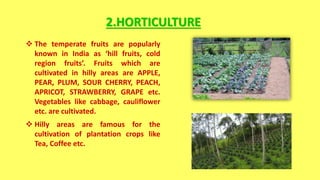
2.HORTICULTURE
 The temperate fruits are popularly
known in India as ‘hill fruits, cold
region fruits’. Fruits which are
cultivated in hilly areas are APPLE,
PEAR, PLUM, SOUR CHERRY, PEACH,
APRICOT, STRAWBERRY, GRAPE etc.
Vegetables like cabbage, cauliflower
etc. are cultivated.
 Hilly areas are famous for the
cultivation of plantation crops like
Tea, Coffee etc.
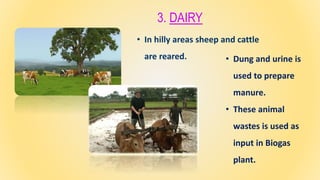
3. DAIRY
• Dung and urine is
used to prepare
manure.
• These animal
wastes is used as
input in Biogas
plant.
• In hilly areas sheep and cattle
are reared.
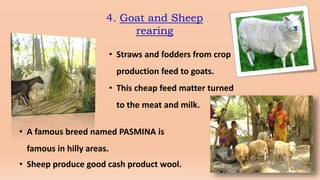
4. Goat and Sheep
rearing
• Straws and fodders from crop
production feed to goats.
• This cheap feed matter turned
to the meat and milk.
• Sheep produce good cash product wool.
• A famous breed named PASMINA is
famous in hilly areas.
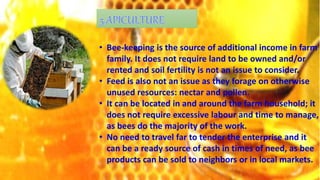
• Bee-keeping is the source of additional income in farm
family. It does not require land to be owned and/or
rented and soil fertility is not an issue to consider.
• Feed is also not an issue as they forage on otherwise
unused resources: nectar and pollen.
• It can be located in and around the farm household; it
does not require excessive labour and time to manage,
as bees do the majority of the work.
• No need to travel far to tender the enterprise and it
can be a ready source of cash in times of need, as bee
products can be sold to neighbors or in local markets.
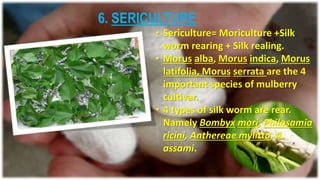
6. SERICULTURE
• Sericulture= Moriculture +Silk
worm rearing + Silk realing.
• Morus alba, Morus indica, Morus
latifolia, Morus serrata are the 4
important species of mulberry
cultivar.
• 4 types of silk worm are rear.
Namely Bombyx mori, Philosamia
ricini, Anthereae mylitta, A.
assami.
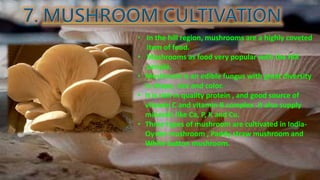
• In the hill region, mushrooms are a highly coveted
item of food.
• Mushrooms as food very popular with the Hill
people.
• Mushroom is an edible fungus with great diversity
in shape, size and color.
• It is rich in quality protein , and good source of
vitamin C and vitamin B complex .It also supply
minerals like Ca, P, K and Cu.
• Three types of mushroom are cultivated in India-
Oyster mushroom , Paddy straw mushroom and
White button mushroom.
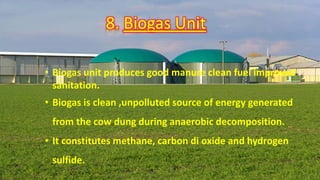
8. Biogas Unit
• Biogas unit produces good manure clean fuel improved
sanitation.
• Biogas is clean ,unpolluted source of energy generated
from the cow dung during anaerobic decomposition.
• It constitutes methane, carbon di oxide and hydrogen
sulfide.
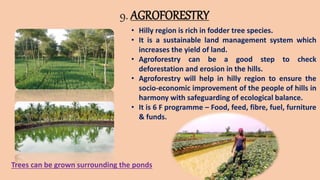
9. AGROFORESTRY
• Hilly region is rich in fodder tree species.
• It is a sustainable land management system which
increases the yield of land.
• Agroforestry can be a good step to check
deforestation and erosion in the hills.
• Agroforestry will help in hilly region to ensure the
socio-economic improvement of the people of hills in
harmony with safeguarding of ecological balance.
• It is 6 F programme – Food, feed, fibre, fuel, furniture
& funds.
Trees can be grown surrounding the ponds
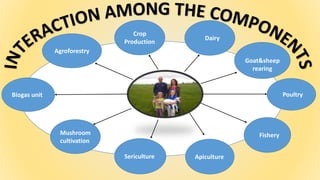
Crop
Production
Dairy
Poultry
Apiculture
Mushroom
cultivation
Biogas unit
Agroforestry
Sericulture
Fishery
Goat&sheep
rearing
CONCLUSION
“You don’t have to see the whole
staircase, just take the first step’’ –
Martin Luther King
THANK YOU

Integrated farming system in hilly region

  • 1.
    A FUTURE WAYOF LIVELIHOOD SECURITY OF RURAL INDIA INTEGRATED FARMING SYSTEM IN HILLY REGION
  • 2.
     Population inour country is increasing warranting to produce more food from limited area available for cultivation.  Compounding with this, the agricultural systems have encountered numerous ecological and environmental constraints.  India would need to produce an additional food grain production of 100 and 160 m.t. by 2030 and 2050 A.D. respectively, to feed projected population.  The future of Indian agricultural depends mainly on poor farm families of different agro-ecological zones.
  • 3.
    WHAT IS IFS? IFS is a biologically integrated system which integrates natural resources in a regulated mechanism into farming activities to achieve maximum replacement of off-farm inputs, secures sustainable production of high quality food and other products through ecologically preferred technologies, sustain farm income, eliminates sources of environmental pollution generated agriculture.
  • 4.
    WHY IFS ? •To maximize productivity. • To maximize profitability. • To provide balance food. • To reduce environmental pollution. • To get income round the year. • To save the energy by biofuel construction. • To meet timber and fuel crisis by introducing agro forestry. • To meet fodder crisis by alley cropping. • To generate employment through agro based industries. • To enhance input use efficiency.
  • 5.
    COMPONENTS OF IFS: 1. CROPPING SYSTEM: In hilly areas rice, vegetables, horticultural crops are grown mainly by contour farming. Contour farming is practiced in hilly areas with slopes and with falling contour. The land is divided into series of horizontal strips called terraces. Small bunds are constructed at the end of each terraces to hold water up to equal height. Besides producing crop yield, it helps in mitigating indirectly controlling flood, soil conservation.
  • 6.
    2.HORTICULTURE  The temperatefruits are popularly known in India as ‘hill fruits, cold region fruits’. Fruits which are cultivated in hilly areas are APPLE, PEAR, PLUM, SOUR CHERRY, PEACH, APRICOT, STRAWBERRY, GRAPE etc. Vegetables like cabbage, cauliflower etc. are cultivated.  Hilly areas are famous for the cultivation of plantation crops like Tea, Coffee etc.
  • 7.
    3. DAIRY • Dungand urine is used to prepare manure. • These animal wastes is used as input in Biogas plant. • In hilly areas sheep and cattle are reared.
  • 8.
    4. Goat andSheep rearing • Straws and fodders from crop production feed to goats. • This cheap feed matter turned to the meat and milk. • Sheep produce good cash product wool. • A famous breed named PASMINA is famous in hilly areas.
  • 9.
    • Bee-keeping isthe source of additional income in farm family. It does not require land to be owned and/or rented and soil fertility is not an issue to consider. • Feed is also not an issue as they forage on otherwise unused resources: nectar and pollen. • It can be located in and around the farm household; it does not require excessive labour and time to manage, as bees do the majority of the work. • No need to travel far to tender the enterprise and it can be a ready source of cash in times of need, as bee products can be sold to neighbors or in local markets.
  • 10.
    6. SERICULTURE • Sericulture=Moriculture +Silk worm rearing + Silk realing. • Morus alba, Morus indica, Morus latifolia, Morus serrata are the 4 important species of mulberry cultivar. • 4 types of silk worm are rear. Namely Bombyx mori, Philosamia ricini, Anthereae mylitta, A. assami.
  • 11.
    • In thehill region, mushrooms are a highly coveted item of food. • Mushrooms as food very popular with the Hill people. • Mushroom is an edible fungus with great diversity in shape, size and color. • It is rich in quality protein , and good source of vitamin C and vitamin B complex .It also supply minerals like Ca, P, K and Cu. • Three types of mushroom are cultivated in India- Oyster mushroom , Paddy straw mushroom and White button mushroom.
  • 12.
    8. Biogas Unit •Biogas unit produces good manure clean fuel improved sanitation. • Biogas is clean ,unpolluted source of energy generated from the cow dung during anaerobic decomposition. • It constitutes methane, carbon di oxide and hydrogen sulfide.
  • 13.
    9. AGROFORESTRY • Hillyregion is rich in fodder tree species. • It is a sustainable land management system which increases the yield of land. • Agroforestry can be a good step to check deforestation and erosion in the hills. • Agroforestry will help in hilly region to ensure the socio-economic improvement of the people of hills in harmony with safeguarding of ecological balance. • It is 6 F programme – Food, feed, fibre, fuel, furniture & funds. Trees can be grown surrounding the ponds
  • 14.
  • 15.
  • 16.
    “You don’t haveto see the whole staircase, just take the first step’’ – Martin Luther King THANK YOU