ARCHITECTURAL ANTHROPOLOGY
INTANGIBLE
CULTURAL
HERITAGE
CULTURAL ANTHROPOLOGY
SHARON SHERANI DANIEL
BARCH II YR IV SEM
TEAM : ANTHROPOLOGY
DR. MGR EDUCATIONAL AND
RESEARCH INSTITUTE
Culture or civilization, taken in it's board,
ethnographic sense, is that complex
whole which includes knowledge, belief,
art, morals, law, custom and any other
capabilities and habits acquired by man
as a member of society.
SIR EDWARD TYLOR
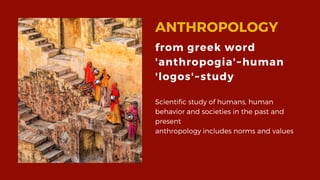
ANTHROPOLOGY
Scientific study of humans, human
behavior and societies in the past and
present
anthropology includes norms and values
from greek word
'anthropogia'~human
'logos'~study
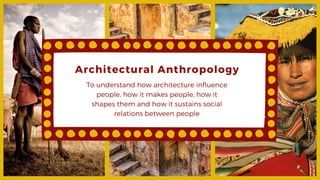
Architectural Anthropology
To understand how architecture influence
people, how it makes people, how it
shapes them and how it sustains social
relations between people
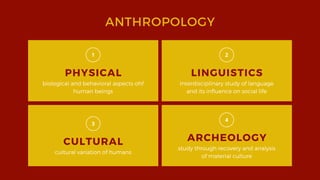
ANTHROPOLOGY
PHYSICAL
biological and behavioral aspects ohf
human beings
LINGUISTICS
Interdisciplinary study of language
and its influence on social life
CULTURAL
cultural variation of humans
ARCHEOLOGY
study through recovery and analysis
of material culture
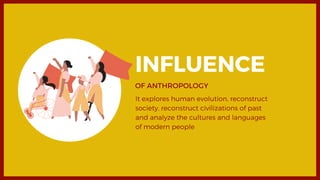
INFLUENCE
OF ANTHROPOLOGY
It explores human evolution, reconstruct
society, reconstruct civilizations of past
and analyze the cultures and languages
of modern people
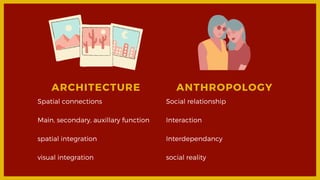
ANTHROPOLOGY
Social relationship
Interaction
Interdependancy
social reality
ARCHITECTURE
Spatial connections
Main, secondary, auxillary function
spatial integration
visual integration
CULTURAL
ANTHROPOLOGY
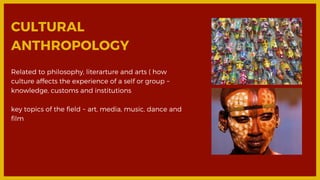
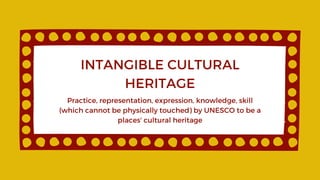
Related to philosophy, literarture and arts ( how
culture affects the experience of a self or group ~
knowledge, customs and institutions
key topics of the field ~ art, media, music, dance and
film
INTANGIBLE CULTURAL
HERITAGE
Practice, representation, expression, knowledge, skill
(which cannot be physically touched) by UNESCO to be a
places' cultural heritage
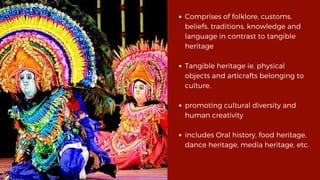
Comprises of folklore, customs,
beliefs, traditions, knowledge and
language in contrast to tangible
heritage
Tangible heritage ie. physical
objects and articrafts belonging to
culture.
promoting cultural diversity and
human creativity
includes Oral history, food heritage,
dance heritage, media heritage, etc.
LETS LEARN
FEW TERMS:
CASTE
Each of the hereditary classes of hindu
society, distinguished by relative degrees of
ritual purity or pollution and of social status
social class- system of dividing society
Any class or group of people who inherit
exclusive privilage or are percieved as
socially distinct
Eg. Iyer, Paraiyar, Nadar, Vanniyar, Vellar,
Reddy etc.
CUSTOMS:
Repitition of same behaviour, habitual practice,
method of doing or living
BEHAVIOUR:
Human conduct relative to social norms
according to behave or act
HABIT:
Action performed repeatedly and automatically
without awareness on regular basis
BELIEF:
Mental acceptance of a claim, faith or trust in
the reality of something based on reasoning,
evidence
MYTHOLOGY:
Collection of myths of people, their origin,
history, diety, ancestors and heros
FOLK:
Inhabitants of a land, their culture, tradition or
history
FOLKLORE:
The tales, legend and superstition of particular
ethnic population
MYTHS:
Traditional story which the people believe
About natural forces, personified soul, and other sacred
narratives
LITTLE
TRADITIONS
Robert Redfield-
Mexican studies
Formal illerate tradition of rural people
living within a civilization at the level of folk
society which is known
A type of interaction reflected in villages
based on caste
Little and great traditions help to analyse
social change in rural India. The nature of
this change is basically cultural. There is a
constant interaction between great
tradition and little tradition. The interaction
between the two traditions brings about
change in rural society.
Forestry Congress,
2003
SACRED
GROOVES
SPIRITUAL, SOCIOCULTURAL AND
ECOLOGICAL STATUS OF SACRED
GROOVES
Ancient tradition - Nature worship, trees
were very sacred and considered to be
Abode of Gods
They have residing deity and folklore
associated with are taboos, rituals, local
beliefs, mystic folk tales etc,.
Eg. Banyan, Peepal, Neem, Tamarind
These trees are dedicated to Village Gods or
spirits, snake gods, shaivaites or vaishnavites
The trees are indentified with colored
clothes around. Any disease, epidemic or
agriculture failure are believed to related to
it
SACRED
GROOVES
Forestry Congress,
2003
MANAGEMENT AND CUSTODY
The head family of the village, or the chief temple
or the dominating community
THREATS
Young generation consider the above to be
superstition
Invation of exotic weeds
Mining
Dead wood collection and bio mass gathering
CULTURE
Several fests and Community cooking takes place
in accordance to the tree.
The tree also accounts to several medicinal values.
It is a form of Conservation of Bio diversity
ORAL
HISTORY
INTERVIEW
QUESTIONS
FOR
KOVILUR
RESIDENTS
INTRODUCTION
FAMILY HISTORY 
LIFETIME CHANGES
FAMILY LIFE
CAREER
RELIGION
CUSTOM
BELIEF
SUPERSTITION
PERSONAL
FINANCIAL STATUS
WEALTH AND PROPERTY
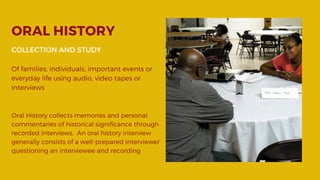
ORAL HISTORY
COLLECTION AND STUDY
Of families, individuals, important events or
everyday life using audio, video tapes or
interviews
Oral History collects memories and personal
commentaries of historical significance through
recorded interviews. An oral history interview
generally consists of a well-prepared interviewer
questioning an interviewee and recording 
EXAMPLE QUESTIONS
How old are you now?
When were you born?Where were you born?
Where was your mother born?
Do you know where your mother's mother (your grandmother on your
mother's side) was born?
How about your mother's father? Where was your grandfather (on your
mother's side) born?
What village did your mother's ancestors come from?
What part of the village did your mother's ancestors come from?
Where was your father born?Do you know where your father's mother
(your grandmother on your father's side) was born?
What about your father's father (your grandfather on your father's side)?
Do you know where he was born or where he came from?
Do you remember hearing any stories about why your ancestors --
either on your father's or mother's side of the family ?
SOURCE
Science Direct,Procedia Economics,vol 39 2016
Handwerker, W. Penn, 2002 "The Construct
Validity of Cultures: Cultural Diversity, Culture
Theory, and a Method for Ethnography".
From Wikipedia, the free encyclopedia
THANK YOU

INTANGIBLE CULTURAL HERITAGE - AN INTRODUCTION

  • 1.
  • 2.
    SHARON SHERANI DANIEL BARCHII YR IV SEM TEAM : ANTHROPOLOGY DR. MGR EDUCATIONAL AND RESEARCH INSTITUTE
  • 3.
    Culture or civilization,taken in it's board, ethnographic sense, is that complex whole which includes knowledge, belief, art, morals, law, custom and any other capabilities and habits acquired by man as a member of society. SIR EDWARD TYLOR
  • 4.
    ANTHROPOLOGY Scientific study ofhumans, human behavior and societies in the past and present anthropology includes norms and values from greek word 'anthropogia'~human 'logos'~study
  • 5.
    Architectural Anthropology To understandhow architecture influence people, how it makes people, how it shapes them and how it sustains social relations between people
  • 6.
    ANTHROPOLOGY PHYSICAL biological and behavioralaspects ohf human beings LINGUISTICS Interdisciplinary study of language and its influence on social life CULTURAL cultural variation of humans ARCHEOLOGY study through recovery and analysis of material culture
  • 7.
    INFLUENCE OF ANTHROPOLOGY It exploreshuman evolution, reconstruct society, reconstruct civilizations of past and analyze the cultures and languages of modern people
  • 8.
    ANTHROPOLOGY Social relationship Interaction Interdependancy social reality ARCHITECTURE Spatialconnections Main, secondary, auxillary function spatial integration visual integration
  • 9.
    CULTURAL ANTHROPOLOGY Related to philosophy,literarture and arts ( how culture affects the experience of a self or group ~ knowledge, customs and institutions key topics of the field ~ art, media, music, dance and film
  • 10.
    INTANGIBLE CULTURAL HERITAGE Practice, representation,expression, knowledge, skill (which cannot be physically touched) by UNESCO to be a places' cultural heritage
  • 11.
    Comprises of folklore,customs, beliefs, traditions, knowledge and language in contrast to tangible heritage Tangible heritage ie. physical objects and articrafts belonging to culture. promoting cultural diversity and human creativity includes Oral history, food heritage, dance heritage, media heritage, etc.
  • 12.
    LETS LEARN FEW TERMS: CASTE Eachof the hereditary classes of hindu society, distinguished by relative degrees of ritual purity or pollution and of social status social class- system of dividing society Any class or group of people who inherit exclusive privilage or are percieved as socially distinct Eg. Iyer, Paraiyar, Nadar, Vanniyar, Vellar, Reddy etc.
  • 13.
    CUSTOMS: Repitition of samebehaviour, habitual practice, method of doing or living BEHAVIOUR: Human conduct relative to social norms according to behave or act HABIT: Action performed repeatedly and automatically without awareness on regular basis BELIEF: Mental acceptance of a claim, faith or trust in the reality of something based on reasoning, evidence
  • 14.
    MYTHOLOGY: Collection of mythsof people, their origin, history, diety, ancestors and heros FOLK: Inhabitants of a land, their culture, tradition or history FOLKLORE: The tales, legend and superstition of particular ethnic population MYTHS: Traditional story which the people believe About natural forces, personified soul, and other sacred narratives
  • 15.
    LITTLE TRADITIONS Robert Redfield- Mexican studies Formalillerate tradition of rural people living within a civilization at the level of folk society which is known A type of interaction reflected in villages based on caste Little and great traditions help to analyse social change in rural India. The nature of this change is basically cultural. There is a constant interaction between great tradition and little tradition. The interaction between the two traditions brings about change in rural society.
  • 16.
    Forestry Congress, 2003 SACRED GROOVES SPIRITUAL, SOCIOCULTURALAND ECOLOGICAL STATUS OF SACRED GROOVES Ancient tradition - Nature worship, trees were very sacred and considered to be Abode of Gods They have residing deity and folklore associated with are taboos, rituals, local beliefs, mystic folk tales etc,. Eg. Banyan, Peepal, Neem, Tamarind These trees are dedicated to Village Gods or spirits, snake gods, shaivaites or vaishnavites The trees are indentified with colored clothes around. Any disease, epidemic or agriculture failure are believed to related to it
  • 17.
    SACRED GROOVES Forestry Congress, 2003 MANAGEMENT ANDCUSTODY The head family of the village, or the chief temple or the dominating community THREATS Young generation consider the above to be superstition Invation of exotic weeds Mining Dead wood collection and bio mass gathering CULTURE Several fests and Community cooking takes place in accordance to the tree. The tree also accounts to several medicinal values. It is a form of Conservation of Bio diversity
  • 18.
    ORAL HISTORY INTERVIEW QUESTIONS FOR KOVILUR RESIDENTS INTRODUCTION FAMILY HISTORY  LIFETIME CHANGES FAMILYLIFE CAREER RELIGION CUSTOM BELIEF SUPERSTITION PERSONAL FINANCIAL STATUS WEALTH AND PROPERTY
  • 19.
    ORAL HISTORY COLLECTION ANDSTUDY Of families, individuals, important events or everyday life using audio, video tapes or interviews Oral History collects memories and personal commentaries of historical significance through recorded interviews. An oral history interview generally consists of a well-prepared interviewer questioning an interviewee and recording 
  • 20.
    EXAMPLE QUESTIONS How oldare you now? When were you born?Where were you born? Where was your mother born? Do you know where your mother's mother (your grandmother on your mother's side) was born? How about your mother's father? Where was your grandfather (on your mother's side) born? What village did your mother's ancestors come from? What part of the village did your mother's ancestors come from? Where was your father born?Do you know where your father's mother (your grandmother on your father's side) was born? What about your father's father (your grandfather on your father's side)? Do you know where he was born or where he came from? Do you remember hearing any stories about why your ancestors -- either on your father's or mother's side of the family ?
  • 21.
    SOURCE Science Direct,Procedia Economics,vol39 2016 Handwerker, W. Penn, 2002 "The Construct Validity of Cultures: Cultural Diversity, Culture Theory, and a Method for Ethnography". From Wikipedia, the free encyclopedia
  • 22.