Dr. LUBNA SURAIYA
Assistant Professor,
PG & Research Department of Commerce,
Sri Vidya Mandir Arts and Science College (Autonomous),
Katteri, Uthangarai Taluk, Krishnagiri District
Mob : 8778830885
email : lubnasadiyah@gmail.com
ORIGINOF INSURANCE
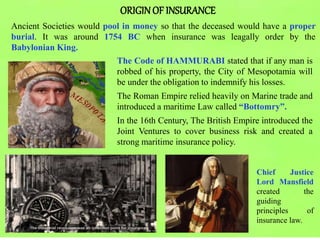
Ancient Societies would pool in money so that the deceased would have a proper
burial. It was around 1754 BC when insurance was leagally order by the
Babylonian King.
The Code of HAMMURABI stated that if any man is
robbed of his property, the City of Mesopotamia will
be under the obligation to indemnify his losses.
The Roman Empire relied heavily on Marine trade and
introduced a maritime Law called “Bottomry”.
In the 16th Century, The British Empire introduced the
Joint Ventures to cover business risk and created a
strong maritime insurance policy.
Chief Justice
Lord Mansfield
created the
guiding
principles of
insurance law.
EVOLUTIONOF INSURANCEBUSINESSIN INDIA
First General Insurance Company was started in the year 1850 in Culcatta in India
by the Britishers. The Company was named TRITON Insurance Company Limited.
In 1907, the First Indian Based Insurance Company named The Indian Mercantile
Insurance Limited was established. They took over all General Insurance Business.
In the Year 1957, Indian Government formed General Insurance Council.
 In 1968, Insurance Act was amended to regulate investments and set minimum solvency
margins.
 On 1st January 1973, General Insurance business was nationalized. During that time, there
were 107 General Insurance Companies, later minimized to 4 namely:
1. National Insurance Company Limited
2. The New India Assurane Company Limited
3. Oriental Insurance Company Limited
4. United India Insurance Company Limited
 The Government of India in 1993 went on a dialemma whether Insurance business can be
privitized or not under the headship of R.N. Malhotra, Former Governor of RBI. The report
was submitted in 1994. It was stated that insurance business can be privitized but
considering few conditions. Indian Companies must start as a JV allowing 24% foreign
investments.
 In 1999, Insurance Regultory Authority of India was constituted and in April 2000 it came
into existence headquartered in Delhi and in 2001 its HQ was shifted to Telengana,
Hyderabad.
UNDERSTANDING THE CONCEPTS
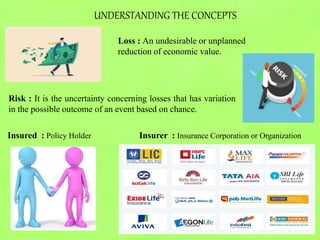
Loss : An undesirable or unplanned
reduction of economic value.
Risk : It is the uncertainty concerning losses that has variation
in the possible outcome of an event based on chance.
Insured : Policy Holder Insurer : Insurance Corporation or Organization
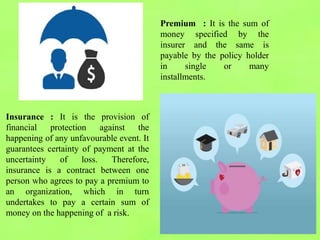
Insurance : It is the provision of
financial protection against the
happening of any unfavourable event. It
guarantees certainty of payment at the
uncertainty of loss. Therefore,
insurance is a contract between one
person who agrees to pay a premium to
an organization, which in turn
undertakes to pay a certain sum of
money on the happening of a risk.
Premium : It is the sum of
money specified by the
insurer and the same is
payable by the policy holder
in single or many
installments.
MEANINGOF INSURANCE
Insurance is a legal contract that transfers risk from a policyholder to an
insurance provider.
HOWTO HANDLE RISKS?
1. Avoidance: Choosing not to participate in an activity because of the risk
involved. e.g. not getting a driver’s license.
2. Retention: Saving money in case of future losses. e.g. putting 1000 in a savings
account in case of a car accident.
3. Transfer: Passing the risk on to an insurance company. e.g. paying a monthly fee
for an insurance policy and expecting the insurance company to protect your assets.
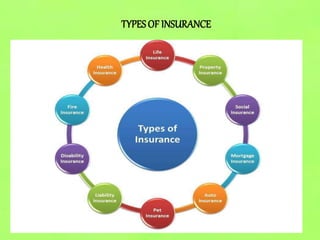
TYPESOF INSURANCE
I LIFE INSURANCE
Life insurance (or life assurance) is a contract between an insurance policy
holder and an insurer, where the insurer promises to pay beneficiary a sum of
money upon the death of an insured person.
RISK FACTORS ASSOCIATED
1. Age
2. Gender
3. Height and Weight
4. Medical Records
5. Personal Habits (Smoking, Drug Use, Alcoholic influence)
6. Occupation
7. Amount of coverage required
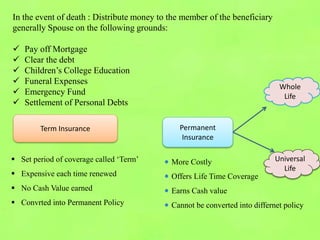
In the event of death : Distribute money to the member of the beneficiary
generally Spouse on the following grounds:
 Pay off Mortgage
 Clear the debt
 Children’s College Education
 Funeral Expenses
 Emergency Fund
 Settlement of Personal Debts
Term Insurance Permanent
Insurance
 Set period of coverage called ‘Term’
 Expensive each time renewed
 No Cash Value earned
 Convrted into Permanent Policy
More Costly
Offers Life Time Coverage
Earns Cash value
Cannot be converted into differnet policy
Whole
Life
Universal
Life
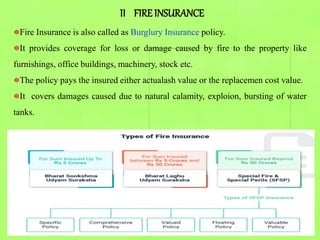
II FIRE INSURANCE
Fire Insurance is also called as Burglury Insurance policy.
It provides coverage for loss or damage caused by fire to the property like
furnishings, office buildings, machinery, stock etc.
The policy pays the insured either actualash value or the replacemen cost value.
It covers damages caused due to natural calamity, exploion, bursting of water
tanks.
Valued Policy : The insurer undertakes to pay in the event of destruction of
property by fire.
Specific Policy : The insurer pays not more than the sum specified in the policy.
Thus, the value of the property is not considered for this purpose.
Average Policy : If the property is under-insured, ie; insured for a sum smaller than
the value of the property. The insurer must bear only the proportion of the actual
loss at the time of loss.
Floating Policy : It covers several types of goods lying at various locations for one
amount and one premium.
Excess Policy : The insured might have to take another insurance policy to cover
the maximum amount of stocks which might reach sometimes. The former type of
policy is called First Loss Policy and the latter is called Excess Policy.
Blanket Policy : It covers all assets, fixed as well as current, under one policy.
Comprehensive Policy : Risks such as fire, flood, riots, strikes, burglary etc, upto
certain specified.
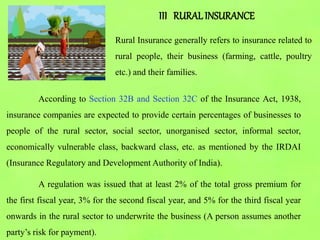
III RURALINSURANCE
Rural Insurance generally refers to insurance related to
rural people, their business (farming, cattle, poultry
etc.) and their families.
According to Section 32B and Section 32C of the Insurance Act, 1938,
insurance companies are expected to provide certain percentages of businesses to
people of the rural sector, social sector, unorganised sector, informal sector,
economically vulnerable class, backward class, etc. as mentioned by the IRDAI
(Insurance Regulatory and Development Authority of India).
A regulation was issued that at least 2% of the total gross premium for
the first fiscal year, 3% for the second fiscal year, and 5% for the third fiscal year
onwards in the rural sector to underwrite the business (A person assumes another
party’s risk for payment).
Types of rural policies
Personal Accident Insurance – To financially protect the insured’s family in
case the earning member faces death or disability due to death.
Critical Illness Insurance – To provide financial aid in times of financial
distress caused by the diagnosis of a critical illness.
Motor insurance – To offer coverage for agriculture-related vehicles such as
tractors or equipment such as pump sets.
Property Insurance – To cover damages caused to shops, outlets, schools,
etc. located in rural areas.
Livestock Insurance – To provide financial security to the owners of cows,
buffaloes, bulls, sheep, goat, etc.
Rural Insurance Coverage
• Hut insurance
• Poultry insurance
• Cycle rickshaw policy
• Sericulture insurance (Production of raw silk by raising silkworm)
• Honey bee insurance
• Failed- well insurance
• Sheep and goat insurance
• Lift irrigation insurance
• Farmers’ package insurance
• Agricultural pump-set policy
• Animal-driven cart insurance
• Gramin personal accident insurance
• Aqua-culture (prawn/ shrimp) insurance (the study or practice of growing
flowers, fruit and vegetables).
• Animals included in rural insurance are elephants, rabbits, pigs, birds, zoo and
circus animals.
How Rural Insurance Functions?
1) Analyse your requirement
2) Estimate the loss associated with your assets
3) Determine the type of insurance to opt for
4) The analysis will also help in deciding the premium amount
5) Check and compare various insurance companies and plans
6) The insurer checks whether the applicant resides in the rural area.
7) The premium is mutually agreed between the insurer and the insured.
8) When a risk occurs, the insured immediately informs the bank/insurer company
9) Evidence of the event, duly filled claim form and FIR Report are submitted by
the insured.
10) The claim is verified by bank officials. If authentic settled, else it is rejected.
EligibilityCriteria
According to the Insurance Regulatory and Development Authority of India
(IRDA), rural sector which is eligible for this insurance has to fulfil the
following categories:
Has a population less than 5,000 people.
Density of population is not more than 400 per square kilometre.
Minimum 75% of male population must be engaged in farming activities.
ClaimProcess
It is important to be aware of the steps in order to avoid any rejection:
After the eventuality, inform the insurance company as soon as possible.
Provide the duly filled in claim form.
Submit the proofs and certificates.
After an assessment, if the provider finds it fit, your claim will be accepted and
you will receive your compensation, else it will be rejected.
If you are not satisfied with the decision, you can approach the court of law.
Documents required:
a) Duly filled in claim form
b) Photocopy of insurance policy
c) FIR report in case of accidents/ vandalism
d) Death certificate (in case of death of the insured)
e) Evidence of equipment damage (in case of property insurance)
f) Ear tags (in case of cattle insurance)
g) Demand draft/cancelled cheque of the bank account for claiming
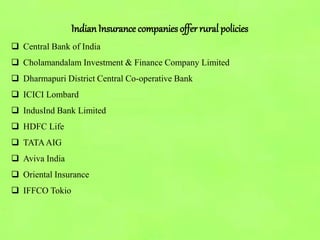
IndianInsurance companies offer rural policies
 Central Bank of India
 Cholamandalam Investment & Finance Company Limited
 Dharmapuri District Central Co-operative Bank
 ICICI Lombard
 IndusInd Bank Limited
 HDFC Life
 TATAAIG
 Aviva India
 Oriental Insurance
 IFFCO Tokio
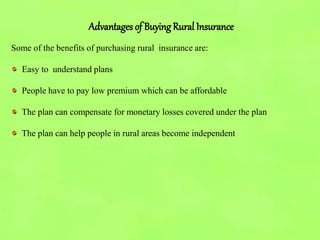
Advantages of Buying Rural Insurance
Some of the benefits of purchasing rural insurance are:
Easy to understand plans
People have to pay low premium which can be affordable
The plan can compensate for monetary losses covered under the plan
The plan can help people in rural areas become independent
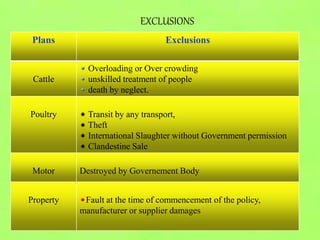
EXCLUSIONS
Plans Exclusions
Cattle
Overloading or Over crowding
unskilled treatment of people
death by neglect.
Poultry Transit by any transport,
Theft
International Slaughter without Government permission
Clandestine Sale
Motor Destroyed by Governement Body
Property Fault at the time of commencement of the policy,
manufacturer or supplier damages
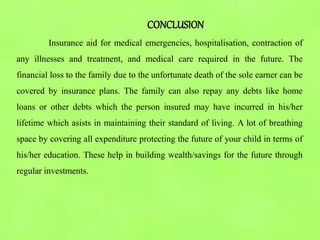
CONCLUSION
Insurance aid for medical emergencies, hospitalisation, contraction of
any illnesses and treatment, and medical care required in the future. The
financial loss to the family due to the unfortunate death of the sole earner can be
covered by insurance plans. The family can also repay any debts like home
loans or other debts which the person insured may have incurred in his/her
lifetime which asists in maintaining their standard of living. A lot of breathing
space by covering all expenditure protecting the future of your child in terms of
his/her education. These help in building wealth/savings for the future through
regular investments.
Insurance Outlined.pptx

Insurance Outlined.pptx

  • 1.
    Dr. LUBNA SURAIYA AssistantProfessor, PG & Research Department of Commerce, Sri Vidya Mandir Arts and Science College (Autonomous), Katteri, Uthangarai Taluk, Krishnagiri District Mob : 8778830885 email : lubnasadiyah@gmail.com
  • 2.
    ORIGINOF INSURANCE Ancient Societieswould pool in money so that the deceased would have a proper burial. It was around 1754 BC when insurance was leagally order by the Babylonian King. The Code of HAMMURABI stated that if any man is robbed of his property, the City of Mesopotamia will be under the obligation to indemnify his losses. The Roman Empire relied heavily on Marine trade and introduced a maritime Law called “Bottomry”. In the 16th Century, The British Empire introduced the Joint Ventures to cover business risk and created a strong maritime insurance policy. Chief Justice Lord Mansfield created the guiding principles of insurance law.
  • 3.
    EVOLUTIONOF INSURANCEBUSINESSIN INDIA FirstGeneral Insurance Company was started in the year 1850 in Culcatta in India by the Britishers. The Company was named TRITON Insurance Company Limited. In 1907, the First Indian Based Insurance Company named The Indian Mercantile Insurance Limited was established. They took over all General Insurance Business. In the Year 1957, Indian Government formed General Insurance Council.
  • 4.
     In 1968,Insurance Act was amended to regulate investments and set minimum solvency margins.  On 1st January 1973, General Insurance business was nationalized. During that time, there were 107 General Insurance Companies, later minimized to 4 namely: 1. National Insurance Company Limited 2. The New India Assurane Company Limited 3. Oriental Insurance Company Limited 4. United India Insurance Company Limited  The Government of India in 1993 went on a dialemma whether Insurance business can be privitized or not under the headship of R.N. Malhotra, Former Governor of RBI. The report was submitted in 1994. It was stated that insurance business can be privitized but considering few conditions. Indian Companies must start as a JV allowing 24% foreign investments.  In 1999, Insurance Regultory Authority of India was constituted and in April 2000 it came into existence headquartered in Delhi and in 2001 its HQ was shifted to Telengana, Hyderabad.
  • 5.
    UNDERSTANDING THE CONCEPTS Loss: An undesirable or unplanned reduction of economic value. Risk : It is the uncertainty concerning losses that has variation in the possible outcome of an event based on chance. Insured : Policy Holder Insurer : Insurance Corporation or Organization
  • 6.
    Insurance : Itis the provision of financial protection against the happening of any unfavourable event. It guarantees certainty of payment at the uncertainty of loss. Therefore, insurance is a contract between one person who agrees to pay a premium to an organization, which in turn undertakes to pay a certain sum of money on the happening of a risk. Premium : It is the sum of money specified by the insurer and the same is payable by the policy holder in single or many installments.
  • 7.
    MEANINGOF INSURANCE Insurance isa legal contract that transfers risk from a policyholder to an insurance provider. HOWTO HANDLE RISKS? 1. Avoidance: Choosing not to participate in an activity because of the risk involved. e.g. not getting a driver’s license. 2. Retention: Saving money in case of future losses. e.g. putting 1000 in a savings account in case of a car accident. 3. Transfer: Passing the risk on to an insurance company. e.g. paying a monthly fee for an insurance policy and expecting the insurance company to protect your assets.
  • 8.
  • 9.
    I LIFE INSURANCE Lifeinsurance (or life assurance) is a contract between an insurance policy holder and an insurer, where the insurer promises to pay beneficiary a sum of money upon the death of an insured person. RISK FACTORS ASSOCIATED 1. Age 2. Gender 3. Height and Weight 4. Medical Records 5. Personal Habits (Smoking, Drug Use, Alcoholic influence) 6. Occupation 7. Amount of coverage required
  • 10.
    In the eventof death : Distribute money to the member of the beneficiary generally Spouse on the following grounds:  Pay off Mortgage  Clear the debt  Children’s College Education  Funeral Expenses  Emergency Fund  Settlement of Personal Debts Term Insurance Permanent Insurance  Set period of coverage called ‘Term’  Expensive each time renewed  No Cash Value earned  Convrted into Permanent Policy More Costly Offers Life Time Coverage Earns Cash value Cannot be converted into differnet policy Whole Life Universal Life
  • 11.
    II FIRE INSURANCE FireInsurance is also called as Burglury Insurance policy. It provides coverage for loss or damage caused by fire to the property like furnishings, office buildings, machinery, stock etc. The policy pays the insured either actualash value or the replacemen cost value. It covers damages caused due to natural calamity, exploion, bursting of water tanks.
  • 12.
    Valued Policy :The insurer undertakes to pay in the event of destruction of property by fire. Specific Policy : The insurer pays not more than the sum specified in the policy. Thus, the value of the property is not considered for this purpose. Average Policy : If the property is under-insured, ie; insured for a sum smaller than the value of the property. The insurer must bear only the proportion of the actual loss at the time of loss. Floating Policy : It covers several types of goods lying at various locations for one amount and one premium. Excess Policy : The insured might have to take another insurance policy to cover the maximum amount of stocks which might reach sometimes. The former type of policy is called First Loss Policy and the latter is called Excess Policy. Blanket Policy : It covers all assets, fixed as well as current, under one policy. Comprehensive Policy : Risks such as fire, flood, riots, strikes, burglary etc, upto certain specified.
  • 13.
    III RURALINSURANCE Rural Insurancegenerally refers to insurance related to rural people, their business (farming, cattle, poultry etc.) and their families. According to Section 32B and Section 32C of the Insurance Act, 1938, insurance companies are expected to provide certain percentages of businesses to people of the rural sector, social sector, unorganised sector, informal sector, economically vulnerable class, backward class, etc. as mentioned by the IRDAI (Insurance Regulatory and Development Authority of India). A regulation was issued that at least 2% of the total gross premium for the first fiscal year, 3% for the second fiscal year, and 5% for the third fiscal year onwards in the rural sector to underwrite the business (A person assumes another party’s risk for payment).
  • 14.
    Types of ruralpolicies Personal Accident Insurance – To financially protect the insured’s family in case the earning member faces death or disability due to death. Critical Illness Insurance – To provide financial aid in times of financial distress caused by the diagnosis of a critical illness. Motor insurance – To offer coverage for agriculture-related vehicles such as tractors or equipment such as pump sets. Property Insurance – To cover damages caused to shops, outlets, schools, etc. located in rural areas. Livestock Insurance – To provide financial security to the owners of cows, buffaloes, bulls, sheep, goat, etc.
  • 15.
    Rural Insurance Coverage •Hut insurance • Poultry insurance • Cycle rickshaw policy • Sericulture insurance (Production of raw silk by raising silkworm) • Honey bee insurance • Failed- well insurance • Sheep and goat insurance • Lift irrigation insurance • Farmers’ package insurance • Agricultural pump-set policy • Animal-driven cart insurance • Gramin personal accident insurance • Aqua-culture (prawn/ shrimp) insurance (the study or practice of growing flowers, fruit and vegetables). • Animals included in rural insurance are elephants, rabbits, pigs, birds, zoo and circus animals.
  • 16.
    How Rural InsuranceFunctions? 1) Analyse your requirement 2) Estimate the loss associated with your assets 3) Determine the type of insurance to opt for 4) The analysis will also help in deciding the premium amount 5) Check and compare various insurance companies and plans 6) The insurer checks whether the applicant resides in the rural area. 7) The premium is mutually agreed between the insurer and the insured. 8) When a risk occurs, the insured immediately informs the bank/insurer company 9) Evidence of the event, duly filled claim form and FIR Report are submitted by the insured. 10) The claim is verified by bank officials. If authentic settled, else it is rejected.
  • 17.
    EligibilityCriteria According to theInsurance Regulatory and Development Authority of India (IRDA), rural sector which is eligible for this insurance has to fulfil the following categories: Has a population less than 5,000 people. Density of population is not more than 400 per square kilometre. Minimum 75% of male population must be engaged in farming activities.
  • 18.
    ClaimProcess It is importantto be aware of the steps in order to avoid any rejection: After the eventuality, inform the insurance company as soon as possible. Provide the duly filled in claim form. Submit the proofs and certificates. After an assessment, if the provider finds it fit, your claim will be accepted and you will receive your compensation, else it will be rejected. If you are not satisfied with the decision, you can approach the court of law. Documents required: a) Duly filled in claim form b) Photocopy of insurance policy c) FIR report in case of accidents/ vandalism d) Death certificate (in case of death of the insured) e) Evidence of equipment damage (in case of property insurance) f) Ear tags (in case of cattle insurance) g) Demand draft/cancelled cheque of the bank account for claiming
  • 19.
    IndianInsurance companies offerrural policies  Central Bank of India  Cholamandalam Investment & Finance Company Limited  Dharmapuri District Central Co-operative Bank  ICICI Lombard  IndusInd Bank Limited  HDFC Life  TATAAIG  Aviva India  Oriental Insurance  IFFCO Tokio
  • 20.
    Advantages of BuyingRural Insurance Some of the benefits of purchasing rural insurance are: Easy to understand plans People have to pay low premium which can be affordable The plan can compensate for monetary losses covered under the plan The plan can help people in rural areas become independent
  • 21.
    EXCLUSIONS Plans Exclusions Cattle Overloading orOver crowding unskilled treatment of people death by neglect. Poultry Transit by any transport, Theft International Slaughter without Government permission Clandestine Sale Motor Destroyed by Governement Body Property Fault at the time of commencement of the policy, manufacturer or supplier damages
  • 22.
    CONCLUSION Insurance aid formedical emergencies, hospitalisation, contraction of any illnesses and treatment, and medical care required in the future. The financial loss to the family due to the unfortunate death of the sole earner can be covered by insurance plans. The family can also repay any debts like home loans or other debts which the person insured may have incurred in his/her lifetime which asists in maintaining their standard of living. A lot of breathing space by covering all expenditure protecting the future of your child in terms of his/her education. These help in building wealth/savings for the future through regular investments.