INTODUCTION TO
REINSURANCE
Prepared By:
Salum Mlaponi,
Dip CII
INTRODUCTION
Every day we and our possessions are
exposed to many and innumerable risks
These risks are unforeseen and can
cause damage to us and our properties
and no one knows when these risks will
occur or the extent of damage they will
cause if they occur.
INTRODUCTION
Examples of these risks are:-
I. Natural Perils- Earthquakes, Seaquakes
(Tsunamis), floods, Hurricanes, Typhoons,
Tornadoes etc
II. Man made perils
III. Nuclear disasters
IV.Fire, Theft, Illnesses, Accidents, Epidemics,
Criminal Acts, etc.
But Man’s desire for security and his wish to provide
against future uncertainty lead to find the way to
INTRODUCTION
Risk threaten our lives and the threat can be only
dealt with through the process of risk management.
Risk management is the process aimed at
eliminating or minimizing the adverse effects of
accidental losses.
Risk management involves risks control measures
and risk financing.
Risk control aim at minimize the frequency and/ or
severity of the loss.
Risk financing aim at providing finance to make
good after risk occurrence. Eg. Insurance.
INSURANCE The idea of Insurance come from the
notion of supporting one another.
Insurance is part of risk financing, its
core business is to accept risk from the
insured with the promise to indemnify
them in case of a loss occurrence.
The main function of insurer is to
provide financial protection against the
loss or damage caused by specified
perils.
But sometimes risks may be a very large
and beyond the capacity of an
individual insurance company or market
to retain in full.
In such case insurer may opt to decline,
limit the acceptance, share the risk with
other insurer, reinsure.
.
REINSURANCE
Reinsurance exist because of Insurance. That’s to say it is impossible
to have reinsurance without there is insurance at the first place.
Reinsurance is a business of insuring an insurance company or
underwriter against suffering too great a loss from their insurance
operations.
This allow an insurance company or underwriter to lay off or pass on
part of their liability to another insurer on a given insurance which
they have accepted.
DEFINITION OF REINSURANCE
A legal definition of reinsurance was given by Lord
Mansfield in the case of Delver v. Barnes (1807),
that reinsurance:
 “Consists of a new assurance, effected by a new
policy, on the same risk which was before insured
in order to indemnify the underwriters from their
previous subscription, and both policies are in
existence at the same time”
 In summary, reinsurance is insurance for
insurance company.
 The definition provided by Lord Mansfield relate
REINSURANCE
PROCESS
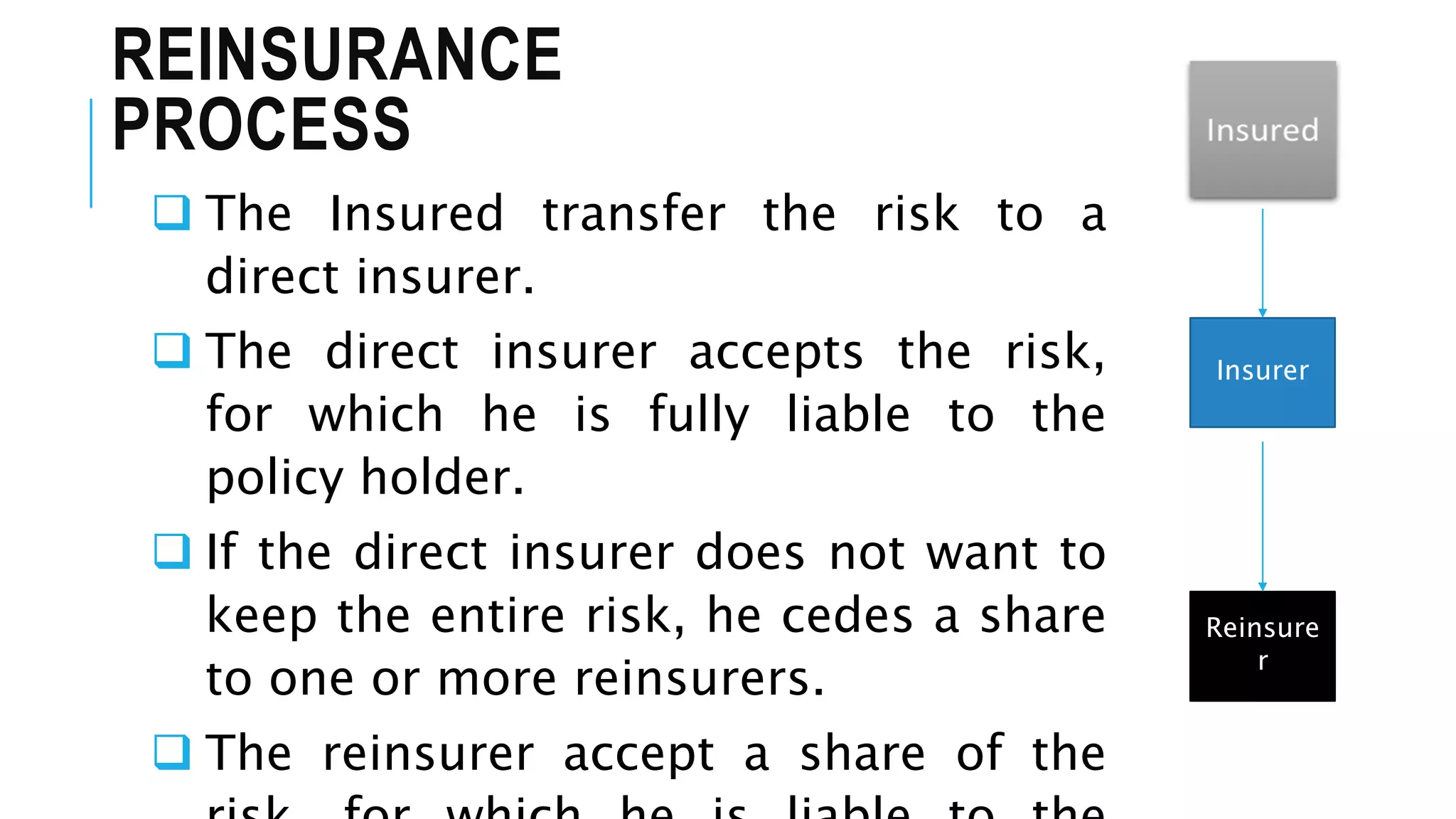
 The Insured transfer the risk to a
direct insurer.
 The direct insurer accepts the risk,
for which he is fully liable to the
policy holder.
 If the direct insurer does not want to
keep the entire risk, he cedes a share
to one or more reinsurers.
 The reinsurer accept a share of the
Insurer
Reinsure
r
PURPOSE AND FUNCTION OF
REINSURANCE
Increase Capacity
Reinsurers provide insurers with
additional underwriting capacity which
enables them:-
To accept larger risks than otherwise
would be possible;
To write types of business which
normally they would prefer to avoid
PURPOSE AND FUNCTION OF
REINSURANCE
 Example
A complex mall with an overall sum insured of TZS
10B offered to Strategis Insurance, which only
wishes to retain TZS 4B in net account.
Placement of this risk can be only achieved either
with support of reinsurance or by the use of co-
insurance.
Reinsurance allow insurer to accept the whole risk
and pass on TZS 6B to one or more reinsurer.
Therefore, if a loss occur at the Mall, Strategis is
fully liable up to a maximum of TZS 10B but it can it
PURPOSE AND FUNCTION OF
REINSURANCE
FINANCIAL STABILITY
Reinsurers absorb the impact of
large losses or an unexpected
series of medium or small losses,
which could lead to wide
fluctuations in results which can
be very damaging to its image
with the public and great concern
to share holders; and in so
doing, the Reinsurer:
Protects the insured against
sudden fluctuations in the cost of
cover (premium rates).
Protects the share holders of the
insurance company against a
considerable reduction or even
the loss of the registered capital.
This guarantees the share
holders a constant and possibly
increasing yield.
PURPOSE AND FUNCTION OF
REINSURANCE
STRENGTHENING OF FINANCES:-
Reinsurance gives the following financial
advantages:-
 Protects the Insurers’ balance Sheet and the
Profit and Loss accounts
 Protects image/Reputation of the insurer- ability
to pay claims
 Protects market share of the insurer - by giving
capacity to write for growth and pays claims in
time,
 Protects share prices
PURPOSE AND FUNCTION OF
REINSURANCE
Protects/Enhances the solvency
margins of the Insurance
Companies. Solvency Margin is
the ratio between capital &
reserves as a percentage of the
premium income. The ratio must
be greater or equal to a % age
required by law, e.g. 15% in
Tanzania.
EXAMPLE:
Capital & Free reserves:
30,000,000
Premium Income: 200,000,000
Solvency Ratio: 30m/200m x 100
= 15% without reinsurance.
With reinsurance :Assuming a
premium cession of
150,000,000, then solvency ratio
will be 30m/200m-150m x 100
= 60%
PURPOSE AND FUNCTION OF
REINSURANCE
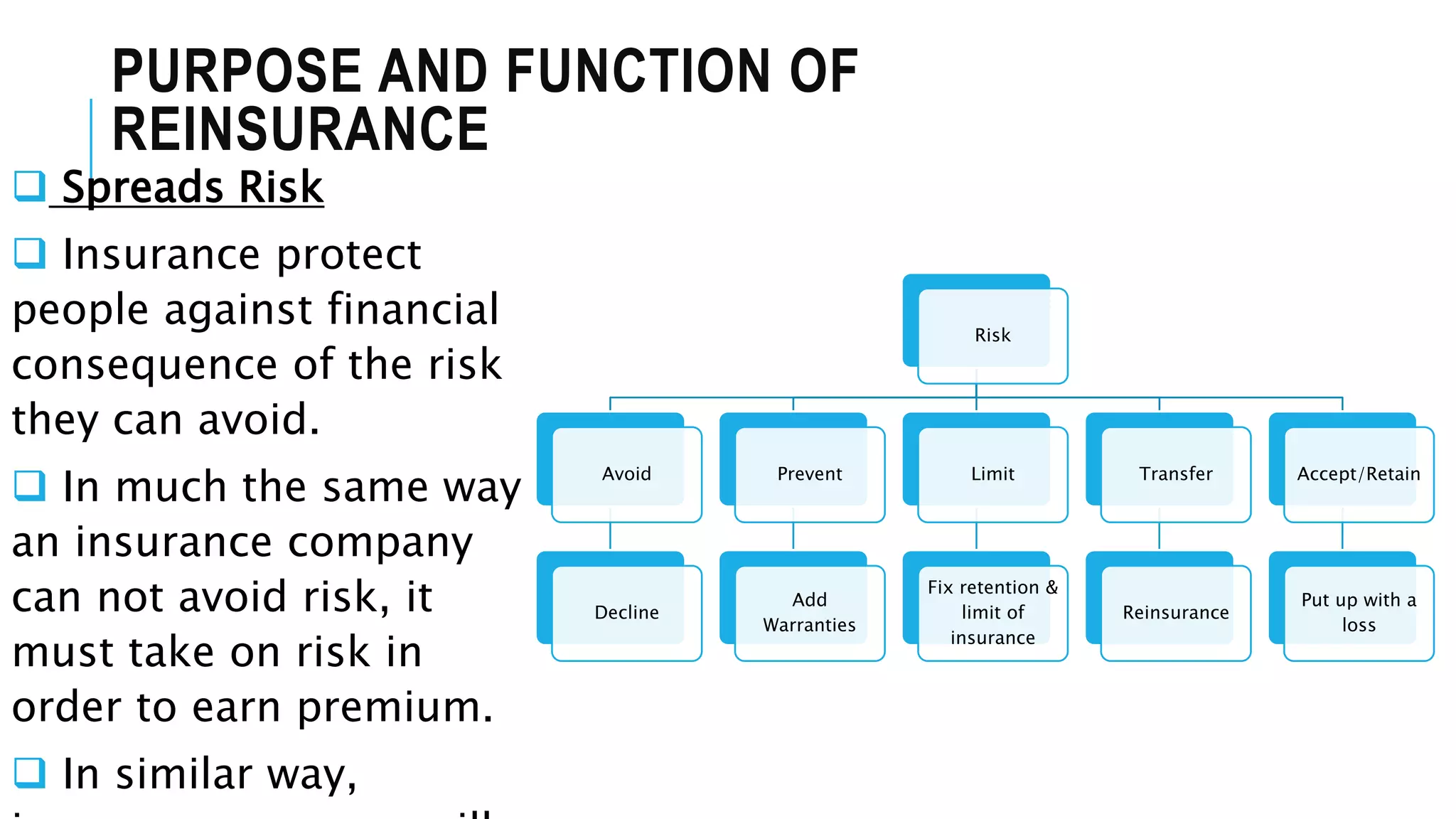
Risk
Avoid
Decline
Prevent
Add
Warranties
Limit
Fix retention &
limit of
insurance
Transfer
Reinsurance
Accept/Retain
Put up with a
loss
 Spreads Risk
 Insurance protect
people against financial
consequence of the risk
they can avoid.
 In much the same way
an insurance company
can not avoid risk, it
must take on risk in
order to earn premium.
 In similar way,
TYPES AND
METHOD OF
REINSURANCE
Reinsurance
Facultative
Proportional
Quota Share
Non-
Proportional
Excess of
Loss
Treaty
Proportional
Quota Share Surplus
Non-
Proportional
Excess of
Loss
Stop Loss
Reinsurance is broadly
categorized under two
branches that is treaty
reinsurance also known
as obligatory
reinsurance and
facultative reinsurance
also known as optional
reinsurance.
 These two branches can
be further broken down
in two sub-categories
i.e. Proportional
ANY QUESTION?
END

Introduction to reinsurance

  • 1.
  • 2.
    INTRODUCTION Every day weand our possessions are exposed to many and innumerable risks These risks are unforeseen and can cause damage to us and our properties and no one knows when these risks will occur or the extent of damage they will cause if they occur.
  • 3.
    INTRODUCTION Examples of theserisks are:- I. Natural Perils- Earthquakes, Seaquakes (Tsunamis), floods, Hurricanes, Typhoons, Tornadoes etc II. Man made perils III. Nuclear disasters IV.Fire, Theft, Illnesses, Accidents, Epidemics, Criminal Acts, etc. But Man’s desire for security and his wish to provide against future uncertainty lead to find the way to
  • 4.
    INTRODUCTION Risk threaten ourlives and the threat can be only dealt with through the process of risk management. Risk management is the process aimed at eliminating or minimizing the adverse effects of accidental losses. Risk management involves risks control measures and risk financing. Risk control aim at minimize the frequency and/ or severity of the loss. Risk financing aim at providing finance to make good after risk occurrence. Eg. Insurance.
  • 5.
    INSURANCE The ideaof Insurance come from the notion of supporting one another. Insurance is part of risk financing, its core business is to accept risk from the insured with the promise to indemnify them in case of a loss occurrence. The main function of insurer is to provide financial protection against the loss or damage caused by specified perils. But sometimes risks may be a very large and beyond the capacity of an individual insurance company or market to retain in full. In such case insurer may opt to decline, limit the acceptance, share the risk with other insurer, reinsure. .
  • 6.
    REINSURANCE Reinsurance exist becauseof Insurance. That’s to say it is impossible to have reinsurance without there is insurance at the first place. Reinsurance is a business of insuring an insurance company or underwriter against suffering too great a loss from their insurance operations. This allow an insurance company or underwriter to lay off or pass on part of their liability to another insurer on a given insurance which they have accepted.
  • 7.
    DEFINITION OF REINSURANCE Alegal definition of reinsurance was given by Lord Mansfield in the case of Delver v. Barnes (1807), that reinsurance:  “Consists of a new assurance, effected by a new policy, on the same risk which was before insured in order to indemnify the underwriters from their previous subscription, and both policies are in existence at the same time”  In summary, reinsurance is insurance for insurance company.  The definition provided by Lord Mansfield relate
  • 8.
    REINSURANCE PROCESS  The Insuredtransfer the risk to a direct insurer.  The direct insurer accepts the risk, for which he is fully liable to the policy holder.  If the direct insurer does not want to keep the entire risk, he cedes a share to one or more reinsurers.  The reinsurer accept a share of the Insurer Reinsure r
  • 9.
    PURPOSE AND FUNCTIONOF REINSURANCE Increase Capacity Reinsurers provide insurers with additional underwriting capacity which enables them:- To accept larger risks than otherwise would be possible; To write types of business which normally they would prefer to avoid
  • 10.
    PURPOSE AND FUNCTIONOF REINSURANCE  Example A complex mall with an overall sum insured of TZS 10B offered to Strategis Insurance, which only wishes to retain TZS 4B in net account. Placement of this risk can be only achieved either with support of reinsurance or by the use of co- insurance. Reinsurance allow insurer to accept the whole risk and pass on TZS 6B to one or more reinsurer. Therefore, if a loss occur at the Mall, Strategis is fully liable up to a maximum of TZS 10B but it can it
  • 11.
    PURPOSE AND FUNCTIONOF REINSURANCE FINANCIAL STABILITY Reinsurers absorb the impact of large losses or an unexpected series of medium or small losses, which could lead to wide fluctuations in results which can be very damaging to its image with the public and great concern to share holders; and in so doing, the Reinsurer: Protects the insured against sudden fluctuations in the cost of cover (premium rates). Protects the share holders of the insurance company against a considerable reduction or even the loss of the registered capital. This guarantees the share holders a constant and possibly increasing yield.
  • 12.
    PURPOSE AND FUNCTIONOF REINSURANCE STRENGTHENING OF FINANCES:- Reinsurance gives the following financial advantages:-  Protects the Insurers’ balance Sheet and the Profit and Loss accounts  Protects image/Reputation of the insurer- ability to pay claims  Protects market share of the insurer - by giving capacity to write for growth and pays claims in time,  Protects share prices
  • 13.
    PURPOSE AND FUNCTIONOF REINSURANCE Protects/Enhances the solvency margins of the Insurance Companies. Solvency Margin is the ratio between capital & reserves as a percentage of the premium income. The ratio must be greater or equal to a % age required by law, e.g. 15% in Tanzania. EXAMPLE: Capital & Free reserves: 30,000,000 Premium Income: 200,000,000 Solvency Ratio: 30m/200m x 100 = 15% without reinsurance. With reinsurance :Assuming a premium cession of 150,000,000, then solvency ratio will be 30m/200m-150m x 100 = 60%
  • 14.
    PURPOSE AND FUNCTIONOF REINSURANCE Risk Avoid Decline Prevent Add Warranties Limit Fix retention & limit of insurance Transfer Reinsurance Accept/Retain Put up with a loss  Spreads Risk  Insurance protect people against financial consequence of the risk they can avoid.  In much the same way an insurance company can not avoid risk, it must take on risk in order to earn premium.  In similar way,
  • 15.
    TYPES AND METHOD OF REINSURANCE Reinsurance Facultative Proportional QuotaShare Non- Proportional Excess of Loss Treaty Proportional Quota Share Surplus Non- Proportional Excess of Loss Stop Loss Reinsurance is broadly categorized under two branches that is treaty reinsurance also known as obligatory reinsurance and facultative reinsurance also known as optional reinsurance.  These two branches can be further broken down in two sub-categories i.e. Proportional
  • 16.