Course overview
Lawof insurance is an area of financial law
governing nature and function of insurance
It deals wz definition of insurance, types of
insurance, function of insurance, requirements for
formation of valid contract of insurance,
requirements to operate insurance business, rights
and duties of parties to insurance K
The course has generally five chapters:
3.
Overview cont’d
Chapterone (insurance in general, significance and basic
principles of insurance)
Chapter two (regulation of insurance business: types of
insurance, parties rights and duties)
Chapter three (Insurance of Objects: scope of risk
covered, scope of compensation)
Chapter four (Liability insurance: third party vehicle
insurance, payment and right of substitution
Chapter five (Life insurance: nature and scope of risk,
designation of beneficiary, insurance against illness and
disease)
4.
Chapter one
Insurance ingeneral
A. The notion of insurance :
It can be defined in several ways. It can be defined
from an individual (Insured) point of view which
is a risk transfer mechanism (from insured to
insurer), from insurer view point in which it is a
risk distribution mechanism
Insurance is a cooperative economic device to
spread the loss caused by a particular risk.
5.
Cont’d
In bothdefinition there exist a term risks.
Q) What is risk? It refers to potential of loss, undesirable
consequence….Think of risks involved in health after appropriate
diagnosis is made, risks created by food poison, risks occurred
during transportation, risks occurred at place of work, risks
occurring during construction, damages that can be sustained by
machine while operating, damages on goods in stock or vessel…
Risks r known for their uncertainty, peril (damage sustained)
and hazard (የአደጋው አባባሽ) and others
Risks could be divided as financial vs non financial,
fundamental/ those affecting the mass such as earth quake. Ex
suname/ vs particular risk/affecting a particular individual/
6.
Insurance defn
UnderEthiopian law, art 654 ff commercial code
talks about insurance. However, the code gives no
meaning to insurance rather it defines insurance
policy. As per proc 746/2004 (art 2/16): it is a
contract whereby an insurer by collecting a premium
from the insured agreed to pay compensation where
specified risks in the agreement did occur.
The definition embodies the following elements:
7.
Cont’d
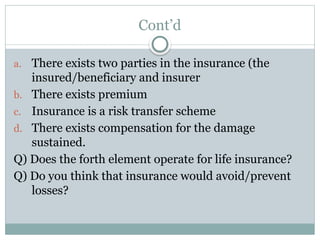
a. There existstwo parties in the insurance (the
insured/beneficiary and insurer
b. There exists premium
c. Insurance is a risk transfer scheme
d. There exists compensation for the damage
sustained.
Q) Does the forth element operate for life insurance?
Q) Do you think that insurance would avoid/prevent
losses?
8.
Features of insurancek
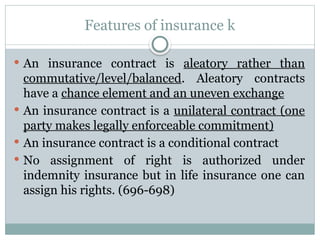
An insurance contract is aleatory rather than
commutative/level/balanced. Aleatory contracts
have a chance element and an uneven exchange
An insurance contract is a unilateral contract (one
party makes legally enforceable commitment)
An insurance contract is a conditional contract
No assignment of right is authorized under
indemnity insurance but in life insurance one can
assign his rights. (696-698)
9.
Insurance vs wagering/gamblingK
Q) R both the same or different? Both r different b/c
a. Their object is different (risk compensation vs gamble
for money)
b. In insurance there is an insurable interest whereas in
gambling there is no insurable interest.
c. Insurance is based on principle of indemnification
except for life insurance whereas there is no
indemnification issue for contract for gamble.
d. Insurance is based on scientific calculation whereas in
contract of gamble there is no calculation scientifically
10.
Significance of insurance
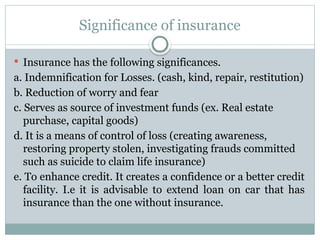
Insurance has the following significances.
a. Indemnification for Losses. (cash, kind, repair, restitution)
b. Reduction of worry and fear
c. Serves as source of investment funds (ex. Real estate
purchase, capital goods)
d. It is a means of control of loss (creating awareness,
restoring property stolen, investigating frauds committed
such as suicide to claim life insurance)
e. To enhance credit. It creates a confidence or a better credit
facility. I.e it is advisable to extend loan on car that has
insurance than the one without insurance.
11.
Basic principles ofinsurance
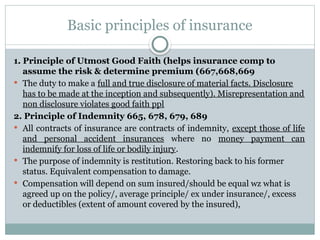
1. Principle of Utmost Good Faith (helps insurance comp to
assume the risk & determine premium (667,668,669
The duty to make a full and true disclosure of material facts. Disclosure
has to be made at the inception and subsequently). Misrepresentation and
non disclosure violates good faith ppl
2. Principle of Indemnity 665, 678, 679, 689
All contracts of insurance are contracts of indemnity, except those of life
and personal accident insurances where no money payment can
indemnify for loss of life or bodily injury.
The purpose of indemnity is restitution. Restoring back to his former
status. Equivalent compensation to damage.
Compensation will depend on sum insured/should be equal wz what is
agreed up on the policy/, average principle/ ex under insurance/, excess
or deductibles (extent of amount covered by the insured),
12.
Principle cont’d
3. ProximateCause (the risk must be covered and hence it must not be
the one w/c the policy exclude or uninsured) 663, 665
The insurer is liable only for those losses which have been proximately caused by
the peril/danger/risk/ insured against. I.e considering the last cause of the risk.
This will enable to decide whether z stated risk is covered under the policy or not.
4. Insurable Interest (otherwise the k will become void k) 675,693
This is refers to existence in actual sense of the property or subject matter of
insurance.
Absence of insurable interest will make the policy the gamble or a wagering
agreement.
In order to have an insurable interest the person must have lawful relation wz a
thing (whose source is from ownership, law such as k of bail, from k such as
construction k, from strict liability) and also must be subject to monetary value
except for life insurance. Example one cannot claim insurable interest on stolen
property.
13.
Principle con’td
5. Doctrineof Subrogation (aims at avoiding double
compens
It applies only to property insurance.
It is a situation in which the insurer that pays on behalf of the
insured brings claim against third party at fault to take back the
money it has paid. (683)
6. Risk Must Attach
If the subject-matter of insurance ceases to exist (e.g. the goods are
burnt) or the insured ship has already arrived safely, at the time the
policy is effected, the risk does not attach, and as a consequence,
the premium paid can be recovered from the insurers because the
consideration for the premium has totally failed
14.
Pps cont’d
7. Mitigationof Loss
Insured must endeavor to minimize the risk.
8. Doctrine of Contribution 681
Like the doctrine of subrogation, the doctrine of contribution also applies only to
contracts of indemnity, i.e., to property insurances.
The essential conditions required for the application of the doctrine of contribution are:
There must be double insurance (at different insurance firms
There must be either over-insurance or only partial loss
9. Reinsurance
An insurer assuming larger risk from the direct insurance business may arrange with
another insurer to off load the excess of the undertaken risk over his retention capacity.
Such arrangement between two insurers is termed as ‘reinsurance.’ Thus, by the
device of reinsurance the original insurer transfers part of the risk to the reinsurer.
10. Third Party Interests in Liability Insurance
15.
Assignment
Q) Ethiopian commercialcode while defining
insurance assert that an insurer will pay a sum of
money where specified risk materializes. Does this
mean that other mode of compensation are not
applicable under Ethiopian insurance law?
Q) Many of the insurance company’s r applying
excess and deductibles as principle though not
regulated under commercial code. How will these
principles enforced in courts?
16.
Chapter Two
Regulation ofInsurance Business
Q) Why regulation of Insurance needed?
-enforce monetary policy objectives;
-promote domestic and international competition;
- enhance efficiency;
- maintain financial stability and security;
- protect consumers;
- encourage information flow and prudential decision
making; and
- achieve general economic and social policy objectives.
17.
Cont’d
Regulation ofinsurance in our country took place through NBE.
NBE has set different requirements starting from entry to exit
from the market.
These requirements are requirements of licensing, capital
adequacy, reserving, accounting, valuation, liquidity, solvency,
functional and ownership separation, risk diversification, risk
transferring, information exchanging and fund guarantee
requirements, prohibitions of anti-competitive mergers,
agreements and practices, and abuse of dominant positions, rules
on insider dealing and market manipulation, auditing, disclosure
and others (refer proc 86/94 and supervision of insurance
business directive of NBE: SIB/1/94 up to SIB/34/2012.
18.
Types of Insurance
Under commercial code, they r divided into two
1. Indemnity insurance (654/2). Further divided into
property insurance and liability insurance
2. Life insurance (654/3)
Currently there r different types of insurance such
as health insurance, marine insurance, air
insurance, vessel insurance and etc)
19.
K of insuranceand insurance policy
When we say K, requirements for formation of valid k
must exist (1675). These are: meeting of mind, plurality
of parties, proprietary nature, legally possible and
enforceable obligations, form observance (optional).
Generally capacity, consent, object and form.
K will be undertaken through offer and acceptance
mechanism.
K of insurance must also comply z requirements of art
1678. failure to comply wz z requirements will result in
invalidation of k as per 1808.
20.
Cont’d
Q) What wouldbe the effect of proposal form filled
and submitted by the insured and the insurer failing
to respond w/o delay?
In USA there r 3 remedies.
a. Silence amounts to breach of implied agreement
b. If an insured fills the proposal and also effect
payment that is acceptance
c. Failure to respond will result in tortuous liability.
Q) What about Ethiopia? Commercial code is silent.
Can we apply provision of civil code by analogy?
21.
Cont’d
To concludeinsurance K two documents r needed.
A. Proposal form (to be filled by insured).መግብያ ቅፅ).
This will help z insurer to determine premium and
assume z risk. Z insured will provide detail
information here. Ex description of proposed insured,
description of risk, circumstance affecting z risk, sum
insured)
B. Policy (to be filled by insurer). It is a k and hence
includes place of k, parties address, property insured,
parties respective rights and obligations, duration,
amount of premium, risks covered.
22.
Parties to insurancek
Under indemnity insurance they r insured and
insurer
Under life insurance in addition to the above two
there exists beneficiaries.
23.
Parties rights andobligations
a. Obligation of insurer
1. Duty to pay compensation as agreed on z policy
(when risk in z policy in z period stated materialize)
663/665. earlier ppls such as good faith must exist
to benefit
2. Duty to serve as insurer
24.
Count’d
b. Insured obligation
1.Duty to pay premium (659, 666, 709). Refer them for
effects of failure to pay premium too
2. Disclosure of information and notification of
occurrence of damage (670). Notification wz in 5 days. 5
days requirement is amended to 10 for 3rd
party
insurance wz procl 799/2005 art 17 (1)
Q) What is z effect of failure to notify z damage? 2 opposing
views (one it denies z right to get compensation and z
second view it will not deny). Refer cassation dec file no
17689 decided on tahissas 10/1998.
25.
Chapter Three
Insurance ofobject
It is an insurance where by an owner of an object enters an
insurance for property he/she owns. In such kinds of
insurance, an insurer will indemnify an insured where risk
specified in the policy did materialize. Hence insurance of
object is a contract for compensation (Art 678).
Q) Who will enter into insurance of object? To enter into
insurance of object requirement of insurable interest
must exist. Insurable interest here refers to a person’s legally
recognized r/ship to z subject matter of insurance. Hence,
such r/ship must be of legal one in nature.
Q) How do u see article 675 from insurable interest point of
view? It says any person interested in preservation only?
26.
Cont’d
Insurable interestconsists of the following essential elements;
a. Existence of an object (property) subject to insurance. A property must be
proprietary nature. (የመድን ሽፋን ሊሰጠዉ የሚችል ንብረት፤መብት፤ጥቅም እና ሁኔታ
ሊኖር ይገባል). For instance loss of an object insured will result in the
termination of the policy as per article 677 of commercial code.
b. Legal r/ship of a person entering insurance K wz an object (መድን ገቢዉ
የመድን ሽፋን ከሚሰጠዉ ነገር ጋር ሕጋዊ ግንኙነት ያለዉ ስለመሆኑ ማሳየት አለበት)
c. R/ship between an insured and an object must be z one enforceable and
recognized under z law. (በመድን ገቢዉ እና የመድን ሽፋን በተሰጠዉ ነገር መካከል
ያለዉ ግንኙነት በህግ ተቀባይነት ያለዉ መሆን አለበት)
An insurable interest could be obtained from
a. ownership over property, (w/c could be joint or sole o/p). Example;
mortgagee
b. Interest arising from law (Example : K of bail)
c. Insurable interest arising from k (Example: construction K)
d. insurable interest arising from strict liability (Example: Art 96 of labor
proclamation)
27.
Cont’d
Therefore, toenter into insurance of object, requirement
of insurable interest must be complied with. This interest
could be either direct or indirect as enshrined on art 675.
As far as scope of risks (remember the three types of
risks namely: insured risks, excluded/excepted risks and
uninsured risks) covered under insurance of object are
concerned, those risks that r covered by the policy will be
covered. Accordingly, it is only insured risks that will be
under the scope of risks of insurance of object. Article 676
of commercial code for instance talks about uninsured
risks; risks associated wz international or civil war).
28.
Scope of compensation
Insurance of object from the very outset is an
insurance for compensation.
Q) What would be the scope of compensation?
In insurance K, amount of compensation will be
proportionate to the loss incurred. If the amount of
compensation exceeds the damage sustained, it will
affect the insurer as the premium collected is
assumed to be the public money. The very essence of
compensating is to reinstate the insured to its place.
29.
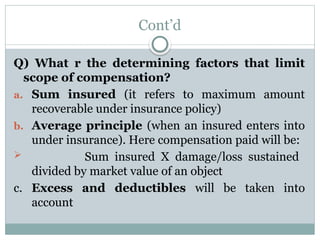
Cont’d
Q) What rthe determining factors that limit
scope of compensation?
a. Sum insured (it refers to maximum amount
recoverable under insurance policy)
b. Average principle (when an insured enters into
under insurance). Here compensation paid will be:
Sum insured X damage/loss sustained
divided by market value of an object
c. Excess and deductibles will be taken into
account
30.
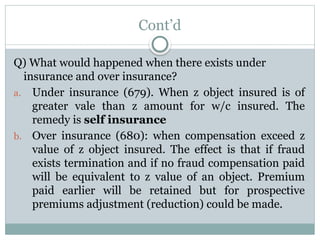
Cont’d
Q) What wouldhappened when there exists under
insurance and over insurance?
a. Under insurance (679). When z object insured is of
greater vale than z amount for w/c insured. The
remedy is self insurance
b. Over insurance (680): when compensation exceed z
value of z object insured. The effect is that if fraud
exists termination and if no fraud compensation paid
will be equivalent to z value of an object. Premium
paid earlier will be retained but for prospective
premiums adjustment (reduction) could be made.
31.
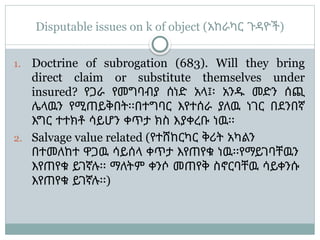
Disputable issues onk of object (አከራካር ጉዳዮች)
1. Doctrine of subrogation (683). Will they bring
direct claim or substitute themselves under
insured? የጋራ የመግባብያ ሰነድ አላ፤፡ አንዱ መድን ሰጪ
ሌላዉን የሚጠይቅበት፡፡በተግባር እየተሰራ ያለዉ ነገር በደንበኛ
እግር ተተክቶ ሳይሆን ቀጥታ ክስ እያቀረቡ ነዉ፡፡
2. Salvage value related (የተሸከርካር ቅሪት አካልን
በተመለከተ ዋጋዉ ሳይሰላ ቀጥታ እየጠየቁ ነዉ፡፡የማይገባቸዉን
እየጠየቁ ይገኛሉ፡፡ ማለትም ቀንሶ መጠየቅ ስኖርባቸዉ ሳይቀንሱ
እየጠየቁ ይገኛሉ፡፡)
32.
Group assignments
1. Competitionin Ethiopian Insurance market and its
regulation (Group 1)
2. Supervision and regulation of Insurance Industry
in Ethiopia (Group 2)
3. Regulation of licensed insurance brokers under
Ethiopian Insurance law (Group 3)
4. Comparison of Ethiopian Insurance Industry wz
selected African countries (Group 4)
5. Licensing and cancellation of Insurance licenses
under Ethiopian Insurance regime (Group 5)
33.
Chapter four
Liability Insurance(Compulsory third party
liability insurance) procl 799/2013
Q) Why third party liability insurance necessitated?
The preamble has an answer. Accordingly the
legislation is enacted as a response to escalating
vehicle accident (aims at responding to the problem),
the need to provide emergency medical treatment to
victims, reducing social problems of such accidents,
the need to fill the legal voids.
34.
Cont’d
Q) Who isthird party? Third Party” is as any person
other than the insured person’s family, the
driver or any person employed on a vehicle to
which an insurance policy applies at the time when
an accident occurred giving liability under such
insurance policy. (Art 2(10)
Hence the law excludes; insured person’s family,
driver or any person employed on a vehicle.
Q) Why such exclusion? What is z policy behind it?
35.
Cont’d
In linewith the above preamble, article 3 of the same
proclamation stipulates that:
1, No person shall drive or cause or permit any other person to
drive a vehicle on a road unless he has a valid vehicle insurance
coverage against third party risks in relation to such vehicle.
2, Notwithstanding the provision of sub article 1 of this article, the
Ministry may determine vehicles to operate on the road without
requiring compulsory motor vehicle insurance coverage.
Q) What is z effect of driving a vehicle w/o the certificate? Article
13 (it will be regarded as primafacia evidence that z vehicle is
not insured. Detention of car and administrative penalty (art 30
fine ranging from 3,000 birr to 5,000 birr)
36.
Group discussion
Q) Caninsurer object payment based on various
grounds? Article 5 has an answer. It states that, once
a certificate of insurance (third party) is given for the
insured, an insurer cannot object payment of
compensation based on the ground of age, physical
condition of the person driving, condition and value of
the car, number of person travelling, time the vehicle is
used. Hence this shows that there is clear unlimited
liability. The above statement is further strengthened
on article 6 which states that any agreement which
limit liability of insurer shall have no effect
37.
Cont’d
We haveto notice that third party insurance does not cover all
subject matters. Hence, there are excluded subject matters.
These are clearly indicated on article 7. Accordingly; the following
shall be excluded from the coverage of any insurance policy
against third party risks
1. death or bodily injury to the insured person or member of the insured
person’s family;
2. liability in respect of death or bodily injury caused to a person hired
by the insured person and occurred in the course of such
employment;
3. damage to the insured vehicle;
4. liability in respect of damage to goods carried on the basis of rent or
payment on the insured vehicle; and
5. Damage to any property owned by or is under the custody of the
insured person.
38.
Cont’d
As itis clearly indicated under articles 9, 12, and 13
of the proclamation, an insurance company shall
issue a certificate of insurance to third person
at the same time it issues an insurance policy and
insurance stickers.
The absence of an insurance sticker shall
constitute a prima facie evidence that the vehicle
has not been insured and the police shall have the
power to detain such vehicle until the appropriate
certificate of insurance presented
39.
Cont’d
As tothe extent of liability, article 16 clearly stipulates that: the
amount of compensation due to damage caused by an insured
vehicle shall not exceed:
Birr 40,000 (forty thousand) in the case of death;
Birr 15,000 (fifteen thousand) in the case of bodily injury; and
Birr 100,000 (one hundred thousand) in case of damage to
property.
Any person who alleges to be entitled to compensation above
the limit provided for under sub-article (1) of this article shall
have the right to claim the same from the insured person in
accordance with the relevant laws. I.e extra contractual )
40.
Cont’d
Q) What aboutforeign registered vehicles such as diplomats vehicles
and etc? The treatment of Foreign Registered Vehicles is provided under
article 26 of the proclamation as follows:
The driver of any foreign registered vehicle permitted to be driven on the roads
of Ethiopia shall possess a valid certificate of insurance and insurance sticker
or, where the insurance policy is not issued by a local insurance company, he
shall produce a yellow card or an equivalent proof of insurance coverage. It is a
certificate issued for payment of compensation as per COMESA protocol.
Q) What about extent of compensation?
The insurance coverage against third party risks with respect to an accident
caused by any foreign registered vehicle while driven on the Ethiopian road
shall not be less than the amount of compensation specified under Article 16 of
this proclamation.
41.
Parties obligation underliability insurance
1. Obligation of insured
Providing true information (utmost good faith pple)
Art 11
Notifying the accident (wz in 10 days though it is 5
days under property insurance). Art 17
Duty to secure insurance coverage (Art 15)
2. Obligation of Insurer
Providing compensation
Duty to execute court judgment
Obligation to provide insurance sticker
 Most read

 Most read
 Most read