Legal Principles
1
Chapter 5
Basic Insurance Principles
2
3
INTRODUCTION
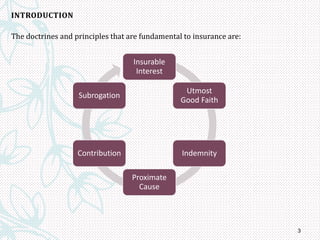
The doctrines and principles that are fundamental to insurance are:
Insurable
Interest
Utmost
Good Faith
Indemnity
Proximate
Cause
Contribution
Subrogation
4
INSURABLE INTEREST
A person who wishes to obtain insurance must have an insurable interest in the subject
matter to be insured. If there is no insurable interest, the contract is void and is
unenforceable. As a general rule, a person has insurable interest when he stands to
benefit by the existence or safety of the subject matter insured or he may be prejudiced
by its loss or damage thereto.
CASE LAW
Definition of insurable interest
CASE 5-1 Lucena –v- Craufurd 127 E.R. 630
In Lucena -v- Craufurd, Lawrence J. explained at p. 642:
“A man is interested in a thing to whom advantage may arise, or prejudice happen from the
circumstances which may attend to it… [I]nterest does not necessarily imply a right to the
whole, or part of the thing, nor necessarily or exclusively that which may be subject to provation,
but having some relationship to, or concern in the subject of the insurance, which relation or
concern by the happening of the perils insured against may be so affected as to produce a
damage, detriment or prejudice to the person insuring; and where a man is so circumstanced
with respect to matters exposed to certain risks or dangers, as to have a moral certainty of the
advantage or benefit… To be interested in the preservation of a thing, is to be so circumstanced
with respect to it as to have benefit from its existence, prejudice from its destruction.”
5
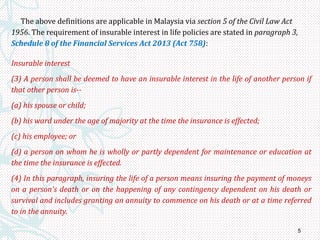
The above definitions are applicable in Malaysia via section 5 of the Civil Law Act
1956. The requirement of insurable interest in life policies are stated in paragraph 3,
Schedule 8 of the Financial Services Act 2013 (Act 758):
Insurable interest
(3) A person shall be deemed to have an insurable interest in the life of another person if
that other person is--
(a) his spouse or child;
(b) his ward under the age of majority at the time the insurance is effected;
(c) his employee; or
(d) a person on whom he is wholly or partly dependent for maintenance or education at
the time the insurance is effected.
(4) In this paragraph, insuring the life of a person means insuring the payment of moneys
on a person's death or on the happening of any contingency dependent on his death or
survival and includes granting an annuity to commence on his death or at a time referred
to in the annuity.
6
UTMOST GOOD FAITH
Section 17 of the Marine Insurance Act 1906 states:
Insurance is uberrimae fidei
A contract of marine insurance is a contract based upon utmost good faith, and if the
utmost good faith be not observed by either party, the contract may be avoided by the
other party.
INDEMNITY
The principle of indemnity in insurance law ensures that an insured who has
suffered or incurred loss, damage or liability as a result of the insured peril
happening is fully indemnified or compensated for such loss, damage or liability.
CASE LAW
Principle of indemnity
CASE 5-3 Castellian –v- Preston [1883] 11 Q.B.D. 380
In the case of Castellian –v- Preston, Brett LJ in affirming at p.386 that a marine or fire policy is a contract
of indemnity, reiterated that a contract of indemnity means that the assured shall be fully indemnified,
but shall never be more than fully indemnified in case of a loss against which the policy has been made.
That is the fundamental principle of insurance.
PROXIMATE CAUSE
An insurer is only liable to pay the claim under the policy if the loss was
proximately caused by the risk insured
Disputes on insurance claims before the court are dealt with by firstly ascertaining
the precise scope of the policy.
Secondly, the court will determine whether the loss is caused proximately by the
risk insured based on the facts of the case.
7
CASE LAW
Insured risks – loss of goods
CASE 5-4 Moore –v- Evans [1918] A.C. 185
In the English case of Moore –v- Evans, the plaintiffs, a firm of jewellers insured their stock against the risk of
‘loss and/or damage or misfortune… arising from any cause whatsoever’. Loss by theft or dishonesty was
excluded. A consignment of pearls sent to Belgium and Germany could not be returned to the insured due to the
outbreak of war between Britain and Germany in 1914. The goods in Germany remained in the hands of the
consignees whilst the goods in Belgium were placed in a bank, with the consent of the insured. The insured
made a claim for the loss of the jewellery.
The House of Lords decided that a policy insuring the loss of goods was primarily intended to cover the physical
loss of the goods. It did not cover economic loss or loss of business opportunity. It was held by Lord Atkinson at
p.191 that the detention of the goods abroad may be a misfortune to the plaintiff but it did not constitute loss or
damage to the property.
8
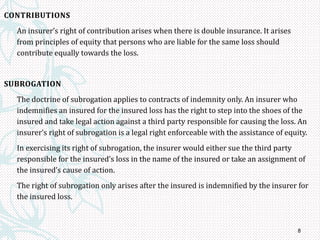
CONTRIBUTIONS
An insurer’s right of contribution arises when there is double insurance. It arises
from principles of equity that persons who are liable for the same loss should
contribute equally towards the loss.
SUBROGATION
The doctrine of subrogation applies to contracts of indemnity only. An insurer who
indemnifies an insured for the insured loss has the right to step into the shoes of the
insured and take legal action against a third party responsible for causing the loss. An
insurer’s right of subrogation is a legal right enforceable with the assistance of equity.
In exercising its right of subrogation, the insurer would either sue the third party
responsible for the insured’s loss in the name of the insured or take an assignment of
the insured’s cause of action.
The right of subrogation only arises after the insured is indemnified by the insurer for
the insured loss.
Chapter 5 Principles of Basic Insurance.ppt

Chapter 5 Principles of Basic Insurance.ppt

  • 1.
  • 2.
  • 3.
    3 INTRODUCTION The doctrines andprinciples that are fundamental to insurance are: Insurable Interest Utmost Good Faith Indemnity Proximate Cause Contribution Subrogation
  • 4.
    4 INSURABLE INTEREST A personwho wishes to obtain insurance must have an insurable interest in the subject matter to be insured. If there is no insurable interest, the contract is void and is unenforceable. As a general rule, a person has insurable interest when he stands to benefit by the existence or safety of the subject matter insured or he may be prejudiced by its loss or damage thereto. CASE LAW Definition of insurable interest CASE 5-1 Lucena –v- Craufurd 127 E.R. 630 In Lucena -v- Craufurd, Lawrence J. explained at p. 642: “A man is interested in a thing to whom advantage may arise, or prejudice happen from the circumstances which may attend to it… [I]nterest does not necessarily imply a right to the whole, or part of the thing, nor necessarily or exclusively that which may be subject to provation, but having some relationship to, or concern in the subject of the insurance, which relation or concern by the happening of the perils insured against may be so affected as to produce a damage, detriment or prejudice to the person insuring; and where a man is so circumstanced with respect to matters exposed to certain risks or dangers, as to have a moral certainty of the advantage or benefit… To be interested in the preservation of a thing, is to be so circumstanced with respect to it as to have benefit from its existence, prejudice from its destruction.”
  • 5.
    5 The above definitionsare applicable in Malaysia via section 5 of the Civil Law Act 1956. The requirement of insurable interest in life policies are stated in paragraph 3, Schedule 8 of the Financial Services Act 2013 (Act 758): Insurable interest (3) A person shall be deemed to have an insurable interest in the life of another person if that other person is-- (a) his spouse or child; (b) his ward under the age of majority at the time the insurance is effected; (c) his employee; or (d) a person on whom he is wholly or partly dependent for maintenance or education at the time the insurance is effected. (4) In this paragraph, insuring the life of a person means insuring the payment of moneys on a person's death or on the happening of any contingency dependent on his death or survival and includes granting an annuity to commence on his death or at a time referred to in the annuity.
  • 6.
    6 UTMOST GOOD FAITH Section17 of the Marine Insurance Act 1906 states: Insurance is uberrimae fidei A contract of marine insurance is a contract based upon utmost good faith, and if the utmost good faith be not observed by either party, the contract may be avoided by the other party. INDEMNITY The principle of indemnity in insurance law ensures that an insured who has suffered or incurred loss, damage or liability as a result of the insured peril happening is fully indemnified or compensated for such loss, damage or liability. CASE LAW Principle of indemnity CASE 5-3 Castellian –v- Preston [1883] 11 Q.B.D. 380 In the case of Castellian –v- Preston, Brett LJ in affirming at p.386 that a marine or fire policy is a contract of indemnity, reiterated that a contract of indemnity means that the assured shall be fully indemnified, but shall never be more than fully indemnified in case of a loss against which the policy has been made. That is the fundamental principle of insurance.
  • 7.
    PROXIMATE CAUSE An insureris only liable to pay the claim under the policy if the loss was proximately caused by the risk insured Disputes on insurance claims before the court are dealt with by firstly ascertaining the precise scope of the policy. Secondly, the court will determine whether the loss is caused proximately by the risk insured based on the facts of the case. 7 CASE LAW Insured risks – loss of goods CASE 5-4 Moore –v- Evans [1918] A.C. 185 In the English case of Moore –v- Evans, the plaintiffs, a firm of jewellers insured their stock against the risk of ‘loss and/or damage or misfortune… arising from any cause whatsoever’. Loss by theft or dishonesty was excluded. A consignment of pearls sent to Belgium and Germany could not be returned to the insured due to the outbreak of war between Britain and Germany in 1914. The goods in Germany remained in the hands of the consignees whilst the goods in Belgium were placed in a bank, with the consent of the insured. The insured made a claim for the loss of the jewellery. The House of Lords decided that a policy insuring the loss of goods was primarily intended to cover the physical loss of the goods. It did not cover economic loss or loss of business opportunity. It was held by Lord Atkinson at p.191 that the detention of the goods abroad may be a misfortune to the plaintiff but it did not constitute loss or damage to the property.
  • 8.
    8 CONTRIBUTIONS An insurer’s rightof contribution arises when there is double insurance. It arises from principles of equity that persons who are liable for the same loss should contribute equally towards the loss. SUBROGATION The doctrine of subrogation applies to contracts of indemnity only. An insurer who indemnifies an insured for the insured loss has the right to step into the shoes of the insured and take legal action against a third party responsible for causing the loss. An insurer’s right of subrogation is a legal right enforceable with the assistance of equity. In exercising its right of subrogation, the insurer would either sue the third party responsible for the insured’s loss in the name of the insured or take an assignment of the insured’s cause of action. The right of subrogation only arises after the insured is indemnified by the insurer for the insured loss.