INSURANCE
BY- DHRUV ARORA
WHAT IS INSURANCE?
INSURANCE is a practice or arrangement by which company
or government agency provides a guarantee of compensation
for specified loss, damage, illness or death in return for a
payment of a premium.
A contract in which an individual or entity receives financial
protection or reimbursement against losses from an
company.
KEY TERMS
 Insured or assurance underwriter
 Insurer
 Policy
 Premium
 Sumassured
IMPORTANCE OF INSURANCE
 Provides protection against occurrence of
uncertain events.
 Co-operative method of spreading risks.
 Facilitates international trade.
 Serves as an agency of capital formation.
 Financial support.
 Medical support.
 Source of employment.
FUNCTIONS OF
INSURANCE
Various functions of insurance are as follows-
 Providing certainty
 Protection
 Assist in capital formation
 Risk sharing
1. PROVIDING CERTAINTY
 Insurance provides certainty of payment for the risk of loss.
There are uncertainties of happenings of time and amount of
loss. Insurance removes these uncertainties and the assured
receives payment of loss. The insurer charges premium for
providing the certainty.
2. PROTECTION
 The second main function of insurance is to provide
protection from probable chances of loss. Insurance
cannot stop the happening of a risk or event but can
compensate for losses arising out of it.
3. RISK SHARING
 On the happening of a risk event, the loss is shared by
all the persons exposed to it. The share is obtained
from every insured member by way of premiums.
4. Assist in capital
formation
 The accumulated funds of the insurer received by way of
premium payments made by the insured are invested in
various income generating schemes.
PRINCIPLE OF
INSURANCE
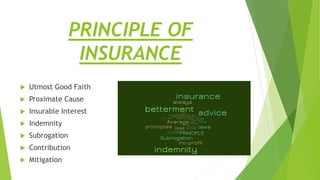
 Utmost Good Faith
 Proximate Cause
 Insurable Interest
 Indemnity
 Subrogation
 Contribution
 Mitigation
1. Utmost Good Faith
 The very basic principle is that both the parties in an insurance
contract should act in good faith towards each other i.e. they
must provide clear and concise information related to the terms
and conditions of the contract.
 The Insured should provide all the information related to the
subject matter and the insurer must give clear details regarding
the contract.
2. Proximate Cause
 This principle applies when the loss is the result of two or
more causes. The insurance company will find the nearest
cause of loss to the property. If the proximate cause is the
one in which the property is insured, then the company
must pay compensation. If it is not a cause the property is
insured against, then no payment will be made by the
insured.
3. Insurable Interest
 This principle says that the individual (insured) must have an
insurable interest in the subject matter. Insurable interest
means that the subject matter for which the individual enters
the insurance contract must provide some financial gain to the
insured and also lead to a financial loss if there is any damage,
destruction or loss.
4. Indemnity
 This principle says that insurance is done only for the coverage of
the loss hence insured should not make any profit from the
insurance contract. In other words, the insured should be
compensated the amount equal to the actual loss and not the
amount exceeding the loss. The purpose of the indemnity principle
is to set back the insured at the same financial position as he was
before the loss occurred. Principle of indemnity is observed
strictly for property insurance and not applicable for the life
insurance contract.
5. Subrogation
 Subrogation means one party stands in for another. As per this
principle, After the insured i.e. the individual has been
compensated for the incurred loss to him on the subject matter
that was insured, the rights of the ownership of that property goes
to the insurer i.e. the company.
 Subrogation gives the right to the insurance company to claim the
amount of loss from the third-party responsible for the same.
6. Contribution
 Contribution principle applies when the insured takes more
than one insurance policy for the same subject matter. It
states the same thing as in the principle of indemnity i.e.
the insured cannot make a profit by claiming the loss of one
subject matter from different policies or companies
7. Mitigation
 This principle says that as an owner, it is obligatory on part of the
insurer to take necessary steps to minimize the loss to the insured
property. The principle does not allow the owner to be
irresponsible or negligent just because the subject matter is
insured.
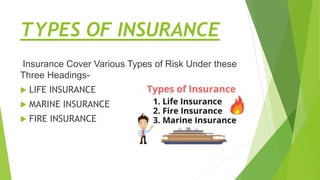
TYPES OF INSURANCE
Insurance Cover Various Types of Risk Under these
Three Headings-
 LIFE INSURANCE
 MARINE INSURANCE
 FIRE INSURANCE
1. LIFE INSURANCE
 We can define Life Insurance
as a contract in which insured
person pays regular premium
to the insurer i.e. insurance
co. and on the death of
insured or at the maturity
period, the insurance
companies pay the
compensation or the matured
sum respectively.
MAIN ELEMENTS OF A LIFE
INSURANCE CONTRACT
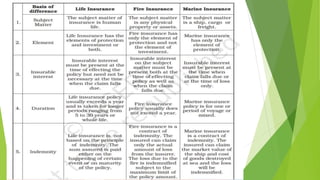
 The life insurance contract must have all the essentials of a valid
contract. Certain elements like offer and acceptance, free
consent, capacity to enter into a contract, lawful consideration
and lawful object must be present for the contract to be valid.
 The contract of life insurance is a contract of utmost good
faith. The assured should be honest and truthful in giving

information to the insurance company. He must disclose all
material facts about his health to the insurer. It is his duty to
disclose accurately all material facts known to him even if the
insurer does not ask him.
 In life insurance, the insured must have insurable interest in
the life assured. Without insurable interest the contract of
insurance is void. In case of life insurance, insurable interest
must be present at the time when the insurance is affected.
It is not necessary that the assured should have insurable
interest at the time of maturity also.
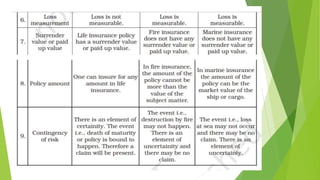
 Life insurance contract is not a contract of indemnity. The
life of a human being cannot be compensated and only a
specified sum of money is paid. That is why the amount
payable in life insurance on the happening of the event is
fixed in advance.
TYPES OF LIFE INSURANCE
POLICIES
 Whole life policy
 Endowment life assurance policy
 Joint life policy
 Annuity policy
 Children’s endowment policy
2. FIRE INSURANCE
 An insurance against damage created
from the fire is called fire insurance.
Such insurance compensate the damage
of house, machine, equipments, goods,
things and other immovable properties of
the insured from the risk of the fire.
 A claim for loss by fire must satisfy the
two following conditions:
(i) There must be actual loss
(ii) Fire must be accidental and
Non-intentional
MAIN ELEMENTS OF A FIRE
INSURANCE CONTRACT
 In fire insurance, the insured must have insurable interest in
the subject matter of the insurance. Without insurable interest
the contract of insurance is void. In case of fire insurance,
unlike life insurance insurable interest must be present both at
the time of insurance and at the time of loss.
 Similar to the life insurance contract, the contract of fire
insurance is a contract of utmost good faith. The insured should
be truthful and honest in giving information to the insurance
company regarding the subject matter of the insurance.
 The contract of fire insurance is a contract of strict
indemnity. The insured can, in the event of loss, recover
the actual amount of loss from the insurer. This is subject
to the maximum amount for which the subject matter is
insured.
 The insurer is liable to compensate only when fire is the
proximate cause of damage or loss.
3. MARINE INSURANCE
 This insurance is done by business
house for safety delivery of goods
while transporting goods from
one place to another by sea way,
land way or air way accident may
occur in transit period causing
loss or damage to goods or
vehicle. To recover such loss
marine insurance is done.
MAIN ELEMENTS OF A MARINE
INSURANCE CONTRACT
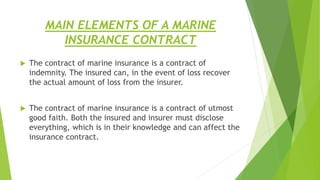
 The contract of marine insurance is a contract of
indemnity. The insured can, in the event of loss recover
the actual amount of loss from the insurer.
 The contract of marine insurance is a contract of utmost
good faith. Both the insured and insurer must disclose
everything, which is in their knowledge and can affect the
insurance contract.
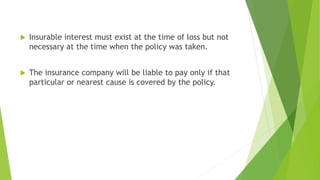
 Insurable interest must exist at the time of loss but not
necessary at the time when the policy was taken.
 The insurance company will be liable to pay only if that
particular or nearest cause is covered by the policy.
There are three things involved i.e.,
ship or hull, cargo or goods, and freight
 Ship or hull insurance
 Cargo insurance
 Freight insurance
REGULATORY MECHANISM
 The insurance regulatory and the
development authority is related to the
government of India which is been
undertaken by the national agency. It is
based on the Hyderabad and it was
formed from an act of IRDA by Indian
parliament. It is one of the successful
regulatory mechanisms so far by the
"government of India". It has all the
superior power in its control as it is
formed by the parliament of India.
The functions of IRDA includes:
 To protect the interest of and secure fair treatment to
policyholders.
 To bring about speedy and orderly growth of the insurance
industry for the benefit of the common man, and to
provide long term funds for accelerating growth of the
economy.
 To set, promote, monitor and enforce high standards of
integrity, financial soundness, fair dealing and
competence of those it regulates.
 To ensure speedy settlement of genuine claims, to prevent
insurance frauds and other malpractices and put in place
effective grievance redressal machinery.
 To promote fairness, transparency and orderly conduct in financial markets
dealing with insurance and build a reliable management information system
to enforce high standards of financial soundness amongst market players.
 To take action where such standards are inadequate or ineffectively
enforced.
 To bring about optimum amount of self-regulation in day-to-day working of
the industry consistent with the requirements of prudential regulation.
 To register the companies who runs the insurance business.
History Of Insurance In India
 Insurance in India began in the year 1870. The first policy issued was
in 1870 by 'The European & The Albert’.
 The first Indian insurance company was 'Bombay Mutual Assurance
Society Ltd.' formed in 1870.
 As the ‘Swadeshi' movement was catching up many more Indian
companies were formed.
 The insurance companies were nationalized in 1956.
 There were 170 insurance companies and 75 provident fund securities
which got merged and on 1st of Sept 1956 Life Insurance Corporation
of India was born.
 In 1993, the Malhotra Committee, headed by the former RBI Governor
R. N. Malhotra was appointed. This committee submitted the report a
year later and recommended 'privatization'.
 The Insurance Regulatory and Development Authority (IRDA) thus
came in being and it now regulates all insurance business in India.
 Currently there are 23 players in India.
Insurance