MULTI-SENSORY
APPROACH
Submitted By,
Jishna J.M.
I yr B.Ed
English
 “The effective use of various senses for receiving
information from various sources is known as multi-
sensory approach”.
 As a literal definition, multi-sensory, comes from two
pieces off words . The two words are “multi” and
“sensory”. “Multi” means “more than one.” “sensory”
“involves or is delivered from the senses”.
 Margaret Taylor Smith developed Multi-sensory
Teaching Approach(MTA) in the mid 80’s as a refined
and more “teacher friendly” curriculum that enhances
and further develops Alphabetic phonics by teaching
for mastery.
 Use a multi-sensory teaching technique means helping a child
to learn through more than one sense.
VAKT
 A multi sensory approach , “also known as VAKT (visual
auditory-kinestheitc & tactile).
 Visual
- seeing and perceiving through their eyes
 Auditory
- hearing and speaking through their ears
 Kinesthetic
- movement, and doing through body movements
 Tactile
- through touch
Visual Learner
They learn by seeing words in
printed form or by using graphics
and pictures, observing real life,
and other visual aids.
Auditory Learner
 They learn reading by listening
to someone present information
orally and by being allowed to
discuss and ask questions
Tactile Learners
 Tactile learners learn through
their sense of touch, such as using
their writing, drawing, hand on
manipulative.
Kinesthetic Learners
Kinesthetic learners learn
best through movement of
their small or gross motor
muscles. They take
information best while
moving and doing, being
Dales cone of experience
 In 1946, Edger Dale introduced the cone of
experience
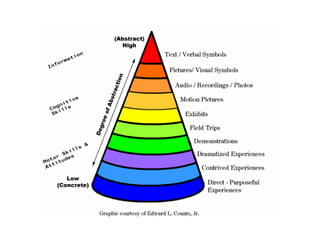
 The cone of experience is a pictorial device use to
explain the interrelationship of the various types of
audio-visual media , as well as their individual
“positions” in the learning process.
 The cones utility in selecting instructional resources
and activities is as practical today as when Dale
created it.
Verbal Symbols
 Principle medium of communication
 Bear on physical resemblance to the objects or ideas
for which they stand
May be a word for concretion, idea, scientific
principle and formula
Disadvantages; highly abstract
Visual symbols
 Chalkboard/whiteboard, flat maps, diagams, charts
 Fits the tempo of presentation of idea, topic or
situation
Very easy to procure and prepare
 Limitations: ;lack of ability to use the media size of
individuals simplification of visual materials leads of
misconceptions
Recordings, Radio, Still Pictures
 Attention- getting, particularly projected views
Concretize verbal abstraction
Limitations: size of pictures or illustrations
expensiveness of projected materials and equipment
timing difficulties between radio shows and
classroom lessons
Television And Motion Pictures
 A solution to time and space constraints
 Provides “windows to the world”
 Effective for presenting movements, continuity of
ideas or events
 Substitute for dangerous direct learning experiences
limitations:
• Expensive
• Viewing problem
• Timing with classroom lessons
• Misconceptions about time, size ideas
Exhibits
 Present objects or processes otherwise impossible
inside the classroom
Exposure to new ideas, discoveries, inventions
Problem that may be encountered:
Too little space
Time-consuming
Maintenance
Demonstration
 Visualized explanation of an important fact or idea or
process
 May require nothing more than observation or
students may be asked to do what has just been
shown how to do
 Disadvantages: ideas or processes might not be
interpreted or conceived very well visibility to all
learners
Field Trip
 Undertake primarily for the purpose of experiencing
something that cannot be uncounted within the
classroom
 A rich experience in learning about objects, systems,
and situations
Disadvantages: time-consuming expensive high
exposure to danger/accidents inadequacy of the
community’s resources
Dramatized Experiences
 Help get closer to certain realities that are no longer
available at first hand
 Stirring and attention getting
 Participant learns to understand intimately the
character hw portrays
 Teachers cooperative work
 Disadvantages: time consuming without
commensurate result participation to few individuals
Contrived Experiences
 An “editing” of reality
 Substitutes for confusing or unmanageable first-hand
experiences
 Easier to handle, manipulate or operate
 Disadvantages : simplification leads to
misconceptions, distorted views, and incomplete
pictures of reality no freedom to handle expensive or
fragile models, mock-up, specimens etc.
Direct, Purposeful Experiences
 Unabridged version of life its self
 Direct participation with responsibility
 The basis for the most effective and lasting learning
 Disadvantages: no all things can be learned through
direct, first hand experiencing

Multi Sensory Approach

  • 1.
  • 2.
     “The effectiveuse of various senses for receiving information from various sources is known as multi- sensory approach”.  As a literal definition, multi-sensory, comes from two pieces off words . The two words are “multi” and “sensory”. “Multi” means “more than one.” “sensory” “involves or is delivered from the senses”.
  • 3.
     Margaret TaylorSmith developed Multi-sensory Teaching Approach(MTA) in the mid 80’s as a refined and more “teacher friendly” curriculum that enhances and further develops Alphabetic phonics by teaching for mastery.  Use a multi-sensory teaching technique means helping a child to learn through more than one sense.
  • 4.
    VAKT  A multisensory approach , “also known as VAKT (visual auditory-kinestheitc & tactile).  Visual - seeing and perceiving through their eyes  Auditory - hearing and speaking through their ears  Kinesthetic - movement, and doing through body movements  Tactile - through touch
  • 5.
    Visual Learner They learnby seeing words in printed form or by using graphics and pictures, observing real life, and other visual aids.
  • 6.
    Auditory Learner  Theylearn reading by listening to someone present information orally and by being allowed to discuss and ask questions
  • 7.
    Tactile Learners  Tactilelearners learn through their sense of touch, such as using their writing, drawing, hand on manipulative.
  • 8.
    Kinesthetic Learners Kinesthetic learnerslearn best through movement of their small or gross motor muscles. They take information best while moving and doing, being
  • 9.
    Dales cone ofexperience  In 1946, Edger Dale introduced the cone of experience  The cone of experience is a pictorial device use to explain the interrelationship of the various types of audio-visual media , as well as their individual “positions” in the learning process.  The cones utility in selecting instructional resources and activities is as practical today as when Dale created it.
  • 11.
    Verbal Symbols  Principlemedium of communication  Bear on physical resemblance to the objects or ideas for which they stand May be a word for concretion, idea, scientific principle and formula Disadvantages; highly abstract
  • 12.
    Visual symbols  Chalkboard/whiteboard,flat maps, diagams, charts  Fits the tempo of presentation of idea, topic or situation Very easy to procure and prepare  Limitations: ;lack of ability to use the media size of individuals simplification of visual materials leads of misconceptions
  • 13.
    Recordings, Radio, StillPictures  Attention- getting, particularly projected views Concretize verbal abstraction Limitations: size of pictures or illustrations expensiveness of projected materials and equipment timing difficulties between radio shows and classroom lessons
  • 14.
    Television And MotionPictures  A solution to time and space constraints  Provides “windows to the world”  Effective for presenting movements, continuity of ideas or events  Substitute for dangerous direct learning experiences limitations: • Expensive • Viewing problem • Timing with classroom lessons • Misconceptions about time, size ideas
  • 15.
    Exhibits  Present objectsor processes otherwise impossible inside the classroom Exposure to new ideas, discoveries, inventions Problem that may be encountered: Too little space Time-consuming Maintenance
  • 16.
    Demonstration  Visualized explanationof an important fact or idea or process  May require nothing more than observation or students may be asked to do what has just been shown how to do  Disadvantages: ideas or processes might not be interpreted or conceived very well visibility to all learners
  • 17.
    Field Trip  Undertakeprimarily for the purpose of experiencing something that cannot be uncounted within the classroom  A rich experience in learning about objects, systems, and situations Disadvantages: time-consuming expensive high exposure to danger/accidents inadequacy of the community’s resources
  • 18.
    Dramatized Experiences  Helpget closer to certain realities that are no longer available at first hand  Stirring and attention getting  Participant learns to understand intimately the character hw portrays  Teachers cooperative work  Disadvantages: time consuming without commensurate result participation to few individuals
  • 19.
    Contrived Experiences  An“editing” of reality  Substitutes for confusing or unmanageable first-hand experiences  Easier to handle, manipulate or operate  Disadvantages : simplification leads to misconceptions, distorted views, and incomplete pictures of reality no freedom to handle expensive or fragile models, mock-up, specimens etc.
  • 20.
    Direct, Purposeful Experiences Unabridged version of life its self  Direct participation with responsibility  The basis for the most effective and lasting learning  Disadvantages: no all things can be learned through direct, first hand experiencing