Process Scheduling
Mrs.G.Chandraprabha,M.Sc.,M.Phil.,
Assistant Professor
Department of Information Technology
V.V.Vanniaperumal College for Women
Virudhunagar
Process Scheduling
Definition
• The process scheduling is the activity of the process manager that
handles the removal of the running process from the CPU and the
selection of another process on the basis of a particular strategy.
• Process scheduling is an essential part of a Multiprogramming
operating systems. Such operating systems allow more than one
process to be loaded into the executable memory at a time and the
loaded process shares the CPU using time multiplexing.
Process Scheduling Queues
 The OS maintains all PCBs in Process Scheduling Queues.
 The OS maintains a separate queue for each of the process
states and PCBs of all processes in the same execution state
are placed in the same queue.
 When the state of a process is changed, its PCB is unlinked
from its current queue and moved to its new state queue.
Process Scheduling Queues
The Operating System maintains the following important
process scheduling queues −
Job queue − This queue keeps all the processes in the system.
Ready queue − This queue keeps a set of all processes
residing in main memory, ready and waiting to execute. A new
process is always put in this queue.
Device queues − The processes which are blocked due to
unavailability of an I/O device constitute this queue.
Process Scheduling Queues
The OS can use different policies to manage each queue
(FIFO, Round Robin, Priority, etc.).
The OS scheduler determines how to move processes
between the ready and run queues which can only have one
entry per processor core on the system; in the above diagram,
it has been merged with the CPU.
Schedulers
Schedulers are special system software which handle process
scheduling in various ways.
Their main task is to select the jobs to be submitted into the
system and to decide which process to run.
Schedulers are of three types −
1. Long-Term Scheduler
2. Short-Term Scheduler
3. Medium-Term Scheduler
Long Term Scheduler
It is also called a job scheduler. A long-term scheduler
determines which programs are admitted to the system for
processing.
It selects processes from the queue and loads them into
memory for execution. Process loads into the memory for CPU
scheduling.
The primary objective of the job scheduler is to provide a
balanced mix of jobs, such as I/O bound and processor bound.
It also controls the degree of multiprogramming.
Long Term Scheduler
If the degree of multiprogramming is stable, then the
average rate of process creation must be equal to the average
departure rate of processes leaving the system.
On some systems, the long-term scheduler may not be
available or minimal.
Time-sharing operating systems have no long term
scheduler. When a process changes the state from new to
ready, then there is use of long-term scheduler.
Short Term Scheduler
It is also called as CPU scheduler.
Its main objective is to increase system performance in
accordance with the chosen set of criteria.
It is the change of ready state to running state of the process.
CPU scheduler selects a process among the processes that are
ready to execute and allocates CPU to one of them.
Short-term schedulers, also known as dispatchers, make the
decision of which process to execute next. Short-term schedulers
are faster than long-term schedulers.
Medium Term Scheduler
Medium-term scheduling is a part of swapping. It removes the
processes from the memory.
It reduces the degree of multiprogramming. The medium-term
scheduler is in-charge of handling the swapped out-processes.
A running process may become suspended if it makes an I/O
request.
A suspended processes cannot make any progress towards
completion. In this condition, to remove the process from
memory and make space for other processes, the suspended
process is moved to the secondary storage.
This process is called swapping, and the process is said to be
swapped out or rolled out. Swapping may be necessary to
improve the process mix.
Comparison among Scheduler
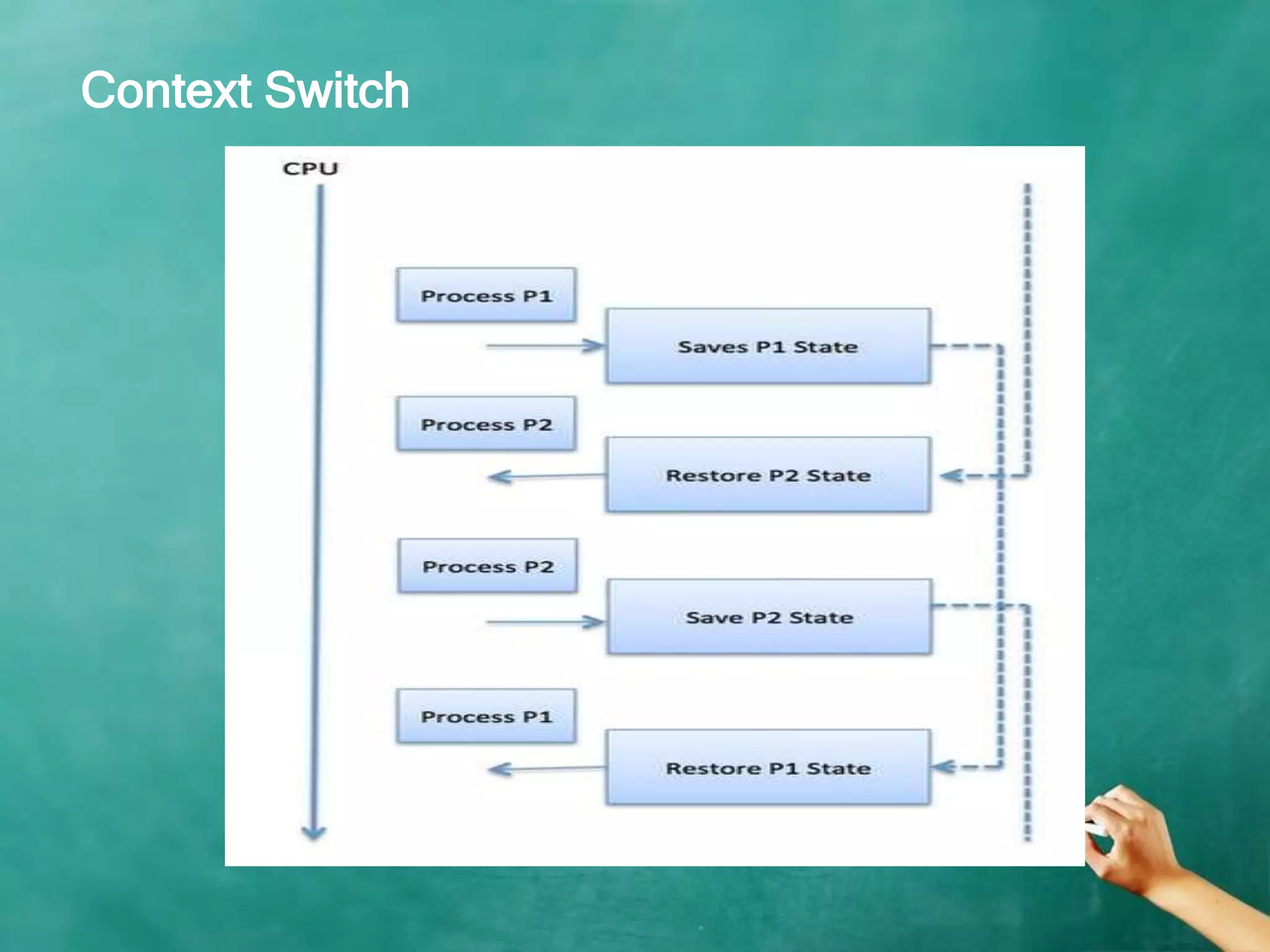
Context Switch
A context switch is the mechanism to store and restore the
state or context of a CPU in Process Control block so that a
process execution can be resumed from the same point at a
later time.
Using this technique, a context switcher enables multiple
processes to share a single CPU. Context switching is an
essential part of a multitasking operating system features.
Context Switch
When the scheduler switches the CPU from executing one
process to execute another, the state from the current running
process is stored into the process control block.
After this, the state for the process to run next is loaded from
its own PCB and used to set the PC, registers, etc. At that point,
the second process can start executing.
Context Switch
Context Switch
Context switches are computationally intensive since register
and memory state must be saved and restored. To avoid the
amount of context switching time, some hardware systems
employ two or more sets of processor registers.
When the process is switched, the following information is
stored for later use.
Program Counter
Scheduling information
Base and limit register value
Currently used register
Changed State
I/O State information
Accounting information

Process scheduling

  • 1.
    Process Scheduling Mrs.G.Chandraprabha,M.Sc.,M.Phil., Assistant Professor Departmentof Information Technology V.V.Vanniaperumal College for Women Virudhunagar
  • 2.
    Process Scheduling Definition • Theprocess scheduling is the activity of the process manager that handles the removal of the running process from the CPU and the selection of another process on the basis of a particular strategy. • Process scheduling is an essential part of a Multiprogramming operating systems. Such operating systems allow more than one process to be loaded into the executable memory at a time and the loaded process shares the CPU using time multiplexing.
  • 3.
    Process Scheduling Queues The OS maintains all PCBs in Process Scheduling Queues.  The OS maintains a separate queue for each of the process states and PCBs of all processes in the same execution state are placed in the same queue.  When the state of a process is changed, its PCB is unlinked from its current queue and moved to its new state queue.
  • 4.
    Process Scheduling Queues TheOperating System maintains the following important process scheduling queues − Job queue − This queue keeps all the processes in the system. Ready queue − This queue keeps a set of all processes residing in main memory, ready and waiting to execute. A new process is always put in this queue. Device queues − The processes which are blocked due to unavailability of an I/O device constitute this queue.
  • 5.
  • 6.
    Process Scheduling Queues TheOS can use different policies to manage each queue (FIFO, Round Robin, Priority, etc.). The OS scheduler determines how to move processes between the ready and run queues which can only have one entry per processor core on the system; in the above diagram, it has been merged with the CPU.
  • 7.
    Schedulers Schedulers are specialsystem software which handle process scheduling in various ways. Their main task is to select the jobs to be submitted into the system and to decide which process to run. Schedulers are of three types − 1. Long-Term Scheduler 2. Short-Term Scheduler 3. Medium-Term Scheduler
  • 8.
    Long Term Scheduler Itis also called a job scheduler. A long-term scheduler determines which programs are admitted to the system for processing. It selects processes from the queue and loads them into memory for execution. Process loads into the memory for CPU scheduling. The primary objective of the job scheduler is to provide a balanced mix of jobs, such as I/O bound and processor bound. It also controls the degree of multiprogramming.
  • 9.
    Long Term Scheduler Ifthe degree of multiprogramming is stable, then the average rate of process creation must be equal to the average departure rate of processes leaving the system. On some systems, the long-term scheduler may not be available or minimal. Time-sharing operating systems have no long term scheduler. When a process changes the state from new to ready, then there is use of long-term scheduler.
  • 10.
    Short Term Scheduler Itis also called as CPU scheduler. Its main objective is to increase system performance in accordance with the chosen set of criteria. It is the change of ready state to running state of the process. CPU scheduler selects a process among the processes that are ready to execute and allocates CPU to one of them. Short-term schedulers, also known as dispatchers, make the decision of which process to execute next. Short-term schedulers are faster than long-term schedulers.
  • 11.
    Medium Term Scheduler Medium-termscheduling is a part of swapping. It removes the processes from the memory. It reduces the degree of multiprogramming. The medium-term scheduler is in-charge of handling the swapped out-processes. A running process may become suspended if it makes an I/O request. A suspended processes cannot make any progress towards completion. In this condition, to remove the process from memory and make space for other processes, the suspended process is moved to the secondary storage. This process is called swapping, and the process is said to be swapped out or rolled out. Swapping may be necessary to improve the process mix.
  • 12.
  • 13.
    Context Switch A contextswitch is the mechanism to store and restore the state or context of a CPU in Process Control block so that a process execution can be resumed from the same point at a later time. Using this technique, a context switcher enables multiple processes to share a single CPU. Context switching is an essential part of a multitasking operating system features.
  • 14.
    Context Switch When thescheduler switches the CPU from executing one process to execute another, the state from the current running process is stored into the process control block. After this, the state for the process to run next is loaded from its own PCB and used to set the PC, registers, etc. At that point, the second process can start executing.
  • 15.
  • 16.
    Context Switch Context switchesare computationally intensive since register and memory state must be saved and restored. To avoid the amount of context switching time, some hardware systems employ two or more sets of processor registers. When the process is switched, the following information is stored for later use. Program Counter Scheduling information Base and limit register value Currently used register Changed State I/O State information Accounting information