

Instant Messaging
Pankaj Gamit (120423116003)
Prepared By:
Pankaj Gamit
4rd
year I.T
Enrollment No.120423116003
Guided By:
Prof. Hiren Vavaiya
SARVAJANIK COLLEGE OF ENGINEERING & TECHNOLOGY
Dr. R. K. Desai Road, Athwalines, Surat – 395 001,
Gujarat, India
INFORMATION TECHNOLOGY
DEPARTMENT
What is Instant Messaging?
 Today, Instant Message is widely applied. By this
kind of software, people who log online can get
response in a short time after sending message which
is a way to real-time communication and chatting.
 For most people, it is cheaper than chatting by
telephone; furthermore, the newest IM software
integrated data transmission, voice chatting, video
conference, e-mail and so on. Some analysts call IM
as “real-time e-mail.” For enterprises, IM exploits
new area for web-services.
Pankaj Gamit (120423116003)
History about IM
 Instant messaging predates the Internet, first
appearing on multi-user operating systems
like Compatible Time-Sharing System
(CTSS) and Multiplexed Information and
Computing Service (Multics) in the mid-
1960s. Initially, some of these systems were
used as notification systems for services like
printing, but quickly were used to facilitate
communication with other users logged in to
the same machine.
Pankaj Gamit (120423116003)
 Instant messaging first began to become popular in
the mid 90’s following its predecessors IRC’s
(internet relay chat) and MUD’s (Multi User
Dungeons) footsteps. IRC is an older program,
which is still in use today, which is “a small
program that allowed users to communicate on
hundreds of servers dedicated to just about every
topic imaginable” Similarly, MUD’s is a interactive
role playing chat program that allows people to
communicate with each other in an interactive
virtual community.
Pankaj Gamit (120423116003)
INSTANT MESSAGING AND CLIENT-
SERVER COMMUNICATIONS
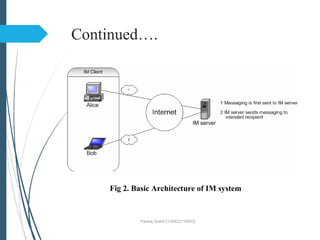
 All IM systems employee the same basic
client-server architecture. Users install instant
messaging clients on their client machines—
desktop computers, wireless devices, or
PDAs, for example—and these clients
communicate with an IM server in the
messaging provider’s infrastructure to locate
other users and exchange messages.
Pankaj Gamit (120423116003)
INSTANT MESSAGING AND CLIENT-
SERVER COMMUNICATIONS
 INSTANT MESSAGING AND ENCRYPTION
 Instant messaging systems encrypt messages
as they travel from the client to the server and
back to the second client. This data is
potentially visible to eavesdroppers anywhere
along its Internet path or within the IM
provider’s network. Also, popular IM
systems do not encrypt peer-to-peer traffic.
Pankaj Gamit (120423116003)
Continued….
Pankaj Gamit (120423116003)
Fig 2. Basic Architecture of IM system
SECURING INSTANT MESSAGING IN
YOUR CORPORATION
 Instant messaging may soon become an
indispensable business tool; however, the
risks of using an unsecured IM platform in
corporations are high. This section explores
the security issues introduced with the use of
corporate instant messaging and offers best
practices that can help in deploying a secure
IM platform.
Pankaj Gamit (120423116003)
BASICS OF IM PROTOCOLS AND
FEATURES
 Most of the protocols for the major IM
networks are available on the Internet.
Software makers have released the protocols
or the protocols have been reverse-
engineered.
 Online user
 Presence
 availability/user mode
 contact/buddy list
Pankaj Gamit (120423116003)
 Block list
 allow list
 one-to-one chat
 group chat
 chat room
Pankaj Gamit (120423116003)
IM USAGE
 Much of the research into IM that is non-
work related has been based on its use by the
younger generation. This research has
focused on socialization, including social
presence and social interactions among users.
 In addition to socialization, network- related
uses of IM include event planning and
project collaboration.
Pankaj Gamit (120423116003)
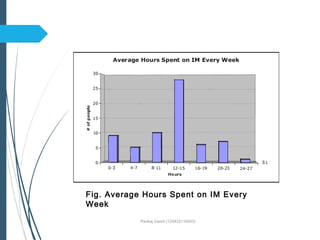
Fig. Average Hours Spent on IM Every
Week
Recommended instant messaging
client settings
 For the best security, do not use any
external IM system that does not employ a
certified Encryption system.
 Configure all IM clients so that they will
accept chat requests only from users
specified in Employees buddy lists. This
prevents attackers from connecting to
computers on the network and sending
malicious code. Only those users explicitly
specified by employees should be able to
contact them.
Pankaj Gamit (120423116003)
Continued…..
 Instant Messaging Provider
 AOL Instant Messenger, or AIM
 Yahoo Messenger
 MSN Messenger (Windows Live Messenger)
 Skype
 Meebo
 Facebook Chat
 iChat
 ICQ Pankaj Gamit (120423116003)
Advantages &
Disadvantages
 Advantages
 Easy to use
 Real Time Fast instant Response
 Contact/Buddy List
 Controlled access
 View availability Online
 Cheaper than Phonecalls
Pankaj Gamit (120423116003)
Continued…
 Disadvantages
 Security risks
 Message interception
 Virus via file transfer
 Privacy concerns
Pankaj Gamit (120423116003)
The Future of Instant Messaging
 The future of instant messaging is very
bright. All of the utilities described in this
article continue to be updated by their
owners, and IM providers continue to
collaborate on allowing more interfaces
between users of their services. Business
users can now have virtual conferences and
collaborate on projects very easily. If you
have not tried IM, you're missing out on a
whole new world of communication.
Pankaj Gamit (120423116003)

Instant messaging tech scet

  • 1.
    Instant Messaging Pankaj Gamit(120423116003) Prepared By: Pankaj Gamit 4rd year I.T Enrollment No.120423116003 Guided By: Prof. Hiren Vavaiya SARVAJANIK COLLEGE OF ENGINEERING & TECHNOLOGY Dr. R. K. Desai Road, Athwalines, Surat – 395 001, Gujarat, India INFORMATION TECHNOLOGY DEPARTMENT
  • 2.
    What is InstantMessaging?  Today, Instant Message is widely applied. By this kind of software, people who log online can get response in a short time after sending message which is a way to real-time communication and chatting.  For most people, it is cheaper than chatting by telephone; furthermore, the newest IM software integrated data transmission, voice chatting, video conference, e-mail and so on. Some analysts call IM as “real-time e-mail.” For enterprises, IM exploits new area for web-services. Pankaj Gamit (120423116003)
  • 3.
    History about IM Instant messaging predates the Internet, first appearing on multi-user operating systems like Compatible Time-Sharing System (CTSS) and Multiplexed Information and Computing Service (Multics) in the mid- 1960s. Initially, some of these systems were used as notification systems for services like printing, but quickly were used to facilitate communication with other users logged in to the same machine. Pankaj Gamit (120423116003)
  • 4.
     Instant messagingfirst began to become popular in the mid 90’s following its predecessors IRC’s (internet relay chat) and MUD’s (Multi User Dungeons) footsteps. IRC is an older program, which is still in use today, which is “a small program that allowed users to communicate on hundreds of servers dedicated to just about every topic imaginable” Similarly, MUD’s is a interactive role playing chat program that allows people to communicate with each other in an interactive virtual community. Pankaj Gamit (120423116003)
  • 5.
    INSTANT MESSAGING ANDCLIENT- SERVER COMMUNICATIONS  All IM systems employee the same basic client-server architecture. Users install instant messaging clients on their client machines— desktop computers, wireless devices, or PDAs, for example—and these clients communicate with an IM server in the messaging provider’s infrastructure to locate other users and exchange messages. Pankaj Gamit (120423116003)
  • 6.
    INSTANT MESSAGING ANDCLIENT- SERVER COMMUNICATIONS  INSTANT MESSAGING AND ENCRYPTION  Instant messaging systems encrypt messages as they travel from the client to the server and back to the second client. This data is potentially visible to eavesdroppers anywhere along its Internet path or within the IM provider’s network. Also, popular IM systems do not encrypt peer-to-peer traffic. Pankaj Gamit (120423116003)
  • 7.
    Continued…. Pankaj Gamit (120423116003) Fig2. Basic Architecture of IM system
  • 8.
    SECURING INSTANT MESSAGINGIN YOUR CORPORATION  Instant messaging may soon become an indispensable business tool; however, the risks of using an unsecured IM platform in corporations are high. This section explores the security issues introduced with the use of corporate instant messaging and offers best practices that can help in deploying a secure IM platform. Pankaj Gamit (120423116003)
  • 9.
    BASICS OF IMPROTOCOLS AND FEATURES  Most of the protocols for the major IM networks are available on the Internet. Software makers have released the protocols or the protocols have been reverse- engineered.  Online user  Presence  availability/user mode  contact/buddy list Pankaj Gamit (120423116003)
  • 10.
     Block list allow list  one-to-one chat  group chat  chat room Pankaj Gamit (120423116003)
  • 11.
    IM USAGE  Muchof the research into IM that is non- work related has been based on its use by the younger generation. This research has focused on socialization, including social presence and social interactions among users.  In addition to socialization, network- related uses of IM include event planning and project collaboration. Pankaj Gamit (120423116003)
  • 12.
    Pankaj Gamit (120423116003) Fig.Average Hours Spent on IM Every Week
  • 13.
    Recommended instant messaging clientsettings  For the best security, do not use any external IM system that does not employ a certified Encryption system.  Configure all IM clients so that they will accept chat requests only from users specified in Employees buddy lists. This prevents attackers from connecting to computers on the network and sending malicious code. Only those users explicitly specified by employees should be able to contact them. Pankaj Gamit (120423116003)
  • 14.
    Continued…..  Instant MessagingProvider  AOL Instant Messenger, or AIM  Yahoo Messenger  MSN Messenger (Windows Live Messenger)  Skype  Meebo  Facebook Chat  iChat  ICQ Pankaj Gamit (120423116003)
  • 15.
    Advantages & Disadvantages  Advantages Easy to use  Real Time Fast instant Response  Contact/Buddy List  Controlled access  View availability Online  Cheaper than Phonecalls Pankaj Gamit (120423116003)
  • 16.
    Continued…  Disadvantages  Securityrisks  Message interception  Virus via file transfer  Privacy concerns Pankaj Gamit (120423116003)
  • 17.
    The Future ofInstant Messaging  The future of instant messaging is very bright. All of the utilities described in this article continue to be updated by their owners, and IM providers continue to collaborate on allowing more interfaces between users of their services. Business users can now have virtual conferences and collaborate on projects very easily. If you have not tried IM, you're missing out on a whole new world of communication. Pankaj Gamit (120423116003)
  • 18.
  • 19.