Lesson 19-E-Commerce
Security Needs
Overview


Understand e-commerce services.

Understand the importance of availability.

Implement client-side security.

Implement server-side security.

Implement application security.

Implement database server security.

Develop an e-commerce architecture.
Understand E-Commerce
        Services

Organizations perform e-commerce to make profit by

providing goods and services at a lower cost.

Providing electronic library functions for sensitive or

confidential information has come with the advent of e-

commerce over the Internet.
Understand E-Commerce
        Services


E-commerce service is most commonly thought of as the

purchasing of goods.

Security to e-commerce services can be measured by its

confidentiality, integrity, and accountability.
Understand E-Commerce
        Services


E-Commerce Services and regular DMZ Services differ in

their requirements.

Requirement of verification and confidentiality differentiate

the e-commerce services from regular DMZ services.

Availability becomes a critical security issue for the e-

commerce site.
Understand E-Commerce
        Services


E-commerce services may involve selling goods, providing

confidential information, or distribution of information.

Security to e-commerce services can be measured in terms

of confidentiality, integrity, and accountability.
Understand the Importance of
        Availability


Availability is the key issue for e-commerce services.

Availability of the site has a direct impact on the confidence

a customer will have in using the service.

Failure in availability is almost guaranteed to push a

potential customer to a competitor.
Understand the Importance of
          Availability


Business-to-consumer issues:

     The entire site along with payment processing must be up at

     all times.

     Problem of availability includes business issues such as ability

     of the organization to fulfill orders entered into the system.

     Size of the infrastructure must be built according to the

     expected load.
Understand the Importance of
          Availability


Business-to-business issues:

     Business-to-business e-commerce is established between two

     organizations that have some type of relationship.

     Availability issues may be more stringent in Business-to-

     business e-commerce.

     When one organization needs to make an order, the other

     organization must be able to receive and process it.
Understand the Importance of
             Availability


Global time:

     E-commerce availability is governed by the concept of global

     time.

     This concept identifies the global nature of the Internet and of

     e-commerce.

     An e-commerce site must be able to handle orders from

     unexpected locations.
Understand the Importance of
          Availability


Client comfort:

     Client must feel comfortable with the ability of the

     organization to process orders and deliver goods.

     Customer comfort or discomfort can multiply quickly.
Understand the Importance of
          Availability


Cost of downtime:

     The cost of downtime is high.

     It can be measured by taking the average number of

     transactions over a period of time and the revenue of the

     average transaction.

     An e-commerce site must not have single points of failure.

     The site should also have procedures for updating hardware

     and software.
Understand the Importance of
           Availability


Solving the availability problem:

     Downtime can be reduced through redundancy.

     For sites that expect large amounts of traffic, load-balancing

     application layer switches can be used.

     Network infrastructure components must also be configured to

     fail-over if high availability is required.
Implement Client-Side
Security


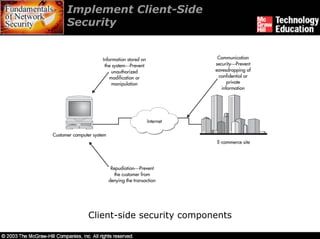
   Client-side security components
Implement Client-Side
        Security

Client-side security deals with the security from the

customer’s desktop system to the e-commerce server.

A realistic solution to communications security is encryption

of information.
Implement Client-Side
        Security


A cookie is a small amount of information that is stored on

the client system by the Web server in cleartext or

encrypted.

Organizations must ensure that a legitimate customer

places the order to reduce possible repudiation.
Implement Server-Side
          Security


Security of servers includes:

     Information stored on the server.

     Protecting the server from attack.
Information Stored on the
        Server


An e-commerce server is a semi-trusted or untrusted

system which should not store sensitive information.

If information is kept on the e-commerce server, it should

be protected from unauthorized access through file access

controls.
Protecting the Server from
          Attack


Three categories in protecting an e-commerce server from

attack:

      Server location.

      Operating system configuration.

      Web server configuration.
Server Location


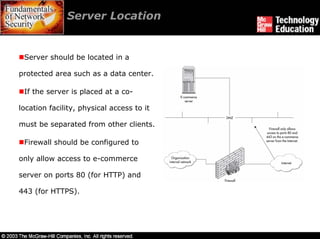
 Server should be located in a

protected area such as a data center.

 If the server is placed at a co-

location facility, physical access to it

must be separated from other clients.

 Firewall should be configured to

only allow access to e-commerce

server on ports 80 (for HTTP) and

443 (for HTTPS).
Operating System
        Configuration


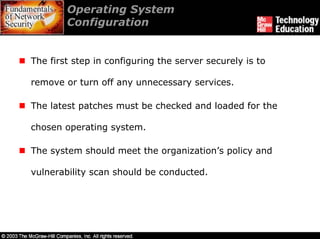
The first step in configuring the server securely is to

remove or turn off any unnecessary services.

The latest patches must be checked and loaded for the

chosen operating system.

The system should meet the organization’s policy and

vulnerability scan should be conducted.
Web Server Configuration


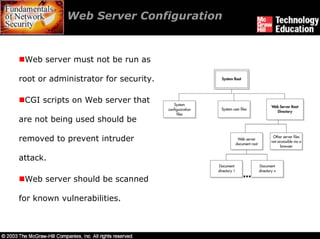
 Web server must not be run as

root or administrator for security.

 CGI scripts on Web server that

are not being used should be

removed to prevent intruder

attack.

 Web server should be scanned

for known vulnerabilities.
Implement Application
        Security


Security of e-commerce application as a whole is the most

important part of e-commerce security.

Security requirements should be included in the

requirements definition phase of project.

Security requirements include requirements pertaining to

protection, authentication, audit, availability, and

identifying sensitive information.
Implement Application
        Security


All sensitive information needs to be protected.

Programs are a major source of system vulnerabilities due

to programming errors.

Buffer overflows can be reduced by not making

assumptions about the size of user input and not passing

unchecked user input to shell commands.

Peer review or code review can catch many programming

errors before the server goes into production.
Implement Application
        Security


Vulnerability scanners should detect buffer overflow

problems before the site goes into production.

The two parts of configuration management are control of

authorized changes and identification of unauthorized

changes.

To prevent false alarms, checksum should be updated

during configuration management procedure.
Implement Database Server
        Security


The database server may contain sensitive and confidential

information which should be protected.

Organizations must examine database location,

communication with e-commerce server, and internal

access protection.

Database servers must be kept in controlled areas.

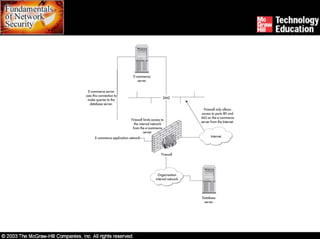
The e-commerce server should initiate SQL connection to

the database server for processing transactions.
Implement Database Server
             Security


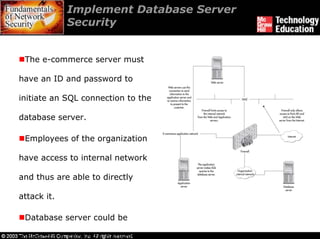
 The e-commerce server must

have an ID and password to

initiate an SQL connection to the

database server.

 Employees of the organization

have access to internal network

and thus are able to directly

attack it.

 Database server could be
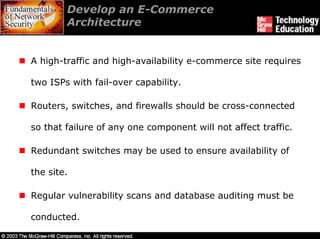
Develop an E-Commerce
        Architecture


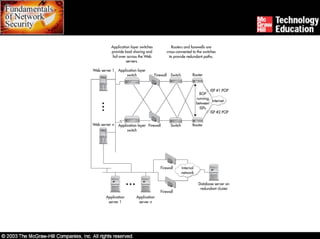
A high-traffic and high-availability e-commerce site requires

two ISPs with fail-over capability.

Routers, switches, and firewalls should be cross-connected

so that failure of any one component will not affect traffic.

Redundant switches may be used to ensure availability of

the site.

Regular vulnerability scans and database auditing must be

conducted.
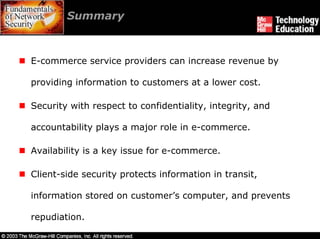
Summary


E-commerce service providers can increase revenue by

providing information to customers at a lower cost.

Security with respect to confidentiality, integrity, and

accountability plays a major role in e-commerce.

Availability is a key issue for e-commerce.

Client-side security protects information in transit,

information stored on customer’s computer, and prevents

repudiation.
Summary


Server-side security involves protection of information

stored on the server and protection of the server itself.

Security of the e-commerce application as a whole is

probably the most important part of e-commerce security.

Confidential and sensitive information present in the

database server must be protected.

Ch19 E Commerce Security

  • 1.
  • 2.
    Overview Understand e-commerce services. Understandthe importance of availability. Implement client-side security. Implement server-side security. Implement application security. Implement database server security. Develop an e-commerce architecture.
  • 3.
    Understand E-Commerce Services Organizations perform e-commerce to make profit by providing goods and services at a lower cost. Providing electronic library functions for sensitive or confidential information has come with the advent of e- commerce over the Internet.
  • 4.
    Understand E-Commerce Services E-commerce service is most commonly thought of as the purchasing of goods. Security to e-commerce services can be measured by its confidentiality, integrity, and accountability.
  • 5.
    Understand E-Commerce Services E-Commerce Services and regular DMZ Services differ in their requirements. Requirement of verification and confidentiality differentiate the e-commerce services from regular DMZ services. Availability becomes a critical security issue for the e- commerce site.
  • 6.
    Understand E-Commerce Services E-commerce services may involve selling goods, providing confidential information, or distribution of information. Security to e-commerce services can be measured in terms of confidentiality, integrity, and accountability.
  • 7.
    Understand the Importanceof Availability Availability is the key issue for e-commerce services. Availability of the site has a direct impact on the confidence a customer will have in using the service. Failure in availability is almost guaranteed to push a potential customer to a competitor.
  • 8.
    Understand the Importanceof Availability Business-to-consumer issues: The entire site along with payment processing must be up at all times. Problem of availability includes business issues such as ability of the organization to fulfill orders entered into the system. Size of the infrastructure must be built according to the expected load.
  • 9.
    Understand the Importanceof Availability Business-to-business issues: Business-to-business e-commerce is established between two organizations that have some type of relationship. Availability issues may be more stringent in Business-to- business e-commerce. When one organization needs to make an order, the other organization must be able to receive and process it.
  • 10.
    Understand the Importanceof Availability Global time: E-commerce availability is governed by the concept of global time. This concept identifies the global nature of the Internet and of e-commerce. An e-commerce site must be able to handle orders from unexpected locations.
  • 11.
    Understand the Importanceof Availability Client comfort: Client must feel comfortable with the ability of the organization to process orders and deliver goods. Customer comfort or discomfort can multiply quickly.
  • 12.
    Understand the Importanceof Availability Cost of downtime: The cost of downtime is high. It can be measured by taking the average number of transactions over a period of time and the revenue of the average transaction. An e-commerce site must not have single points of failure. The site should also have procedures for updating hardware and software.
  • 13.
    Understand the Importanceof Availability Solving the availability problem: Downtime can be reduced through redundancy. For sites that expect large amounts of traffic, load-balancing application layer switches can be used. Network infrastructure components must also be configured to fail-over if high availability is required.
  • 14.
    Implement Client-Side Security Client-side security components
  • 15.
    Implement Client-Side Security Client-side security deals with the security from the customer’s desktop system to the e-commerce server. A realistic solution to communications security is encryption of information.
  • 16.
    Implement Client-Side Security A cookie is a small amount of information that is stored on the client system by the Web server in cleartext or encrypted. Organizations must ensure that a legitimate customer places the order to reduce possible repudiation.
  • 17.
    Implement Server-Side Security Security of servers includes: Information stored on the server. Protecting the server from attack.
  • 18.
    Information Stored onthe Server An e-commerce server is a semi-trusted or untrusted system which should not store sensitive information. If information is kept on the e-commerce server, it should be protected from unauthorized access through file access controls.
  • 19.
    Protecting the Serverfrom Attack Three categories in protecting an e-commerce server from attack: Server location. Operating system configuration. Web server configuration.
  • 20.
    Server Location Servershould be located in a protected area such as a data center. If the server is placed at a co- location facility, physical access to it must be separated from other clients. Firewall should be configured to only allow access to e-commerce server on ports 80 (for HTTP) and 443 (for HTTPS).
  • 22.
    Operating System Configuration The first step in configuring the server securely is to remove or turn off any unnecessary services. The latest patches must be checked and loaded for the chosen operating system. The system should meet the organization’s policy and vulnerability scan should be conducted.
  • 23.
    Web Server Configuration Web server must not be run as root or administrator for security. CGI scripts on Web server that are not being used should be removed to prevent intruder attack. Web server should be scanned for known vulnerabilities.
  • 24.
    Implement Application Security Security of e-commerce application as a whole is the most important part of e-commerce security. Security requirements should be included in the requirements definition phase of project. Security requirements include requirements pertaining to protection, authentication, audit, availability, and identifying sensitive information.
  • 25.
    Implement Application Security All sensitive information needs to be protected. Programs are a major source of system vulnerabilities due to programming errors. Buffer overflows can be reduced by not making assumptions about the size of user input and not passing unchecked user input to shell commands. Peer review or code review can catch many programming errors before the server goes into production.
  • 26.
    Implement Application Security Vulnerability scanners should detect buffer overflow problems before the site goes into production. The two parts of configuration management are control of authorized changes and identification of unauthorized changes. To prevent false alarms, checksum should be updated during configuration management procedure.
  • 27.
    Implement Database Server Security The database server may contain sensitive and confidential information which should be protected. Organizations must examine database location, communication with e-commerce server, and internal access protection. Database servers must be kept in controlled areas. The e-commerce server should initiate SQL connection to the database server for processing transactions.
  • 28.
    Implement Database Server Security The e-commerce server must have an ID and password to initiate an SQL connection to the database server. Employees of the organization have access to internal network and thus are able to directly attack it. Database server could be
  • 29.
    Develop an E-Commerce Architecture A high-traffic and high-availability e-commerce site requires two ISPs with fail-over capability. Routers, switches, and firewalls should be cross-connected so that failure of any one component will not affect traffic. Redundant switches may be used to ensure availability of the site. Regular vulnerability scans and database auditing must be conducted.
  • 31.
    Summary E-commerce service providerscan increase revenue by providing information to customers at a lower cost. Security with respect to confidentiality, integrity, and accountability plays a major role in e-commerce. Availability is a key issue for e-commerce. Client-side security protects information in transit, information stored on customer’s computer, and prevents repudiation.
  • 32.
    Summary Server-side security involvesprotection of information stored on the server and protection of the server itself. Security of the e-commerce application as a whole is probably the most important part of e-commerce security. Confidential and sensitive information present in the database server must be protected.