INSTANT MESSAGING 
Presented By : 
Sana Riaz 
Roll no:F1F12MCOM0185
DEFINITION 
Instant messaging (IM) is a form of online communication that 
allows real-time (or close to real-time) interaction through personal 
computers or mobile computing devices. Users can exchange 
messages privately, similar to email or join the group conversation,
HISTORY 
o First real instant messaging program was developed in 
1987. 
o In 1996, Israeli Software firm named Mirabilis 
launched ICQ, 
o In 1997, AOL released AOL Instant Messenger 
(AIM) 
o By 1998, AOL has purchased Mirabilis. 
o Appearance of new networks like Yahoo and MSN
WHO’S DOING IT? 
1. Large and growing numbers of teens 
2. today’s and tomorrow’s college students 
3. colleges and universities are adding IM to campus functions 
4. Some institutional libraries have set up online reference desks 
with IM applications 
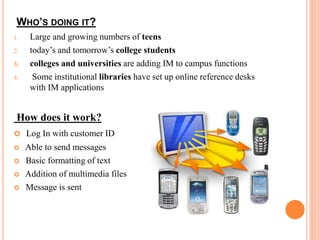
How does it work? 
 Log In with customer ID 
 Able to send messages 
 Basic formatting of text 
 Addition of multimedia files 
 Message is sent
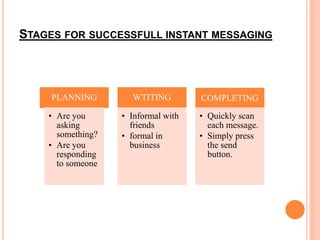
STAGES FOR SUCCESSFULL INSTANT MESSAGING 
PLANNING 
• Are you 
asking 
something? 
• Are you 
responding 
to someone 
WTITING 
• Informal with 
friends 
• formal in 
business 
COMPLETING 
• Quickly scan 
each message. 
• Simply press 
the send 
button.
INSTANT MESSAGING FEATURES 
 Sharing Web links 
 Sharing videos 
 Video chat 
 Text chat 
 Conference 
 Mobile capabilities 
 Sharing files 
 Sharing images 
 Chat history log 
 Interoperability with other IM networks
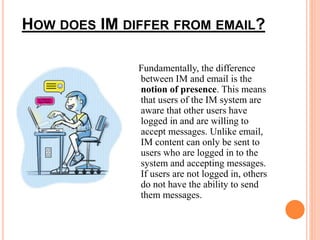
HOW DOES IM DIFFER FROM EMAIL? 
Fundamentally, the difference 
between IM and email is the 
notion of presence. This means 
that users of the IM system are 
aware that other users have 
logged in and are willing to 
accept messages. Unlike email, 
IM content can only be sent to 
users who are logged in to the 
system and accepting messages. 
If users are not logged in, others 
do not have the ability to send 
them messages.
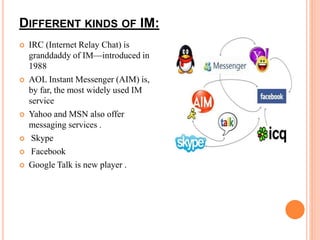
DIFFERENT KINDS OF IM: 
 IRC (Internet Relay Chat) is 
granddaddy of IM—introduced in 
1988 
 AOL Instant Messenger (AIM) is, 
by far, the most widely used IM 
service 
 Yahoo and MSN also offer 
messaging services . 
 Skype 
 Facebook 
 Google Talk is new player .
BENEFITS OF INSTANT MESSAGING: 
 Connect Team Members 
 Break Down Barriers 
 Saving cost . 
 Save travel time. 
 Wide availability. 
 Enhanced collaboration. 
 Information archieving. 
 Employee satisfaction. 
 Rapid response.
THREATS AND SECURITY ISSUES 
 Hijacking 
 Denial of Service 
 Identity theft 
 Information leaks. 
 Worms, viruses, etc.
LEGAL ISSUE: 
The scandal had started when Pakistani-American 
businessman Mansoor Ijaz claimed last year of having 
received a message from Haqqani to deliver a 
confidential memo to Admiral Mike Mullen, regarding a 
possible military takeover.
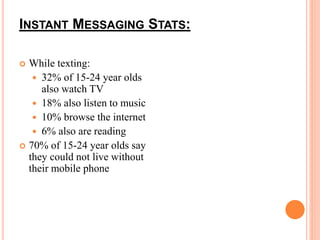
INSTANT MESSAGING STATS: 
 While texting: 
 32% of 15-24 year olds 
also watch TV 
 18% also listen to music 
 10% browse the internet 
 6% also are reading 
 70% of 15-24 year olds say 
they could not live without 
their mobile phone
TIPS FOR USING INSTANTMESSAGING FOR BUSINESS 
 Keep your instant messages simple 
 Organize your contact lists. 
 Be aware of virus and security risks. 
 Don’t Share personal data or information 
 Don’t Allow excessive personal messaging at work. 
 Don’t Confuse your contacts with a misleading 
 Don’t use instant messaging to communicate confidential 
or sensitive information user name.
CONCLUSION 
Actually it is a unique tool of communication that affects 
everyone differently depending upon the personality and 
social nature.
Communicatio  Skills

Communicatio Skills

  • 1.
    INSTANT MESSAGING PresentedBy : Sana Riaz Roll no:F1F12MCOM0185
  • 2.
    DEFINITION Instant messaging(IM) is a form of online communication that allows real-time (or close to real-time) interaction through personal computers or mobile computing devices. Users can exchange messages privately, similar to email or join the group conversation,
  • 3.
    HISTORY o Firstreal instant messaging program was developed in 1987. o In 1996, Israeli Software firm named Mirabilis launched ICQ, o In 1997, AOL released AOL Instant Messenger (AIM) o By 1998, AOL has purchased Mirabilis. o Appearance of new networks like Yahoo and MSN
  • 4.
    WHO’S DOING IT? 1. Large and growing numbers of teens 2. today’s and tomorrow’s college students 3. colleges and universities are adding IM to campus functions 4. Some institutional libraries have set up online reference desks with IM applications How does it work?  Log In with customer ID  Able to send messages  Basic formatting of text  Addition of multimedia files  Message is sent
  • 5.
    STAGES FOR SUCCESSFULLINSTANT MESSAGING PLANNING • Are you asking something? • Are you responding to someone WTITING • Informal with friends • formal in business COMPLETING • Quickly scan each message. • Simply press the send button.
  • 6.
    INSTANT MESSAGING FEATURES  Sharing Web links  Sharing videos  Video chat  Text chat  Conference  Mobile capabilities  Sharing files  Sharing images  Chat history log  Interoperability with other IM networks
  • 7.
    HOW DOES IMDIFFER FROM EMAIL? Fundamentally, the difference between IM and email is the notion of presence. This means that users of the IM system are aware that other users have logged in and are willing to accept messages. Unlike email, IM content can only be sent to users who are logged in to the system and accepting messages. If users are not logged in, others do not have the ability to send them messages.
  • 8.
    DIFFERENT KINDS OFIM:  IRC (Internet Relay Chat) is granddaddy of IM—introduced in 1988  AOL Instant Messenger (AIM) is, by far, the most widely used IM service  Yahoo and MSN also offer messaging services .  Skype  Facebook  Google Talk is new player .
  • 9.
    BENEFITS OF INSTANTMESSAGING:  Connect Team Members  Break Down Barriers  Saving cost .  Save travel time.  Wide availability.  Enhanced collaboration.  Information archieving.  Employee satisfaction.  Rapid response.
  • 10.
    THREATS AND SECURITYISSUES  Hijacking  Denial of Service  Identity theft  Information leaks.  Worms, viruses, etc.
  • 11.
    LEGAL ISSUE: Thescandal had started when Pakistani-American businessman Mansoor Ijaz claimed last year of having received a message from Haqqani to deliver a confidential memo to Admiral Mike Mullen, regarding a possible military takeover.
  • 12.
    INSTANT MESSAGING STATS:  While texting:  32% of 15-24 year olds also watch TV  18% also listen to music  10% browse the internet  6% also are reading  70% of 15-24 year olds say they could not live without their mobile phone
  • 14.
    TIPS FOR USINGINSTANTMESSAGING FOR BUSINESS  Keep your instant messages simple  Organize your contact lists.  Be aware of virus and security risks.  Don’t Share personal data or information  Don’t Allow excessive personal messaging at work.  Don’t Confuse your contacts with a misleading  Don’t use instant messaging to communicate confidential or sensitive information user name.
  • 15.
    CONCLUSION Actually itis a unique tool of communication that affects everyone differently depending upon the personality and social nature.