Instant Messaging Private Sector/Public Sector A CIO’s Dilemma By: Jessica Williams
Historical Overview Bulletin Boards & Online Services Purpose was to share or exchange messages regarding specific interests Internet Software developers wanted to mimic some aspects of the online service (chat room software) July 1996, 4 gentlemen began company called Mirabilis Goal was to “connect” people
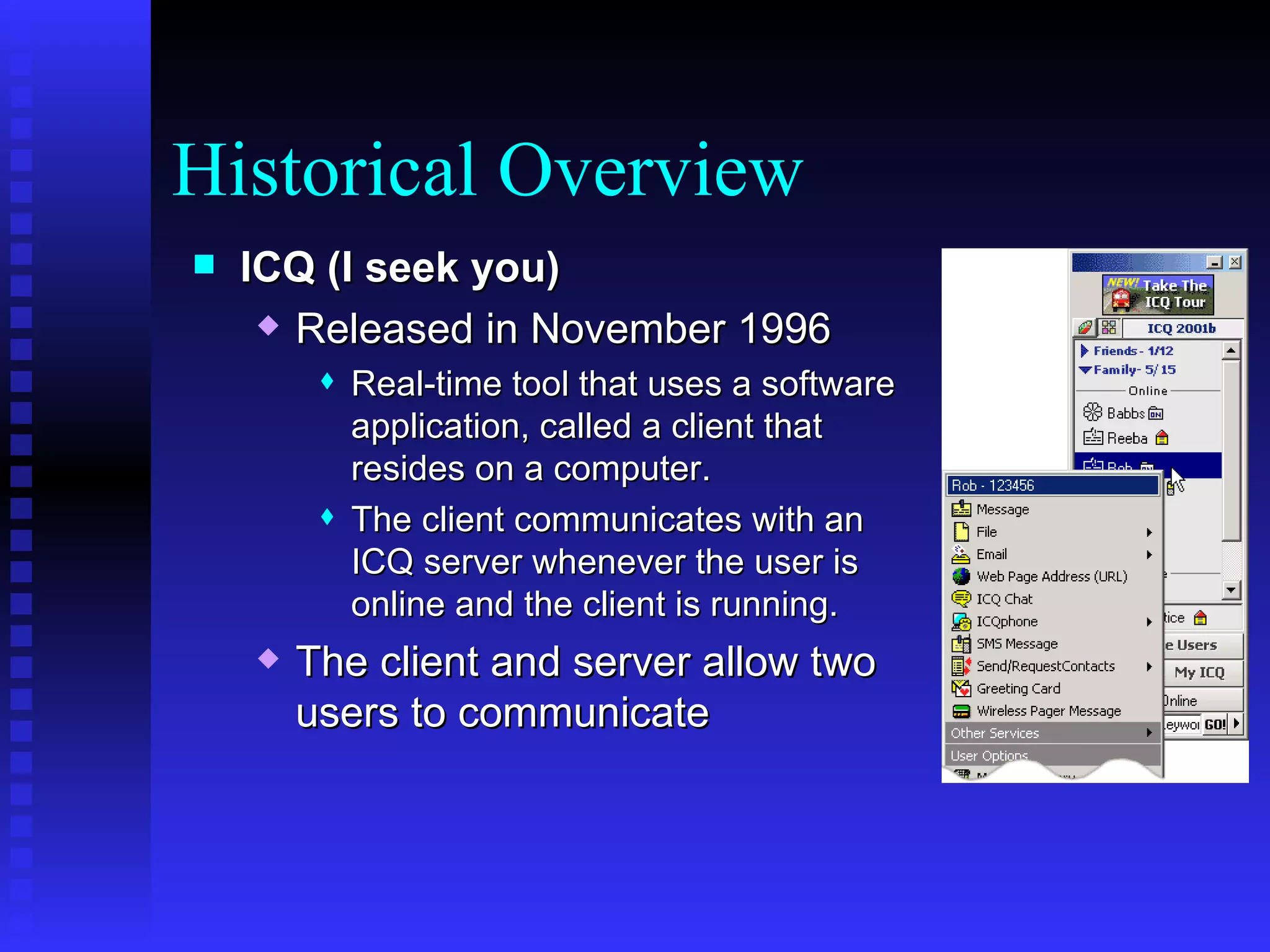
Historical Overview ICQ (I seek you) Released in November 1996 Real-time tool that uses a software application, called a client that resides on a computer.  The client communicates with an ICQ server whenever the user is online and the client is running.  The client and server allow two users to communicate
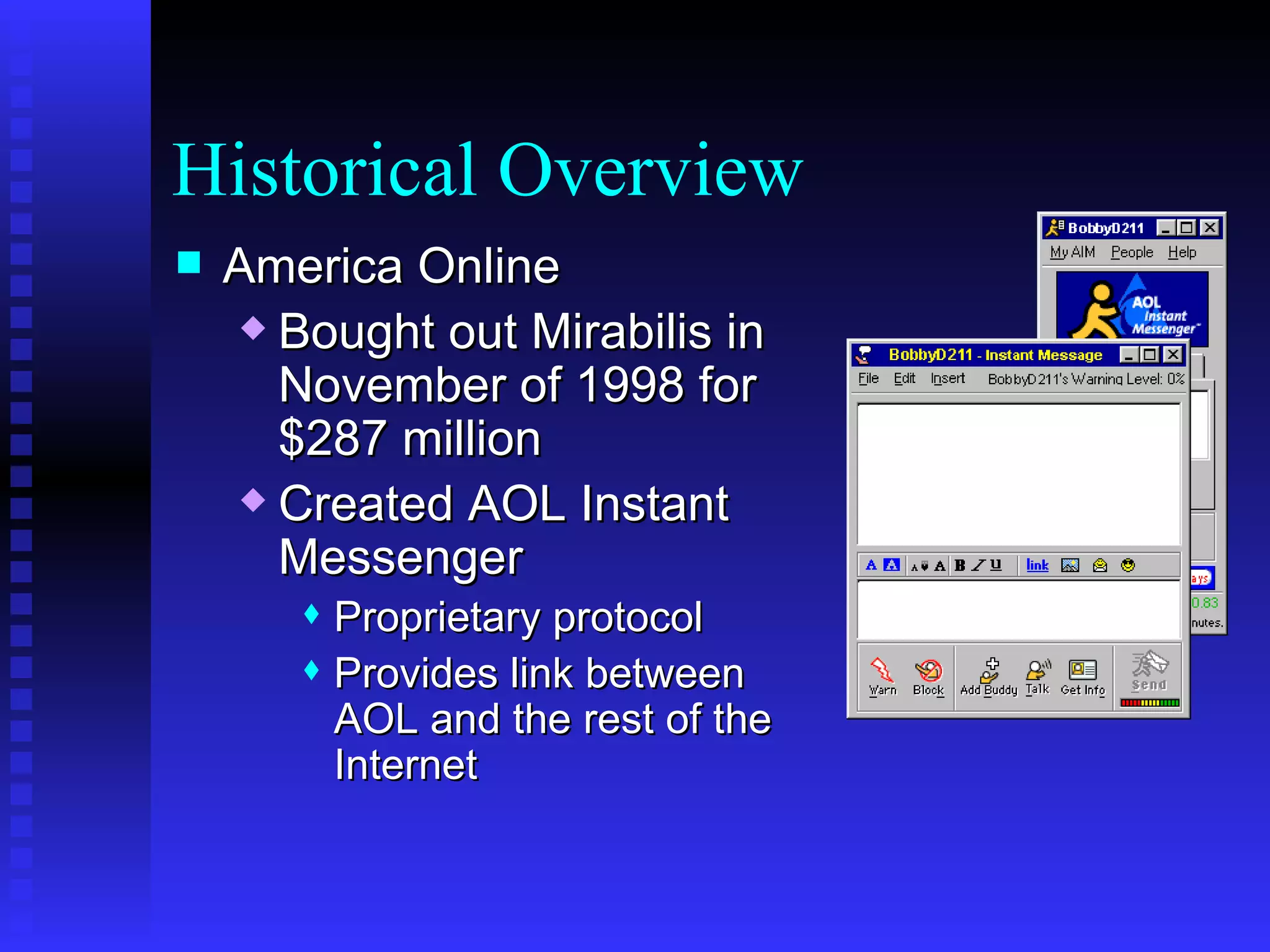
Historical Overview America Online Bought out Mirabilis in November of 1998 for $287 million Created A OL Instant Messenger  Proprietar y protocol Provides link between AOL and the rest of the Internet
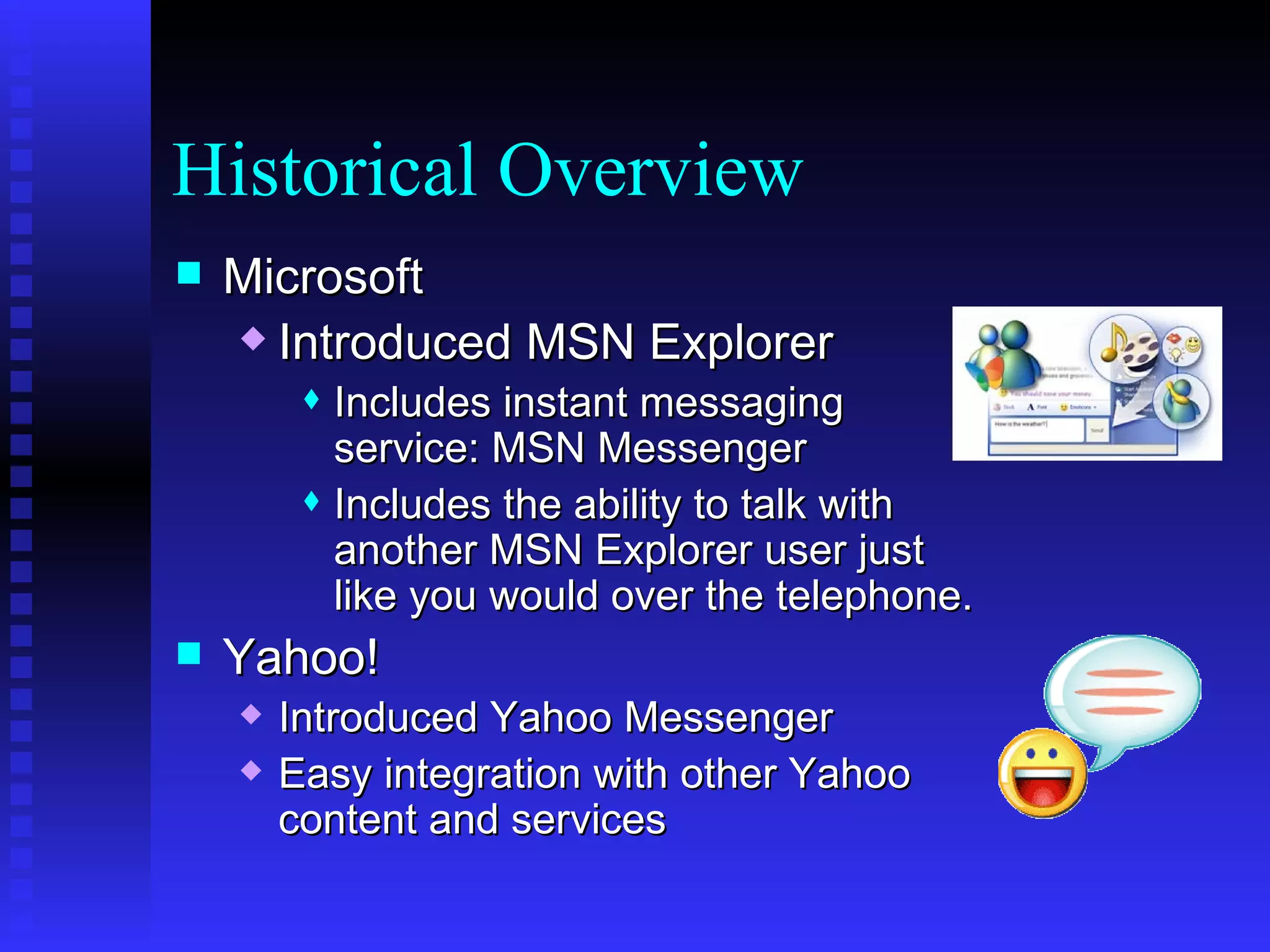
Historical Overview Microsoft Introduced MSN Explorer  Includes instant messaging service: MSN Messenger Includes the ability to talk with another MSN Explorer user just like you would over the telephone.  Yahoo! Introduced Yahoo Messenger Easy integration with other Yahoo content and services
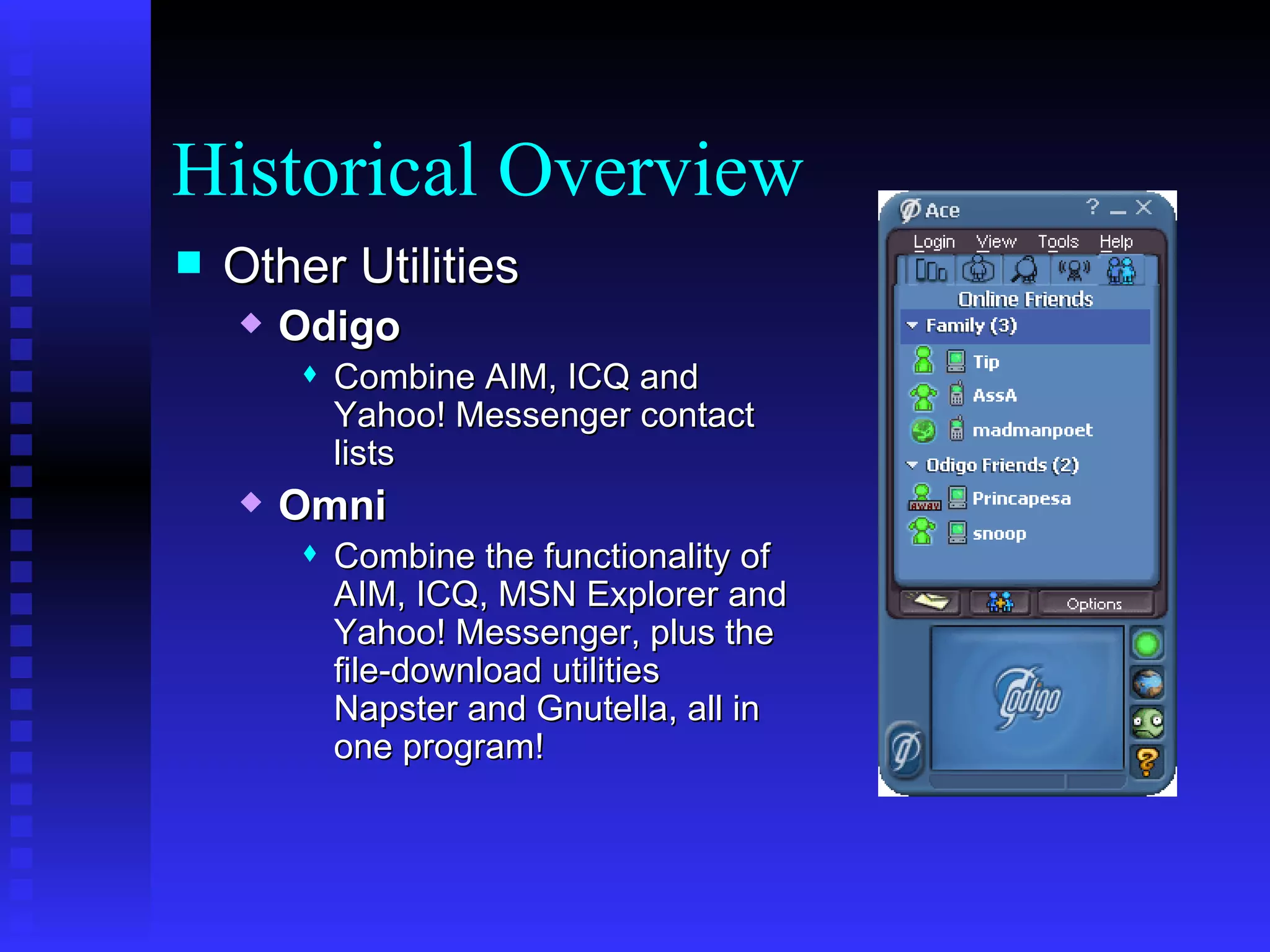
Historical Overview Other Utilities Odigo Combine AIM, ICQ and Yahoo! Messenger contact lists   Omni Combine the functionality of AIM, ICQ, MSN Explorer and Yahoo! Messenger, plus the file-download utilities Napster and Gnutella, all in one program!
How Does IM Work? Web-based instant messaging, the most common form of IM, allows you to contact other individuals using the Internet as a means of communication.  Use of proprietary protocols A "client" is loaded on local computers, they login to a server and are able to communicate directly with other logged in "clients".
Business Usage –  “if you can’t beat em, join em” In 2002, business didn’t understand the importance of IM Saw it as a threat to worker productivity End users saw it as a collaboration tool – a communications niche somewhere between phone and email IT departments are beginning to see IM as communications tool & are looking for ways to control it, implement security measures, and implement it with other groupware components
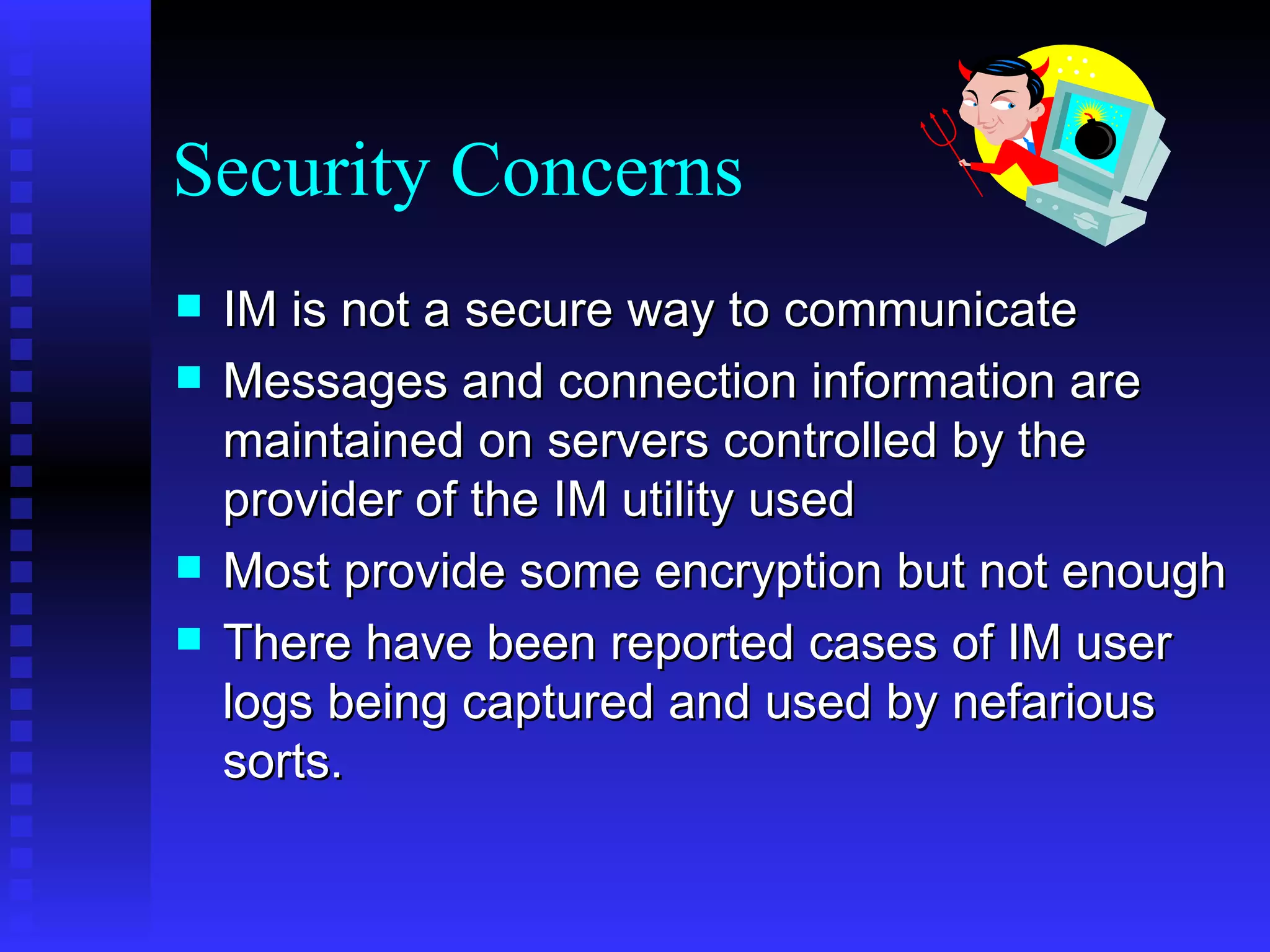
Security Concerns IM is not a secure way to communicate Messages and connection information are maintained on servers controlled by the provider of the IM utility used Most provide some encryption but not enough There have been reported cases of IM user logs being captured and used by nefarious sorts.
Enterprise Instant Messaging MSN Messenger Connect for Enterprises AIM Enterprise Gateway Yahoo Enterprise Edition 1.0 All provide ways to integrate users with corporate directories, and log and archive traffic
Educational Usage Morris Library – Southern Illinois University Potential collaboration tool for student / faculty population 3 Main Issues to Full Implementation Faculty learning curve Lack of extra time  Security
Government Usage FEMA – IM service for first responders Government has more to lose, but could gain the most cost savings 4 Main Issues to Full Implementation Lack of interoperability Absence of compelling business case Public Records Security
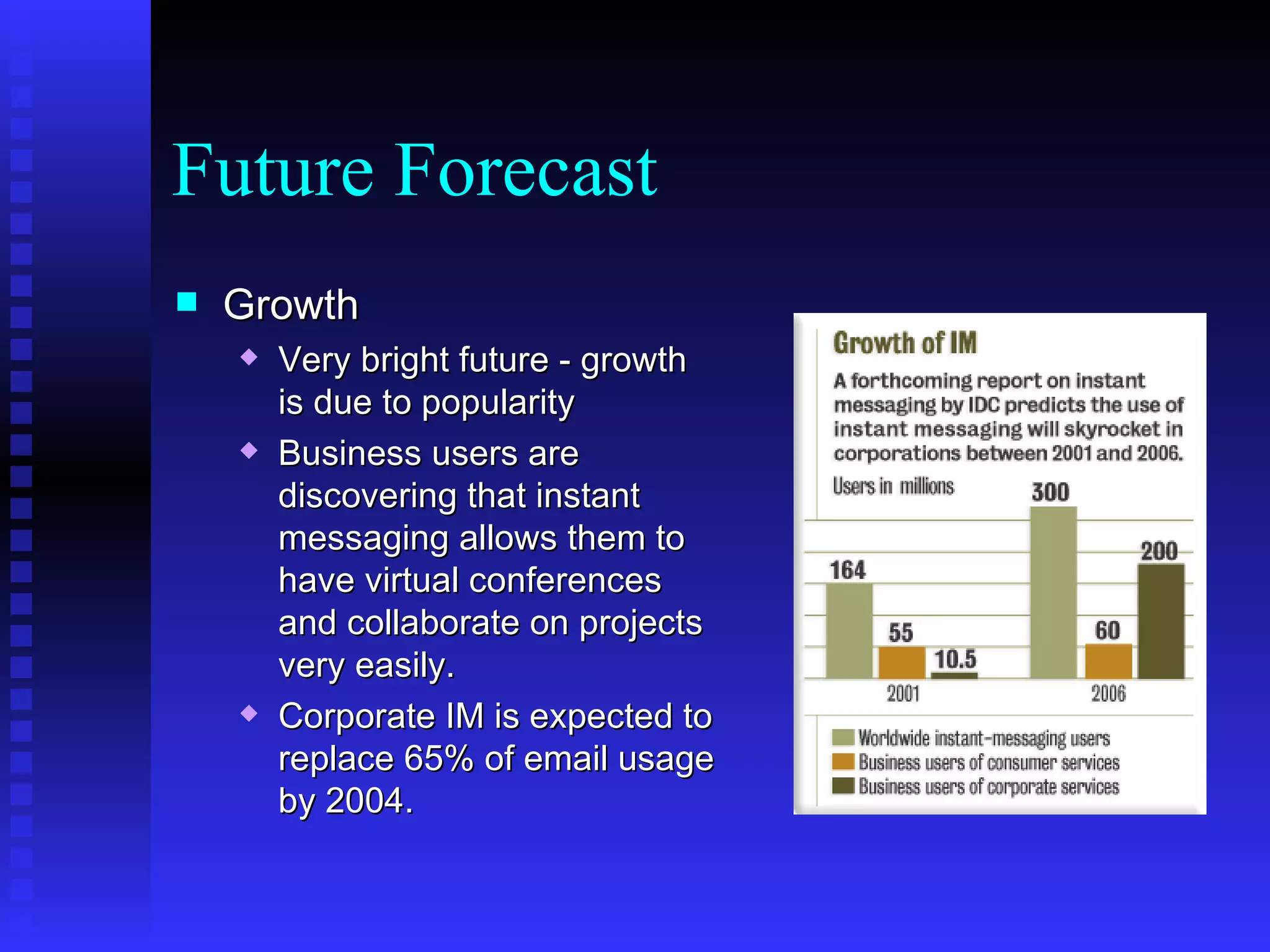
Future Forecast Growth Very bright future - growth is due to popularity Business users are discovering that instant messaging allows them to have virtual conferences and collaborate on projects very easily.  Corporate IM is expected to replace 65% of email usage by 2004.
Future Forecast Interoperability Many IM clients with features that are proprietary Internet Engineering Task Force (IETF) is developing a standard protocol for instant messaging (IMPP - Instant Messaging Presence Protocol) Could lead to interoperable instant messaging system that works like email
Two Things to Remember This is all possible from an IT perspective There are no technological impediments preventing IM from reaching its full potential If there are obstacles, they will come from industry failure to agree on open standards

Private Public Sector Im

  • 1.
    Instant Messaging PrivateSector/Public Sector A CIO’s Dilemma By: Jessica Williams
  • 2.
    Historical Overview BulletinBoards & Online Services Purpose was to share or exchange messages regarding specific interests Internet Software developers wanted to mimic some aspects of the online service (chat room software) July 1996, 4 gentlemen began company called Mirabilis Goal was to “connect” people
  • 3.
    Historical Overview ICQ(I seek you) Released in November 1996 Real-time tool that uses a software application, called a client that resides on a computer. The client communicates with an ICQ server whenever the user is online and the client is running. The client and server allow two users to communicate
  • 4.
    Historical Overview AmericaOnline Bought out Mirabilis in November of 1998 for $287 million Created A OL Instant Messenger Proprietar y protocol Provides link between AOL and the rest of the Internet
  • 5.
    Historical Overview MicrosoftIntroduced MSN Explorer Includes instant messaging service: MSN Messenger Includes the ability to talk with another MSN Explorer user just like you would over the telephone. Yahoo! Introduced Yahoo Messenger Easy integration with other Yahoo content and services
  • 6.
    Historical Overview OtherUtilities Odigo Combine AIM, ICQ and Yahoo! Messenger contact lists Omni Combine the functionality of AIM, ICQ, MSN Explorer and Yahoo! Messenger, plus the file-download utilities Napster and Gnutella, all in one program!
  • 7.
    How Does IMWork? Web-based instant messaging, the most common form of IM, allows you to contact other individuals using the Internet as a means of communication. Use of proprietary protocols A "client" is loaded on local computers, they login to a server and are able to communicate directly with other logged in "clients".
  • 8.
    Business Usage – “if you can’t beat em, join em” In 2002, business didn’t understand the importance of IM Saw it as a threat to worker productivity End users saw it as a collaboration tool – a communications niche somewhere between phone and email IT departments are beginning to see IM as communications tool & are looking for ways to control it, implement security measures, and implement it with other groupware components
  • 9.
    Security Concerns IMis not a secure way to communicate Messages and connection information are maintained on servers controlled by the provider of the IM utility used Most provide some encryption but not enough There have been reported cases of IM user logs being captured and used by nefarious sorts.
  • 10.
    Enterprise Instant MessagingMSN Messenger Connect for Enterprises AIM Enterprise Gateway Yahoo Enterprise Edition 1.0 All provide ways to integrate users with corporate directories, and log and archive traffic
  • 11.
    Educational Usage MorrisLibrary – Southern Illinois University Potential collaboration tool for student / faculty population 3 Main Issues to Full Implementation Faculty learning curve Lack of extra time Security
  • 12.
    Government Usage FEMA– IM service for first responders Government has more to lose, but could gain the most cost savings 4 Main Issues to Full Implementation Lack of interoperability Absence of compelling business case Public Records Security
  • 13.
    Future Forecast GrowthVery bright future - growth is due to popularity Business users are discovering that instant messaging allows them to have virtual conferences and collaborate on projects very easily. Corporate IM is expected to replace 65% of email usage by 2004.
  • 14.
    Future Forecast InteroperabilityMany IM clients with features that are proprietary Internet Engineering Task Force (IETF) is developing a standard protocol for instant messaging (IMPP - Instant Messaging Presence Protocol) Could lead to interoperable instant messaging system that works like email
  • 15.
    Two Things toRemember This is all possible from an IT perspective There are no technological impediments preventing IM from reaching its full potential If there are obstacles, they will come from industry failure to agree on open standards