Dr. Anita Sharma, Asstt. Prof. Entom
ology
PEST – DEFINITION & CATEGORIES OF PEST
PEST - Derived from French word ‘Peste’ and Latin term ‘Pestis’ meaning plague
or contagious disease
 Pest is any animal which is noxious, destructive or troublesome to man or his
interests
A pest is an organism which harms man or his property significantly or is likely
to do so (Woods, 1976)
 Insects are pests when they are sufficiently numerous to cause economic
damage (Debacli, 1964)
PEST - Any organism that cause significant and economic damage to crops,
stored produced and animals”.
Pests are organisms which impose burdens on human population by causing -
 Injury to crop plants, forests and ornamentals
 Annoyance, injury and death to humans and domesticated animals
 Destruction or value depreciation of stored products.
Dr. Anita Sharma, Asstt. Prof. Entom
ology
CATEGORIES OF PESTS
I. Insect pests are classified as follows based on season and locality-
 Regular pests: Occur most frequently (regularly) in a crop and have close
association with that particular crop. Eg: Chilli Thrips Scirtothrips dorsalis , brinjal
shoot and fruit borer, Leucinodes orbonalis, Rice stem borer.
 Occasional pests: Here a close association with a particular crop is absent and
they occur infrequently. Eg: Rice case worm, Nymphula depunctalis castor slug
caterpillar, Parasa lepida , mango stem borer, Batocera rufamaculata
 Seasonal pests: Occur mostly during a particular part of the year, and usually
the incidence is governed by climatic conditions. Eg: Red hairy caterpillar on
groundnut-June - July, Rice grasshoppers –June-July
Persistent pests: Occur on a crop almost throughout the year. Eg. Thrips on
chillies.
 Sporadic pests: Pests, which occur in a few isolated localities Eg. Rice ear head
bug.
Dr. Anita Sharma, Asstt. Prof. Entom
ology
II. Based on level of infestation –
1. Pest epidemic: Sudden outbreak of a pest in a severe form in a region at a
particular time e.g. BPH in Tanjore, RHC in Madurai, Pollachi
2. Endemic pest: Occurrence of the pest in a low level in few pockets, regularly
and confined to particular area e.g. Rice gall midge in Madurai, Mango
hoppers in Periyakulam
III. Pests are classified as follows based on damage potential
 Key pests: These are the most severely damaging pests. The GEP is always
above the EIL. Human intervention may bring the population temporarily
below the EIL, but it rises back rapidly and repeated interventions (sprays) may
be required to minimize damage. These are persistent pests. The environment
must be changed to bring GEP below EIL. Ex.Cotton bollworm, Diamond
backmoth
 Major pests: These are pests with the population crosses EIL quite frequently.
Economic damage can be prevented by timely and repeated sprays e.g. Cotton
Dr. Anita Sharma, Asstt. Prof. Entom
ology
 Minor pests: These are pests with population rarely crosses EIL and fluctuates
around ETL. But these pests are easily amenable to available control measures
and a single application of insecticides is usually enough to prevent economic
damage (5-10% damage).
 Potential pests: These pests normally do not cause any economic damage. Any
change in the ecosystem may make them to cause economic damage .
 Sporadic pests : GEP generally below EIL The population of these pests is
usually negligible but in certain years under favorable environmental
conditions, they appear in a virtually epidemic form crossing many times over
DB and EIL. Under these conditions, the pest has to be controlled by
undertaking suitable management strategies. These pests are highly sensitive
to abiotic conditions and once the favorable season is over, only a residual
population survives. Ex: White grub, hairy caterpillars, cut worm, grass hoppers
Dr. Anita Sharma, Asstt. Prof. Entom
ology
INTEGRATED PEST MANAGEMENT
History of Integrated Pest Management:
 - Michel bacher and Bacon (1952) coined the term “integrated control”
 - Stern et al. (1959) defined integrated control as “applied pest control which
combines and integrates biological and chemical control”
 - Geier (1966) coined the term “pest management”
 - Council on Environmental Quality (CEQ, 1972) gave the term “Integrated Pest
Management”
 - In 1989, IPM Task Force was established and in 1990. IPM Working Group
(IPMWG) was constituted to strengthen implementation of IPM at international level.
 - In 1997, Smith and Adkisson were awarded the World Food Prize for pioneering
work on implementation of IPM.
Definition IPM by Food and Agricultural Organization (FAO, 1967)
Integrated Pest Management (IPM) is a pest management system that, in the
context of associated environment and population dynamics of the pest species,
utilizes all suitable techniques and methods in as compatible a manner as possible
Dr. Anita Sharma, Asstt. Prof. Entom
ology
Need for Pest Management (or) Why Pest Management
1. Development of resistance in insects against insecticides e.g. OP and synthetic
pyrethroid resistance in Helicoverpa armigera.
2. Out break of secondary pests e.g. Whiteflies emerged as major pest when
spraying insecticide against H. armigera.
3. Resurgence of target pests e.g. BPH of rice increased when some OP chemicals
are applied.
4. When number of application increases, profit decreases.
5. Environmental contamination and reduction in its quality.
6. Killing of non-target animals and natural enemies.
7. Human and animal health hazards.
Dr. Anita Sharma, Asstt. Prof. Entom
ology
Why Pest Management
1) Collapse of control system: During the massive use of pesticides, Rachel Carson, an
American biologist, warned the people about the side effects of the use of pesticides
through her book entitled, Silent Spring. Through her book, she raised a lot of
questions about the real benefits of the use of pesticides as well as the risks of
pesticides rendered in the environment and public health.
2) Phases of crop protection : Smith. R.F (1969) has classified World wide patterns of
crop protection in cotton agro ecosystem into the following phases which are also
applicable to other crop ecosystems-
A) Subsistence phase The crop is usually grown under non irrigated conditions. Crop
does not enter the world market and is consumed in the villages or bartered in the
market place. Crop yields are low. Crop protection is through natural control, hand
picking, host plant resistance, other cultural practices and rarely insecticides are used.
B) Exploitation phase The agricultural production increased from subsistence level to
higher so as to reach the market. Pest control solely depend on chemical pesticides.
These are used intensively, often at fixed intervals. Chemical control measures were
exploited to the maximum extent wherein new synthetic insecticides, new methods of
Dr. Anita Sharma, Asstt. Prof. Entom
ology
C) Crisis phase : After few years in exploitation phase, more frequent applications of
pesticides and higher doses are needed to obtain effective control. Insect populations
often resurge rapidly after treatments and the pest population gradually becomes
tolerant to the pesticide. Another pesticide is substituted and pest population
becomes tolerant to it too. Occasional feeders become serious pests.
Excessive use of insecticides over a number of years led to serious problems like
i) Pest resurgence ii) Pest resistance to insecticides iii) Change of pest status
iv) Increase of production costs, etc
D) Disaster phase: As a result of all deleterious effects, the cost of cultivation got
increased and the crops were not grown profitably. There were frequent encounters of
crop failures and produce not acceptable at market (rejection of the produce due to
residues), and finally collapse of the existing pest control system.
E) Integrated control phase In this phase it is aimed to give the control measures to
the optimum and not to the maximum. Pest management concept is followed to avoid
crisis and disaster phases by a) Combination of the resources b) analysis of eco- factors
c) optimization of techniques d) recognizing or restoring the pest at manageable level
3) Environmental contamination Presence of residues in foods, feed and organisms
Dr. Anita Sharma, Asstt. Prof. Entom
ology
Concepts of IPM
Concepts of IPM Seeks to minimize the disadvantages of pesticide usage and maximizing
socio-economic and ecological advantages
1. Understanding the agricultural ecosystem
 Lesser diversity than natural ecosystem like forests.
 Only 1-4 major crop species and 6-10 major pest species.
 Intensively manipulated by man.
 Subjected to sudden alterations ( Ploughing , inter cultivation, Pesticide treatment)
2. Planning of agricultural ecosystem
 Anticipating pest problem
 Alternatives to the ways of control
 Integration of crop protection with crop production system Ex: Growing of susceptible
varieties should be avoided and related crops shouldn’t be grown Ground nut followed by
soybean increases incidence of the leaf miner
3. Cost benefit ratio
 By predicting the pest problem and defining economic threshold level
 Crop life table provide information analysis of pest damage as well as cost benefit ratio
 Benefit risk analysis includes impact of Pesticide usage on society as well as environment
relevant to its benefits.
Dr. Anita Sharma, Asstt. Prof. Entom
ology
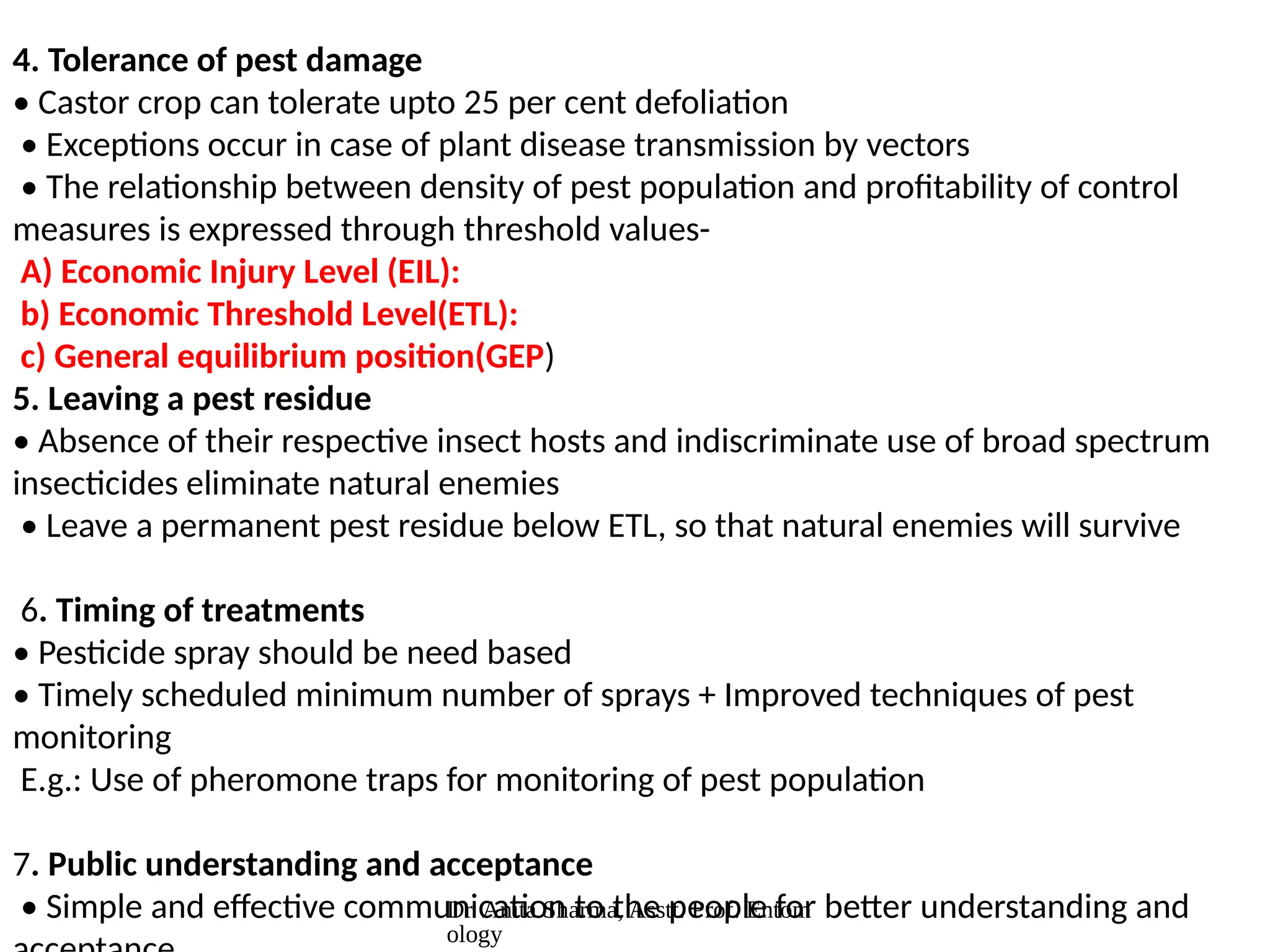
4. Tolerance of pest damage
• Castor crop can tolerate upto 25 per cent defoliation
• Exceptions occur in case of plant disease transmission by vectors
• The relationship between density of pest population and profitability of control
measures is expressed through threshold values-
A) Economic Injury Level (EIL):
b) Economic Threshold Level(ETL):
c) General equilibrium position(GEP)
5. Leaving a pest residue
• Absence of their respective insect hosts and indiscriminate use of broad spectrum
insecticides eliminate natural enemies
• Leave a permanent pest residue below ETL, so that natural enemies will survive
6. Timing of treatments
• Pesticide spray should be need based
• Timely scheduled minimum number of sprays + Improved techniques of pest
monitoring
E.g.: Use of pheromone traps for monitoring of pest population
7. Public understanding and acceptance
• Simple and effective communication to the people for better understanding and
Dr. Anita Sharma, Asstt. Prof. Entom
ology
Limitations of IPM
 Higher degree of management
 Labour intensive
 Accurate field scouting
 Weather dependant
Aims of IPM
 Reduce the use of synthetic organic pesticides
 Pest minimal risk of human health
 Re-useable return on investment
 Provide consumable safe food
Principles of IPM
• Identification of key pests and beneficial organisms
• Defining the management unit, the Agro-ecosystem
• Development of management strategy
• Establishment of Economic thresholds (loss & risks)
• Development of assessment techniques
• Evolving description of predictive pest models
Dr. Anita Sharma, Asstt. Prof. Entom
ology
ECONOMIC LEVELS FOR PESTS CATEGORIZATION
1. Economic injury level- The concept of economic injury level was
first defined by Stern et. al. (1959), who defined it as “ lowest
population density that will cause economic damage”.
cost of control=cost of damage
EIL is usually expressed as the number of insects per unit area
2. Economic thershold level- First defined by Stern et al. in 1959-
The pest population density at which control measures should be
applied to prevent an increasing pest population from reaching
the economic injury level.
ET is most important parameter in pest mgt decision making
also represent as “Action-threshold”
E.g.:- ETL value for BPH in rice is 25 insects/hill
Rice stem borer -5% dead hearts
Gall midge of rice-5% silver shoots
Dr. Anita Sharma, Asstt. Prof. Entom
ology
3. GEP- The general equilibrium position is the average population density of an insect
population over a long period of time & unaffected by the temporary interventions of
pest control.
Based on this insects can be grouped into 4 categories-
a) Negligible pest: Pop. density never increases high enough to cause economic injury
b) Occasional pest: Occasionally their density reaches EIL due to unusual weather
conditions or the injudicious use of insecticides. At their peak population density, some
sort of intervention usually an insecticide is required to reduce their numbers
c) Perennial pest: EIL’s are slightly above the GEP Intervention is necessary at nearly every
upward population fluctuation.
d) Severe pest: They have EIL below the GEP Regular and constant interventions with
insecticides are required to produce marketable crops
4. Damage boundary (DB)- The lowest level of damage which can be measured. ETL is
always less than EIL. Provides sufficient time for control measures.
Dr. Anita Sharma, Asstt. Prof. Entom
ology
Survey, Surveillance & Forecasting of Insect Pests
Pest Monitoring-
Monitoring phytophagous insects and their natural enemies is
a fundamental tool in IPM - for taking management decision
Monitoring
- estimation of changes in insect distribution and abundance
- information about insects, life history
- influence of biotic and abiotic factors on pest population
Survey
Conducted to study the abundance of a pest species
‘An insect pest survey is ‘a detailed collection of insect
population information at a particular time in a given area’.
Dr. Anita Sharma, Asstt. Prof. Entom
ology
Two types of survey- Roving survey and fixed plot survey
1. Roving survey
 Assessment of pest population/damage from randomly selected
spots representing larger area
 Large area surveyed in short period
 Provides information on pest level over large area
2. Fixed plot survey
Assessment of pest population/damage from a fixed plot selected in
a field. The data on pest population/damage recorded periodic from
sowing till harvest-
• e.g. 1 sq.m. plots randomly selected from 5 spots in one acre of crop
area in case of rice. From each plot 10 plant selected at random. Total
tillers and tillers affected by stem borer in these 10 plants counted.
Total leaves and number affected by leaf folder observed. Damage
expressed as per cent damaged tillers or leaves. Population of BPH
from all tillers in 10 plants observed and expressed as number/tiller.
• Qualitative survey - Useful for detection of pest
• Quantitative survey - Useful for enumeration of pest
Dr. Anita Sharma, Asstt. Prof. Entom
ology
Advantages of pest surveillance
 One can know how a pest is multiplying in an area and when it
is expected.
 Minimize the cost of plant protection by reducing the amount
of pesticides used and in turn reduce environmental pollution.
Pest control measures can be initiated in time due to advance
forecasting.
Useful for pest forecasting.
To find out natural enemy population
To study the influence of weather parameters on pests
 Mark endemic areas
 Maintain the stability of the agro ecosystem
Dr. Anita Sharma, Asstt. Prof. Entom
ology
Components of pest surveillance
1. Identification of the pest.
2. Distribution and prevalence of the pest and its
severity.
3. The different levels of incidence and the loss
due to the incidence.
4. Pest population dynamics.
5. Assessment of weather.
6. Assessment of natural enemies etc.
Dr. Anita Sharma, Asstt. Prof. Entom
ology
Indices in pest surveillance
• Economic damage: is ‘the amount of injury, which justify the cost of
artificial control measures’.
1. Economic injury level: is defined, as the lowest number of insects that
will cause economic damage ‘or’ the cost of control measures is equal
yield loss by insects’.
• EIL can be calculated using following formula
• EIL= C/VIDK
• where, EIL = Economic injury level in insects/production (or) insects/ha
• C = Cost of management activity per unit of production (Rs./ha)
• V = Market value per unit of yield or product (Rs./tonne)
• I = Crop injury per insect (Per cent defoliation/insect
• ) D = Damage or yield loss per unit of injury (Tonne loss/% defoliation)
• K = Proportionate reduction in injury from pesticide use Worked
Dr. Anita Sharma, Asstt. Prof. Entom
ology
2. Economic thresh hold level: It is ‘the level at which management action should be
taken to prevent population reaching EIL’.
Factors affecting the ETL:
3. Crop value / market value Primary factors
4. Management costs
5. Degree of injury per insect
6. Crop susceptibility to injury Secondary factors
1. Market value of crop: When crop value increases, EIL decreases and vice-versa
2. Management of injury per insect: When management costs increase, EIL also
increases
3. Degree of injury per insect : Insects damaging leaves or reproductive parts have
different EIL (Lower EIL for Rep. part damages) o If insects are vectors of disease EIL is
very low even 1 or 2 insects if found - management to be taken o If insects found on
fruits - Marketability reduced - EIL very low
4. Crop susceptibility to injury :
 If crop can tolerate the injury and give good yield. EIL can be fixed at a higher value
 When crop is older, it can withstand high pest population - EIL can be high Tertiary
factors Weather, soil factors, biotic factors and human social environment These
tertiary factors cause change in secondary factors thereby affect the ETL and EIL.
Tertiary factors - Weather, soil factors, biotic factors and human social environment
These tertiary factors cause change in secondary factors thereby affect the ETL and EIL.
Dr. Anita Sharma, Asstt. Prof. Entom
ology
Sampling
• It is ‘a representative part of the total population and base our estimate
on that part’.
Sampling techniques:
• Surveillance requires suitable sampling techniques. A sampling
technique is ‘the method used to collect information for a single sample’.
• The sampling techniques include direct counts (insitu counts), knock
down, netting, trapping, (use of light trap, pheromone trap, sticky trap),
extraction from soil etc
Sampling programme:
• It is ‘the procedure for employing the sampling techniques in time and
space’. Sampling programme describes when sampling is to begin,
location of samples, number of samples and how often samples should
be taken.
Dr. Anita Sharma, Asstt. Prof. Entom
ology
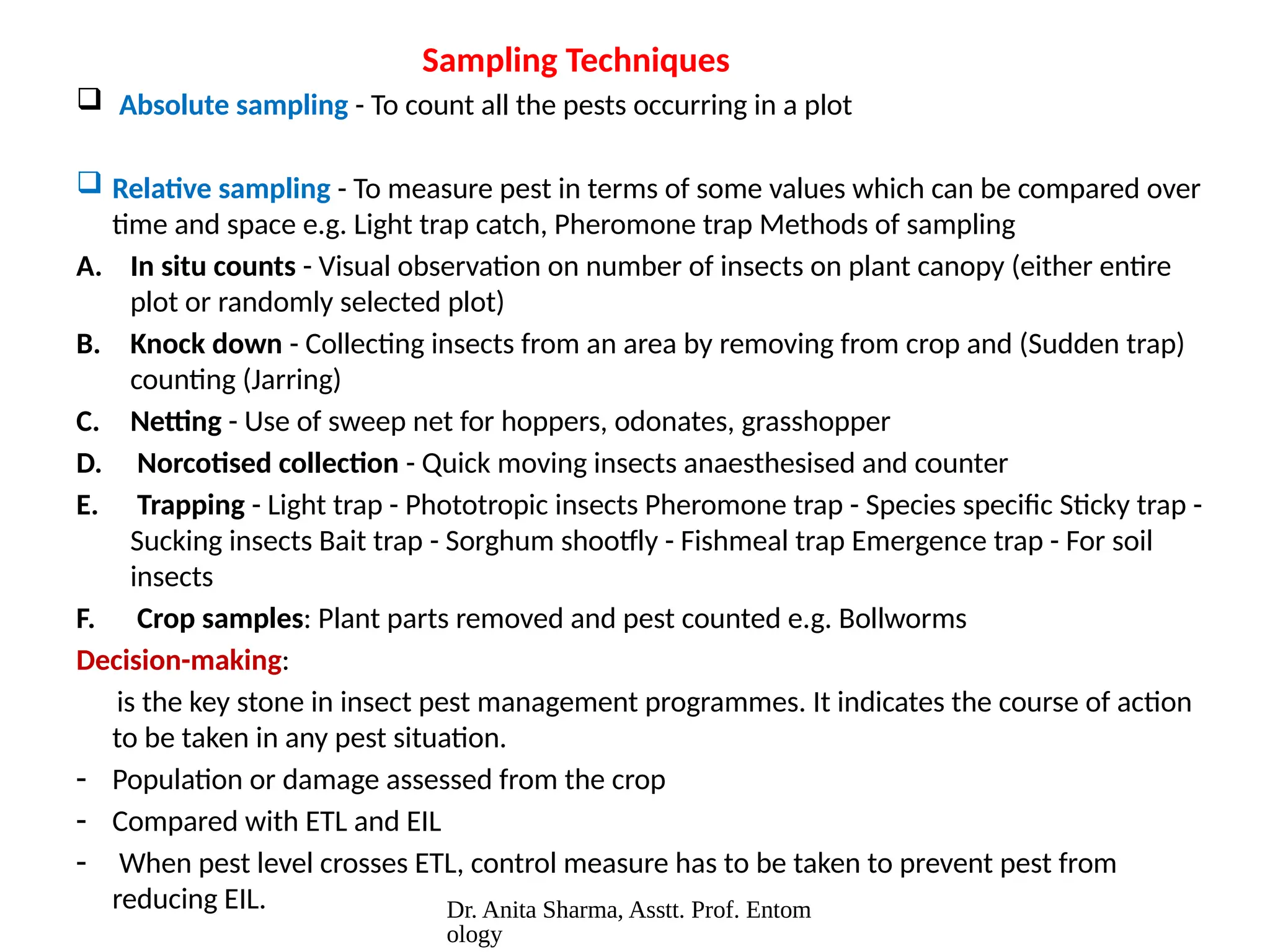
Sampling Techniques
 Absolute sampling - To count all the pests occurring in a plot
 Relative sampling - To measure pest in terms of some values which can be compared over
time and space e.g. Light trap catch, Pheromone trap Methods of sampling
A. In situ counts - Visual observation on number of insects on plant canopy (either entire
plot or randomly selected plot)
B. Knock down - Collecting insects from an area by removing from crop and (Sudden trap)
counting (Jarring)
C. Netting - Use of sweep net for hoppers, odonates, grasshopper
D. Norcotised collection - Quick moving insects anaesthesised and counter
E. Trapping - Light trap - Phototropic insects Pheromone trap - Species specific Sticky trap -
Sucking insects Bait trap - Sorghum shootfly - Fishmeal trap Emergence trap - For soil
insects
F. Crop samples: Plant parts removed and pest counted e.g. Bollworms
Decision-making:
is the key stone in insect pest management programmes. It indicates the course of action
to be taken in any pest situation.
- Population or damage assessed from the crop
- Compared with ETL and EIL
- When pest level crosses ETL, control measure has to be taken to prevent pest from
reducing EIL.
Dr. Anita Sharma, Asstt. Prof. Entom
ology
FORECASTING
• It is ‘an advance knowledge of probable pest infestations (out breaks)
in a crop for planning the cropping pattern in such a way as to
minimize the damage but also to get the best advantage of the pest
control measures’ or ‘forewarning of the forthcoming infestations of
pests’.
• Forecasts are being done based on population's studies, studies on
the pest's life history and field studies of the effect of climatic factors
on the pest and its environment.
Forecasting service serves-
a) To predict the forthcoming infestation level of the pest, which
knowledge in essential in justifying the use of control measures
b) To find out the critical stage at which the applications of insecticides
would afford maximum protection.
c) The pest surveillance programmes are highly useful in forecasting of
the pests.
Dr. Anita Sharma, Asstt. Prof. Entom
ology
• The forecasts may be of two types -
1) Short term forecasting: Covers a particular season or two successive seasons
and it is based on simple sampling.
2) Long term forecasting: Covers large areas and it is based on possible effects of
weather on the insect abundance or by extrapolating from the present
population density into the future.
Forecasting is made through -
• Population studies carried over several years.
• Studies on the pest life history.
• Field studies on the effect of climate on the pest and its environment.
• Predictions form the empirical data on the pests of the previous season.
• Pest surveillance and monitoring in India:
Pest surveillance and monitoring form an integral part of IPM technology.
Directorate of Plant Protection , Quarantine and Storage (DPPQS), Faridabad, is
organizing regular rapid roving pest surveys on major field crops in different agro
ecosystems in collaboration with ICAR and SAU’s and a consolidated report then
issued by Plant Protection Adviser (PPA) to the Government of India.

ipm chapter for B.Sc. AGRICULTURE part 1st

  • 1.
    Dr. Anita Sharma,Asstt. Prof. Entom ology PEST – DEFINITION & CATEGORIES OF PEST PEST - Derived from French word ‘Peste’ and Latin term ‘Pestis’ meaning plague or contagious disease  Pest is any animal which is noxious, destructive or troublesome to man or his interests A pest is an organism which harms man or his property significantly or is likely to do so (Woods, 1976)  Insects are pests when they are sufficiently numerous to cause economic damage (Debacli, 1964) PEST - Any organism that cause significant and economic damage to crops, stored produced and animals”. Pests are organisms which impose burdens on human population by causing -  Injury to crop plants, forests and ornamentals  Annoyance, injury and death to humans and domesticated animals  Destruction or value depreciation of stored products.
  • 2.
    Dr. Anita Sharma,Asstt. Prof. Entom ology CATEGORIES OF PESTS I. Insect pests are classified as follows based on season and locality-  Regular pests: Occur most frequently (regularly) in a crop and have close association with that particular crop. Eg: Chilli Thrips Scirtothrips dorsalis , brinjal shoot and fruit borer, Leucinodes orbonalis, Rice stem borer.  Occasional pests: Here a close association with a particular crop is absent and they occur infrequently. Eg: Rice case worm, Nymphula depunctalis castor slug caterpillar, Parasa lepida , mango stem borer, Batocera rufamaculata  Seasonal pests: Occur mostly during a particular part of the year, and usually the incidence is governed by climatic conditions. Eg: Red hairy caterpillar on groundnut-June - July, Rice grasshoppers –June-July Persistent pests: Occur on a crop almost throughout the year. Eg. Thrips on chillies.  Sporadic pests: Pests, which occur in a few isolated localities Eg. Rice ear head bug.
  • 3.
    Dr. Anita Sharma,Asstt. Prof. Entom ology II. Based on level of infestation – 1. Pest epidemic: Sudden outbreak of a pest in a severe form in a region at a particular time e.g. BPH in Tanjore, RHC in Madurai, Pollachi 2. Endemic pest: Occurrence of the pest in a low level in few pockets, regularly and confined to particular area e.g. Rice gall midge in Madurai, Mango hoppers in Periyakulam III. Pests are classified as follows based on damage potential  Key pests: These are the most severely damaging pests. The GEP is always above the EIL. Human intervention may bring the population temporarily below the EIL, but it rises back rapidly and repeated interventions (sprays) may be required to minimize damage. These are persistent pests. The environment must be changed to bring GEP below EIL. Ex.Cotton bollworm, Diamond backmoth  Major pests: These are pests with the population crosses EIL quite frequently. Economic damage can be prevented by timely and repeated sprays e.g. Cotton
  • 4.
    Dr. Anita Sharma,Asstt. Prof. Entom ology  Minor pests: These are pests with population rarely crosses EIL and fluctuates around ETL. But these pests are easily amenable to available control measures and a single application of insecticides is usually enough to prevent economic damage (5-10% damage).  Potential pests: These pests normally do not cause any economic damage. Any change in the ecosystem may make them to cause economic damage .  Sporadic pests : GEP generally below EIL The population of these pests is usually negligible but in certain years under favorable environmental conditions, they appear in a virtually epidemic form crossing many times over DB and EIL. Under these conditions, the pest has to be controlled by undertaking suitable management strategies. These pests are highly sensitive to abiotic conditions and once the favorable season is over, only a residual population survives. Ex: White grub, hairy caterpillars, cut worm, grass hoppers
  • 5.
    Dr. Anita Sharma,Asstt. Prof. Entom ology INTEGRATED PEST MANAGEMENT History of Integrated Pest Management:  - Michel bacher and Bacon (1952) coined the term “integrated control”  - Stern et al. (1959) defined integrated control as “applied pest control which combines and integrates biological and chemical control”  - Geier (1966) coined the term “pest management”  - Council on Environmental Quality (CEQ, 1972) gave the term “Integrated Pest Management”  - In 1989, IPM Task Force was established and in 1990. IPM Working Group (IPMWG) was constituted to strengthen implementation of IPM at international level.  - In 1997, Smith and Adkisson were awarded the World Food Prize for pioneering work on implementation of IPM. Definition IPM by Food and Agricultural Organization (FAO, 1967) Integrated Pest Management (IPM) is a pest management system that, in the context of associated environment and population dynamics of the pest species, utilizes all suitable techniques and methods in as compatible a manner as possible
  • 6.
    Dr. Anita Sharma,Asstt. Prof. Entom ology Need for Pest Management (or) Why Pest Management 1. Development of resistance in insects against insecticides e.g. OP and synthetic pyrethroid resistance in Helicoverpa armigera. 2. Out break of secondary pests e.g. Whiteflies emerged as major pest when spraying insecticide against H. armigera. 3. Resurgence of target pests e.g. BPH of rice increased when some OP chemicals are applied. 4. When number of application increases, profit decreases. 5. Environmental contamination and reduction in its quality. 6. Killing of non-target animals and natural enemies. 7. Human and animal health hazards.
  • 7.
    Dr. Anita Sharma,Asstt. Prof. Entom ology Why Pest Management 1) Collapse of control system: During the massive use of pesticides, Rachel Carson, an American biologist, warned the people about the side effects of the use of pesticides through her book entitled, Silent Spring. Through her book, she raised a lot of questions about the real benefits of the use of pesticides as well as the risks of pesticides rendered in the environment and public health. 2) Phases of crop protection : Smith. R.F (1969) has classified World wide patterns of crop protection in cotton agro ecosystem into the following phases which are also applicable to other crop ecosystems- A) Subsistence phase The crop is usually grown under non irrigated conditions. Crop does not enter the world market and is consumed in the villages or bartered in the market place. Crop yields are low. Crop protection is through natural control, hand picking, host plant resistance, other cultural practices and rarely insecticides are used. B) Exploitation phase The agricultural production increased from subsistence level to higher so as to reach the market. Pest control solely depend on chemical pesticides. These are used intensively, often at fixed intervals. Chemical control measures were exploited to the maximum extent wherein new synthetic insecticides, new methods of
  • 8.
    Dr. Anita Sharma,Asstt. Prof. Entom ology C) Crisis phase : After few years in exploitation phase, more frequent applications of pesticides and higher doses are needed to obtain effective control. Insect populations often resurge rapidly after treatments and the pest population gradually becomes tolerant to the pesticide. Another pesticide is substituted and pest population becomes tolerant to it too. Occasional feeders become serious pests. Excessive use of insecticides over a number of years led to serious problems like i) Pest resurgence ii) Pest resistance to insecticides iii) Change of pest status iv) Increase of production costs, etc D) Disaster phase: As a result of all deleterious effects, the cost of cultivation got increased and the crops were not grown profitably. There were frequent encounters of crop failures and produce not acceptable at market (rejection of the produce due to residues), and finally collapse of the existing pest control system. E) Integrated control phase In this phase it is aimed to give the control measures to the optimum and not to the maximum. Pest management concept is followed to avoid crisis and disaster phases by a) Combination of the resources b) analysis of eco- factors c) optimization of techniques d) recognizing or restoring the pest at manageable level 3) Environmental contamination Presence of residues in foods, feed and organisms
  • 9.
    Dr. Anita Sharma,Asstt. Prof. Entom ology Concepts of IPM Concepts of IPM Seeks to minimize the disadvantages of pesticide usage and maximizing socio-economic and ecological advantages 1. Understanding the agricultural ecosystem  Lesser diversity than natural ecosystem like forests.  Only 1-4 major crop species and 6-10 major pest species.  Intensively manipulated by man.  Subjected to sudden alterations ( Ploughing , inter cultivation, Pesticide treatment) 2. Planning of agricultural ecosystem  Anticipating pest problem  Alternatives to the ways of control  Integration of crop protection with crop production system Ex: Growing of susceptible varieties should be avoided and related crops shouldn’t be grown Ground nut followed by soybean increases incidence of the leaf miner 3. Cost benefit ratio  By predicting the pest problem and defining economic threshold level  Crop life table provide information analysis of pest damage as well as cost benefit ratio  Benefit risk analysis includes impact of Pesticide usage on society as well as environment relevant to its benefits.
  • 10.
    Dr. Anita Sharma,Asstt. Prof. Entom ology 4. Tolerance of pest damage • Castor crop can tolerate upto 25 per cent defoliation • Exceptions occur in case of plant disease transmission by vectors • The relationship between density of pest population and profitability of control measures is expressed through threshold values- A) Economic Injury Level (EIL): b) Economic Threshold Level(ETL): c) General equilibrium position(GEP) 5. Leaving a pest residue • Absence of their respective insect hosts and indiscriminate use of broad spectrum insecticides eliminate natural enemies • Leave a permanent pest residue below ETL, so that natural enemies will survive 6. Timing of treatments • Pesticide spray should be need based • Timely scheduled minimum number of sprays + Improved techniques of pest monitoring E.g.: Use of pheromone traps for monitoring of pest population 7. Public understanding and acceptance • Simple and effective communication to the people for better understanding and
  • 11.
    Dr. Anita Sharma,Asstt. Prof. Entom ology Limitations of IPM  Higher degree of management  Labour intensive  Accurate field scouting  Weather dependant Aims of IPM  Reduce the use of synthetic organic pesticides  Pest minimal risk of human health  Re-useable return on investment  Provide consumable safe food Principles of IPM • Identification of key pests and beneficial organisms • Defining the management unit, the Agro-ecosystem • Development of management strategy • Establishment of Economic thresholds (loss & risks) • Development of assessment techniques • Evolving description of predictive pest models
  • 12.
    Dr. Anita Sharma,Asstt. Prof. Entom ology ECONOMIC LEVELS FOR PESTS CATEGORIZATION 1. Economic injury level- The concept of economic injury level was first defined by Stern et. al. (1959), who defined it as “ lowest population density that will cause economic damage”. cost of control=cost of damage EIL is usually expressed as the number of insects per unit area 2. Economic thershold level- First defined by Stern et al. in 1959- The pest population density at which control measures should be applied to prevent an increasing pest population from reaching the economic injury level. ET is most important parameter in pest mgt decision making also represent as “Action-threshold” E.g.:- ETL value for BPH in rice is 25 insects/hill Rice stem borer -5% dead hearts Gall midge of rice-5% silver shoots
  • 13.
    Dr. Anita Sharma,Asstt. Prof. Entom ology 3. GEP- The general equilibrium position is the average population density of an insect population over a long period of time & unaffected by the temporary interventions of pest control. Based on this insects can be grouped into 4 categories- a) Negligible pest: Pop. density never increases high enough to cause economic injury b) Occasional pest: Occasionally their density reaches EIL due to unusual weather conditions or the injudicious use of insecticides. At their peak population density, some sort of intervention usually an insecticide is required to reduce their numbers c) Perennial pest: EIL’s are slightly above the GEP Intervention is necessary at nearly every upward population fluctuation. d) Severe pest: They have EIL below the GEP Regular and constant interventions with insecticides are required to produce marketable crops 4. Damage boundary (DB)- The lowest level of damage which can be measured. ETL is always less than EIL. Provides sufficient time for control measures.
  • 14.
    Dr. Anita Sharma,Asstt. Prof. Entom ology Survey, Surveillance & Forecasting of Insect Pests Pest Monitoring- Monitoring phytophagous insects and their natural enemies is a fundamental tool in IPM - for taking management decision Monitoring - estimation of changes in insect distribution and abundance - information about insects, life history - influence of biotic and abiotic factors on pest population Survey Conducted to study the abundance of a pest species ‘An insect pest survey is ‘a detailed collection of insect population information at a particular time in a given area’.
  • 15.
    Dr. Anita Sharma,Asstt. Prof. Entom ology Two types of survey- Roving survey and fixed plot survey 1. Roving survey  Assessment of pest population/damage from randomly selected spots representing larger area  Large area surveyed in short period  Provides information on pest level over large area 2. Fixed plot survey Assessment of pest population/damage from a fixed plot selected in a field. The data on pest population/damage recorded periodic from sowing till harvest- • e.g. 1 sq.m. plots randomly selected from 5 spots in one acre of crop area in case of rice. From each plot 10 plant selected at random. Total tillers and tillers affected by stem borer in these 10 plants counted. Total leaves and number affected by leaf folder observed. Damage expressed as per cent damaged tillers or leaves. Population of BPH from all tillers in 10 plants observed and expressed as number/tiller. • Qualitative survey - Useful for detection of pest • Quantitative survey - Useful for enumeration of pest
  • 16.
    Dr. Anita Sharma,Asstt. Prof. Entom ology Advantages of pest surveillance  One can know how a pest is multiplying in an area and when it is expected.  Minimize the cost of plant protection by reducing the amount of pesticides used and in turn reduce environmental pollution. Pest control measures can be initiated in time due to advance forecasting. Useful for pest forecasting. To find out natural enemy population To study the influence of weather parameters on pests  Mark endemic areas  Maintain the stability of the agro ecosystem
  • 17.
    Dr. Anita Sharma,Asstt. Prof. Entom ology Components of pest surveillance 1. Identification of the pest. 2. Distribution and prevalence of the pest and its severity. 3. The different levels of incidence and the loss due to the incidence. 4. Pest population dynamics. 5. Assessment of weather. 6. Assessment of natural enemies etc.
  • 18.
    Dr. Anita Sharma,Asstt. Prof. Entom ology Indices in pest surveillance • Economic damage: is ‘the amount of injury, which justify the cost of artificial control measures’. 1. Economic injury level: is defined, as the lowest number of insects that will cause economic damage ‘or’ the cost of control measures is equal yield loss by insects’. • EIL can be calculated using following formula • EIL= C/VIDK • where, EIL = Economic injury level in insects/production (or) insects/ha • C = Cost of management activity per unit of production (Rs./ha) • V = Market value per unit of yield or product (Rs./tonne) • I = Crop injury per insect (Per cent defoliation/insect • ) D = Damage or yield loss per unit of injury (Tonne loss/% defoliation) • K = Proportionate reduction in injury from pesticide use Worked
  • 19.
    Dr. Anita Sharma,Asstt. Prof. Entom ology 2. Economic thresh hold level: It is ‘the level at which management action should be taken to prevent population reaching EIL’. Factors affecting the ETL: 3. Crop value / market value Primary factors 4. Management costs 5. Degree of injury per insect 6. Crop susceptibility to injury Secondary factors 1. Market value of crop: When crop value increases, EIL decreases and vice-versa 2. Management of injury per insect: When management costs increase, EIL also increases 3. Degree of injury per insect : Insects damaging leaves or reproductive parts have different EIL (Lower EIL for Rep. part damages) o If insects are vectors of disease EIL is very low even 1 or 2 insects if found - management to be taken o If insects found on fruits - Marketability reduced - EIL very low 4. Crop susceptibility to injury :  If crop can tolerate the injury and give good yield. EIL can be fixed at a higher value  When crop is older, it can withstand high pest population - EIL can be high Tertiary factors Weather, soil factors, biotic factors and human social environment These tertiary factors cause change in secondary factors thereby affect the ETL and EIL. Tertiary factors - Weather, soil factors, biotic factors and human social environment These tertiary factors cause change in secondary factors thereby affect the ETL and EIL.
  • 20.
    Dr. Anita Sharma,Asstt. Prof. Entom ology Sampling • It is ‘a representative part of the total population and base our estimate on that part’. Sampling techniques: • Surveillance requires suitable sampling techniques. A sampling technique is ‘the method used to collect information for a single sample’. • The sampling techniques include direct counts (insitu counts), knock down, netting, trapping, (use of light trap, pheromone trap, sticky trap), extraction from soil etc Sampling programme: • It is ‘the procedure for employing the sampling techniques in time and space’. Sampling programme describes when sampling is to begin, location of samples, number of samples and how often samples should be taken.
  • 21.
    Dr. Anita Sharma,Asstt. Prof. Entom ology Sampling Techniques  Absolute sampling - To count all the pests occurring in a plot  Relative sampling - To measure pest in terms of some values which can be compared over time and space e.g. Light trap catch, Pheromone trap Methods of sampling A. In situ counts - Visual observation on number of insects on plant canopy (either entire plot or randomly selected plot) B. Knock down - Collecting insects from an area by removing from crop and (Sudden trap) counting (Jarring) C. Netting - Use of sweep net for hoppers, odonates, grasshopper D. Norcotised collection - Quick moving insects anaesthesised and counter E. Trapping - Light trap - Phototropic insects Pheromone trap - Species specific Sticky trap - Sucking insects Bait trap - Sorghum shootfly - Fishmeal trap Emergence trap - For soil insects F. Crop samples: Plant parts removed and pest counted e.g. Bollworms Decision-making: is the key stone in insect pest management programmes. It indicates the course of action to be taken in any pest situation. - Population or damage assessed from the crop - Compared with ETL and EIL - When pest level crosses ETL, control measure has to be taken to prevent pest from reducing EIL.
  • 22.
    Dr. Anita Sharma,Asstt. Prof. Entom ology FORECASTING • It is ‘an advance knowledge of probable pest infestations (out breaks) in a crop for planning the cropping pattern in such a way as to minimize the damage but also to get the best advantage of the pest control measures’ or ‘forewarning of the forthcoming infestations of pests’. • Forecasts are being done based on population's studies, studies on the pest's life history and field studies of the effect of climatic factors on the pest and its environment. Forecasting service serves- a) To predict the forthcoming infestation level of the pest, which knowledge in essential in justifying the use of control measures b) To find out the critical stage at which the applications of insecticides would afford maximum protection. c) The pest surveillance programmes are highly useful in forecasting of the pests.
  • 23.
    Dr. Anita Sharma,Asstt. Prof. Entom ology • The forecasts may be of two types - 1) Short term forecasting: Covers a particular season or two successive seasons and it is based on simple sampling. 2) Long term forecasting: Covers large areas and it is based on possible effects of weather on the insect abundance or by extrapolating from the present population density into the future. Forecasting is made through - • Population studies carried over several years. • Studies on the pest life history. • Field studies on the effect of climate on the pest and its environment. • Predictions form the empirical data on the pests of the previous season. • Pest surveillance and monitoring in India: Pest surveillance and monitoring form an integral part of IPM technology. Directorate of Plant Protection , Quarantine and Storage (DPPQS), Faridabad, is organizing regular rapid roving pest surveys on major field crops in different agro ecosystems in collaboration with ICAR and SAU’s and a consolidated report then issued by Plant Protection Adviser (PPA) to the Government of India.