Welcome Parents! While everyone is wandering in, please take a moment at your seats to complete a “KWL” chart located on your table as a group. Under the “K”, please jot down everything you already know about the Primary Years Programme. Under the “W”, please identify some things you want to know about the Primary Years Programme. Page
Get to know each other Bingo Page
Primary Years Programme The unique benefits of the PYP
Contents IB mission statement IB Learner profile What are the IB programmes? PYP definition PYP curriculum definition Essential elements – synthesis model Written curriculum Transdisciplinary themes Concepts Skills Attitudes Action Overview Page
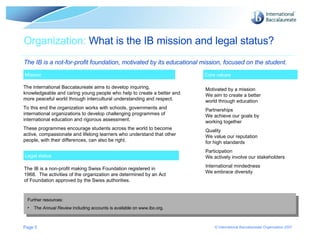
Page  Mission Organization:  What is the IB mission and legal status? The IB is a not-for-profit foundation, motivated by its educational mission, focused on the student. The International Baccalaureate aims to develop inquiring, knowledgeable and caring young people who help to create a better and more peaceful world through intercultural understanding and respect. To this end the organization works with schools, governments and international organizations to develop challenging programmes of international education and rigorous assessment. These programmes encourage students across the world to become active, compassionate and lifelong learners who understand that other people, with their differences, can also be right. The IB is a non-profit making Swiss Foundation registered in 1968.  The activities of the organization are determined by an Act of Foundation approved by the Swiss authorities. Further resources: The  Annual Review  including accounts is available on www.ibo.org. Motivated by a mission We aim to create a better world through education Partnerships We achieve our goals by working together Quality We value our reputation  for high standards Participation We actively involve our stakeholders International mindedness We embrace diversity Legal status Core values
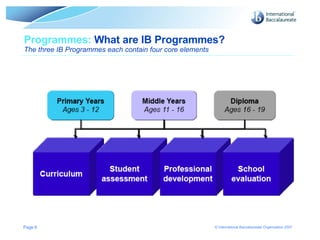
Programmes:  What are IB Programmes? The three IB Programmes each contain four core elements Page
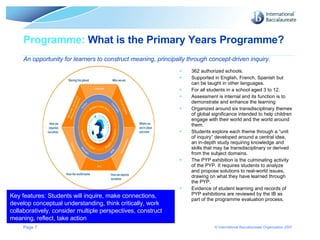
Programme:  What is the Primary Years Programme? An opportunity for learners to construct meaning, principally through concept-driven inquiry. 362 authorized schools. Supported in English, French, Spanish but can be taught in other languages. For all students in a school aged 3 to 12. Assessment is internal and its function is to demonstrate and enhance the learning Organized around six transdisciplinary themes of global significance intended to help children engage with their world and the world around them. Students explore each theme through a “unit of inquiry” developed around a central idea, an in-depth study requiring knowledge and skills that may be transdisciplinary or derived from the subject domains. The PYP exhibition is the culminating activity of the PYP. It requires students to analyze and propose solutions to real-world issues, drawing on what they have learned through the PYP. Evidence of student learning and records of PYP exhibitions are reviewed by the IB as part of the programme evaluation process. Page  Key features: Students will inquire, make connections, develop conceptual understanding, think critically, work collaboratively, consider multiple perspectives, construct meaning, reflect, take action
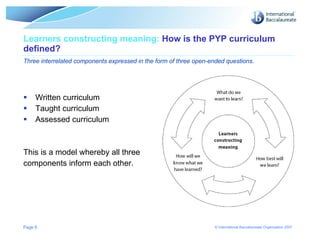
Learners constructing meaning:  How is the PYP curriculum defined?  Three interrelated components expressed in the form of three open-ended questions. Written curriculum Taught curriculum Assessed curriculum This is a model whereby all three components inform each other. Page
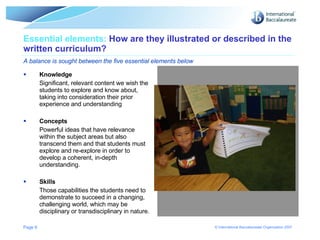
Essential elements:  How are they illustrated or described in the written curriculum? A balance is sought between the five essential elements below Knowledge Significant, relevant content we wish the students to explore and know about, taking into consideration their prior experience and understanding Concepts Powerful ideas that have relevance within the subject areas but also transcend them and that students must explore and re-explore in order to develop a coherent, in-depth understanding. Skills Those capabilities the students need to demonstrate to succeed in a changing, challenging world, which may be disciplinary or transdisciplinary in nature. Page
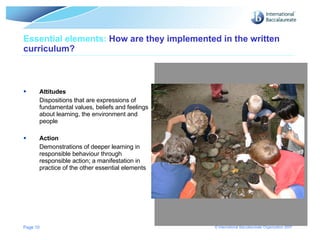
Essential elements:  How are they implemented in the written curriculum? Attitudes Dispositions that are expressions of fundamental values, beliefs and feelings about learning, the environment and people Action Demonstrations of deeper learning in responsible behaviour through responsible action; a manifestation in practice of the other essential elements Page
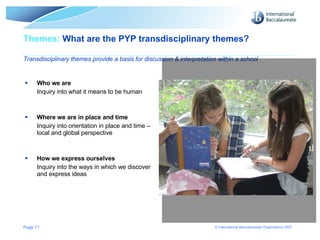
Themes:  What are the PYP transdisciplinary themes?  Transdisciplinary themes provide a basis for discussion & interpretation within a school Who we are   Inquiry into what it means to be human Where we are in place and time Inquiry into orientation in place and time – local and global perspective How we express ourselves   Inquiry into the ways in which we discover and express ideas Page
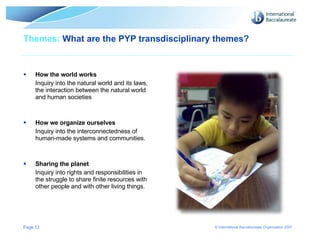
Themes:  What are the PYP transdisciplinary themes? How the world works Inquiry into the natural world and its laws, the interaction between the natural world and human societies How we organize ourselves Inquiry into the interconnectedness of human-made systems and communities. Sharing the planet Inquiry into rights and responsibilities in the struggle to share finite resources with other people and with other living things. Page
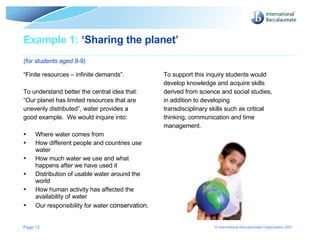
Example 1:  ‘Sharing the planet’  (for students aged 8-9) “ Finite resources – infinite demands”.  To understand better the central idea that: “ Our planet has limited resources that are unevenly distributed”, water provides a  good example.  We would inquire into: Where water comes from How different people and countries use water How much water we use and what happens after we have used it Distribution of usable water around the world How human activity has affected the availability of water Our responsibility for water  conservation. To support this inquiry students would develop knowledge and acquire skills derived from science and social studies, in addition to developing  transdisciplinary skills such as critical thinking, communication and time  management. Page
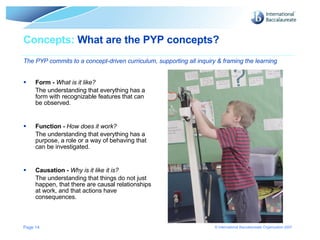
Concepts:  What are the PYP concepts? The PYP commits to a concept-driven curriculum, supporting all inquiry & framing the learning Form -  What is it like?   The understanding that everything has a form with recognizable features that can be observed. Function -  How does it work?  The understanding that everything has a purpose, a role or a way of behaving that can be investigated. Causation -  Why is it like it is?  The understanding that things do not just happen, that there are causal relationships at work, and that actions have consequences. Page
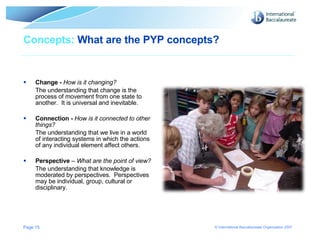
Concepts:  What are the PYP concepts? Change -  How is it changing?  The understanding that change is the process of movement from one state to another.  It is universal and inevitable. Connection -  How is it connected to other things? The understanding that we live in a world of interacting systems in which the actions of any individual element affect others. Perspective  –  What are the point of view? The understanding that knowledge is moderated by perspectives.  Perspectives may be individual, group, cultural or disciplinary. Page
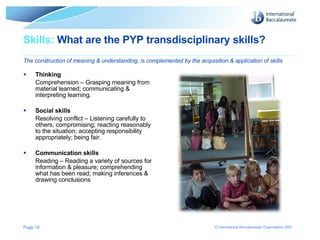
Skills:  What are the PYP transdisciplinary skills? The construction of meaning & understanding, is complemented by the acquisition & application of skills Thinking Comprehension – Grasping meaning from material learned; communicating & interpreting learning. Social skills Resolving conflict – Listening carefully to others; compromising; reacting reasonably to the situation; accepting responsibility appropriately; being fair. Communication skills Reading – Reading a variety of sources for information & pleasure; comprehending what has been read; making inferences & drawing conclusions Page
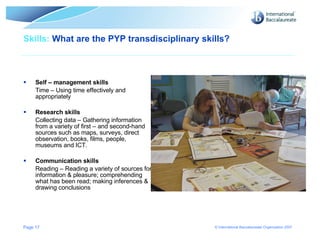
Skills:  What are the PYP transdisciplinary skills? Self – management skills Time – Using time effectively and appropriately Research skills  Collecting data – Gathering information from a variety of first – and second-hand sources such as maps, surveys, direct observation, books, films, people, museums and ICT. Communication skills Reading – Reading a variety of sources for information & pleasure; comprehending what has been read; making inferences & drawing conclusions Page
Attitudes:  What are the PYP attitudes? Attitudes, as an essential element of the PYP, make a commitment to a values-laden curriculum Appreciation Commitment Confidence Cooperation Creativity Curiosity Empathy Enthusiasm Independence Integrity Respect Tolerance Page
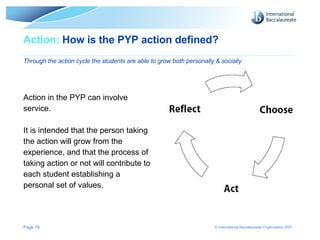
Action:  How is the PYP action defined? Through the action cycle the students are able to grow both personally & socially Action in the PYP can involve service. It is intended that the person taking the action will grow from the experience, and that the process of taking action or not will contribute to each student establishing a personal set of values. Page
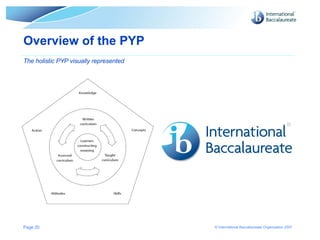
Overview of the PYP The holistic PYP visually represented Page
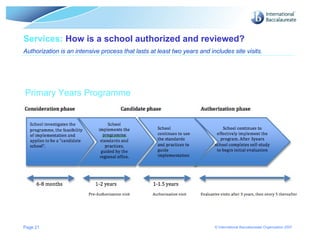
Services:  How is a school authorized and reviewed? Authorization is an intensive process that lasts at least two years and includes site visits. Page  Primary Years Programme
Learner Profile activity Page
How we use the Learner Profile at AIS/D Slideshow Page
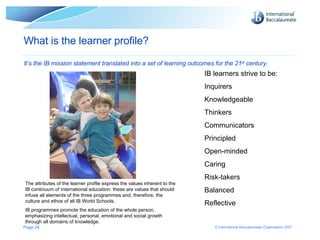
Page  What is the learner profile? It’s the IB mission statement translated into a set of learning outcomes for the 21 st  century. The attributes of the learner profile express the values inherent to the IB continuum of international education: these are values that should infuse all elements of the three programmes and, therefore, the culture and ethos of all IB World Schools.  IB programmes promote the education of the whole person, emphasizing intellectual, personal, emotional and social growth through all domains of knowledge.  IB learners strive to be: Inquirers Knowledgeable Thinkers Communicators Principled Open-minded Caring Risk-takers Balanced Reflective

Intro to PYP for Parents

  • 1.
    Welcome Parents! Whileeveryone is wandering in, please take a moment at your seats to complete a “KWL” chart located on your table as a group. Under the “K”, please jot down everything you already know about the Primary Years Programme. Under the “W”, please identify some things you want to know about the Primary Years Programme. Page
  • 2.
    Get to knoweach other Bingo Page
  • 3.
    Primary Years ProgrammeThe unique benefits of the PYP
  • 4.
    Contents IB missionstatement IB Learner profile What are the IB programmes? PYP definition PYP curriculum definition Essential elements – synthesis model Written curriculum Transdisciplinary themes Concepts Skills Attitudes Action Overview Page
  • 5.
    Page MissionOrganization: What is the IB mission and legal status? The IB is a not-for-profit foundation, motivated by its educational mission, focused on the student. The International Baccalaureate aims to develop inquiring, knowledgeable and caring young people who help to create a better and more peaceful world through intercultural understanding and respect. To this end the organization works with schools, governments and international organizations to develop challenging programmes of international education and rigorous assessment. These programmes encourage students across the world to become active, compassionate and lifelong learners who understand that other people, with their differences, can also be right. The IB is a non-profit making Swiss Foundation registered in 1968. The activities of the organization are determined by an Act of Foundation approved by the Swiss authorities. Further resources: The Annual Review including accounts is available on www.ibo.org. Motivated by a mission We aim to create a better world through education Partnerships We achieve our goals by working together Quality We value our reputation for high standards Participation We actively involve our stakeholders International mindedness We embrace diversity Legal status Core values
  • 6.
    Programmes: Whatare IB Programmes? The three IB Programmes each contain four core elements Page
  • 7.
    Programme: Whatis the Primary Years Programme? An opportunity for learners to construct meaning, principally through concept-driven inquiry. 362 authorized schools. Supported in English, French, Spanish but can be taught in other languages. For all students in a school aged 3 to 12. Assessment is internal and its function is to demonstrate and enhance the learning Organized around six transdisciplinary themes of global significance intended to help children engage with their world and the world around them. Students explore each theme through a “unit of inquiry” developed around a central idea, an in-depth study requiring knowledge and skills that may be transdisciplinary or derived from the subject domains. The PYP exhibition is the culminating activity of the PYP. It requires students to analyze and propose solutions to real-world issues, drawing on what they have learned through the PYP. Evidence of student learning and records of PYP exhibitions are reviewed by the IB as part of the programme evaluation process. Page Key features: Students will inquire, make connections, develop conceptual understanding, think critically, work collaboratively, consider multiple perspectives, construct meaning, reflect, take action
  • 8.
    Learners constructing meaning: How is the PYP curriculum defined? Three interrelated components expressed in the form of three open-ended questions. Written curriculum Taught curriculum Assessed curriculum This is a model whereby all three components inform each other. Page
  • 9.
    Essential elements: How are they illustrated or described in the written curriculum? A balance is sought between the five essential elements below Knowledge Significant, relevant content we wish the students to explore and know about, taking into consideration their prior experience and understanding Concepts Powerful ideas that have relevance within the subject areas but also transcend them and that students must explore and re-explore in order to develop a coherent, in-depth understanding. Skills Those capabilities the students need to demonstrate to succeed in a changing, challenging world, which may be disciplinary or transdisciplinary in nature. Page
  • 10.
    Essential elements: How are they implemented in the written curriculum? Attitudes Dispositions that are expressions of fundamental values, beliefs and feelings about learning, the environment and people Action Demonstrations of deeper learning in responsible behaviour through responsible action; a manifestation in practice of the other essential elements Page
  • 11.
    Themes: Whatare the PYP transdisciplinary themes? Transdisciplinary themes provide a basis for discussion & interpretation within a school Who we are Inquiry into what it means to be human Where we are in place and time Inquiry into orientation in place and time – local and global perspective How we express ourselves Inquiry into the ways in which we discover and express ideas Page
  • 12.
    Themes: Whatare the PYP transdisciplinary themes? How the world works Inquiry into the natural world and its laws, the interaction between the natural world and human societies How we organize ourselves Inquiry into the interconnectedness of human-made systems and communities. Sharing the planet Inquiry into rights and responsibilities in the struggle to share finite resources with other people and with other living things. Page
  • 13.
    Example 1: ‘Sharing the planet’ (for students aged 8-9) “ Finite resources – infinite demands”. To understand better the central idea that: “ Our planet has limited resources that are unevenly distributed”, water provides a good example. We would inquire into: Where water comes from How different people and countries use water How much water we use and what happens after we have used it Distribution of usable water around the world How human activity has affected the availability of water Our responsibility for water conservation. To support this inquiry students would develop knowledge and acquire skills derived from science and social studies, in addition to developing transdisciplinary skills such as critical thinking, communication and time management. Page
  • 14.
    Concepts: Whatare the PYP concepts? The PYP commits to a concept-driven curriculum, supporting all inquiry & framing the learning Form - What is it like? The understanding that everything has a form with recognizable features that can be observed. Function - How does it work? The understanding that everything has a purpose, a role or a way of behaving that can be investigated. Causation - Why is it like it is? The understanding that things do not just happen, that there are causal relationships at work, and that actions have consequences. Page
  • 15.
    Concepts: Whatare the PYP concepts? Change - How is it changing? The understanding that change is the process of movement from one state to another. It is universal and inevitable. Connection - How is it connected to other things? The understanding that we live in a world of interacting systems in which the actions of any individual element affect others. Perspective – What are the point of view? The understanding that knowledge is moderated by perspectives. Perspectives may be individual, group, cultural or disciplinary. Page
  • 16.
    Skills: Whatare the PYP transdisciplinary skills? The construction of meaning & understanding, is complemented by the acquisition & application of skills Thinking Comprehension – Grasping meaning from material learned; communicating & interpreting learning. Social skills Resolving conflict – Listening carefully to others; compromising; reacting reasonably to the situation; accepting responsibility appropriately; being fair. Communication skills Reading – Reading a variety of sources for information & pleasure; comprehending what has been read; making inferences & drawing conclusions Page
  • 17.
    Skills: Whatare the PYP transdisciplinary skills? Self – management skills Time – Using time effectively and appropriately Research skills Collecting data – Gathering information from a variety of first – and second-hand sources such as maps, surveys, direct observation, books, films, people, museums and ICT. Communication skills Reading – Reading a variety of sources for information & pleasure; comprehending what has been read; making inferences & drawing conclusions Page
  • 18.
    Attitudes: Whatare the PYP attitudes? Attitudes, as an essential element of the PYP, make a commitment to a values-laden curriculum Appreciation Commitment Confidence Cooperation Creativity Curiosity Empathy Enthusiasm Independence Integrity Respect Tolerance Page
  • 19.
    Action: Howis the PYP action defined? Through the action cycle the students are able to grow both personally & socially Action in the PYP can involve service. It is intended that the person taking the action will grow from the experience, and that the process of taking action or not will contribute to each student establishing a personal set of values. Page
  • 20.
    Overview of thePYP The holistic PYP visually represented Page
  • 21.
    Services: Howis a school authorized and reviewed? Authorization is an intensive process that lasts at least two years and includes site visits. Page Primary Years Programme
  • 22.
  • 23.
    How we usethe Learner Profile at AIS/D Slideshow Page
  • 24.
    Page Whatis the learner profile? It’s the IB mission statement translated into a set of learning outcomes for the 21 st century. The attributes of the learner profile express the values inherent to the IB continuum of international education: these are values that should infuse all elements of the three programmes and, therefore, the culture and ethos of all IB World Schools. IB programmes promote the education of the whole person, emphasizing intellectual, personal, emotional and social growth through all domains of knowledge. IB learners strive to be: Inquirers Knowledgeable Thinkers Communicators Principled Open-minded Caring Risk-takers Balanced Reflective