International Baccalaureate Primary Years Program What does this mean for Chandler Oaks Cheetahs?
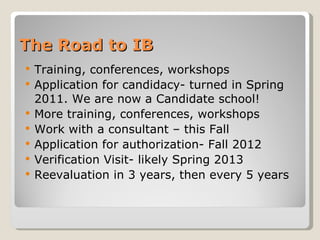
The Road to IB Training, conferences, workshops Application for candidacy- turned in Spring 2011. We are now a Candidate school! More training, conferences, workshops Work with a consultant – this Fall Application for authorization- Fall 2012 Verification Visit- likely Spring 2013 Reevaluation in 3 years, then every 5 years
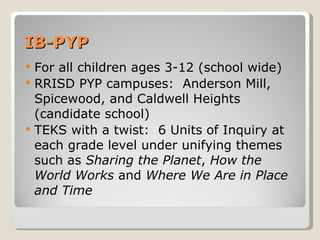
IB-PYP For all children ages 3-12 (school wide) RRISD PYP campuses:  Anderson Mill, Spicewood, and Caldwell Heights (candidate school) TEKS with a twist:  6 Units of Inquiry at each grade level under unifying themes such as  Sharing the Planet ,  How the World Works  and  Where We Are in Place and Time
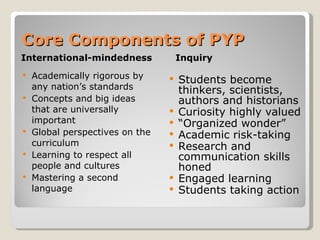
Core Components of PYP International-mindedness Inquiry Academically rigorous by any nation’s standards Concepts and big ideas that are universally important Global perspectives on the curriculum Learning to respect all people and cultures Mastering a second language Students become thinkers, scientists, authors and historians Curiosity highly valued  “ Organized wonder” Academic risk-taking Research and communication skills honed Engaged learning  Students taking action
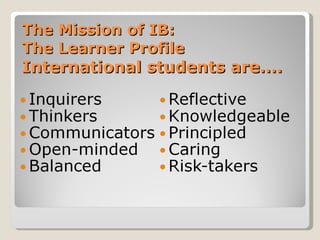
The Mission of IB: The Learner Profile International students are….
 
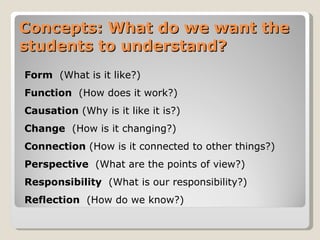
Form   (What is it like?) Function   (How does it work?) Causation   (Why is it like it is?) Change   (How is it changing?) Connection  (How is it connected to other things?) Perspective   (What are the points of view?) Responsibility   (What is our responsibility?) Reflection   (How do we know?) Concepts: What do we want the students to understand?
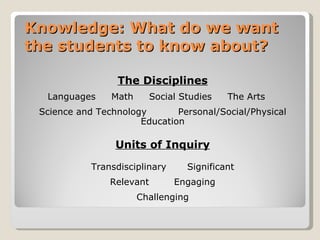
The Disciplines Languages  Math  Social Studies  The Arts  Science and Technology  Personal/Social/Physical Education Units of Inquiry Transdisciplinary Significant Relevant Engaging Challenging Knowledge: What do we want the students to know about?
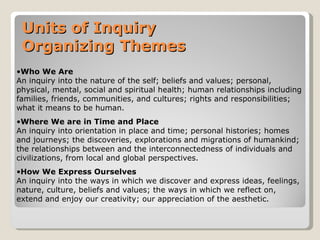
Who We Are  An inquiry into the nature of the self; beliefs and values; personal, physical, mental, social and spiritual health; human relationships including families, friends, communities, and cultures; rights and responsibilities; what it means to be human.  Where We are in Time and Place An inquiry into orientation in place and time; personal histories; homes and journeys; the discoveries, explorations and migrations of humankind; the relationships between and the interconnectedness of individuals and civilizations, from local and global perspectives.  How We Express Ourselves An inquiry into the ways in which we discover and express ideas, feelings, nature, culture, beliefs and values; the ways in which we reflect on, extend and enjoy our creativity; our appreciation of the aesthetic.  Units of Inquiry Organizing Themes
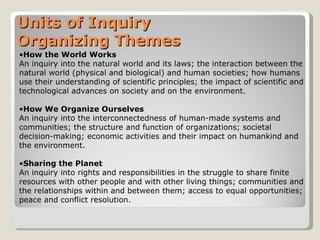
How the World Works An inquiry into the natural world and its laws; the interaction between the natural world (physical and biological) and human societies; how humans use their understanding of scientific principles; the impact of scientific and technological advances on society and on the environment.  How We Organize Ourselves An inquiry into the interconnectedness of human-made systems and communities; the structure and function of organizations; societal decision-making; economic activities and their impact on humankind and the environment.  Sharing the Planet An inquiry into rights and responsibilities in the struggle to share finite resources with other people and with other living things; communities and the relationships within and between them; access to equal opportunities; peace and conflict resolution.  Units of Inquiry Organizing Themes
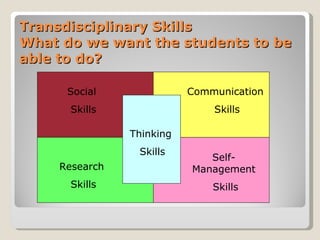
Transdisciplinary Skills What do we want the students to be able to do? Communication Skills Social Skills Self-Management Skills Research Skills Thinking Skills
What do we want the students to be able to do? The search for  conceptual understanding  is central to the Primary Years Program Also includes a fundamental recognition of the importance of developing  skills
The PYP focuses on a wide range of skills beyond those we normally call “basic”. These suggested skills transcend individual disciplines
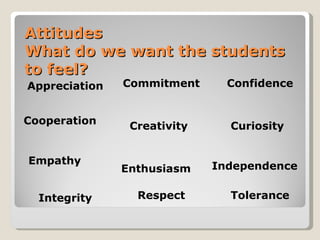
Attitudes What do we want the students to feel? Appreciation Commitment Confidence Cooperation Creativity Curiosity Empathy Enthusiasm Independence Integrity Respect Tolerance
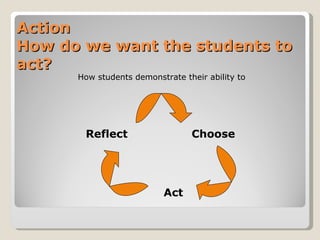
Action How do we want the students to act? How students demonstrate their ability to   Choose Act Reflect
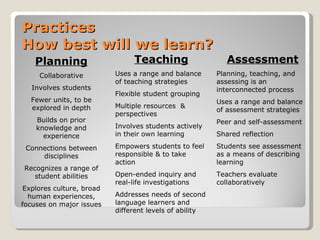
Practices How best will we learn? Planning Collaborative Involves students Fewer units, to be explored in depth Builds on prior knowledge and experience Connections between disciplines Recognizes a range of student abilities Explores culture, broad human experiences, focuses on major issues Teaching Uses a range and balance of teaching strategies Flexible student grouping Multiple resources  & perspectives Involves students actively in their own learning Empowers students to feel responsible & to take action Open-ended inquiry and real-life investigations Addresses needs of second language learners and different levels of ability Assessment Planning, teaching, and assessing is an interconnected process Uses a range and balance of assessment strategies Peer and self-assessment Shared reflection Students see assessment as a means of describing learning Teachers evaluate collaboratively
Assessment How will we know what we have learned? Formative Assessment Summative Assessment Evaluation Rubrics Checklists Performance Assessments Observations Portfolios Open-ended Tasks Tests/Quizzes Benchmarks/Exemplars Anecdotal Records Continuums The PYP Exhibition
Why IB? In a nutshell… We want our students to be aware of the problems and challenges the world faces while feeling confident in their own ability to help solve them. The best way to keep any of our students from being victims is to equip them with the compassion, awareness, and skills to be advocates for social justice, scientists, artists, and committed world citizens who never stop inquiring.

IB Parent Information

  • 1.
    International Baccalaureate PrimaryYears Program What does this mean for Chandler Oaks Cheetahs?
  • 2.
    The Road toIB Training, conferences, workshops Application for candidacy- turned in Spring 2011. We are now a Candidate school! More training, conferences, workshops Work with a consultant – this Fall Application for authorization- Fall 2012 Verification Visit- likely Spring 2013 Reevaluation in 3 years, then every 5 years
  • 3.
    IB-PYP For allchildren ages 3-12 (school wide) RRISD PYP campuses: Anderson Mill, Spicewood, and Caldwell Heights (candidate school) TEKS with a twist: 6 Units of Inquiry at each grade level under unifying themes such as Sharing the Planet , How the World Works and Where We Are in Place and Time
  • 4.
    Core Components ofPYP International-mindedness Inquiry Academically rigorous by any nation’s standards Concepts and big ideas that are universally important Global perspectives on the curriculum Learning to respect all people and cultures Mastering a second language Students become thinkers, scientists, authors and historians Curiosity highly valued “ Organized wonder” Academic risk-taking Research and communication skills honed Engaged learning Students taking action
  • 5.
    The Mission ofIB: The Learner Profile International students are….
  • 6.
  • 7.
    Form (What is it like?) Function (How does it work?) Causation (Why is it like it is?) Change (How is it changing?) Connection (How is it connected to other things?) Perspective (What are the points of view?) Responsibility (What is our responsibility?) Reflection (How do we know?) Concepts: What do we want the students to understand?
  • 8.
    The Disciplines Languages Math Social Studies The Arts Science and Technology Personal/Social/Physical Education Units of Inquiry Transdisciplinary Significant Relevant Engaging Challenging Knowledge: What do we want the students to know about?
  • 9.
    Who We Are An inquiry into the nature of the self; beliefs and values; personal, physical, mental, social and spiritual health; human relationships including families, friends, communities, and cultures; rights and responsibilities; what it means to be human. Where We are in Time and Place An inquiry into orientation in place and time; personal histories; homes and journeys; the discoveries, explorations and migrations of humankind; the relationships between and the interconnectedness of individuals and civilizations, from local and global perspectives. How We Express Ourselves An inquiry into the ways in which we discover and express ideas, feelings, nature, culture, beliefs and values; the ways in which we reflect on, extend and enjoy our creativity; our appreciation of the aesthetic. Units of Inquiry Organizing Themes
  • 10.
    How the WorldWorks An inquiry into the natural world and its laws; the interaction between the natural world (physical and biological) and human societies; how humans use their understanding of scientific principles; the impact of scientific and technological advances on society and on the environment. How We Organize Ourselves An inquiry into the interconnectedness of human-made systems and communities; the structure and function of organizations; societal decision-making; economic activities and their impact on humankind and the environment. Sharing the Planet An inquiry into rights and responsibilities in the struggle to share finite resources with other people and with other living things; communities and the relationships within and between them; access to equal opportunities; peace and conflict resolution. Units of Inquiry Organizing Themes
  • 11.
    Transdisciplinary Skills Whatdo we want the students to be able to do? Communication Skills Social Skills Self-Management Skills Research Skills Thinking Skills
  • 12.
    What do wewant the students to be able to do? The search for conceptual understanding is central to the Primary Years Program Also includes a fundamental recognition of the importance of developing skills
  • 13.
    The PYP focuseson a wide range of skills beyond those we normally call “basic”. These suggested skills transcend individual disciplines
  • 14.
    Attitudes What dowe want the students to feel? Appreciation Commitment Confidence Cooperation Creativity Curiosity Empathy Enthusiasm Independence Integrity Respect Tolerance
  • 15.
    Action How dowe want the students to act? How students demonstrate their ability to Choose Act Reflect
  • 16.
    Practices How bestwill we learn? Planning Collaborative Involves students Fewer units, to be explored in depth Builds on prior knowledge and experience Connections between disciplines Recognizes a range of student abilities Explores culture, broad human experiences, focuses on major issues Teaching Uses a range and balance of teaching strategies Flexible student grouping Multiple resources & perspectives Involves students actively in their own learning Empowers students to feel responsible & to take action Open-ended inquiry and real-life investigations Addresses needs of second language learners and different levels of ability Assessment Planning, teaching, and assessing is an interconnected process Uses a range and balance of assessment strategies Peer and self-assessment Shared reflection Students see assessment as a means of describing learning Teachers evaluate collaboratively
  • 17.
    Assessment How willwe know what we have learned? Formative Assessment Summative Assessment Evaluation Rubrics Checklists Performance Assessments Observations Portfolios Open-ended Tasks Tests/Quizzes Benchmarks/Exemplars Anecdotal Records Continuums The PYP Exhibition
  • 18.
    Why IB? Ina nutshell… We want our students to be aware of the problems and challenges the world faces while feeling confident in their own ability to help solve them. The best way to keep any of our students from being victims is to equip them with the compassion, awareness, and skills to be advocates for social justice, scientists, artists, and committed world citizens who never stop inquiring.