Inquiry-Based Learning Bertram (Chip) Bruce Library & Information Science U. of Illinois at Urbana-Champaign
Writing assignment What learning experience do you remember from your undergraduate years?
Keywords Learning Technology Lived Experience
Learning
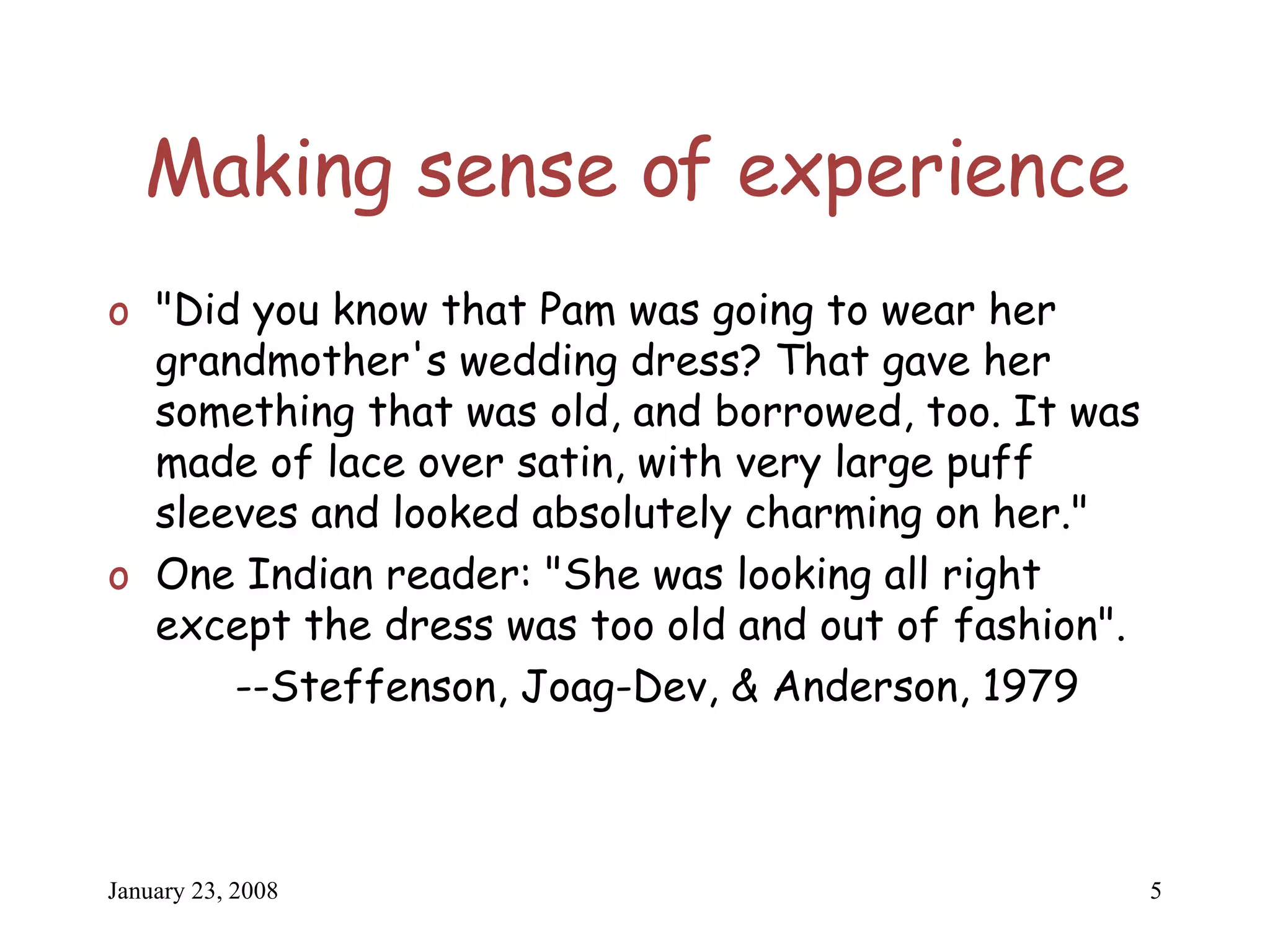
Making sense of experience "Did you know that Pam was going to wear her grandmother's wedding dress? That gave her something that was old, and borrowed, too. It was made of lace over satin, with very large puff sleeves and looked absolutely charming on her." One Indian reader: "She was looking all right except the dress was too old and out of fashion". --Steffenson, Joag-Dev, & Anderson, 1979
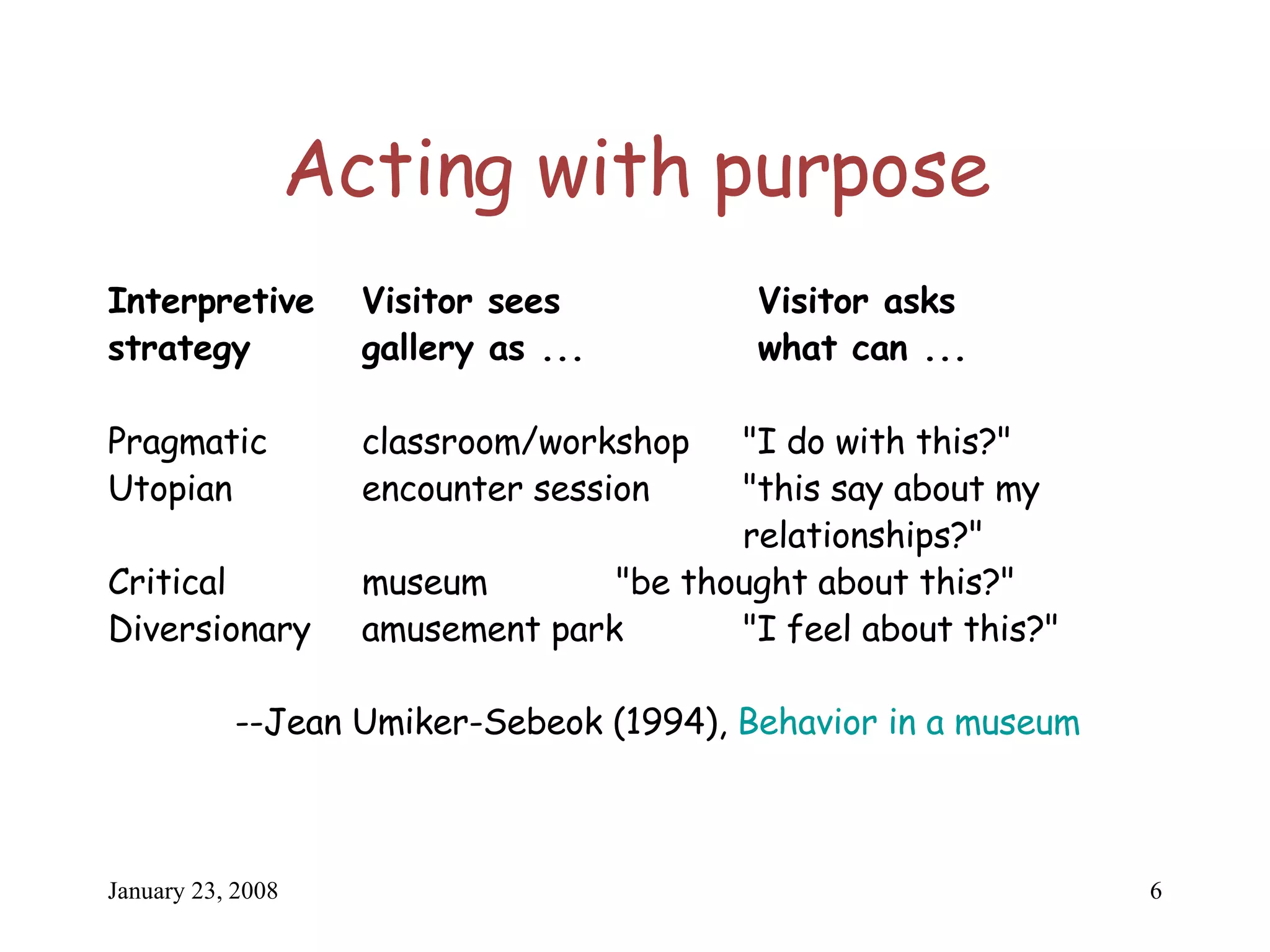
Acting with purpose Interpretive  Visitor sees  Visitor asks strategy gallery as ...   what can ... Pragmatic classroom/workshop "I do with this?" Utopian encounter session "this say about my relationships?" Critical museum "be thought about this?" Diversionary amusement park "I feel about this?" --Jean Umiker-Sebeok (1994),  Behavior in a museum
What shape is the earth? 1. 2. 3.
Is the world round? Child: I can see it. The world is flat.  Adult: No, the world is round. Child: It’s round? Oh, a pancake! Adult: No, no... a ball! Look at this photo of earth from outer space. Child: Oh! Two earths! The round one in space and the flat one we live on.
Overcoming difficulty Piaget: disequilibrium Vygotsky: zone of proximal development Dewey: felt difficulty
Learning is grounded in the personal, social, material, historical situation
Scratch theory
Technology
LIS 391: Literacy in the information age Discoveries Projects Collaborative activities, e.g., timeline Media: web board, doc cam, video, web interactive syllabus
Instant messaging all of the students use it none of the faculty do questions: What functions does it serve? What are its drawbacks? Why are student and faculty needs different? What are their communication practices?
Student use of IM Communicate with family & friends at home Get homework help Dating General socializing Second nature
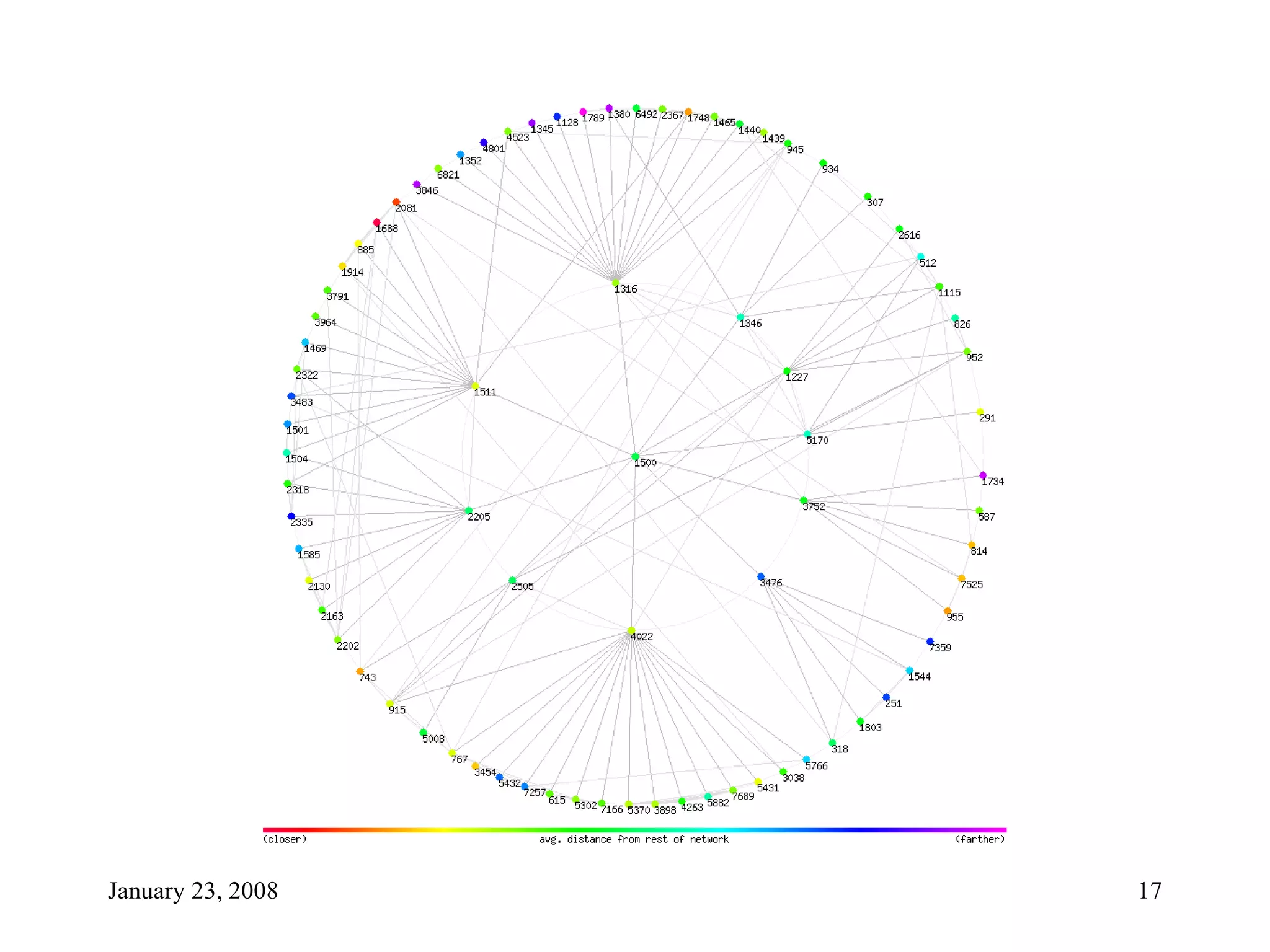
Isaac Oates and Omar Ashrafi at the University of  Illinois
 
 
Types of away messages Passive-Aggressive away messages Posting information about your feelings/emotional state Quotes/Song lyrics Hyperlinks to websites Posting romantic messages Sexual away messages Posting away messages while under the influence of drugs or alcohol
(cont.) Information about where you are or what you're doing Posting false information in order to avoid someone Posting false information in order to make yourself look better (e.g., more popular) Posting humorous away messages/jokes   --From a survey created by Brandon Rowe and Sarah Chamovitz at Haverford
Using away messages Screening chats Checking away messages Monitoring who checks your away message Using away messages to communicate (sync => async)
“ Daddy, your away message is boring. No one will visit you if all you say is ‘away’”
It’s snowing His soul swooned slowly as he heard the snow falling faintly through the universe and faintly falling, like the descent of their last end, upon all the living and the dead" James Joyce,  Dubliners
Re-creation of technology Christine Wang,  Constructing a third  space at the computer in a first-grade classroom
Technology is  design through use Through creation of content, contributions to interactive elements, and incorporation into practice, users are not merely recipients of technology, but participate actively in its ongoing development.
Lived experience
Stephen's questions Why do cars speed up passing a stop sign? Why do things far away seem blue? Why do my eyes water when I stare? How does your body make tears? Is salt in tears the same as the salt on food? What’s that pipe from the silo to the barn?
 
Paris street signs Ask: reading to navigate Investigate: street names dictionary, web Create:  notice clusters / locality further connections: Lamarck, Buffon, Aristide Briand Discuss: history of the signs Reflect: write about, act
Learning is lived experience We always live at the time we live and not at some other time, and only by extracting at each present time the full meaning of each present experience are we prepared for doing the same in the future. This is the only preparation which in the long run amounts to anything. – John Dewey,  Experience & Education
What is the role for the information resources professional?
21st-century challenge Find problems Integrate knowledge from multiple sources and media Think critically Collaborate Learn how to learn
Inquiry-based learning Questions: arising out of experience Materials: diverse, authentic, challenging; two-way Activities: engaging. hands-on, creating, collaborating, living new roles Dialogue: listening; articulating meaning Reflection: from concepts to action
Inquiry Page
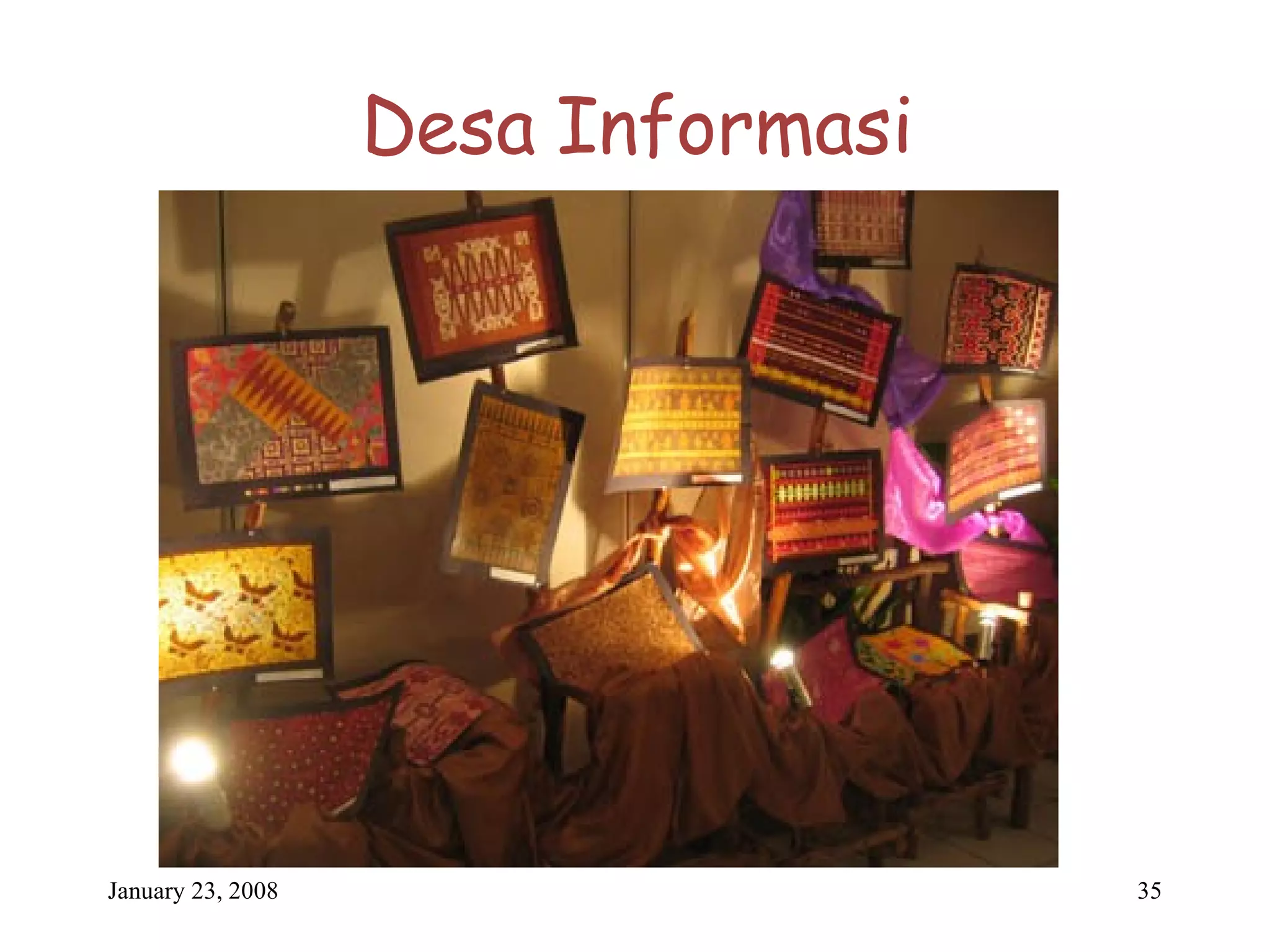
Desa Informasi
Local eContent collection Digital theses eDIMENSI (scientific journals) Petr@rt Gallery Petra iPoster Petra Chronicle Surabaya Memory
Paseo Boricua Puerto Rican Cultural Center in Chicago's Humboldt Park neighborhood Galvanizes neighborhood residents around community projects Addresses critical issues: gang violence, AIDS, social and environmental justice, literacy, and economic development
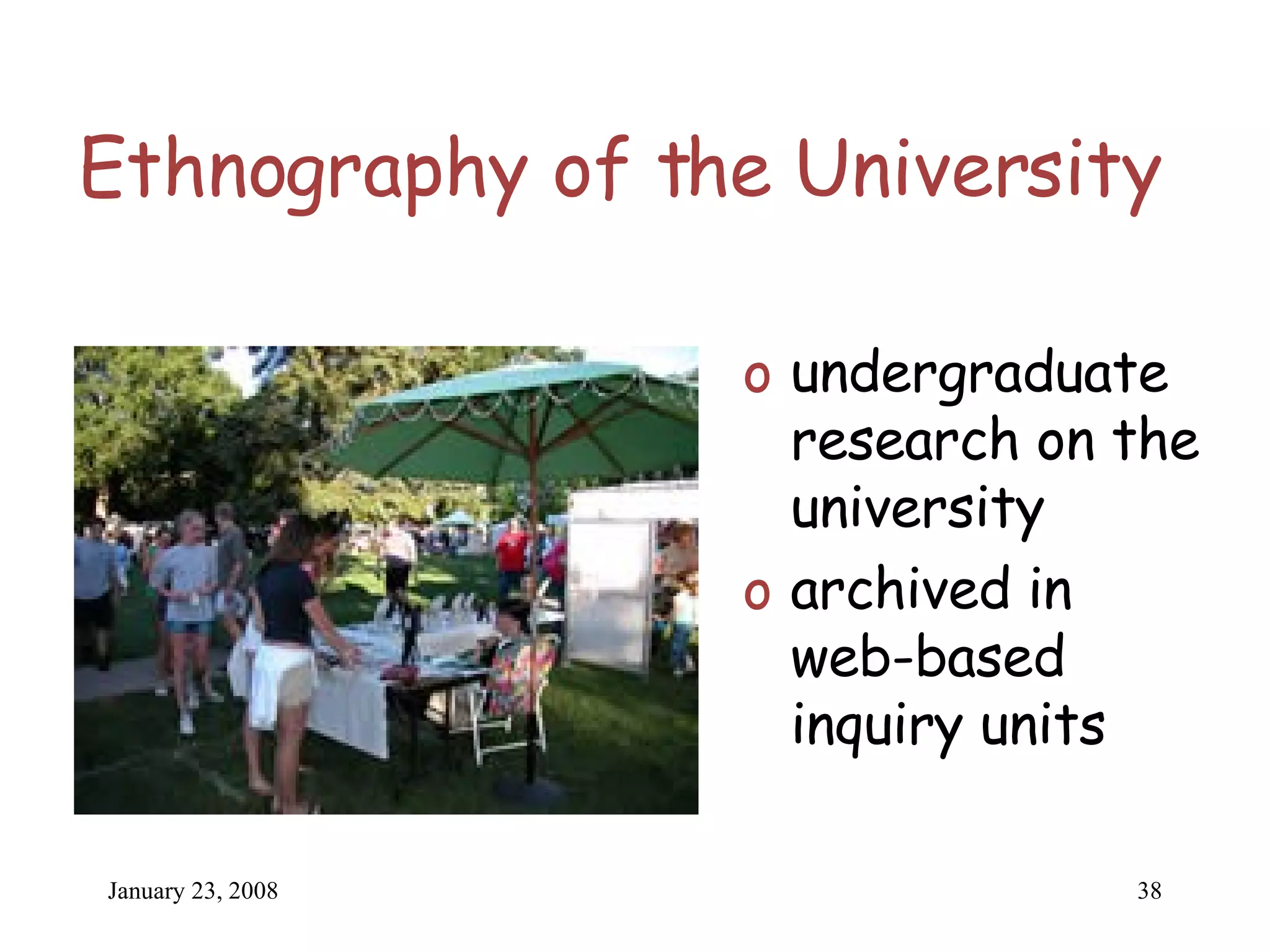
Ethnography of the University undergraduate research on the university archived in web-based inquiry units
Integrated learning Relate the school to life, and all studies are of necessity correlated.  --Dewey,  School and Society
Teacher as inquirer Inquiry about the world Partner in inquiry Modeling Guiding Inquiry about teaching and learning
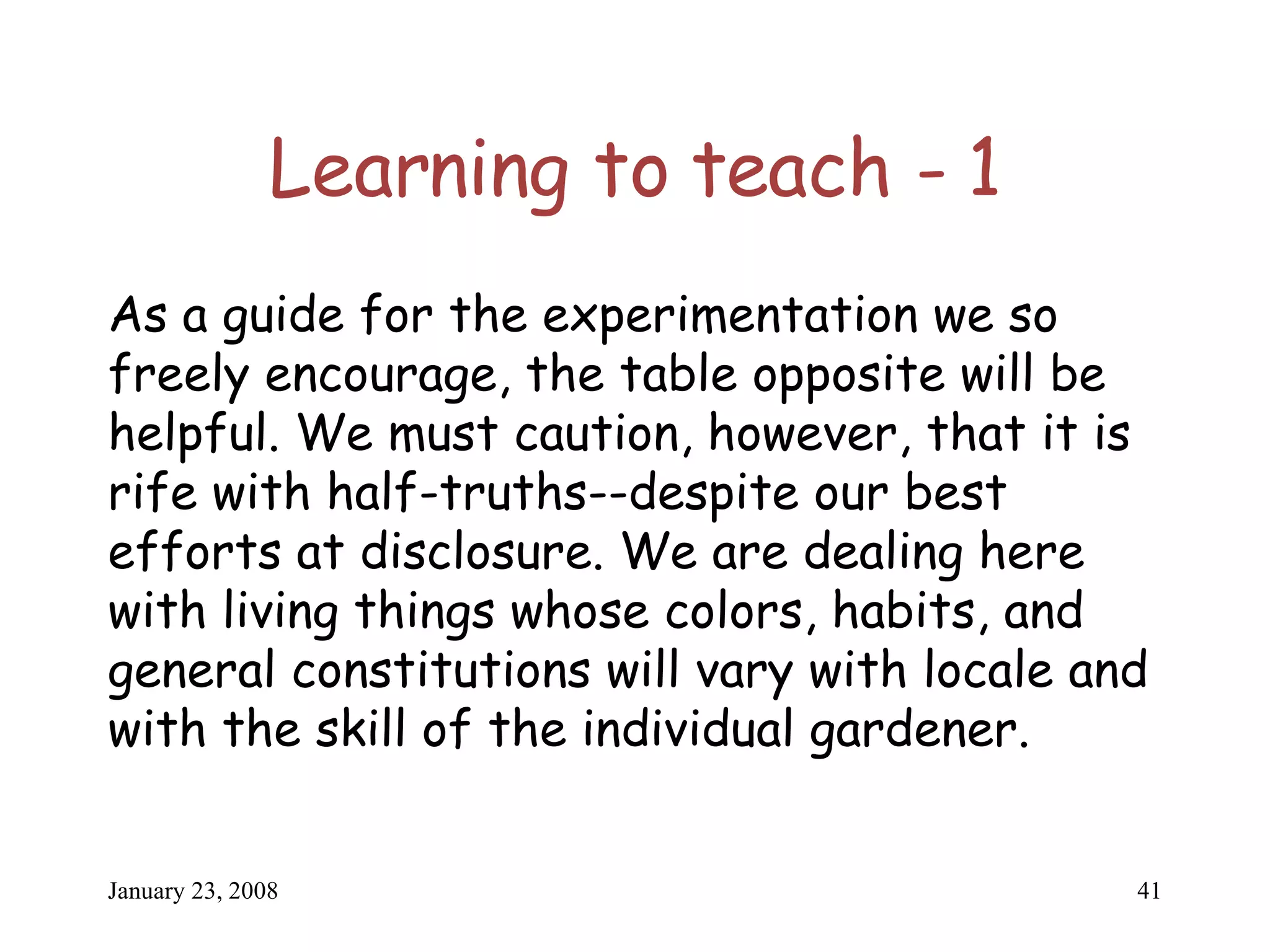
Learning to teach - 1 As a guide for the experimentation we so freely encourage, the table opposite will be helpful. We must caution, however, that it is rife with half-truths--despite our best efforts at disclosure. We are dealing here with living things whose colors, habits, and general constitutions will vary with locale and with the skill of the individual gardener.
Learning to teach - 2 This unpredictability, which strikes terror into the heart of the beginner, is in fact one of the glories of gardening. Things change, certainly from year to year and sometimes from morning to evening. There are mysteries, surprises, and always, lessons to be learned. After almost 40 years hard at it, we are only beginning. – Amos Pettingill,  The Garden Book , 1986
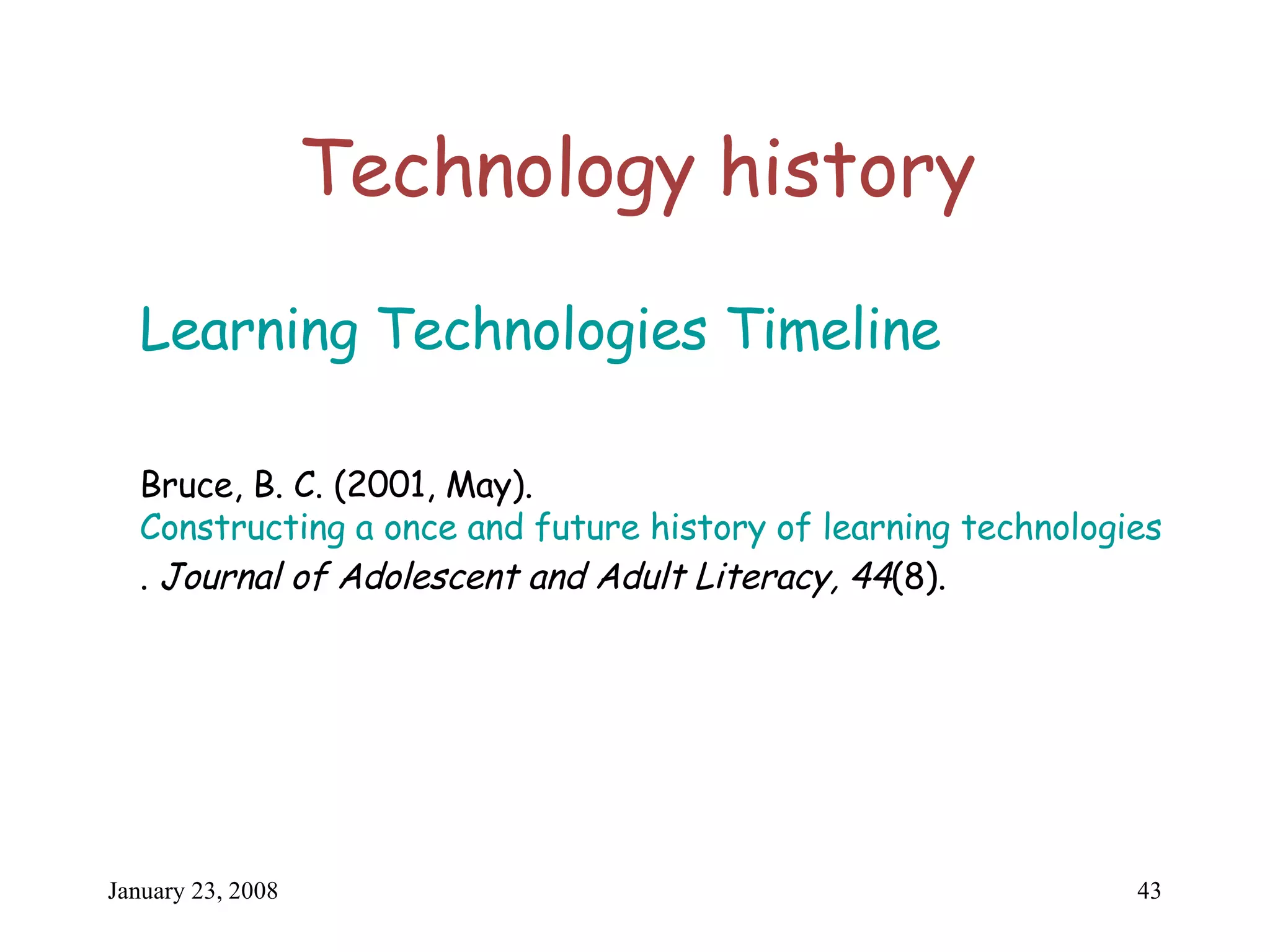
Technology history Learning Technologies Timeline Bruce, B. C. (2001, May).  Constructing a once and future history of learning technologies .  Journal of Adolescent and Adult Literacy, 44 (8).
Privacy and identity “Identity theft and security on the internet,” by  Aaron Krimbel, Lana Lewandowski, Tom Kelly, Vinh Vu Survey of users Simulated shopping site Line tap
Undergraduates… are smarter (James Flynn) are better educated (Berliner & Biddle; Marable) more professionally-oriented, older, more female, more non-white, more non-English speaking get too little sleep (Mary Carskadon) use the Internet instead of print sources, but trust print more (Leigh Healy) focus on grades too much
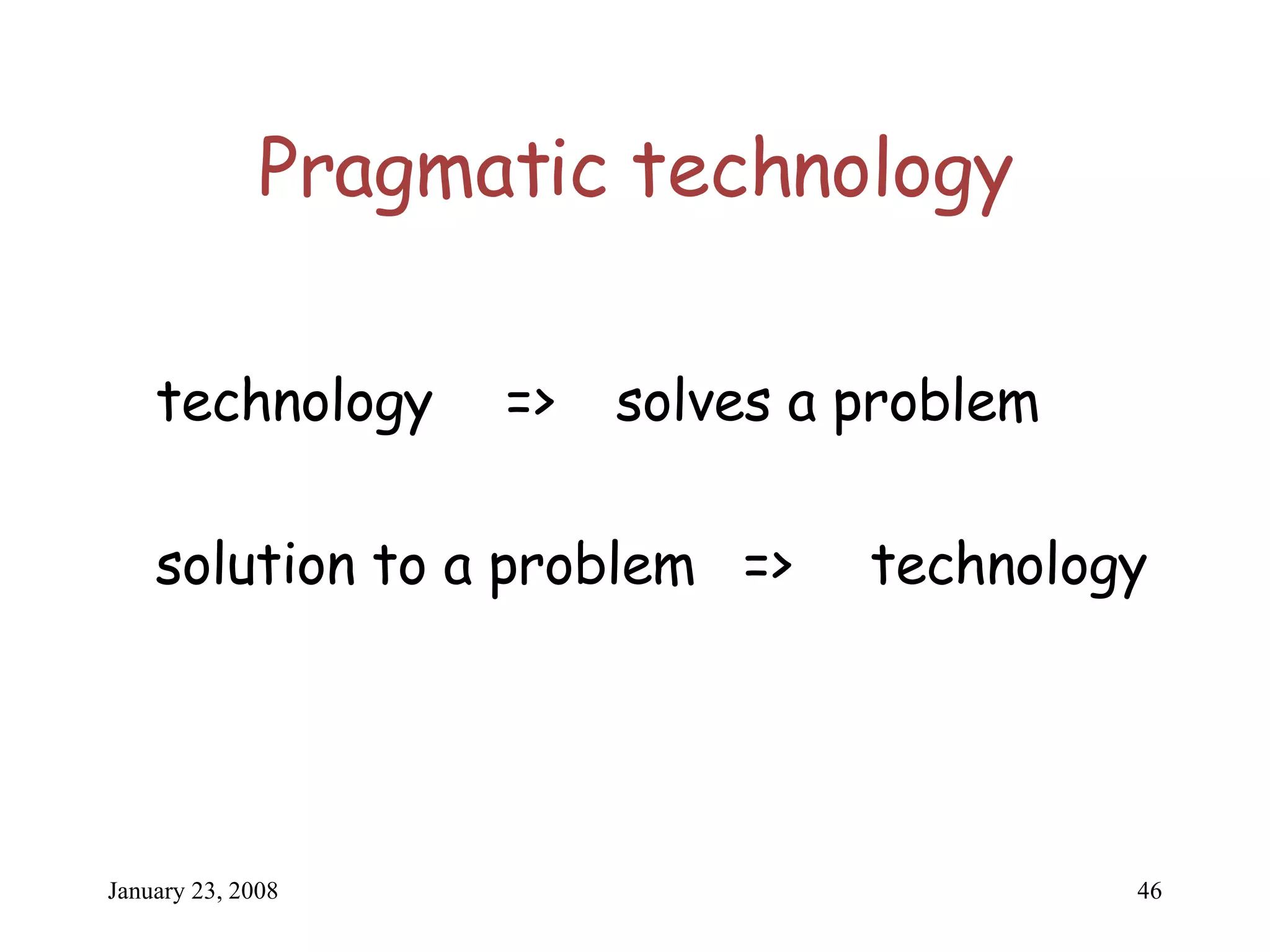
Pragmatic technology technology   =>  solves a problem solution to a problem => technology
Problem-solving cycle problem 1 => technology 1   technology 1 => problem 2   problem 2 => technology 2   technology 2 => problem 3 …
Community Inquiry Laboratory a place where members of a community come together to develop shared capacity and work on common problems.
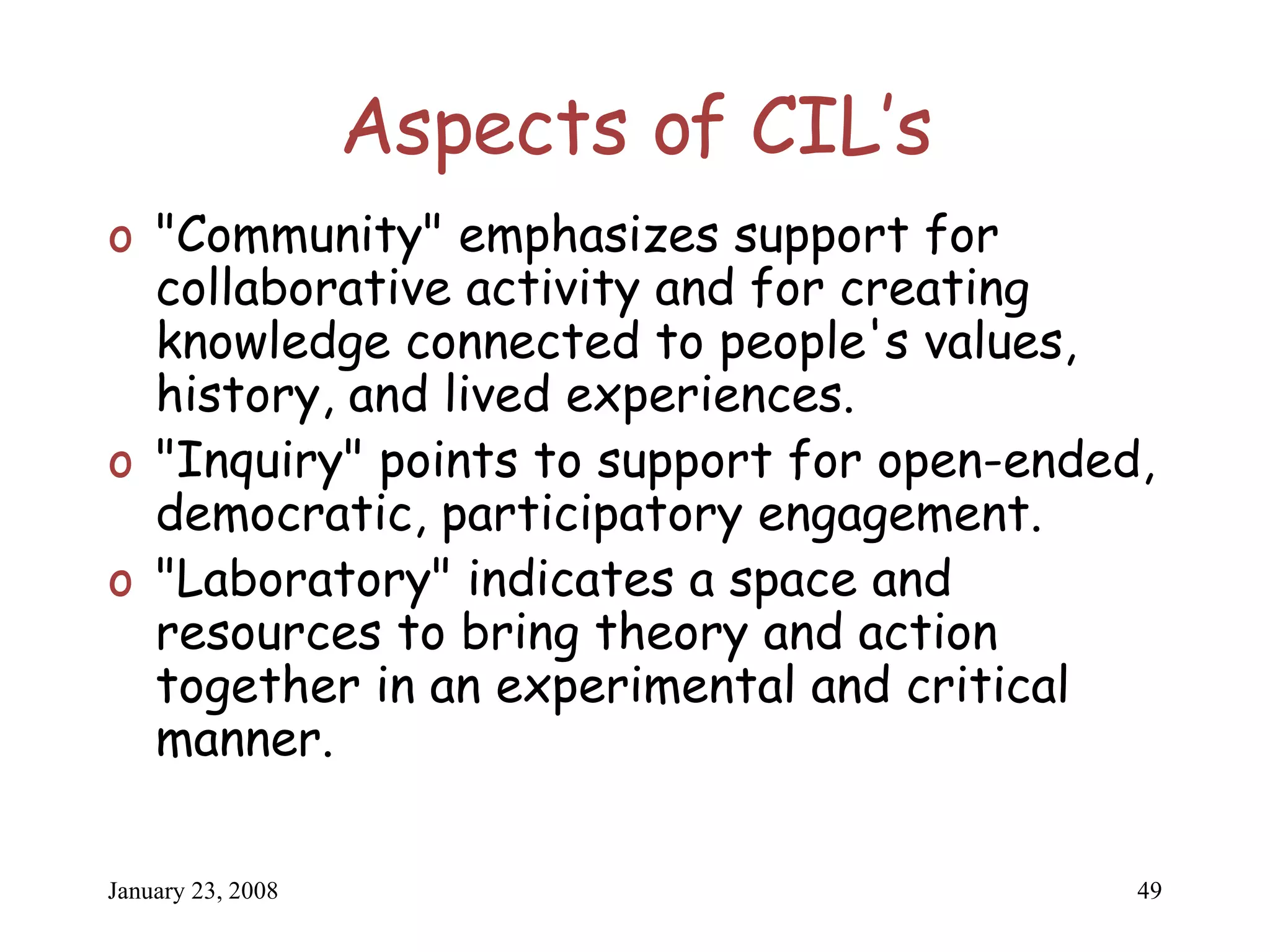
Aspects of CIL’s "Community" emphasizes support for collaborative activity and for creating knowledge connected to people's values, history, and lived experiences. "Inquiry" points to support for open-ended, democratic, participatory engagement. "Laboratory" indicates a space and resources to bring theory and action together in an experimental and critical manner.
New media web rings video conferencing digital libraries virtual reality hypermedia, the web, the  deep web internet radio robot surgery telepresence ubiquitous computing simputer monkey & cursor
Active participation every individual must be consulted in such a way, actively not passively, that he himself becomes a part of the process of authority.  --Dewey,  Democracy & Education

Inquiry For Ir

  • 1.
    Inquiry-Based Learning Bertram(Chip) Bruce Library & Information Science U. of Illinois at Urbana-Champaign
  • 2.
    Writing assignment Whatlearning experience do you remember from your undergraduate years?
  • 3.
  • 4.
  • 5.
    Making sense ofexperience "Did you know that Pam was going to wear her grandmother's wedding dress? That gave her something that was old, and borrowed, too. It was made of lace over satin, with very large puff sleeves and looked absolutely charming on her." One Indian reader: "She was looking all right except the dress was too old and out of fashion". --Steffenson, Joag-Dev, & Anderson, 1979
  • 6.
    Acting with purposeInterpretive Visitor sees Visitor asks strategy gallery as ... what can ... Pragmatic classroom/workshop "I do with this?" Utopian encounter session "this say about my relationships?" Critical museum "be thought about this?" Diversionary amusement park "I feel about this?" --Jean Umiker-Sebeok (1994), Behavior in a museum
  • 7.
    What shape isthe earth? 1. 2. 3.
  • 8.
    Is the worldround? Child: I can see it. The world is flat. Adult: No, the world is round. Child: It’s round? Oh, a pancake! Adult: No, no... a ball! Look at this photo of earth from outer space. Child: Oh! Two earths! The round one in space and the flat one we live on.
  • 9.
    Overcoming difficulty Piaget:disequilibrium Vygotsky: zone of proximal development Dewey: felt difficulty
  • 10.
    Learning is groundedin the personal, social, material, historical situation
  • 11.
  • 12.
  • 13.
    LIS 391: Literacyin the information age Discoveries Projects Collaborative activities, e.g., timeline Media: web board, doc cam, video, web interactive syllabus
  • 14.
    Instant messaging allof the students use it none of the faculty do questions: What functions does it serve? What are its drawbacks? Why are student and faculty needs different? What are their communication practices?
  • 15.
    Student use ofIM Communicate with family & friends at home Get homework help Dating General socializing Second nature
  • 16.
    Isaac Oates andOmar Ashrafi at the University of Illinois
  • 17.
  • 18.
  • 19.
    Types of awaymessages Passive-Aggressive away messages Posting information about your feelings/emotional state Quotes/Song lyrics Hyperlinks to websites Posting romantic messages Sexual away messages Posting away messages while under the influence of drugs or alcohol
  • 20.
    (cont.) Information aboutwhere you are or what you're doing Posting false information in order to avoid someone Posting false information in order to make yourself look better (e.g., more popular) Posting humorous away messages/jokes --From a survey created by Brandon Rowe and Sarah Chamovitz at Haverford
  • 21.
    Using away messagesScreening chats Checking away messages Monitoring who checks your away message Using away messages to communicate (sync => async)
  • 22.
    “ Daddy, youraway message is boring. No one will visit you if all you say is ‘away’”
  • 23.
    It’s snowing Hissoul swooned slowly as he heard the snow falling faintly through the universe and faintly falling, like the descent of their last end, upon all the living and the dead" James Joyce, Dubliners
  • 24.
    Re-creation of technologyChristine Wang, Constructing a third space at the computer in a first-grade classroom
  • 25.
    Technology is design through use Through creation of content, contributions to interactive elements, and incorporation into practice, users are not merely recipients of technology, but participate actively in its ongoing development.
  • 26.
  • 27.
    Stephen's questions Whydo cars speed up passing a stop sign? Why do things far away seem blue? Why do my eyes water when I stare? How does your body make tears? Is salt in tears the same as the salt on food? What’s that pipe from the silo to the barn?
  • 28.
  • 29.
    Paris street signsAsk: reading to navigate Investigate: street names dictionary, web Create: notice clusters / locality further connections: Lamarck, Buffon, Aristide Briand Discuss: history of the signs Reflect: write about, act
  • 30.
    Learning is livedexperience We always live at the time we live and not at some other time, and only by extracting at each present time the full meaning of each present experience are we prepared for doing the same in the future. This is the only preparation which in the long run amounts to anything. – John Dewey, Experience & Education
  • 31.
    What is therole for the information resources professional?
  • 32.
    21st-century challenge Findproblems Integrate knowledge from multiple sources and media Think critically Collaborate Learn how to learn
  • 33.
    Inquiry-based learning Questions:arising out of experience Materials: diverse, authentic, challenging; two-way Activities: engaging. hands-on, creating, collaborating, living new roles Dialogue: listening; articulating meaning Reflection: from concepts to action
  • 34.
  • 35.
  • 36.
    Local eContent collectionDigital theses eDIMENSI (scientific journals) Petr@rt Gallery Petra iPoster Petra Chronicle Surabaya Memory
  • 37.
    Paseo Boricua PuertoRican Cultural Center in Chicago's Humboldt Park neighborhood Galvanizes neighborhood residents around community projects Addresses critical issues: gang violence, AIDS, social and environmental justice, literacy, and economic development
  • 38.
    Ethnography of theUniversity undergraduate research on the university archived in web-based inquiry units
  • 39.
    Integrated learning Relatethe school to life, and all studies are of necessity correlated. --Dewey, School and Society
  • 40.
    Teacher as inquirerInquiry about the world Partner in inquiry Modeling Guiding Inquiry about teaching and learning
  • 41.
    Learning to teach- 1 As a guide for the experimentation we so freely encourage, the table opposite will be helpful. We must caution, however, that it is rife with half-truths--despite our best efforts at disclosure. We are dealing here with living things whose colors, habits, and general constitutions will vary with locale and with the skill of the individual gardener.
  • 42.
    Learning to teach- 2 This unpredictability, which strikes terror into the heart of the beginner, is in fact one of the glories of gardening. Things change, certainly from year to year and sometimes from morning to evening. There are mysteries, surprises, and always, lessons to be learned. After almost 40 years hard at it, we are only beginning. – Amos Pettingill, The Garden Book , 1986
  • 43.
    Technology history LearningTechnologies Timeline Bruce, B. C. (2001, May). Constructing a once and future history of learning technologies . Journal of Adolescent and Adult Literacy, 44 (8).
  • 44.
    Privacy and identity“Identity theft and security on the internet,” by Aaron Krimbel, Lana Lewandowski, Tom Kelly, Vinh Vu Survey of users Simulated shopping site Line tap
  • 45.
    Undergraduates… are smarter(James Flynn) are better educated (Berliner & Biddle; Marable) more professionally-oriented, older, more female, more non-white, more non-English speaking get too little sleep (Mary Carskadon) use the Internet instead of print sources, but trust print more (Leigh Healy) focus on grades too much
  • 46.
    Pragmatic technology technology => solves a problem solution to a problem => technology
  • 47.
    Problem-solving cycle problem1 => technology 1 technology 1 => problem 2 problem 2 => technology 2 technology 2 => problem 3 …
  • 48.
    Community Inquiry Laboratorya place where members of a community come together to develop shared capacity and work on common problems.
  • 49.
    Aspects of CIL’s"Community" emphasizes support for collaborative activity and for creating knowledge connected to people's values, history, and lived experiences. "Inquiry" points to support for open-ended, democratic, participatory engagement. "Laboratory" indicates a space and resources to bring theory and action together in an experimental and critical manner.
  • 50.
    New media webrings video conferencing digital libraries virtual reality hypermedia, the web, the deep web internet radio robot surgery telepresence ubiquitous computing simputer monkey & cursor
  • 51.
    Active participation everyindividual must be consulted in such a way, actively not passively, that he himself becomes a part of the process of authority. --Dewey, Democracy & Education