Features of Input of Second Language Acquisition Article by Xiaoru Wang Project by Sarah Ruff
What is Input? A variety of student and teacher characteristics Intelligence Sex Personality Learning style Teaching style Previous experience Motivation Attitudes
Features of Input Simplified, input is “general learning or teaching style” Students in other countries learning English: Depend almost entirely on classroom to improve English skills Only hear “Teacher talk” Short, simple, grammatically correct sentences General, high frequency vocabulary Unreal, irrelevant questions Teachers do most of the talking Uninteresting topics
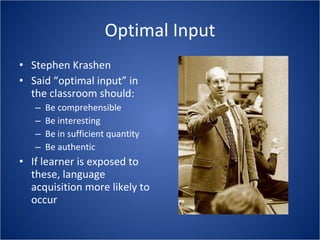
Optimal Input Stephen Krashen Said “optimal input” in the classroom should: Be comprehensible Be interesting Be in sufficient quantity Be authentic If learner is exposed to these, language acquisition more likely to occur
“ Be Comprehensible” Material should be reasonably paced Material should not be too demanding If a student cannot keep up with the rate of exposure, he will fail to comprehend and thus fail to acquire
“ Be Interesting” Most textbooks available to Chinese ELLs are designed to cater solely to the needs of exams To prepare for these tests, students have little time to read more interesting materials
“ Be In Sufficient Quantity” Main concern of optimal input hypothesis Difference between learning English in native vs. target language environment Students may only have textbook to rely on Important to provide material from which they can derive meaning rather than just grammatical concepts
“ Be Authentic” ELLs in native country are not exposed to authentic speech patterns Must learn more than “textbook English”, which: Simplifies material lexically and syntactically Loss of cultural meaning
Application in the Classroom Relevant/interesting topics within the classroom Student life Clothing Family Likes/dislikes Immediate environment Classroom
Application continued. Language activities establishing relationships between forms and meanings Hands-on activities Using spoken/written forms to achieve a goal Teaching both formal AND informal English Present a conversation in formal English With another English speaker, “perform” the same dialogue informally Lead a discussion with the students pointing out the differences
For example…… Given this “formal” dialogue: Perform “informally”: Click image to play
In Conclusion English language teachers ought to provide students with optimal input Encourage students to explore optimal input outside of classroom If teachers could employ this strategy, they should find their teaching more effective
Source Wang, Xiaoru (2010). Features of Input of Second Language Acquisition.  Journal  Of Language Teaching And Research, 1(3).  Retrieved July 5, 2010, from http://www.academypublisher.com/ojs/index.php/jltr/article/view/0103282284/1813

Input ESOL

  • 1.
    Features of Inputof Second Language Acquisition Article by Xiaoru Wang Project by Sarah Ruff
  • 2.
    What is Input?A variety of student and teacher characteristics Intelligence Sex Personality Learning style Teaching style Previous experience Motivation Attitudes
  • 3.
    Features of InputSimplified, input is “general learning or teaching style” Students in other countries learning English: Depend almost entirely on classroom to improve English skills Only hear “Teacher talk” Short, simple, grammatically correct sentences General, high frequency vocabulary Unreal, irrelevant questions Teachers do most of the talking Uninteresting topics
  • 4.
    Optimal Input StephenKrashen Said “optimal input” in the classroom should: Be comprehensible Be interesting Be in sufficient quantity Be authentic If learner is exposed to these, language acquisition more likely to occur
  • 5.
    “ Be Comprehensible”Material should be reasonably paced Material should not be too demanding If a student cannot keep up with the rate of exposure, he will fail to comprehend and thus fail to acquire
  • 6.
    “ Be Interesting”Most textbooks available to Chinese ELLs are designed to cater solely to the needs of exams To prepare for these tests, students have little time to read more interesting materials
  • 7.
    “ Be InSufficient Quantity” Main concern of optimal input hypothesis Difference between learning English in native vs. target language environment Students may only have textbook to rely on Important to provide material from which they can derive meaning rather than just grammatical concepts
  • 8.
    “ Be Authentic”ELLs in native country are not exposed to authentic speech patterns Must learn more than “textbook English”, which: Simplifies material lexically and syntactically Loss of cultural meaning
  • 9.
    Application in theClassroom Relevant/interesting topics within the classroom Student life Clothing Family Likes/dislikes Immediate environment Classroom
  • 10.
    Application continued. Languageactivities establishing relationships between forms and meanings Hands-on activities Using spoken/written forms to achieve a goal Teaching both formal AND informal English Present a conversation in formal English With another English speaker, “perform” the same dialogue informally Lead a discussion with the students pointing out the differences
  • 11.
    For example…… Giventhis “formal” dialogue: Perform “informally”: Click image to play
  • 12.
    In Conclusion Englishlanguage teachers ought to provide students with optimal input Encourage students to explore optimal input outside of classroom If teachers could employ this strategy, they should find their teaching more effective
  • 13.
    Source Wang, Xiaoru(2010). Features of Input of Second Language Acquisition. Journal Of Language Teaching And Research, 1(3). Retrieved July 5, 2010, from http://www.academypublisher.com/ojs/index.php/jltr/article/view/0103282284/1813