English as an International Language: Implications for Policy and Pedagogy 2011 AFFILIATE COLLOQUIUM TESOL International Convention Examining the “E”  in TESOL New Orleans, LA March, 2011 Dr. Jeremy Sykes, National  Taiwan University of Science and Technology
Approaches to English Language Pedagogy in Taiwan: English for Academic Purposes (EAP) (EFL) Content and Language Integrated Learning (CLIL) English as a Lingua Franca (ELF) Taiwan In a Global World of English
English for Academic Purposes (EAP) (EFL) Taiwan Has An Outstanding Academic Education System
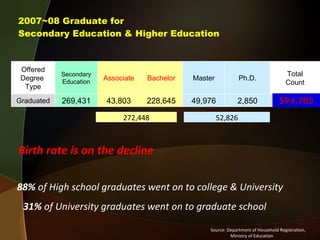
2007~08 Graduate for  Secondary Education & Higher Education Source: Department of Household Registration,  Ministry of Education 594,705 88%  of High school graduates went on to college & University  31%  of University graduates went on to graduate school 272,448 52,826 Birth rate is on the decline Offered Degree  Type Secondary Education Associate Bachelor Master Ph.D. Total Count Graduated 269,431 43,803 228,645 49,976 2,850 594,705
Resistance to Oral and Performance Based English Language Instruction 1 .  Primary reliance on Teacher Lecture passive/receptive learning 2.  Traditional reliance on written assessment tools that measure decontextualized grammatical knowledge and translation skills.  This is particularly true of the all-important university entrance examinations. 3. Belief that assessing students in a more integrative, communicative way is impractical:  time consuming, logistically complicated, expensive and subjective. 4. Instructors’ are afraid to use “incorrect English” in the classroom,  since accuracy is valued above all else.
Disappointing Results The College Entrance Examination Center reported statistics in  March, 2009 , which showed that the number of examinees who scored  zero  in the  guided writing  section of the English exam hit a five year high of  22,462 , out of a total of  141,858  test-takers. The compares with  16,168  test takers who scored zero in 2008 (Taipei Times, Sunday, March 15, 2009).
Inability to Communicate in English Mo st young Taiwanese students who go on to college and then into the world of work,  are not able to communicate with others in spoken English , despite all the years of English language instruction which they have received.
Government Response Increasing the competency requirements for English language teaching certification 2. Lowering the age when English instruction begins 3. Increasing instructional time in English 4. Raising exam standards 5. Requiring  university graduates to demonstrate some level of English language fluency 6. Requiring government and military employees to pass English competency exams for advancement
Results of These Policy Changes 1.  High school graduates are showing some improvement in their reading and writing. 2.  There is evidence that starting to learn English at an earlier age makes a difference. 3.  Most high school graduates remain unable to communicate verbally in English.
Content and Language Integrated Learning (CLIL) 1. The improvements in reading and writing English are enabling universities to require students to use English language text books in their college courses. 2. Some expansion is taking place in offering courses where both the text books and the language of instruction are in English. 3.  There are no universities in Taiwan that conduct all their instruction in English
English as a Lingua Franca (ELF) The greatest challenge for Taiwan is the fact that so few college graduates can communicate in  spoken  English when they enter the world of work.
The International Research Foundation for English Language Education The “human global network” of people participating in free markets has expanded from 800 million people five years ago, to 3 billion people now: half the population of the planet.
The International Research Foundation for English Language Education President of TIRF, Reece Duca, said that The “threshold of expectation” is going up.  There is and will be a huge growth in the need for local knowledge workers who have three critical skills:   the knowledge of their domain of expertise, their ability to solve problems,  and their ability to communicate in English.
The International Research Foundation for English Language Education “ In this expanding economic battle ground, there is no doubt that the  global winners   will be those which have work forces which can employ the English language efficiently.”
The International Research Foundation for English Language Education TIRF research shows that in the 1000 largest corporations in the world, most of which conduct much of their business in English, 30% of their employees were Non Native Speakers of English in 1996; 50% in 2006; and 70% in 20ll
The International Research Foundation for English Language Education The tolerance for poor English skills has declined.  The TIRF survey of global corporations showed that  91%  of global businesses considered English to be a critical factor in their business, while only  9%  indicated that the current level of English proficiency in their work forces was sufficient !
Reform of Government Policy There is little evidence of an intention on the part of the government of Taiwan to make changes in these areas. New Initiatives must be pioneered by the universities.
Reform of Government Policy What Taiwan needs to ensure that students entering the work world have the needed communicative skills in English is: 1.   A university entrance exam system that tests verbal competency. 2.   A shift from lecture mode instruction to task based interactive learning in the language classrooms. 3.   An accompanying nationwide teacher training program.
Functional Business Language? 1950 to 2005:  most international business was organized using local regional offices, where  local languages dominated. 2005 to ~:  Arrival of global communication browsers like Google The importance of English for basic communicative purposes in business has exploded.  Even at the local level, employees find themselves needing to use   Functional business English
Functional Business English  in the International Context 1. This is the English needed to explain ideas, communicate requests, convey information, and express needs. 2. It is a pragmatic English stripped largely stripped of Anglo-American similes and metaphors. 3. It is the practical language needed in report writing, e-mails, text messaging, and Skype.
The Issue of Grammar in EIL Clear communication in a second language involves  gaining progressive control over the systems of options  in the new language… The smaller the number of meaning distinctions a learner controls, the  more dependent on  context   his or her language is likely to be, both in terms of understanding and in terms of being understood. (Lock, 2005)
The Grammar of Discourse Marianne Celce-Murcia identified four particular "discourse framing" patterns for discussion: one which sets up  further   elaboration ; one which  builds to a climax ; one which  sets up discussion ; and one which  relates episodes  to one another.  These patterns of grammar "set up discourse".  Many such patterns exist, and can be included in a communicative English language curriculum.
New Post Secondary Initiatives in Second Language Instruction Using the TOEIC as an accepted assessment: This permits an increased focus in instruction on speaking and listening.  Example: Aichi Shukutokyo University, Nagoya, Japan, now offers 442 English communication classes to its 7,800 undergraduates.  Average progress on TOEIC scores has increased from 72.9 to 125+ since its new TOEIC program was introduced in 2004.
New Post Secondary Initiatives in Second Language Instruction University Sponsored Initiatives National Taiwan University  of Science and Technology *  All students must take courses in communicative English to graduate. *  Language Professors are encouraged to use innovative teaching and assessment methods.
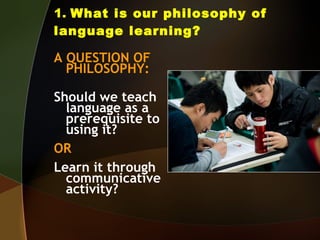
1.  What is our philosophy of language learning? A QUESTION OF PHILOSOPHY: Should we teach language as a prerequisite to using it? OR Learn it through communicative activity?
How do you learn to converse? If students are to develop stronger grammatical control over their expressive language, and incorporate new vocabulary, they have to first exercise their interlanguage.  It is pointless to wait for students to acquire “proper” structures first before offering them opportunities to converse.
Pedagogical Principle One for Communicative Language Learning: Create a Communicative Context Communicative language skills can only be learned in an environment where active communication is taking place all the time. Teachers should strive to create lesson plans where students spend at least 50% of their class time in active communication 2. Improvements in communicative language skills come AFTER people attempt to communicate with each other.
Pedagogical Principle Two for Communicative Language Learning: Teach Through Tasks 1.  The most interesting things to communicate are things that relate to real tasks in the real world. The focus of instruction should be on content not on language instruction itself. Widdowson (1998) “there is a fundamental difference between ‘task’ and ‘exercise’ (depending) on whether whether linguistic skills are viewed as developing through communicative activity or as a prerequisite for engaging in it.”
What is a task? Ellis:  1.  A work plan designed to precipitate leaner  activity.   2.  Seeks to engage learners in using language  pragmatically rather than just  displaying language. 3. Involves real-world processes of language  use. 4. A task can involve all four skills. 5. A task engages students in higher level  cognitive processes. 6. A task has a clearly defined communicative   outcome.
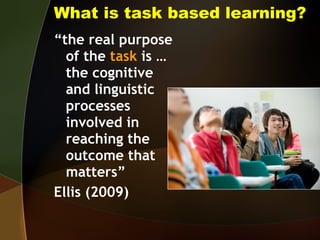
What is task based learning? “ the real purpose of the  task  is … the cognitive and linguistic processes involved in reaching the outcome that matters”  Ellis (2009)
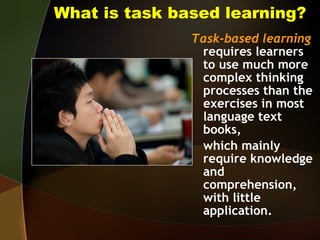
What is task based learning? Task-based learning  requires learners to use much more complex thinking processes than the exercises in most language text books, which mainly require knowledge and comprehension, with little application.
What is task based learning? In Task-based learning, students have to: Synthesize what they have learned, in order to present their opinions. They have to use the highest levels of Bloom’s Taxonomy:  ANALYSIS, SYNTHESIS and  EVALUATION , in order to complete their task
What is task based learning? Research on second language acquisition favors learning a language through  communicative activity : Craik and Tulving (1975) showed that retention depends on “the elaborateness of the final encoding.” Material is more likely to be remembered when “information is more deeply processed”  Ellis (2009)
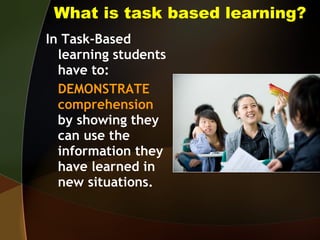
What is task based learning? In Task-Based learning students have to: DEMONSTRATE comprehension  by showing they can use the information they have learned in new situations.
Pedagogical Principle Three for Communicative Language Learning: The Only Mistake is a Failure to Be Understood 1.  What matters is that students are  understood and can successfully  negotiate with non-native speakers of  English from other cultures. 2. They should use every bit of English  they know. 3. They should not worry about  “incorrect” grammar. 4. It does not matter if their English has a definite Chinese feel to it.
How does language develop? 1. Language is not acquired well by attempting to learn a series of set language parts by accumulation. 2. Learners actually “construct a series of systems, known as interlanguages which are gradually grammaticized and restructured as learners incorporate new features.”  Ellis (2009)
Two Examples Business English English Writing
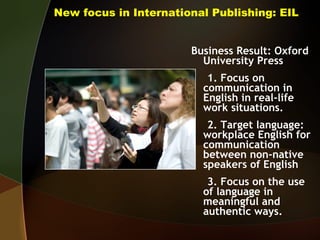
New focus in International Publishing: EIL Business Result: Oxford University Press 1. Focus on communication in English in real-life work situations. 2. Target language: workplace English for communication between non-native speakers of English 3. Focus on the use of language in meaningful and authentic ways.
New focus in International Publishing: EIL CASE STUDIES Groups of Four: 1. Read a case situation 2. Review language 3. Study data individually relating to a new case 4. Share data with each other 5. Discuss findings 6. Write a group report of findings 7. Make an oral presentation
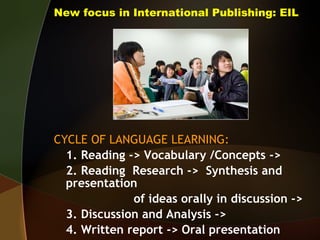
New focus in International Publishing: EIL CYCLE OF LANGUAGE LEARNING: 1. Reading -> Vocabulary /Concepts ->  2. Reading  Research ->  Synthesis and presentation of ideas orally in discussion ->  3. Discussion and Analysis ->  4. Written report -> Oral presentation
New focus in International Publishing: EIL SEMESTER TEACHING STRUCTURE: 1. 16 lessons with about 4 hours of teaching material in each lesson. 2. No long reading texts.  3. Emphasis on listening and speaking. 4. Written exercises are kept at a minimum. 5. Focus on formal and informal information exchange.
English Writing Skills Students create a fictional  Fantasy Island Then they are taught the writing structures to: Create listing order paragraphs  (topic sentences, listing-order signals, concluding sentences, compound sentences, coordinating conjunctions.) Create “How To” paragraphs  (time order signals, independent and dependent clauses, adverb subordinators, complex sentences.) Create descriptions  (space order, specific details, adjectives.) ALL THESE ARE COMPILED INTO A BOOK, AND A READING PRESENTATION
Application of These Principles at the National  Taiwan University of  Science and Technology These principles are being applied in: *  Daily Living English *  Art and Design English *  Hospitality English *  Business English *  English for Academic Purposes *  Speech and Oral Presentation *  Writing
TESPA-IS The  English as an  International Language Interest Section  of TESPA  (The Taiwan English for Special Purposes Association)
The EIL-IS TESPA Agenda It is our belief that in the context of:  English as an International Language: Implications for Policy and Pedagogy We must improve the ability of Taiwan’s students to communicate competently in  functional English that can be used Globally with other non-native speakers, while maintaining high standards in English for Academic Purposes.  Neither should be pursued at the expense of the other.
The EIL-IS TESPA Agenda Research  Disseminating new research on the teaching of EIL Teaching Exploring new approaches to teaching EIL Teaching materials Searching for (and developing) new classroom materials for teaching
Thank you. The future is now. Dr. Charles Jeremy Sykes  [email_address] cjeremysykes  FACEBOOK

Eil implications for policy and pedagogy

  • 1.
    English as anInternational Language: Implications for Policy and Pedagogy 2011 AFFILIATE COLLOQUIUM TESOL International Convention Examining the “E” in TESOL New Orleans, LA March, 2011 Dr. Jeremy Sykes, National Taiwan University of Science and Technology
  • 2.
    Approaches to EnglishLanguage Pedagogy in Taiwan: English for Academic Purposes (EAP) (EFL) Content and Language Integrated Learning (CLIL) English as a Lingua Franca (ELF) Taiwan In a Global World of English
  • 3.
    English for AcademicPurposes (EAP) (EFL) Taiwan Has An Outstanding Academic Education System
  • 4.
    2007~08 Graduate for Secondary Education & Higher Education Source: Department of Household Registration, Ministry of Education 594,705 88% of High school graduates went on to college & University 31% of University graduates went on to graduate school 272,448 52,826 Birth rate is on the decline Offered Degree Type Secondary Education Associate Bachelor Master Ph.D. Total Count Graduated 269,431 43,803 228,645 49,976 2,850 594,705
  • 5.
    Resistance to Oraland Performance Based English Language Instruction 1 . Primary reliance on Teacher Lecture passive/receptive learning 2. Traditional reliance on written assessment tools that measure decontextualized grammatical knowledge and translation skills. This is particularly true of the all-important university entrance examinations. 3. Belief that assessing students in a more integrative, communicative way is impractical: time consuming, logistically complicated, expensive and subjective. 4. Instructors’ are afraid to use “incorrect English” in the classroom, since accuracy is valued above all else.
  • 6.
    Disappointing Results TheCollege Entrance Examination Center reported statistics in March, 2009 , which showed that the number of examinees who scored zero in the guided writing section of the English exam hit a five year high of 22,462 , out of a total of 141,858 test-takers. The compares with 16,168 test takers who scored zero in 2008 (Taipei Times, Sunday, March 15, 2009).
  • 7.
    Inability to Communicatein English Mo st young Taiwanese students who go on to college and then into the world of work, are not able to communicate with others in spoken English , despite all the years of English language instruction which they have received.
  • 8.
    Government Response Increasingthe competency requirements for English language teaching certification 2. Lowering the age when English instruction begins 3. Increasing instructional time in English 4. Raising exam standards 5. Requiring university graduates to demonstrate some level of English language fluency 6. Requiring government and military employees to pass English competency exams for advancement
  • 9.
    Results of ThesePolicy Changes 1. High school graduates are showing some improvement in their reading and writing. 2. There is evidence that starting to learn English at an earlier age makes a difference. 3. Most high school graduates remain unable to communicate verbally in English.
  • 10.
    Content and LanguageIntegrated Learning (CLIL) 1. The improvements in reading and writing English are enabling universities to require students to use English language text books in their college courses. 2. Some expansion is taking place in offering courses where both the text books and the language of instruction are in English. 3. There are no universities in Taiwan that conduct all their instruction in English
  • 11.
    English as aLingua Franca (ELF) The greatest challenge for Taiwan is the fact that so few college graduates can communicate in spoken English when they enter the world of work.
  • 12.
    The International ResearchFoundation for English Language Education The “human global network” of people participating in free markets has expanded from 800 million people five years ago, to 3 billion people now: half the population of the planet.
  • 13.
    The International ResearchFoundation for English Language Education President of TIRF, Reece Duca, said that The “threshold of expectation” is going up. There is and will be a huge growth in the need for local knowledge workers who have three critical skills: the knowledge of their domain of expertise, their ability to solve problems, and their ability to communicate in English.
  • 14.
    The International ResearchFoundation for English Language Education “ In this expanding economic battle ground, there is no doubt that the global winners will be those which have work forces which can employ the English language efficiently.”
  • 15.
    The International ResearchFoundation for English Language Education TIRF research shows that in the 1000 largest corporations in the world, most of which conduct much of their business in English, 30% of their employees were Non Native Speakers of English in 1996; 50% in 2006; and 70% in 20ll
  • 16.
    The International ResearchFoundation for English Language Education The tolerance for poor English skills has declined. The TIRF survey of global corporations showed that 91% of global businesses considered English to be a critical factor in their business, while only 9% indicated that the current level of English proficiency in their work forces was sufficient !
  • 17.
    Reform of GovernmentPolicy There is little evidence of an intention on the part of the government of Taiwan to make changes in these areas. New Initiatives must be pioneered by the universities.
  • 18.
    Reform of GovernmentPolicy What Taiwan needs to ensure that students entering the work world have the needed communicative skills in English is: 1. A university entrance exam system that tests verbal competency. 2. A shift from lecture mode instruction to task based interactive learning in the language classrooms. 3. An accompanying nationwide teacher training program.
  • 19.
    Functional Business Language?1950 to 2005: most international business was organized using local regional offices, where local languages dominated. 2005 to ~: Arrival of global communication browsers like Google The importance of English for basic communicative purposes in business has exploded. Even at the local level, employees find themselves needing to use Functional business English
  • 20.
    Functional Business English in the International Context 1. This is the English needed to explain ideas, communicate requests, convey information, and express needs. 2. It is a pragmatic English stripped largely stripped of Anglo-American similes and metaphors. 3. It is the practical language needed in report writing, e-mails, text messaging, and Skype.
  • 21.
    The Issue ofGrammar in EIL Clear communication in a second language involves gaining progressive control over the systems of options in the new language… The smaller the number of meaning distinctions a learner controls, the more dependent on context his or her language is likely to be, both in terms of understanding and in terms of being understood. (Lock, 2005)
  • 22.
    The Grammar ofDiscourse Marianne Celce-Murcia identified four particular "discourse framing" patterns for discussion: one which sets up further elaboration ; one which builds to a climax ; one which sets up discussion ; and one which relates episodes to one another. These patterns of grammar "set up discourse". Many such patterns exist, and can be included in a communicative English language curriculum.
  • 23.
    New Post SecondaryInitiatives in Second Language Instruction Using the TOEIC as an accepted assessment: This permits an increased focus in instruction on speaking and listening. Example: Aichi Shukutokyo University, Nagoya, Japan, now offers 442 English communication classes to its 7,800 undergraduates. Average progress on TOEIC scores has increased from 72.9 to 125+ since its new TOEIC program was introduced in 2004.
  • 24.
    New Post SecondaryInitiatives in Second Language Instruction University Sponsored Initiatives National Taiwan University of Science and Technology * All students must take courses in communicative English to graduate. * Language Professors are encouraged to use innovative teaching and assessment methods.
  • 25.
    1. Whatis our philosophy of language learning? A QUESTION OF PHILOSOPHY: Should we teach language as a prerequisite to using it? OR Learn it through communicative activity?
  • 26.
    How do youlearn to converse? If students are to develop stronger grammatical control over their expressive language, and incorporate new vocabulary, they have to first exercise their interlanguage. It is pointless to wait for students to acquire “proper” structures first before offering them opportunities to converse.
  • 27.
    Pedagogical Principle Onefor Communicative Language Learning: Create a Communicative Context Communicative language skills can only be learned in an environment where active communication is taking place all the time. Teachers should strive to create lesson plans where students spend at least 50% of their class time in active communication 2. Improvements in communicative language skills come AFTER people attempt to communicate with each other.
  • 28.
    Pedagogical Principle Twofor Communicative Language Learning: Teach Through Tasks 1. The most interesting things to communicate are things that relate to real tasks in the real world. The focus of instruction should be on content not on language instruction itself. Widdowson (1998) “there is a fundamental difference between ‘task’ and ‘exercise’ (depending) on whether whether linguistic skills are viewed as developing through communicative activity or as a prerequisite for engaging in it.”
  • 29.
    What is atask? Ellis: 1. A work plan designed to precipitate leaner activity. 2. Seeks to engage learners in using language pragmatically rather than just displaying language. 3. Involves real-world processes of language use. 4. A task can involve all four skills. 5. A task engages students in higher level cognitive processes. 6. A task has a clearly defined communicative outcome.
  • 30.
    What is taskbased learning? “ the real purpose of the task is … the cognitive and linguistic processes involved in reaching the outcome that matters” Ellis (2009)
  • 31.
    What is taskbased learning? Task-based learning requires learners to use much more complex thinking processes than the exercises in most language text books, which mainly require knowledge and comprehension, with little application.
  • 32.
    What is taskbased learning? In Task-based learning, students have to: Synthesize what they have learned, in order to present their opinions. They have to use the highest levels of Bloom’s Taxonomy: ANALYSIS, SYNTHESIS and EVALUATION , in order to complete their task
  • 33.
    What is taskbased learning? Research on second language acquisition favors learning a language through communicative activity : Craik and Tulving (1975) showed that retention depends on “the elaborateness of the final encoding.” Material is more likely to be remembered when “information is more deeply processed” Ellis (2009)
  • 34.
    What is taskbased learning? In Task-Based learning students have to: DEMONSTRATE comprehension by showing they can use the information they have learned in new situations.
  • 35.
    Pedagogical Principle Threefor Communicative Language Learning: The Only Mistake is a Failure to Be Understood 1. What matters is that students are understood and can successfully negotiate with non-native speakers of English from other cultures. 2. They should use every bit of English they know. 3. They should not worry about “incorrect” grammar. 4. It does not matter if their English has a definite Chinese feel to it.
  • 36.
    How does languagedevelop? 1. Language is not acquired well by attempting to learn a series of set language parts by accumulation. 2. Learners actually “construct a series of systems, known as interlanguages which are gradually grammaticized and restructured as learners incorporate new features.” Ellis (2009)
  • 37.
    Two Examples BusinessEnglish English Writing
  • 38.
    New focus inInternational Publishing: EIL Business Result: Oxford University Press 1. Focus on communication in English in real-life work situations. 2. Target language: workplace English for communication between non-native speakers of English 3. Focus on the use of language in meaningful and authentic ways.
  • 39.
    New focus inInternational Publishing: EIL CASE STUDIES Groups of Four: 1. Read a case situation 2. Review language 3. Study data individually relating to a new case 4. Share data with each other 5. Discuss findings 6. Write a group report of findings 7. Make an oral presentation
  • 40.
    New focus inInternational Publishing: EIL CYCLE OF LANGUAGE LEARNING: 1. Reading -> Vocabulary /Concepts -> 2. Reading Research -> Synthesis and presentation of ideas orally in discussion -> 3. Discussion and Analysis -> 4. Written report -> Oral presentation
  • 41.
    New focus inInternational Publishing: EIL SEMESTER TEACHING STRUCTURE: 1. 16 lessons with about 4 hours of teaching material in each lesson. 2. No long reading texts. 3. Emphasis on listening and speaking. 4. Written exercises are kept at a minimum. 5. Focus on formal and informal information exchange.
  • 42.
    English Writing SkillsStudents create a fictional Fantasy Island Then they are taught the writing structures to: Create listing order paragraphs (topic sentences, listing-order signals, concluding sentences, compound sentences, coordinating conjunctions.) Create “How To” paragraphs (time order signals, independent and dependent clauses, adverb subordinators, complex sentences.) Create descriptions (space order, specific details, adjectives.) ALL THESE ARE COMPILED INTO A BOOK, AND A READING PRESENTATION
  • 43.
    Application of ThesePrinciples at the National Taiwan University of Science and Technology These principles are being applied in: * Daily Living English * Art and Design English * Hospitality English * Business English * English for Academic Purposes * Speech and Oral Presentation * Writing
  • 44.
    TESPA-IS The English as an International Language Interest Section of TESPA (The Taiwan English for Special Purposes Association)
  • 45.
    The EIL-IS TESPAAgenda It is our belief that in the context of: English as an International Language: Implications for Policy and Pedagogy We must improve the ability of Taiwan’s students to communicate competently in functional English that can be used Globally with other non-native speakers, while maintaining high standards in English for Academic Purposes. Neither should be pursued at the expense of the other.
  • 46.
    The EIL-IS TESPAAgenda Research Disseminating new research on the teaching of EIL Teaching Exploring new approaches to teaching EIL Teaching materials Searching for (and developing) new classroom materials for teaching
  • 47.
    Thank you. Thefuture is now. Dr. Charles Jeremy Sykes [email_address] cjeremysykes FACEBOOK